

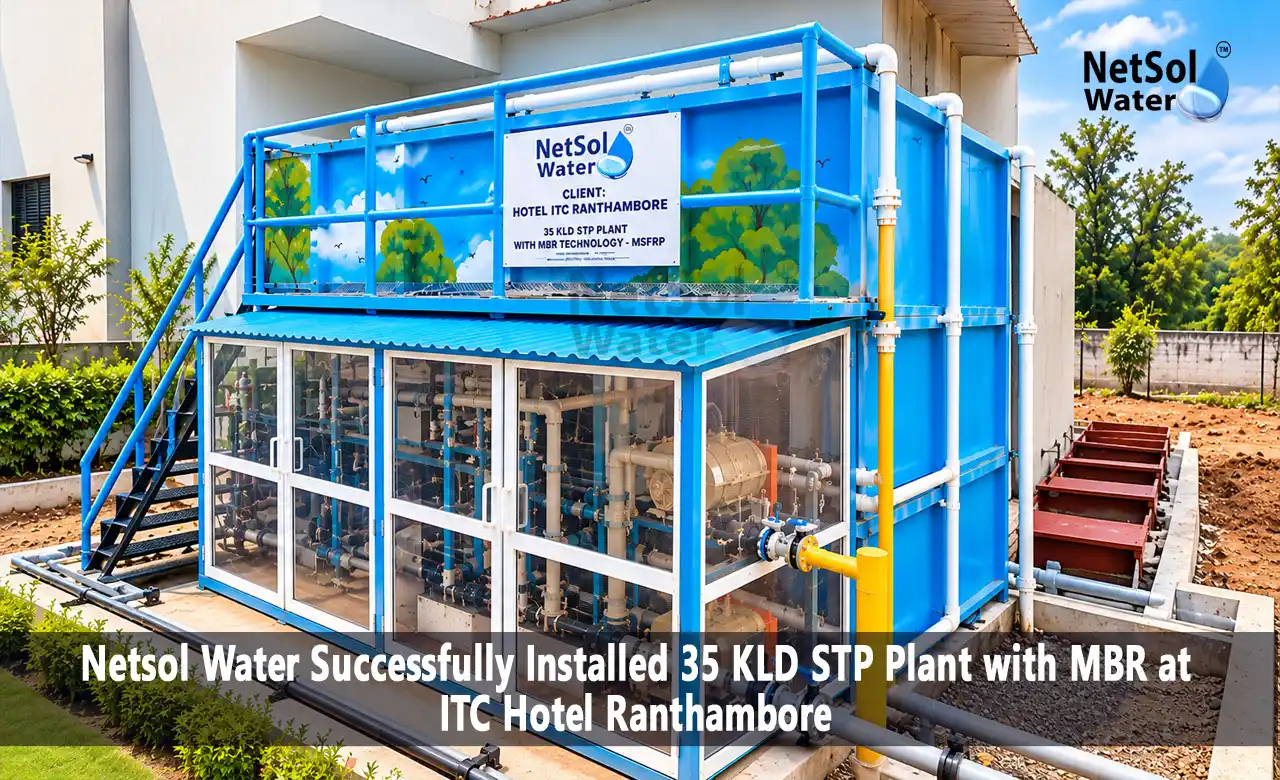
Case Study: Installed 35 KLD STP Plant with MBR at ITC Hotel Ranthambore
A 35 KLD sewage treatment plant based on Membrane Bioreactor (MBR) technology was installed at ITC Hotel Ranthambore, Rajasthan, in 2026. It is a package type plant built in MSFRP, and it treats domestic sewage from hotel facilities.
The treatment sequence runs from a screen chamber to an equalization tank, then MBR, disinfection and a treated water tank. Installation took 5 days, and the main challenge was limited space. The treated water is intended for gardening, flushing and landscaping.
This case study keeps confirmed project facts apart from general engineering explanation. Where the project records are silent, the text says so. No raw or treated water test results have been supplied for this project, so you won't find performance figures or compliance claims here.
It is written for hotel owners, facility managers, consultants and project engineers who are comparing MBR-based STP options. If you want to see what a compact hotel installation looks like and which questions to ask before specifying one, start here.
Why MBR technology is used in sewage treatment plants?
A Membrane Bioreactor combines two steps that conventional plants keep separate: biological treatment and membrane separation.
In the biological stage, microorganisms break down organic matter in the sewage with the help of air. A conventional plant then sends the mixture to a settling tank, where the biomass settles under gravity. An MBR replaces that settling step with membranes. Water passes through the membrane. The biomass and most suspended solids stay behind in the reactor.
General advantages of MBR systems include a smaller footprint than settling-based designs, reliable solids separation and clear treated water that suits further reuse steps. Holding the biomass inside the reactor also lets the plant run with a high concentration of microorganisms.
The operational side deserves equal attention. Membranes need regular cleaning and can foul. Aeration has to be controlled. Power use is often higher than in simple biological plants, and the operator needs training to read alarms and pressure readings.
Membranes also need protection from upstream debris. Fine screening ahead of the membranes keeps hair, fibres and other material from damaging them, which is one reason a screen chamber sits at the head of an MBR plant.
For package STP installations, a compact process is useful where land is limited. The project team has not confirmed why MBR was chosen for this hotel, so this page makes no claim about that decision.
Technical specifications of the 35 KLD STP plant
A package STP plant arrives largely factory built, which shortens the work needed on site. This one is built in MSFRP, the construction listed in the project record. The exact material specification should be confirmed before publication.
The table lists confirmed project details. Rows marked "To be confirmed" cover items that the supplied records do not include.
| Parameter | Detail |
|---|---|
| Project | 35 KLD STP Plant with MBR Technology |
| Location | ITC Hotel Ranthambore, Rajasthan |
| Installation year | 2026 |
| Nominal capacity | 35 KLD (35,000 litres per day) |
| Plant type | Package type |
| Construction | MSFRP |
| Wastewater source | Domestic sewage from hotel facilities |
| Technology | Membrane Bioreactor (MBR) |
| Treatment flow | Screen Chamber → Equalization Tank → MBR → Disinfection → Treated Water Tank |
| Installation duration | 5 days |
| Main installation challenge | Space constraint |
| Intended treated water use | Gardening, flushing and landscaping |
| Membrane make, type and area | Hollowbrane |
What 35 KLD means?
KLD stands for kilolitres per day. One kilolitre is 1,000 litres, so 35 KLD is 35,000 litres per day. That figure is the nominal capacity, which is the design rating of the plant. It doesn't establish how much sewage the hotel produced or how much water the plant treated on any given day. Actual volume depends on occupancy, water use and operating hours, and no measured flow data has been supplied.
Treatment process of the MBR-based STP plant
The plant treats sewage in five stages, in the sequence below. Each description covers the general purpose of that stage in this type of plant. Equipment details are not part of the confirmed record.
1. Screen chamber
Raw sewage enters the screen chamber first. Screens hold back rags, plastics and other coarse solids. Removing them early protects pumps, pipes and the tanks that follow. The screen type and mesh size are not in the supplied records, and the exact name of this unit should be checked against project documentation before publication.
2. Equalization tank
Hotel sewage doesn't arrive at an even rate. The equalization tank collects it and smooths out swings in flow and strength, so the biological stage receives a steadier feed. Some plants add mixing or aeration here to keep solids suspended. The records don't say whether this plant does.
3. MBR treatment
This is the core of the plant. Microorganisms break down the organic load in the sewage. Membranes then separate the clean water from the biomass. Membrane make, pore size, area and operating settings have not been supplied, so none are stated here.
4. Disinfection
Disinfection reduces disease-causing organisms in the treated water before it is stored and reused. Several methods exist. The method used at this hotel has not been confirmed, and this page does not name one.
5. Treated water tank
The treated water tank holds the final water. It acts as a buffer between production and demand, so water is available when the garden, flushing lines or landscaping need it. Capacity and layout details are not available.
Treatment process flow diagram (text version; replace with a designed graphic):
Raw hotel sewage
|
v
Screen Chamber -> Equalization Tank -> MBR
|
v
Treated Water Tank <- Disinfection
|
v
Intended reuse: gardening, flushing, landscaping
Watch Plant Video and Space Constraint
Treated water reuse for gardening, flushing and landscaping
Treated sewage can be reused for non-potable purposes in hotels. Gardening, toilet flushing and landscaping are common examples, and each one lowers the amount of fresh water drawn for the same job. For more on the practice, read our guide on how to reuse treated sewage water.
Reuse works only when the water suits the job. Four points matter:
1. Quality. Water for flushing and for irrigation faces different requirements, and local rules may set limits for each.
2. Disinfection. The water needs to be disinfected before reuse, and the method should suit the application.
3. Storage. Treated water held for long periods can degrade, so tank design and turnover matter.
4. Separate distribution. Treated water lines should stay apart from drinking water supply and be clearly labelled as non-potable.
Gardening, flushing and landscaping are the intended applications provided for this project. This page doesn't state that the treated water meets any particular standard, and it doesn't claim that every reuse application has been commissioned and verified. Treated water quality data would be needed for that.
Engineering benefits and operational considerations
The confirmed characteristics of this project are few and clear. The plant is a package unit in MSFRP, it uses MBR, it follows a five-stage flow, and it went in over 5 days on a site where space was tight. Those facts point to a compact installation, though dimensions would be needed to say how compact.
The points below are general considerations for MBR-based plants. They are not verified details of the installed plant.
1. Membrane maintenance. Membranes need periodic cleaning and eventual replacement. The schedule depends on manufacturer guidance and sewage load.
2. Sludge management. Biological treatment produces excess sludge, which must be withdrawn and disposed of as local rules require.
3. Routine inspection. Screens, mechanical equipment, alarms and pressure readings need regular checks by a trained operator.
4. Treated water testing. Samples should be tested at set intervals to confirm quality before and during reuse.
No savings figures, environmental benefits or performance comparisons are claimed here. None can be supported without measured data from this plant.
Conclusion
The ITC Hotel Ranthambore project is a 35 KLD, package type, MSFRP sewage treatment plant using MBR technology. It was installed in 2026 over 5 days on a site where space was the main constraint. The flow runs from the screen chamber through the equalization tank, MBR and disinfection to a treated water tank.
The treated water is intended for gardening, flushing and landscaping. Planned reuse of this kind reduces how much fresh water a property has to draw for non-potable work, provided the treated water quality is confirmed and managed. Measured results are not part of the record yet, and this case study says so openly.
For a hotel owner or consultant, the useful takeaway is the set of questions this project raises: what the plant must treat, how much space exists, how the water will be reused and what evidence will show its quality.
If you are planning an STP for a hotel, resort or similar property, talk to Netsol Water about capacity, space limits and reuse needs. Write to enquiry@netsolwater.com or see our page on the STP plant in Rajasthan.
Frequently asked questions (FAQs)
Q1. What is the capacity of the STP installed at ITC Hotel Ranthambore?
The plant has a nominal capacity of 35 KLD, which is 35,000 litres per day. This is the design rating. Measured daily flow has not been supplied.
Q2. Which technology is used in this STP plant?
The plant uses Membrane Bioreactor (MBR) technology, which combines biological treatment with membrane separation. Membrane make and specifications have not been supplied.
Q3. What type of STP was installed?
A package type plant built in MSFRP. It was installed in 2026.
Q4. How long did the installation take?
The installation took 5 days. The records supplied do not say whether civil work, commissioning, testing or handover were included in that period.
Q5. What type of wastewater does the plant treat?
Domestic sewage from hotel facilities.
Q6. Where can treated water from an MBR STP be reused?
In general, treated water can be reused for non-potable purposes such as gardening, toilet flushing, landscaping and cleaning, subject to treated water quality, disinfection and local rules. For this project, the intended applications are gardening, flushing and landscaping.
Q7. What was the main installation challenge?
Space constraint. Site layout and plant dimensions have not been supplied.
Q8. Are treated water test results available for this project?
No. Raw water and treated water laboratory results have not been provided, so no BOD, COD, TSS or microbiological values are published here.