Case Study: Installed 3000 LPH Commercial RO Plant at Dhawandeep Society, Delhi
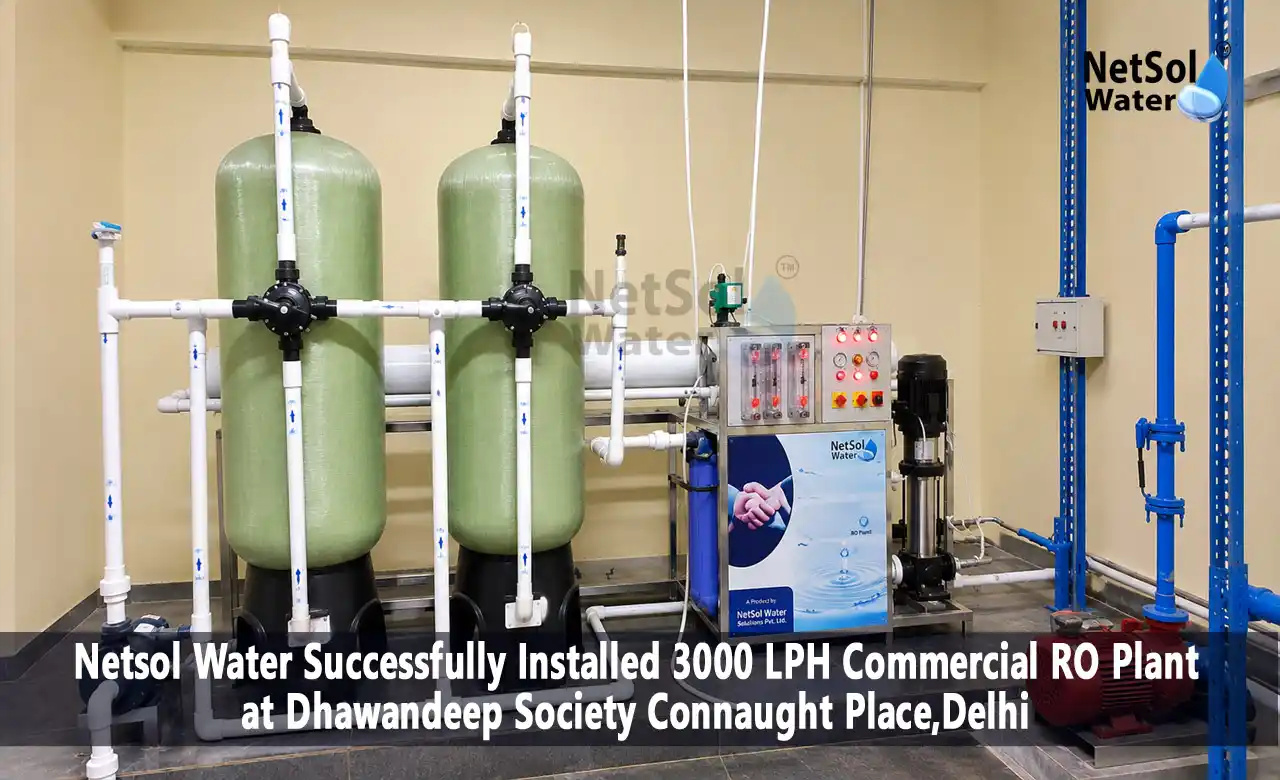
In 2023, Netsol Water Solutions installed a 3000 LPH commercial RO plant for society use at Dhawandeep Society in Connaught Place, New Delhi. The plant sits in the society basement and treats borewell water for the domestic water supply. The borewell water measured 3000 mg/L TDS before treatment and 80 mg/L after it.
LPH means litres per hour. The plant is an MSFRP RO plant, and the installation took four days.
Every figure, brand name and date in this case study is a confirmed project detail. Sentences that begin with "in general" explain how RO systems work as a technology. They do not report measurements from this site.
Project at a Glance
| Parameter | Details |
|---|---|
| Client | Dhawandeep Society |
| Location | Connaught Place, New Delhi, India |
| Installation Year | 2023 |
| Plant Capacity | 3000 LPH |
| Plant Type | MSFRP RO Plant |
| Installation Location | Society Basement |
| Water Source | Borewell |
| Raw Water TDS | 3000 mg/L |
| Treated Water TDS | 80 mg/L |
| RO Recovery | 70% |
| Membranes | 6 LG Membranes |
| High Pressure Pump | Kirloskar |
| Application | Domestic Water Supply |
| Installation Duration | 4 Days |
| Main Challenges | Limited installation space, high raw water TDS, and pipeline connection |
Understanding the Society's Water Treatment Requirements
A residential society draws on one water source for many families. At Dhawandeep Society that source is a borewell, and its water carries 3000 mg/L of TDS. A society water treatment plant has to deal with that figure every day. TDS stands for total dissolved solids, which are the salts and minerals dissolved in water.
In general, filters remove suspended particles such as sand and silt, but they cannot remove dissolved salts. At 3000 mg/L, the dissolved content is high enough that filtration alone would not bring it down. A process built for dissolved solids, such as reverse osmosis, was the logical route.
The society also needed a steady result. When one plant serves a whole complex, every flat receives water from the same source. A single good reading means little if the output drifts from week to week, so consistent treated water quality was as important as the TDS figure itself.
Why a Commercial RO Plant Was Suitable for the Society?
Small domestic RO units suit one kitchen. A society needs a system for the whole building, running for long hours, and that is the job of a commercial RO plant. For apartment complexes with high-TDS groundwater, an RO plant for a housing society is usually the practical choice. If you are comparing suppliers, our page for a commercial RO plant manufacturer shows the range we build.
Buyers of a commercial RO plant for apartment buildings usually ask four things.
. Capacity. The confirmed capacity here is 3000 LPH. Whether a given capacity suits a society depends on the number of residents, daily water use, storage tank volume and the hours the plant will run. Confirm these before choosing a size.
. Water quality. RO membranes reject dissolved salts. At this site, TDS fell from 3000 mg/L to 80 mg/L.
. Maintenance. In general, an RO plant lasts longer when suspended particles, chlorine and scale stay away from the membranes. That is why this plant has a sand filter, carbon filter, micron filter and antiscalant dosing ahead of the membranes.
. Installation. A basement plant must fit the space available. The team finished this one in four days.
Major Challenges During the Project
The project had three challenges. Each one is described below, with the work that went into handling it.
1. Limited Installation Space in the Society Basement
Society basements also hold parking, tanks and service lines, so free floor area is rarely generous. An RO plant needs room for its filters, pumps and membranes, and also room for staff to reach valves and gauges later.
At Dhawandeep Society, space was tight. The installation team assessed the available area first, then decided where each unit would go so the complete plant fitted inside the basement.
2. High Raw Water TDS of 3000 mg/L
A borewell water treatment plant works harder when TDS is high. In general, as water passes through the membranes, dissolved salts become concentrated on the reject side, and sparingly soluble salts can form scale on the membrane surface.
The treatment train was built around this raw water condition. It includes pressure sand filtration, activated carbon filtration, micron filtration and an antiscalant dosing system before the membranes, and it operates at 70% recovery.
3. Pipeline Connection Challenges
The plant had to connect to the borewell supply on one side and to the society's water lines on the other. Pipeline work in an occupied society needs planning, because the existing water supply continues to matter to residents.
The team handled the pipeline connection inside the four-day installation, alongside equipment placement and commissioning. The exact pipe routing is not part of the confirmed information, so we do not describe it here.
Technical Specifications of the 3000 LPH Commercial RO Plant
The table below lists confirmed details only.
| Specification | Details |
|---|---|
| Plant Capacity | 3000 LPH |
| Plant Type | MSFRP RO Plant |
| Water Source | Borewell |
| Raw Water TDS | 3000 mg/L |
| Treated Water TDS | 80 mg/L |
| RO Recovery | 70% |
| RO Membranes | 6 Numbers, LG Brand |
| High Pressure Pump | Kirloskar Brand |
| Application | Domestic Water Supply |
Installed Equipment and Its Purpose
| Equipment | Purpose in the Plant |
|---|---|
| Raw Water Pump | Moves borewell water into the pretreatment stages. |
| Pressure Sand Filter (PSF) | Removes suspended particles such as sand and silt. |
| Activated Carbon Filter (ACF) | Adsorbs organic matter and, where present, chlorine that can harm membranes. |
| Micron Filter | Catches fine particles that pass through the earlier filters. |
| Low Pressure Switch | Protects the high-pressure pump from running at low inlet pressure. |
| High Pressure Pump | Raises water pressure so it can pass through the RO membranes. |
| High Pressure Switch | Stops the system if pressure rises beyond its set limit. |
| RO Membranes | Separate dissolved salts from the water. |
| Antiscalant Dosing System | Adds antiscalant to reduce scale formation on the membranes. |
Treatment Process of the Commercial RO Plant
Water moves through eight stages in this order.
1. Raw water pump. It draws borewell water and sends it forward to the filters.
2. Pressure sand filter. The water passes through a bed of sand, which holds back suspended particles.
3. Activated carbon filter. Carbon adsorbs organic matter and chlorine, if any, so they do not reach the membranes.
4. Micron filter. A fine cartridge filter takes out particles that remain, as a last guard before the pump and membranes.
5. Antiscalant dosing. The system adds a small dose of antiscalant to the feed. It slows the formation of scale as salts concentrate inside the membranes.
6. High pressure pump. The Kirloskar pump raises the pressure. In general, RO needs pressure above the water's osmotic pressure, and higher-TDS water needs more of it.
7. RO membranes. The six LG membranes let water through and reject most dissolved salts, which leave as reject water.
8. Treated water output. The treated water, at 80 mg/L TDS, goes on to the society's domestic supply.
How the Pressure Switches Protect the System?
The low pressure switch sits on the inlet side of the high pressure pump. If feed pressure drops, for example when the raw water supply is interrupted, the switch stops the pump. A high pressure pump should not run dry or starved.
The high pressure switch watches pressure on the membrane side. If it climbs past its set limit, the switch shuts the system down before membranes or pipes take damage. Together the two switches keep the plant inside a safe pressure window.
The model numbers and pressure settings of these parts are not part of the confirmed information.
Installation and Commissioning Process
The plant went in over four days. A daily timeline is not part of the record, so we describe the work in the order it generally follows.
The team began with a site space assessment of the basement. Equipment placement came next, followed by the pipeline connection between the plant and the society's water lines. The team coordinated the installation work within that window.
Commissioning is the final stage. In general, it means starting the plant, checking that the pumps, pressure switches and dosing system respond as they should, and confirming that the plant produces treated water before regular use begins.
RO Plant Performance and Water Quality Results
| Parameter | Result |
|---|---|
| Raw Water TDS | 3000 mg/L |
| Treated Water TDS | 80 mg/L |
| TDS Reduction | Approximately 97.3% |
| RO Recovery | 70% |
The reduction works out like this: 3000 minus 80 is 2920, and 2920 divided by 3000 is 0.9733. That is a reduction of about 97.3% in dissolved solids.
For a society, the practical meaning is simple. Water that came out of the borewell at 3000 mg/L now reaches the domestic supply at 80 mg/L.
Recovery of 70% means that, in general, 70 litres of every 100 litres of feed water become treated water. The remaining 30 litres leave as reject water carrying the concentrated salts.
TDS is one measure of water quality. It does not show bacteria, specific chemicals or metals. A low TDS reading therefore does not prove water is safe to drink. Only a complete water test can judge that.
Project Outcomes and Benefits for Dhawandeep Society
The confirmed outcomes of this installation are:
. Improved water quality, with TDS reduced from 3000 mg/L to 80 mg/L.
. Consistent treated water quality.
. RO-based treatment of high-TDS borewell water.
. Support for the society's domestic water supply requirements.
We state no cost savings, maintenance reductions or guaranteed performance, because the project record confirms none.
Watch the Installation Video of the 3000 LPH Commercial RO Plant
Netsol has published a video of this project on YouTube. It is a useful companion to this case study if you want to see the plant for a society in action rather than read about it.
The video covers the 3000 LPH RO plant installed at Dhawandeep Society, Connaught Place, Delhi.
Why Choose Netsol Water for Commercial RO Plant Installation?
Netsol Water Solutions Pvt. Ltd. is a water and wastewater treatment company based in Greater Noida, Uttar Pradesh. It manufactures commercial RO plants, industrial RO plants, sewage treatment plants, effluent treatment plants and water softener plants.
For a society, that background matters in practical ways. The same company that builds the plant also installs it, which keeps responsibility in one place. The Dhawandeep plant is an example: a basement installation, a high-TDS borewell source and a four-day installation window.
You can see our commercial RO plants in Delhi and the wider RO plants range before you call. To discuss a society project, call +91-9650608473 or write to enquiry@netsolwater.com.
Frequently Asked Questions (FAQs)
Q1. What is a commercial RO plant for society?
It is a reverse osmosis system sized for a housing society or apartment complex, which makes it an RO plant for a residential society rather than a single home. It treats water for many households together instead of one kitchen. The Dhawandeep Society plant is 3000 LPH and treats borewell water for domestic supply.
Q2. Why does a residential society need a commercial RO plant?
Many societies depend on borewell water, and groundwater quality varies from place to place. A commercial RO plant for society use treats it at one point for every household. If the water carries high TDS, as it did at 3000 mg/L here, RO can reduce the dissolved solids for the whole complex.
Q3. Is a 3000 LPH RO plant suitable for a residential society?
It can be, but it depends on the society. Residents, daily water use, storage tank size and plant running hours decide the right capacity. At Dhawandeep Society, a 3000 LPH plant supports the domestic water supply.
Q4. Can a commercial RO plant be installed in a society basement?
Yes, if the space and access allow it. The Dhawandeep plant is in a society basement. Space is the main limit, so assess the area before placing equipment.
Q5. Can an RO plant treat borewell water with 3000 mg/L TDS?
At this site, yes. The plant reduced 3000 mg/L raw water TDS to 80 mg/L at 70% recovery. Other sites may differ, because feed water chemistry decides the design.
Q6. What is the role of antiscalant dosing in a commercial RO plant?
Antiscalant is a chemical dosed into the feed water. As salts concentrate inside the membranes, it slows the formation of scale on the membrane surface. The right dose depends on the water, so it should be set for each site.
Q7. What is the difference between raw water TDS and treated water TDS?
Raw water TDS is the dissolved solids reading before treatment. Treated water TDS is the reading after the RO plant. At Dhawandeep Society they were 3000 mg/L and 80 mg/L.