

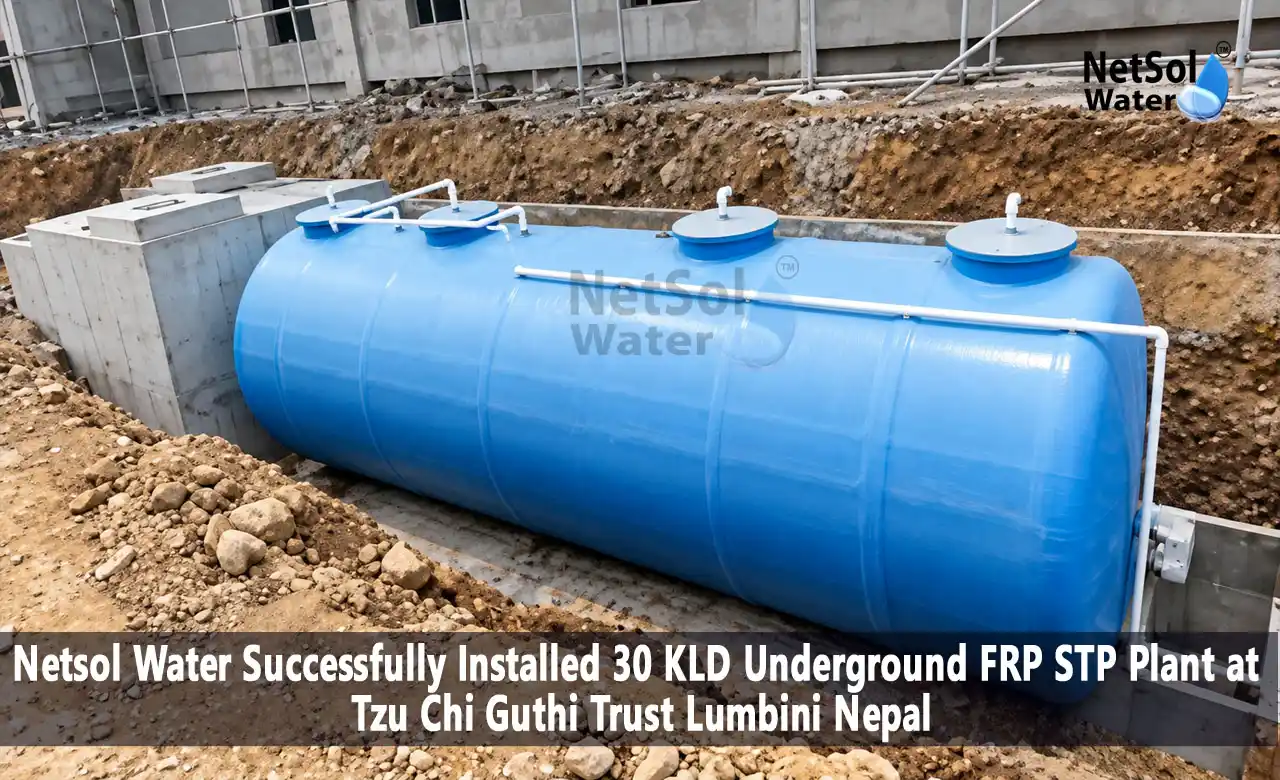
Case Study: Installed 30 KLD Underground FRP STP Plant at Tzu Chi Guthi Trust, Nepal
Project Overview
Netsol Water has installed a 30 KLD Underground FRP STP Plant for Tzu Chi Guthi Trust in Lumbini, Nepal. The plant is an Underground FRP Sewage Treatment Plant that can treat about 30,000 litres of sewage per day. The idea behind the project is simple: give the facility its own system for treating the sewage it produces, and keep the treatment units below ground so the surface stays free for other use. Netsol Water was responsible for the installation.
| Item | Details |
|---|---|
| Client | Tzu Chi Guthi Trust |
| Location | Lumbini, Nepal |
| Plant Capacity | 30 KLD |
| Plant Type | Underground FRP STP |
| Project | Installation of 30 KLD Underground FRP STP Plant |
| Company | Netsol Water Solutions Pvt. Ltd. |
About the Project Location and Facility
Lumbini, in southern Nepal, is known as the birthplace of Gautama Buddha and is a UNESCO World Heritage Site. Pilgrims and visitors come here through the year, and the area is home to monasteries, institutions and community facilities. This case study looks only at the wastewater side of the client's premises, so it does not describe the facility beyond what that needs.
Every institutional or community facility produces sewage daily, from toilets, washing areas and kitchens. If that sewage is not treated, it can affect soil and groundwater and lead to hygiene problems. In a place with so many visitors and such cultural importance, a well planned Sewage Treatment Plant in Nepal, and in particular STP Plant in Lumbini that people can rely on, is a basic part of running a facility responsibly. A STP for institutional facilities is core infrastructure, not an optional extra.
Project Requirement
A facility with residents, staff or visitors produces sewage all day, and the volume depends on how many people use it and how much water they consume. Tzu Chi Guthi Trust needed a dependable way to collect and treat this sewage on site. A 30 KLD Sewage Treatment Plant was installed to meet that need. The detailed design basis, such as occupancy and flow assumptions, is not covered in this case study.
| Requirement | Why it matters |
|---|---|
| Sewage generation | Daily flow changes with occupancy and water use, so treatment capacity has to be planned against it. |
| Wastewater management | Sewage must be collected and treated on site in an organised way. |
| Reliable treatment | A plant that runs inconsistently defeats the purpose of installing one. |
| Space utilisation | Ground-level tanks take up land that could serve buildings, gardens or parking. |
| Responsible sewage treatment | Treatment protects soil, groundwater and public health around the premises. |
An underground layout answers the space question by placing the tanks below the surface, which keeps that land available. This is one common reason underground plants are chosen for compact or landscaped sites.
Why an Underground FRP STP Was Suitable
An Underground FRP STP Plant makes sense where surface area is limited or better used for something else. Underground FRP sewage treatment also keeps the visible footprint small. The table below lists the practical benefits of this configuration.
| Benefit | What it means | What to keep in mind |
|---|---|---|
| Efficient use of space | Tanks sit below ground, so the area above can serve other purposes. | The structure must be designed for the loads above it. |
| Reduced visual impact | Only access covers and service points are visible at surface level. | Covers must stay reachable for operators. |
| Better integration with the premises | The plant fits into the site layout instead of adding a separate structure. | The layout should be settled early. |
| Suitable use of underground space | Space below ground that would otherwise sit idle does useful work. | Ground conditions must be checked. |
Underground does not mean out of mind. Access, ventilation and maintenance provisions must be built in from the start, because operators still have to inspect, service and clean the system. Going underground does not automatically remove odour or maintenance needs. Good design and regular upkeep do that. These are general advantages of the configuration and not confirmed site conditions for this project.
Project Challenges
Netsol Water has not supplied project-specific challenge details for this case study, so none are presented here as confirmed. What follows are general considerations that come up on almost any underground STP installation.
| General consideration | Why it matters |
|---|---|
| Space planning | The tank layout must fit the available area and leave safe working room for excavation and installation. |
| Civil structure coordination | Dimensions, openings and levels in the civil structure must match the STP layout. |
| Inlet and outlet levels | Sewage must reach the plant, and treated water must leave it, at workable levels. |
| Pipeline routing | Pipes need proper gradients and routes that avoid other underground services. |
| Equipment accessibility | Pumps, blowers and other equipment must be reachable for service and replacement. |
| Maintenance access | Manholes and covers should be sized and placed so every chamber can be inspected. |
| Ventilation | Enclosed underground units need proper air provisions. |
| Electrical and mechanical integration | Power supply, controls and mechanical equipment must work together as one system. |
30 KLD Underground FRP STP Plant Design
The design idea is easy to describe. The treatment units sit inside a below-ground structure, and access points at the surface allow inspection and service. A capacity of 30 KLD means the plant is designed for approximately 30,000 litres of sewage per day, since KLD stands for kilolitres per day. As a 30 KLD STP Plant, it suits premises where the daily sewage volume is moderate. Tank dimensions, equipment ratings and process parameters are not detailed here.
| Parameter | Details |
|---|---|
| Client | Tzu Chi Guthi Trust |
| Location | Lumbini, Nepal |
| Capacity | 30 KLD |
| Daily Treatment Capacity | Approximately 30,000 litres of sewage per day |
| Plant Type | Underground FRP STP |
| Application | Sewage treatment for the client's facility |
| Treatment Technology | MBBR |
| Installer | Netsol Water Solutions Pvt. Ltd. |
Sewage Treatment Process
The process technology installed in this plant is [Technology to be confirmed]. The stages below describe how sewage is typically treated in a plant of this kind. They should not be read as the exact installed configuration.
1. Sewage Inlet and Screening
Sewage enters through the inlet line. Screening removes larger solids such as plastics, rags and debris, which protects pumps and downstream units from clogging.
2. Collection and Equalization
A collection tank receives the incoming flow. Sewage generation varies through the day, so equalization evens out flow and load and gives later stages a steadier feed.
3. Biological Treatment
Microorganisms break down dissolved and suspended organic matter in the sewage. The method used in this plant is [Technology to be confirmed].
4. Secondary Clarification
After biological treatment, solids settle so that clearer water can move on. Whether a separate clarifier forms part of this plant depends on the confirmed technology.
5. Filtration and Disinfection
Some plants add filtration to remove finer particles, and disinfection to reduce pathogens before the water reaches the outlet. Their inclusion in this plant is to be confirmed.
6. Treated Water Outlet
Treated water leaves the plant through the outlet line. How it is used or discharged is not covered in this case study.
7. Sludge Handling
Treatment produces sludge that has to be managed and removed from time to time. The method and frequency depend on the plant design.
Installation and Commissioning
The steps below are standard for an underground STP project. They are not a log of the activities carried out at this site.
| Step | Stage | Standard activity |
|---|---|---|
| 1 | Site assessment | Study available space, ground conditions and sewage source points. |
| 2 | Planning and design coordination | Finalise layout, levels and access points. |
| 3 | Civil work coordination | Align the excavation and tank structure with the STP design. |
| 4 | Equipment installation | Place pumps, blowers and related equipment. |
| 5 | Piping | Connect inlet, interconnecting and outlet lines. |
| 6 | Electrical connections | Wire the power supply and control panels. |
| 7 | Testing | Check tanks and pipelines for leaks and equipment for correct operation. |
| 8 | Trial operation | Run the plant with sewage and observe how it behaves. |
| 9 | Commissioning | Bring the plant into regular operation. |
| 10 | Handover | Hand the plant over to the client with operating guidance. |
Project Outcomes and Benefits
The plant gives the facility a treatment capacity of 30,000 litres per day, and sewage is now handled in a purpose-built system. No water quality results are published in this case study, so none are stated.
| Area | Benefit |
|---|---|
| Treatment capacity | 30,000 litres of sewage per day. |
| Sewage management | Sewage is handled in a defined system with a set daily capacity. |
| Untreated disposal | Less dependence on untreated sewage disposal, since sewage is treated on site. |
| Space | Efficient use of available space, subject to structural design. |
| Infrastructure | Permanent wastewater treatment infrastructure for the premises. |
| Environment | Treating sewage before it goes further supports the protection of soil and water sources. |
Project Video
Watch the 30 KLD Underground STP Plant Project
The video gives a visual overview of the project and the installed STP. You can watch it here:
Key Project Specifications
| Specification | Details |
|---|---|
| Project | Installation of 30 KLD Underground FRP STP Plant |
| Client | Tzu Chi Guthi Trust |
| Location | Lumbini, Nepal |
| Capacity | 30 KLD |
| Daily Volume | Approximately 30,000 litres of sewage per day |
| Plant Type | Underground FRP Sewage Treatment Plant |
| Application | Sewage treatment for the client's facility |
| Treatment Technology | [Technology to be confirmed] |
| Water Quality Data | Not published in this case study |
| Company | Netsol Water Solutions Pvt. Ltd. |
Frequently Asked Questions (FAQs)
Q1. What is the capacity of the STP installed at Tzu Chi Guthi Trust?
The plant has a capacity of 30 KLD, which is approximately 30,000 litres of sewage per day.
Q2. Where was the 30 KLD Underground STP installed?
It was installed at the premises of Tzu Chi Guthi Trust in Lumbini, Nepal.
Q3. What does 30 KLD mean?
KLD stands for kilolitres per day. A 30 KLD plant is designed to treat 30 kilolitres, or 30,000 litres, of sewage in a day.
Q4. Why was an Underground STP selected for this project?
An Underground STP Plant suits sites where surface space is limited or better used for other purposes, and where less visible infrastructure is preferred. Site-specific reasons for this project have not been published.
Q5. How much sewage can a 30 KLD STP treat?
A 30,000 litres per day STP can treat up to about 30,000 litres of sewage in a day. Actual performance depends on inflow characteristics and how the plant is operated.
Q6. What are the benefits of an Underground Sewage Treatment Plant?
The main benefits are efficient use of space, reduced visual impact and better integration with the premises. These depend on proper access, ventilation and maintenance provisions.
Q7. Who installed the STP at Tzu Chi Guthi Trust?
Netsol Water Solutions Pvt. Ltd. carried out the installation. The company works as a Sewage Treatment Plant Manufacturer and STP Plant Supplier.
Q8. What factors should be considered when installing an Underground STP?
Available space, civil structure coordination, inlet and outlet levels, pipeline routing, equipment and maintenance access, ventilation, and electrical and mechanical integration. Expected flow and occupancy also guide the choice of capacity.
Conclusion
The 30 KLD Underground STP Plant at Tzu Chi Guthi Trust in Lumbini, Nepal gives the facility a dedicated way to treat about 30,000 litres of sewage per day. The underground layout keeps surface space free, as long as access, ventilation and maintenance are planned well. The project shows why capacity, layout and site coordination deserve attention before installation begins, and Netsol Water carried out the installation. Organisations looking for STP Installation in Nepal can get in touch with Netsol Water to discuss their requirements.
About Netsol Water
Netsol Water is a water and wastewater treatment company based in the Delhi NCR region of India. It works as STP Plant Manufacturer and STP Plant Supplier, and its range also covers effluent treatment plants, water treatment plants and RO plants, along with energy management, automation and waste management solutions.
The company has environmental engineers on its team and puts weight on after-sales service. It reports serving more than 500 customers. For projects like this one, Netsol Water works as an Underground STP Manufacturer and installer, handling the plant from planning through commissioning. More about the company is available at www.netsolwater.com.