
Case Study: Installed 2000 LPH RO Plant at Godrej Zenith, Gurgaon
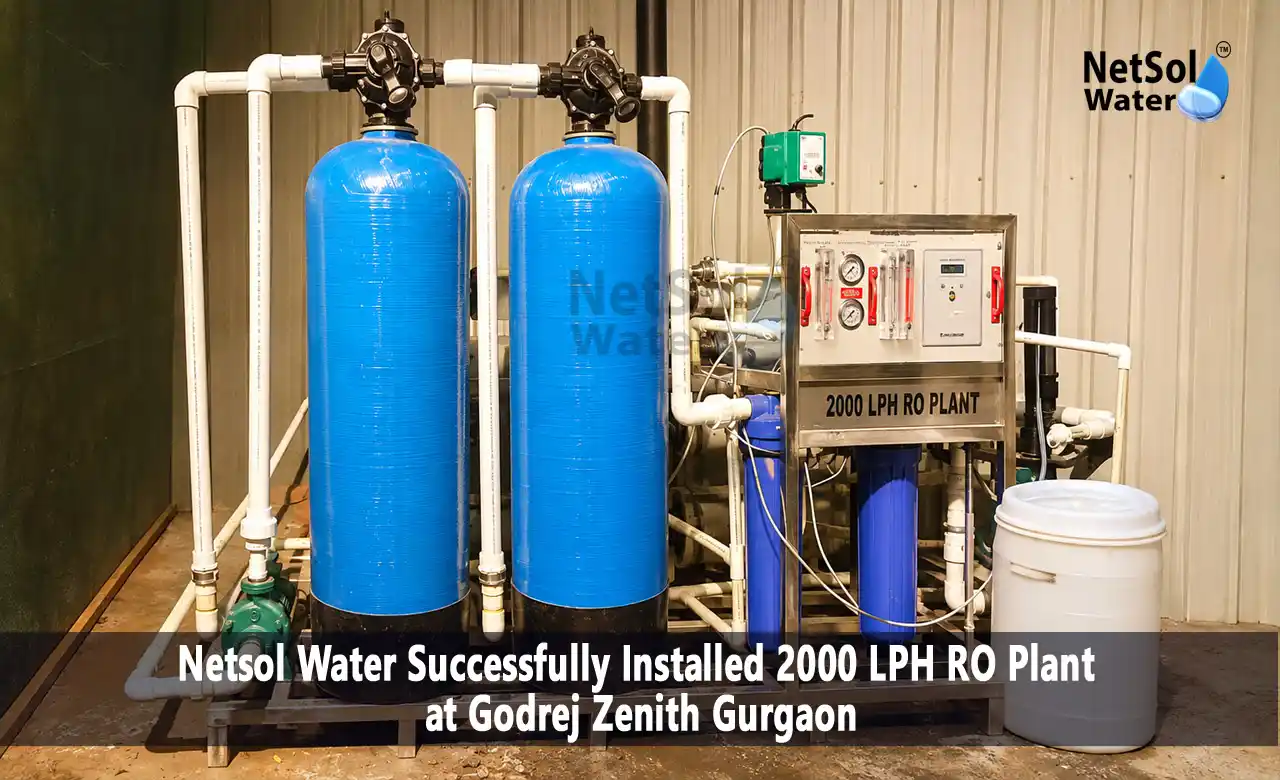
In October 2025, Netsol Water completed a 2000 LPH RO plant installation in Gurgaon, Haryana, at Godrej Zenith. The plant is used for a commercial building application and treats groundwater with a raw water TDS of 2200 mg/L. After RO treatment, the treated water TDS was 90 mg/L.
The system uses eight LG RO membranes and operates at 65% recovery. It has MSFRP plant construction and a PLC control system. Pretreatment includes a pressure sand filter, activated carbon filter, water softener, micron filter and antiscalant dosing system.
The installation was completed in three days. Transportation was the main challenge on this project. This case study covers the project details, equipment, installation approach and measured water quality results. It is written for building owners, facility managers, consultants and procurement teams planning a commercial RO plant installation in Gurgaon or Gurgaon.
About Godrej Zenith, Gurgaon
Godrej Zenith is a commercial building project in Gurgaon, Haryana. Gurgaon, also called Gurgaon, is one of the main business and corporate centres of the Delhi NCR region, with a large number of office and commercial buildings.
Many commercial properties in the region depend on groundwater for part of their water supply. Groundwater quality can differ from one site to another, and dissolved salts are a common concern. A commercial building therefore needs a treatment arrangement that matches the actual water quality at its location.
For this project, Netsol Water worked with a confirmed raw water TDS of 2200 mg/L. Details such as building size, occupancy and daily water consumption are not covered in this case study.
Project Background and Water Treatment Requirements
Total Dissolved Solids, or TDS, measures the dissolved minerals and salts in water. Here it is expressed in mg/L. A raw water TDS of 2200 mg/L is high. Water at this level can taste salty, can leave scale on pipes and fixtures, and is usually not suitable for many commercial uses without treatment. The right treatment depends on how the water will be used.
Reverse osmosis is widely used to reduce dissolved salts. Pressure pushes water through semi-permeable membranes. Water passes through, while most dissolved salts are rejected and leave as a concentrated reject stream.
RO membranes are sensitive to what enters them. Suspended particles, chlorine, organic matter and hardness minerals can foul or scale the membrane surface. Fouling reduces output, raises operating pressure and shortens membrane life. This is why pretreatment is essential in a groundwater RO system. Good pretreatment protects the membranes and helps the plant deliver steady water quality over time. The Godrej Zenith plant includes a five-part pretreatment package for this purpose.
Why Godrej Zenith Required a 2000 LPH RO Plant?
LPH means litres per hour. It describes how much treated water an RO plant is designed to produce in one hour. In commercial applications, capacity decides how reliably the plant can support water needs through the day.
A plant that is too small may run continuously and struggle at peak use. A plant that is oversized may cost more to install and operate than necessary. Proper capacity selection balances water requirement, storage, operating hours and raw water quality.
Raw water quality also matters. With high TDS water, recovery rate and membrane count have to be planned together so the plant works within safe limits. The Godrej Zenith system was set up at 2000 LPH with eight membranes and 65% recovery.
The client's daily water demand is not stated here. The general point is that capacity should come from a site assessment, a water analysis and the intended use, and not from a standard size chart.
Technical Specifications of the 2000 LPH Commercial RO Plant
The table lists only confirmed project information. Pump ratings, membrane model, operating pressure, dimensions and electrical load were not part of the confirmed record, so they are not stated.
| Parameter | Details |
|---|---|
| Project Name | Godrej Zenith |
| Location | Gurgaon, Haryana, India |
| Installation Date | October 2025 |
| Plant Capacity | 2000 LPH |
| Application | Commercial Use |
| Building Type | Commercial Building |
| Raw Water Source | Groundwater |
| Raw Water TDS | 2200 mg/L |
| Treated Water TDS | 90 mg/L |
| RO Recovery | 65% |
| RO Membrane Brand | LG |
| Number of Membranes | 8 |
| Plant Construction | MSFRP |
| Control System | PLC |
| Pretreatment | PSF, ACF, Water Softener, Micron Filter, Antiscalant Dosing |
| Installation Duration | 3 Days |
| Main Installation Challenge | Transportation |
How the RO Plant Works: Treatment Process Explained
Each component in an RO plant has its own job. The notes below describe the general function of each part. They do not describe the exact flow sequence at this site.
. Pressure Sand Filter: removes suspended solids such as silt and fine particles using a bed of graded sand.
. Activated Carbon Filter: adsorbs chlorine, organic matter and compounds that cause odour, all of which can harm RO membranes.
. Water Softener: uses ion exchange resin to swap calcium and magnesium for sodium, which reduces hardness and the risk of scaling.
. Micron Filter: a cartridge filter that catches fine particles missed by earlier stages. It acts as a safeguard for the membranes and high-pressure equipment.
. Antiscalant Dosing System: adds a small, controlled dose of chemical that slows the formation of scale crystals on the membrane surface.
. LG RO Membranes: under pressure, water passes through the membrane while most dissolved salts are rejected. At 65% recovery, about 65 parts of every 100 parts of feed water become treated water. The rest leaves as reject.
. PLC Control System: automates plant operation according to programmed logic. A PLC typically handles start and stop functions, interlocks and alarms, which reduces dependence on manual operation.
Key Equipment Used in the RO Plant Installation
The equipment package suits a groundwater application. It works in layers, and each layer protects the next.
The pressure sand filter and activated carbon filter protect the membranes from particles and from chemical or organic load. The water softener and antiscalant dosing system give two lines of defence against scale. This matters at 2200 mg/L TDS, because dissolved salts become more concentrated inside the membrane section as water is recovered. The micron filter is the last barrier before the membranes.
Eight LG membranes form the heart of the system. LG is a recognised RO membrane brand, and using branded membranes gives buyers a clear point of reference for replacement and service planning.
The plant has MSFRP construction, as recorded for this project. The PLC ties the system together and gives operators a structured way to run the plant, instead of relying only on manual switching.
Installation Process at Godrej Zenith, Gurgaon
The RO plant was installed in October 2025 and the work was completed in three days. A short site window depends on planning done before the equipment arrives.
On commercial projects, site coordination usually starts with the building's representatives. The delivery time, access arrangements and plant location are agreed in advance. Equipment is then unloaded, moved to the installation area and positioned.
Piping and electrical connections follow. These include the raw water inlet, treated water outlet, drain and power supply. The team then inspects fittings and connections, flushes the system and carries out trial operation. During trial runs, the team checks how the PLC responds, how the plant behaves in operation and what the treated water TDS shows. Commissioning comes after these checks.
These are general installation activities. The exact on-site sequence, crew size and daily schedule for this project are not recorded in this case study.
Transportation Challenges During RO Plant Installation
Transportation was the main challenge on this project. Moving a commercial RO plant is more than a delivery task. The plant includes filter vessels, an RO section, membranes, dosing equipment and a control panel. Each item needs careful handling.
Specific obstacles, such as access routes, unloading arrangements or timing restrictions, are not recorded for this project, so they are not described here.
What the project does show is why logistics planning matters. Vehicle selection, packing, load securing and route planning all affect the condition of the equipment when it reaches the site. Delivery timing has to match the building's access rules. Safe handling protects vessels, instruments and the control panel from damage. When transport runs smoothly, the installation team can spend its time on positioning, connections and testing. Here, the plant was installed in three days.
Water Quality Results: Raw Water TDS vs Treated Water TDS
| Parameter | Result |
|---|---|
| Raw Water TDS | 2200 mg/L |
| Treated Water TDS | 90 mg/L |
| RO Recovery | 65% |
The TDS fell from 2200 mg/L to 90 mg/L. That is a reduction of 2110 mg/L, or about 95.9%.
In practical terms, most of the dissolved salts in the groundwater were removed by the RO system. Water with a much lower TDS is generally better for uses where scale and salt content are a concern. The 65% recovery tells us that about two thirds of the feed water becomes treated water.
TDS is only one measure of water quality. A low TDS reading alone does not confirm that water is safe to drink or that it meets any drinking water standard. Other parameters need separate testing, based on the intended use.
Godrej Zenith RO Plant Video
Readers who want to see the project can watch the video below. It is a record of the Godrej Zenith RO plant installation by Netsol Water.
Why Choose Netsol Water for Commercial RO Plant Installation?
Netsol Water designs, manufactures and installs water treatment systems, including RO plants, STP and ETP systems, for commercial and industrial users. Having manufacturing, engineering and installation under one company allows closer coordination between design decisions and site execution.
This project reflects that approach. A 2000 LPH plant with eight LG membranes and a full pretreatment package was installed in three days, and the measured result was a treated water TDS of 90 mg/L from a 2200 mg/L source.
For buyers, the practical step is to ask for a water analysis, a documented specification and an installation plan before finalising any commercial RO plant.
Frequently Asked Questions (FAQs)
Q1. What was the capacity of the RO plant installed at Godrej Zenith?
The plant capacity is 2000 LPH.
Q2. Where was the 2000 LPH RO plant installed?
It was installed at Godrej Zenith, a commercial building in Gurgaon (Gurgaon), Haryana.
Q3. What was the raw water TDS at Godrej Zenith?
The groundwater had a raw water TDS of 2200 mg/L.
Q4. What was the treated water TDS after RO treatment?
The treated water TDS was 90 mg/L, a reduction of about 95.9%.
Q5. Which RO membrane brand was used?
LG RO membranes were used.
Q6. How many RO membranes were installed?
Eight membranes were installed.
Q7. How long did the installation take?
The installation took three days. Transportation was the main challenge.
Q8. What pretreatment equipment was included?
The plant includes a pressure sand filter, activated carbon filter, water softener, micron filter and antiscalant dosing system.