

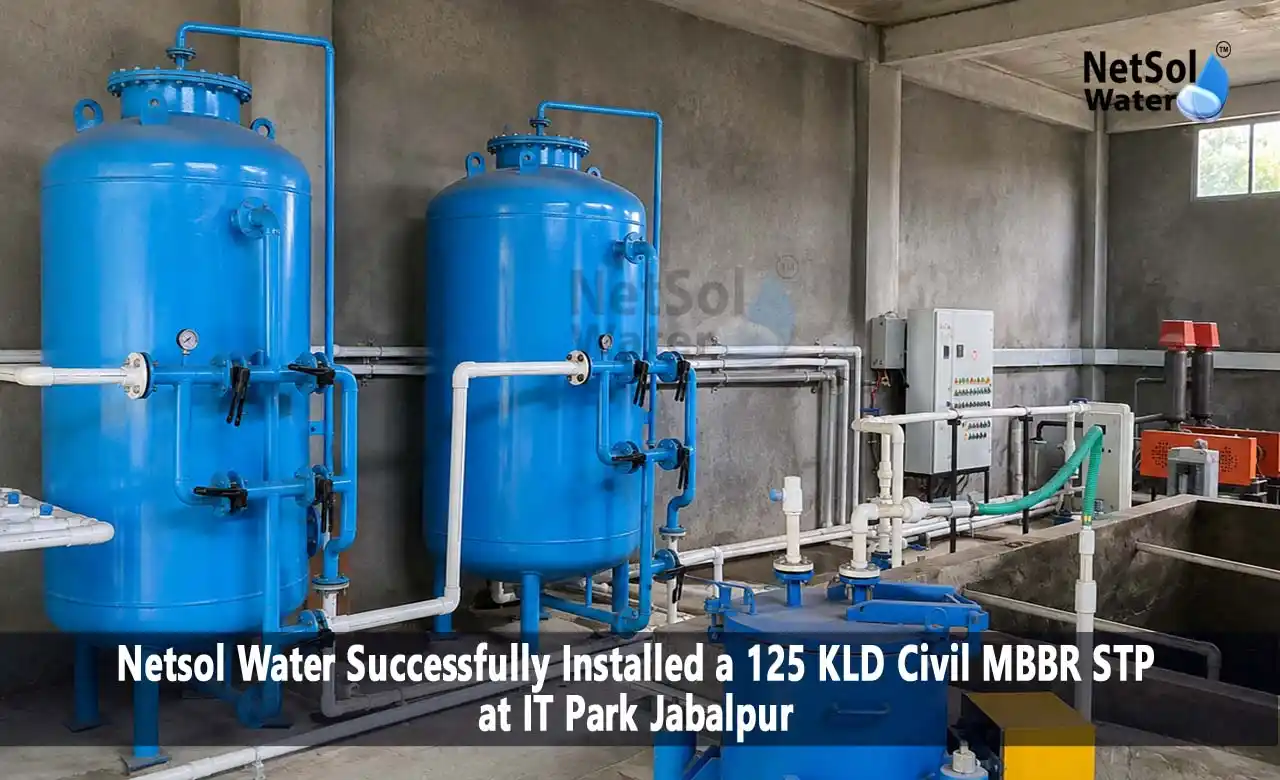
Case Study: 125 KLD Civil MBBR STP Plant at IT Park, Jabalpur
IT Park, Jabalpur is a commercial facility that houses multiple office spaces and generates a daily volume of domestic sewage from its occupants. To manage this wastewater responsibly and meet environmental compliance requirements, a 125 KLD sewage treatment plant was set up on the premises. The project was engineered and executed as a civil sewage treatment plant, with all major treatment tanks constructed using reinforced cement concrete rather than pre-fabricated or packaged units.
Netsol Water, a water and wastewater treatment company, was involved in the design, equipment integration, installation and commissioning of this facility. As a civil sewage treatment plant manufacturer, the company's role centered on aligning the biological treatment process based on MBBR technology with the civil/RCC tank structure built at the site. This case study documents the project requirement, the technology used, the civil construction approach, the treatment process, and the outcome of the completed plant.
Project Overview
The table below summarizes the key details of the 125 KLD sewage treatment plant at IT Park, Jabalpur.
| Project | 125 KLD Sewage Treatment Plant |
| Location | IT Park, Jabalpur, Madhya Pradesh |
| Capacity | 125 KLD (Kilolitres per Day) |
| Technology | MBBR - Moving Bed Biofilm Reactor |
| Construction Type | Complete Civil / RCC Construction |
| Application | Sewage Treatment |
| Company | Netsol Water |
Project Requirement
IT parks accommodate a large number of employees and visitors on a daily basis, which results in a consistent generation of domestic sewage from restrooms, pantries and common areas. Without an on-site sewage treatment plant in Jabalpur, this wastewater would need to be discharged untreated or transported off-site, both of which raise environmental and regulatory concerns.
A permanent, on-site treatment solution was required to:
. Treat sewage generated within the IT Park to a standard suitable for safe discharge or reuse.
. Provide a fixed, durable treatment infrastructure appropriate for a long-term commercial facility.
. Support compliance with local pollution control norms applicable to commercial establishments.
. Handle daily fluctuations in sewage flow associated with office occupancy patterns.
These requirements shaped both the selection of MBBR as the treatment technology and the decision to construct the plant using civil/RCC tanks rather than a packaged or containerized unit.
Why MBBR Technology Was Selected
What is MBBR Technology?
MBBR stands for Moving Bed Biofilm Reactor. It is a biological wastewater treatment process in which specially shaped plastic media are kept in continuous motion inside an aeration tank. Microorganisms attach to the surface of this media and form a biofilm layer, which carries out the biological breakdown of organic matter present in the sewage.
Reasons MBBR Was Selected for This Project
MBBR was selected for the IT Park application for several practical reasons:
. The moving media provides a large surface area for biofilm growth within a defined tank volume.
. The process can accommodate variations in daily sewage flow typical of a commercial office facility.
. MBBR tanks can be readily constructed as civil/RCC structures, allowing the biological process to be integrated directly into the site's permanent tank layout.
. The technology is widely used for institutional and commercial sewage treatment applications where a fixed, on-site plant is preferred over a relocatable unit.
In the context of this project, MBBR was implemented within civil/RCC aeration tanks constructed as part of the overall plant, rather than within a factory-fabricated steel or FRP reactor.
Civil Construction of the 125 KLD STP
What is a Civil Sewage Treatment Plant?
A defining feature of this project is that the entire treatment plant is built as a civil sewage treatment plant every major process stage, from screening to treated water storage, is housed in a reinforced cement concrete (RCC) tank constructed on site, rather than in a packaged or skid-mounted unit.
Why Civil/RCC Construction Is Used for This STP?
Civil/RCC construction plays several important roles in a plant of this nature:
. Structural durability: RCC tanks are built to withstand long-term hydraulic and structural loads, making them suitable for a permanent installation such as an IT Park's sewage treatment infrastructure.
. Hydraulic integration: Civil tanks allow inlet, interconnecting and outlet piping to be designed as part of the overall site layout, supporting smooth flow between treatment stages.
. Process integration: Screening, equalization, MBBR aeration, clarification and storage tanks can be arranged and sized according to the specific footprint and flow requirements of the site.
. Mechanical and electrical coordination: Blowers, diffusers, pumps and control panels are positioned and wired to work with the civil tank layout, rather than being pre-mounted within a factory unit.
Netsol Water's Role as a Civil Sewage Treatment Plant Manufacturer
As a civil sewage treatment plant manufacturer, Netsol Water's role in this project involved coordinating the biological treatment design including MBBR media selection and aeration requirements with the civil tank dimensions and layout constructed at the IT Park site. This approach allows the mechanical and electrical systems to be integrated into the RCC structure rather than supplied as a standalone package.
The table below outlines the key civil construction elements and their role in the plant.
| Civil Construction Element | Role in the Plant |
|---|---|
| Civil/RCC Tanks | House each treatment stage screening, equalization, MBBR, clarification and storage |
| Hydraulic Design | Inlet, interconnecting and outlet piping planned as part of the site layout for smooth inter-stage flow |
| Structural Design | RCC structure sized to withstand long-term hydraulic and structural loads at the site |
| Mechanical Integration | Blowers, diffusers and pumps positioned within the civil tank layout |
| Electrical Integration | Control panels and wiring coordinated with the civil structure and equipment placement |
Treatment Process of the 125 KLD MBBR STP
Treatment Flow Overview
The 125 KLD plant treats incoming sewage through a defined sequence of stages, each carried out in its own civil/RCC tank or chamber. The general treatment flow is as follows:
Inlet Sewage → Screening → Equalization → MBBR Biological Treatment → Clarification → Tertiary Treatment → Disinfection → Treated Water Storage
The table below summarizes each treatment stage, the civil/RCC unit it is housed in, and its function within the process.
| Treatment Stage | Civil/RCC Unit | Function |
|---|---|---|
| Screening | Screening Chamber (RCC) | Removes larger solids and debris from incoming sewage |
| Equalization | Equalization Tank (RCC) | Balances fluctuations in daily sewage flow before biological treatment |
| MBBR Biological Treatment | MBBR Aeration Tank (RCC) | Biofilm on moving media biologically degrades organic pollutants |
| Clarification | Clarifier Tank (RCC) | Settles and separates biological solids from treated liquid |
| Tertiary Treatment | Filtration Unit / Tank (RCC) | Further polishes treated water where required |
| Disinfection | Disinfection Chamber (RCC) | Addresses pathogens before final storage |
| Treated Water Storage | Storage Tank (RCC) | Holds treated water for discharge or reuse |
1. Screening
Incoming sewage first passes through a screening chamber, where larger solids and debris are removed to protect downstream equipment such as pumps and diffusers.
2. Equalization
The equalization tank balances variations in sewage flow and characteristics that occur over the course of a working day at the IT Park, allowing a more consistent flow to be fed into the biological treatment stage.
3. MBBR Biological Treatment
In the MBBR tank, aeration equipment supplies oxygen while the moving media supports the growth of a biofilm. This biofilm biologically degrades organic pollutants present in the sewage as it passes through the tank.
4. Clarification
After biological treatment, the flow moves to a clarifier, where biological solids are allowed to settle and separate from the treated liquid, which then moves forward for further treatment.
5. Tertiary Treatment and Disinfection
Depending on the intended use of the treated water, tertiary treatment stages such as filtration may be applied, followed by disinfection to address pathogens before the water reaches the storage stage.
6. Treated Water Storage
Treated water is collected in a storage tank, from where it can be discharged in compliance with applicable norms or directed toward non-potable reuse applications as determined by the facility.
125 KLD MBBR STP at IT Park, Jabalpur – Project Video
For a visual reference to the plant and its civil/RCC construction, the following project video documents the 125 KLD MBBR sewage treatment plant at IT Park, Jabalpur:
Netsol Water's Role in the Project
For the 125 KLD STP at IT Park, Jabalpur, Netsol Water was responsible for the design, equipment integration, installation and commissioning of the MBBR-based treatment system within the civil/RCC tanks constructed for the project. This included aligning the biological treatment process with the tank layout, integrating aeration and mechanical equipment, and commissioning the plant for operation.
Netsol Water works across sewage treatment plants, effluent treatment plants, water treatment plants, RO systems and other wastewater treatment solutions, which supports its role as a civil sewage treatment plant manufacturer capable of engineering both the biological process and its integration with civil construction.
Project Execution and Commissioning
Execution of the project followed the sequence typical of a civil STP installation: the RCC tanks for screening, equalization, MBBR, clarification and storage were constructed at the site, after which mechanical equipment including blowers, diffusers, MBBR media and pumps was installed within these tanks. Electrical systems and control panels were then integrated to operate the plant.
Once installation was complete, the plant underwent commissioning, during which the biological treatment process was established and the system was brought into operation to treat sewage generated at the IT Park.
Key Benefits of the 125 KLD Civil MBBR STP
. On-site treatment infrastructure that handles sewage generated within the IT Park without dependence on off-site disposal.
. Civil/RCC construction provides a durable, permanent structure suited to long-term commercial facility operation.
. MBBR technology accommodates day-to-day variation in sewage flow associated with office occupancy.
. Defined treatment sequence from screening through disinfection supports consistent process operation.
. Civil tank construction allows the plant layout to be tailored to the available space at the IT Park site.
Treated Water Quality - CPCB / SPCB Discharge Norms
Why Compliance With CPCB/SPCB Norms Matters?
Sewage treatment plants in India are required to treat wastewater to standards prescribed by the Central Pollution Control Board (CPCB) and the respective State Pollution Control Board (SPCB) before discharge or reuse. The 125 KLD MBBR STP at IT Park, Jabalpur is designed around this treatment sequence screening, equalization, MBBR biological treatment, clarification, tertiary treatment and disinfection so that treated water can be brought within these prescribed parameters.
General CPCB/SPCB Reference Parameters
The table below lists the commonly applicable general CPCB/SPCB parameters for treated sewage discharge, which this treatment sequence is designed to work toward. Site-specific consent conditions issued by the SPCB may vary and take precedence.
| Parameter | General CPCB/SPCB Limit |
|---|---|
| pH | 6.5 – 9.0 |
| BOD (3 days, 27°C) | ≤ 10 mg/l |
| COD | ≤ 50 mg/l |
| Total Suspended Solids (TSS) | ≤ 20 mg/l |
| Fecal Coliform | ≤ 100 MPN/100 ml |
Operation and Maintenance
Ongoing operation of an MBBR-based civil STP involves routine monitoring of aeration equipment, periodic inspection of MBBR media and clarifier performance, and regular removal of screened solids and settled sludge. Civil/RCC tanks require periodic structural inspection, while mechanical components such as blowers and pumps need scheduled servicing to maintain consistent treatment performance.
Project Outcome
The completed project provides IT Park, Jabalpur with a 125 KLD sewage treatment plant built entirely on civil/RCC tanks and operated using MBBR biological treatment. The plant treats sewage generated at the facility through a defined sequence of screening, equalization, biological treatment, clarification, tertiary treatment, disinfection and storage, giving the facility a permanent, on-site sewage treatment infrastructure.
Conclusion
The 125 KLD MBBR sewage treatment plant at IT Park, Jabalpur illustrates how civil/RCC construction and MBBR technology can be combined to deliver a permanent, on-site treatment solution for a commercial facility. By constructing every treatment stage in civil tanks and integrating the biological process within this structure, the project provides a durable sewage treatment system suited to the ongoing needs of the IT Park.
For organizations evaluating similar requirements, this project reflects the type of work carried out by a civil sewage treatment plant manufacturer aligning process engineering, mechanical and electrical integration, and civil construction into a single, functioning treatment facility.
Frequently Asked Questions
Q1. What is the capacity of the STP at IT Park, Jabalpur?
The sewage treatment plant at IT Park, Jabalpur has a capacity of 125 KLD, meaning it is designed to treat 125 kilolitres of sewage generated at the facility every day. This capacity was determined based on the sewage generation profile of the IT Park.
Q2. Which technology is used in the 125 KLD STP?
The plant uses MBBR (Moving Bed Biofilm Reactor) technology. In this process, specially designed floating media inside the aeration tank support the growth of a biofilm that carries out biological treatment of the incoming sewage.
Q3. Is the 125 KLD STP constructed using civil tanks?
Yes. The entire plant is built using civil/RCC treatment tanks rather than prefabricated or containerized units. Screening, equalization, MBBR, clarification and treated water storage are all housed in reinforced concrete tanks constructed on site.
Q4. What is a Civil Sewage Treatment Plant?
A Civil Sewage Treatment Plant is a treatment facility in which the process tanks such as equalization, aeration and clarification tanks are constructed using reinforced cement concrete (RCC) rather than steel, FRP or skid-mounted packaged units.
Q5. How does MBBR technology work?
MBBR technology works by circulating specially shaped plastic media inside an aeration tank. Microorganisms attach to the surface of this media and form a biofilm, which biologically breaks down organic pollutants present in the sewage as air is continuously supplied.
Q6. Why is MBBR suitable for commercial facilities?
MBBR is suitable for commercial facilities such as IT parks because it can handle variations in daily sewage flow, operates within a relatively compact biological treatment footprint, and integrates well with civil tank construction used in fixed, on-site installations.
Q7. What is the role of a Civil Sewage Treatment Plant Manufacturer?
A Civil Sewage Treatment Plant Manufacturer is responsible for engineering the treatment process, selecting suitable technology such as MBBR, and coordinating the integration of mechanical and electrical equipment with civil/RCC tanks constructed at the project site.
Q8. What services does Netsol Water provide for sewage treatment projects?
For this project, Netsol Water was involved in the design, engineering, equipment integration, installation and commissioning of the 125 KLD MBBR sewage treatment plant, working with civil/RCC tanks constructed for the IT Park facility in Jabalpur.