

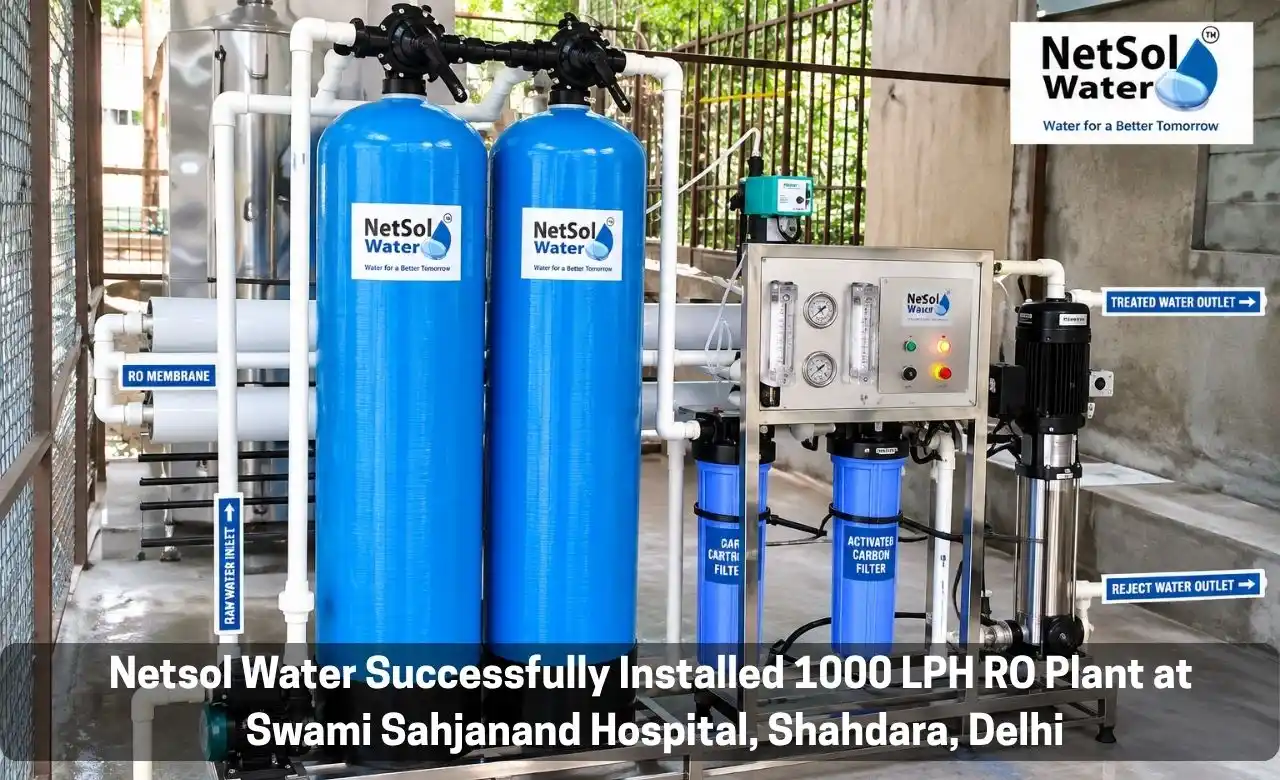
Case Study: 1000 LPH RO Plant Installed at Swami Sahjanand Hospital, Delhi
Netsol Water recently completed the installation of a 1000 LPH RO Plant at Swami Sahjanand Hospital, located in Shahdara, Delhi. The hospital needed a dependable treated water system to meet the daily requirements of patients undergoing treatment, along with the family members, attendants, and visitors who spend long hours, and sometimes several days, on the premises supporting them. In a healthcare setting, consistent access to treated water is a practical necessity rather than an optional facility upgrade, since patients and their attendants are present around the clock. Netsol Water was engaged to design, supply, and install the RO Plant, tailoring the system to the hospital's specific site conditions and operational requirements. The 1000 LPH RO Plant now functions as a centralized treated water source for the hospital, supporting the everyday needs of patients and the people who accompany them through their treatment. This case study walks through the requirement behind the project, why this particular capacity was chosen, how the system was installed, and what it means for the people who use the hospital every day.
Project at a Glance
| Project Name | 1000 LPH RO Plant Installation at Swami Sahjanand Hospital |
| Location | Shahdara, Delhi, India |
| RO Plant Capacity | 1000 LPH (1,000 Litres Per Hour) |
| Application | Hospital / Healthcare Water Treatment |
| Facility Type | Hospital |
| Primary Users / Beneficiaries | Patients, family members, attendants, and visitors |
| Installation Company | Netsol Water |
| Water Treatment Technology | Reverse Osmosis (RO) |
Water Treatment Requirement at Swami Sahjanand Hospital
A hospital operates differently from most other commercial or institutional spaces. Patients admitted for treatment, along with the family members and attendants who stay with them, rely on the facility for their basic daily needs, and drinking water is one of the most consistent requirements throughout the day. Unlike a typical office or retail space, a hospital sees continuous footfall across all hours, with attendants often present around the clock alongside admitted patients, and visitors moving in and out through the day.
A dedicated Hospital Water Treatment Plant, built around a reliable RO Water Treatment System, allows the facility to manage this variability by treating water on-site before it reaches patients, attendants, and staff.
Beyond patients themselves, hospital waiting areas and attendant zones see a steady presence of people who need access to drinking water while they wait, sometimes for extended periods. Support staff moving between departments have similar requirements. A facility that treats water only through scattered, informal means struggles to keep pace with this kind of continuous, distributed demand.
Swami Sahjanand Hospital required exactly this kind of solution: a dependable, appropriately sized system that could support daily treated-water requirements without depending on external or ad hoc water sources. An on-site RO system offered a more structured, sustainable way to ensure treated water stayed available whenever it was needed, for as long as it was needed, across the hospital premises.
Why 1000 LPH RO Plant Was Selected?
The term 1000 LPH refers to the plant's designed treatment capacity: the RO system is built to produce up to 1,000 litres of treated water per hour under specified operating conditions. Actual output over the course of a day depends on how many hours the plant runs and the specific conditions at site, so daily production figures can vary and should not be assumed as a fixed number.
For a facility like Swami Sahjanand Hospital, capacity selection is not a formality. A plant that is undersized cannot keep pace with continuous demand from patients and attendants, while an oversized system adds unnecessary cost and operational complexity without a corresponding benefit. A 1000 LPH RO Plant was selected to align with the hospital's expected usage pattern, taking into account the number of people typically present on the premises and the hours across which treated water is required through the day.
This capacity positions the plant as a Commercial RO Plant suited to institutional use, capable of supporting sustained treated-water demand rather than the intermittent, lower-volume use seen in residential settings. Demand at a hospital does not follow a simple nine-to-five pattern either, since attendants staying overnight and early morning ward activity both draw on the same treated-water source, which is part of why capacity planning has to account for usage spread across the full day rather than a narrow peak window. Matching plant capacity to actual site demand is one of the more important planning decisions in any hospital water treatment project, and it directly shaped the sizing decision made for this site.
1000 LPH RO Plant Installation at Swami Sahjanand Hospital
The installation of the RO plant at Swami Sahjanand Hospital followed a structured process, moving raw water through several treatment stages before it reaches the point of use across the hospital.
Raw water at the facility first passes through a pre-treatment stage, where suspended particles and larger impurities are addressed before the water reaches the reverse osmosis membranes. Pre-treatment is a standard part of any RO system, since it protects the membranes from fouling and helps maintain consistent performance over time. Following pre-treatment, the water is directed through the RO membrane system, where dissolved impurities are separated from the water stream at the membrane level, producing treated water suitable for the hospital's requirements.
Once treated, the water is collected and made available for distribution across the hospital, supporting the requirement for a centralized, on-site source rather than relying on multiple smaller or informal arrangements. This point of collection and distribution is where the plant's output actually reaches wards, waiting areas, and other points across the facility where patients and attendants need it. A project of this kind, an RO Plant Installation in Delhi carried out inside an operating healthcare facility, requires careful coordination with the site's existing infrastructure and available space, since a hospital cannot accommodate lengthy shutdowns or disruptions to its water supply during installation work.
Netsol Water's team worked through the site-specific requirements for this 1000 LPH RO Plant in Shahdara, planning the treatment sequence, equipment positioning, and connection points around the hospital's layout and day-to-day operational constraints. Coordination with hospital staff during the installation window was an important part of this process, since work had to proceed without interrupting patient care or existing water supply to occupied wards. Because exact component specifications for this project, such as membrane configuration, pump ratings, or storage tank capacity, have not been documented here, this section describes the treatment journey at a general level: raw water intake, pre-treatment, RO membrane treatment, and treated water collection for distribution. This sequence reflects the standard approach for a hospital RO installation of this nature, adapted to the specific conditions found at Swami Sahjanand Hospital.
How the RO Plant Supports Patients and Their Attendants?
Water access matters differently in a hospital compared to most other buildings. Patients undergoing treatment, and the family members or attendants who stay with them through long hospital stays, need reliable access to drinking water throughout the day, often without much notice of when that need will arise. A Hospital RO Plant addresses this by creating a single, centralized source of treated water that the facility can draw from consistently, rather than managing water needs through scattered or temporary arrangements.
For attendants and visitors who may spend many hours, or even days, at the hospital supporting a patient, having treated water readily available on the premises removes one more source of inconvenience during an already difficult and stressful time. The plant is not positioned as a medical intervention, but as a practical infrastructure improvement: a way to make sure treated water is accessible to everyone who needs it at the facility, whether they are an admitted patient, a family member waiting nearby, or hospital staff moving between wards.
A dependable on-site source also reduces the facility's reliance on external, packaged water arrangements to fill gaps in supply, giving the hospital more direct control over its own treated-water availability instead of managing it through ad hoc purchases.
By supporting both patients and the people who accompany them, this RO Plant for Hospital use case reflects a broader reality of healthcare facilities: patients are rarely alone, and the people around them have the same basic water requirements throughout their time at the hospital.
Key Features of the 1000 LPH RO Plant
As a 1000 LPH RO Plant in Delhi built for hospital use, the system at Swami Sahjanand Hospital is defined by a set of practical, confirmed characteristics rather than a long list of unverified specifications.
. 1000 LPH treatment capacity, designed for institutional use
. RO-based (Reverse Osmosis) water treatment technology
. Purpose-built for a hospital application
. Suited to regular, ongoing treated-water requirements
. Functions as a centralized water treatment solution for the facility
. Installed as a project-specific system tailored to site conditions
. Supports consistent treated-water availability for patients and attendants
Project Video: 1000 LPH RO Plant Installation
To provide a clearer view of the installation, Netsol Water has documented the 1000 LPH RO Plant Installation at Swami Sahjanand Hospital, Shahdara, Delhi, in a short project video. The video offers a visual walkthrough of the plant setup at the hospital site, giving viewers a practical sense of how the system fits into the facility's existing space and daily operations. For anyone evaluating a similar hospital water treatment project, this kind of on-site documentation can be useful in understanding what an actual installation looks like beyond written specifications and drawings.
Watch the project video:
Project Outcome
With the 1000 LPH RO Plant now installed, Swami Sahjanand Hospital has a dedicated, on-site treated-water system in place. This strengthens the hospital's overall water infrastructure by reducing dependence on ad hoc water arrangements and giving the facility a consistent, centralized source of treated water for daily use.
The installation supports the hospital's ability to serve patients and their attendants with treated water available on the premises throughout the day, regardless of how long a particular family may need to stay at the facility. It also contributes to more organized water management at the hospital overall, since the treatment process is now handled through a single, purpose-built system rather than fragmented or informal sources.
The project also adds a defined water-treatment asset to the hospital's broader facility management, one that administrators can plan maintenance and monitoring around, rather than treating water supply as a background concern handled informally. At this stage, no independent water-quality test results, usage statistics, or cost figures have been documented for this specific project, so this outcome section focuses on what has been confirmed: a Swami Sahjanand Hospital RO Plant is now operational, providing the facility with the treated-water infrastructure it required. As with any water treatment system, ongoing maintenance and monitoring will remain necessary to sustain performance over the plant's operating life.
Why Netsol Water for Hospital RO Plant Installation?
Netsol Water works on water and wastewater treatment projects across commercial, institutional, and industrial settings, including hospitals, hotels, and manufacturing facilities across the Delhi-NCR region and beyond. As a RO Plant Manufacturer in Delhi, the company handles projects from initial site assessment through installation and commissioning, adjusting each system to the specific requirements of the facility rather than applying a fixed template regardless of site conditions.
For a project like the one at Swami Sahjanand Hospital, this meant working within the constraints of an operating healthcare facility, where installation needs to be planned carefully around ongoing hospital activity and patient care. As a RO Plant Supplier in Delhi, Netsol Water brings experience across multiple hospital and institutional water treatment projects, which informs how systems are sized, sequenced, and installed at each new site. That experience carries over into how capacity questions are approached at similar facilities, where usage patterns from patients, attendants, and staff all need to be weighed together before a plant size is finalised. The focus throughout remains on delivering a system that matches the facility's actual water requirements, rather than an oversized or undersized installation that adds cost without a matching benefit.
Frequently Asked Questions (FAQs)
Q1. What is the capacity of the RO plant installed at Swami Sahjanand Hospital?
The RO plant installed at Swami Sahjanand Hospital, Shahdara, Delhi, has a treatment capacity of 1000 LPH (1,000 litres per hour). This capacity was selected to support the hospital's ongoing treated-water requirements for patients and their attendants.
Q2. What does 1000 LPH mean in an RO plant?
1000 LPH means the RO plant is designed to produce up to 1,000 litres of treated water per hour under specified operating conditions. Actual daily output depends on the number of operating hours and site-specific conditions.
Q3. Where was the 1000 LPH RO plant installed?
The 1000 LPH RO Plant was installed at Swami Sahjanand Hospital in Shahdara, Delhi, India. The system was installed by Netsol Water as part of a hospital water treatment project.
Q4. Who will use the treated water from the RO plant?
The treated water is intended for patients admitted at the hospital, along with their family members, attendants, and other visitors who spend time at the facility during treatment periods.
Q5. Why is an RO plant useful for a hospital?
A hospital sees continuous footfall from patients and attendants throughout the day, creating steady demand for treated water. An RO plant provides a centralized, on-site treatment system to help meet this ongoing requirement reliably.
Q6. How much water can a 1000 LPH RO plant produce?
A 1000 LPH RO plant can produce up to 1,000 litres of treated water per hour under specified operating conditions. Total output over a day depends on actual running hours and site conditions, so it should not be assumed as a fixed daily figure.
Q7. Who installed the RO plant at Swami Sahjanand Hospital?
The 1000 LPH RO Plant at Swami Sahjanand Hospital was installed by Netsol Water, which handled the site assessment, system planning, and installation for this hospital water treatment project.