

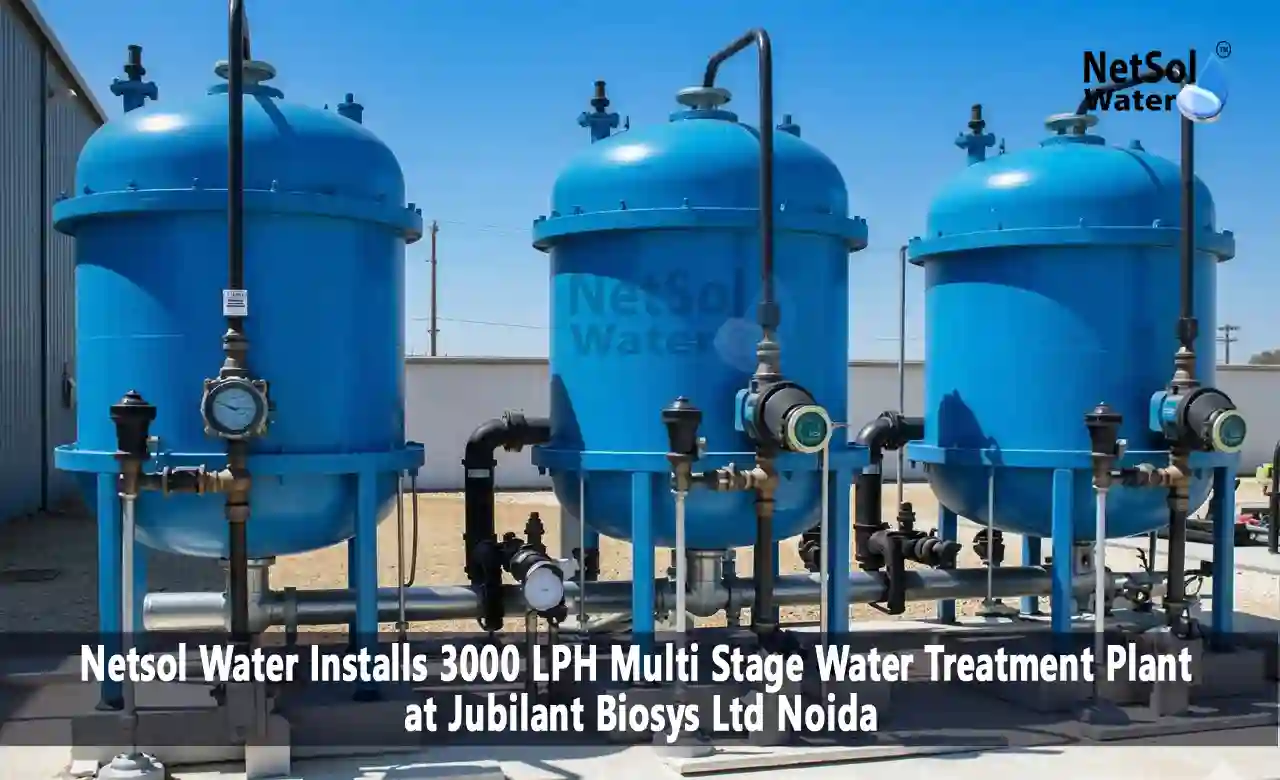
Case Study: 3000 LPH WTP Installation at Jubilant Biosys Noida
Netsol Water , a leading provider of water and wastewater treatment plant in India, successfully designed, engineered, and commissioned a state-of-the-art Multi-Stage Water Treatment Plant (WTP) with a capacity of 3,000 Litres Per Hour (LPH) at the premises of Jubilant Biosys Ltd., Sector-59, Noida.
The project presented a challenging raw water scenario - groundwater with an exceptionally high Total Dissolved Solids (TDS) level of 5,500 mg/L - far exceeding acceptable limits for industrial, laboratory, and pharmaceutical applications. Jubilant Biosys required three distinct grades of treated water to support its diverse operational needs, ranging from general utility to zero-TDS ultra-pure water.
Netsol Water engineered a comprehensive, multi-stage treatment train comprising an Activated Carbon Filter (ACF), Pressure Sand Filter (PSF), Water Softener, RO Plant, De-Mineralisation (DM) Plant and a Mixed Bed (MB) Polishing Unit - delivering soft water, RO-grade water, and ultra-pure zero-TDS water from a single integrated system.
| Parameter | Detail | Parameter | Detail |
|---|---|---|---|
| Client | Jubilant Biosys Ltd. | System Capacity | 3,000 LPH |
| Location | Sector-59, Noida | Raw Water TDS | 5,500 mg/L |
| Water Source | Groundwater (Borewell) | Final Product TDS | 0 mg/L (MB Outlet) |
| Treatment Stages | 6 Stages | Water Grades Produced | 3 (Soft / RO / Ultra-Pure) |
Client Profile
About Jubilant Biosys Ltd.
Jubilant Biosys Ltd. is a part of the globally recognized Jubilant Pharmova Group and is a premier Contract Research Organization (CRO) engaged in integrated drug discovery and development services. The company operates state-of-the-art research facilities at Sector-59, Noida, Uttar Pradesh, catering to leading global pharmaceutical and biotechnology companies.
With a commitment to quality, precision, and regulatory compliance (GLP/GMP standards), Jubilant Biosys relies on high-grade process water at multiple purity levels across its laboratory, synthesis, and utility operations. The requirement for pure and ultra-pure water is critical to ensuring reproducibility, accuracy, and compliance in all research activities.
Water Requirements
The client specified three distinct grades of treated water to be produced simultaneously from the same raw groundwater source, catering to different end-use points across the facility:
| # | Water Grade | TDS Target | Hardness | Primary Application |
|---|---|---|---|---|
| 1 | Soft Water | Hardness < 5 ppm | Negligible | Cooling towers, boilers, utilities |
| 2 | RO Water | ~100 mg/L | Very Low | General lab, process water |
| 3 | Ultra-Pure (Zero TDS) | 0 mg/L | Zero | R&D, HPLC, analytical instruments |
Raw Water Analysis
The raw water source at the Jubilant Biosys facility is a borewell tapping into the deep groundwater aquifer at Sector-59, Noida. Groundwater in this region is characterised by high mineral content, elevated hardness, and significantly elevated TDS - primarily due to dissolved calcium, magnesium, chlorides, sulphates, and sodium salts present in the aquifer geology.
Pre-project water analysis was conducted by the Netsol Water technical team to characterise the feed water quality and design the appropriate treatment train. Key parameters of the raw groundwater are tabulated below:
| S.No. | Parameter | Raw Water Value | Permissible Limit (IS) |
|---|---|---|---|
| 1 | Total Dissolved Solids (TDS) | 5,500 mg/L | 500 mg/L |
| 2 | Total Hardness (as CaCO) | ~1,800 mg/L | 300 mg/L |
| 3 | pH | 7.2 – 7.6 | 6.5 – 8.5 |
| 4 | Turbidity | 5 – 15 NTU | 1 NTU |
| 5 | Total Suspended Solids (TSS) | 15 – 30 mg/L | < 5 mg/L |
| 6 | Iron (Fe) | 0.5 – 1.2 mg/L | 0.3 mg/L |
| 7 | Chlorides | ~900 mg/L | 250 mg/L |
| 8 | Sulphates | ~600 mg/L | 200 mg/L |
| 9 | Electrical Conductivity (EC) | ~8,500 µS/cm | < 750 µS/cm |
| 10 | Colour | Faint yellowish | 5 Hazen units |
Note: The raw TDS of 5,500 mg/L is approximately 11× the permissible drinking water limit and presents significant challenges including severe scaling, membrane fouling, and ion exchange resin exhaustion. This necessitated a robust multi-stage treatment approach.
Treatment Objectives & Design Basis
Based on the client's water requirements and the raw water analysis, the following treatment objectives were established as the design basis for the WTP:
| # | Design Objective | Feed Condition | Treated Condition | Treatment Unit |
|---|---|---|---|---|
| 1 | Remove turbidity & suspended solids | 5–15 NTU / 30 mg/L TSS | < 1 NTU / < 2 mg/L TSS | PSF |
| 2 | Adsorb organic matter, chlorine & odour | Colour + organics | Clear & odourless | ACF |
| 3 | Remove hardness (Ca², Mg² ions) | ~1,800 mg/L hardness | < 5 ppm hardness | Water Softener |
| 4 | Reduce TDS to ~100 mg/L | 5,500 mg/L TDS | ~100 mg/L TDS | RO Plant |
| 5 | Remove ionic impurities to ~8–10 mg/L TDS | ~100 mg/L | TDS 8–10 mg/L | DM Plant |
| 6 | Polish to zero ionic content (TDS = 0) | 8–10 mg/L TDS | TDS = 0 mg/L | MB Plant |
Process Flow & Treatment Stages
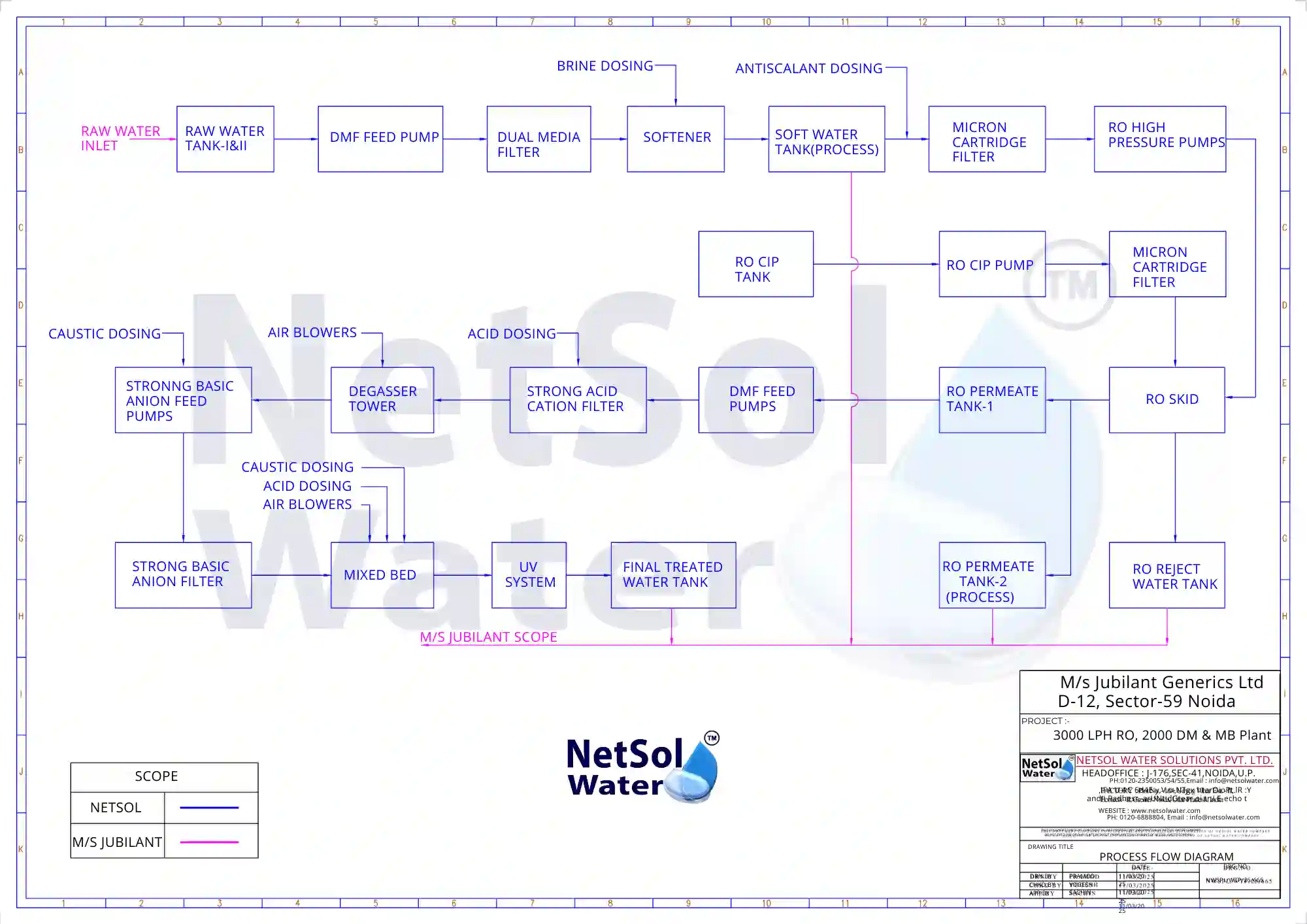
The complete water treatment system follows a carefully sequenced six-stage treatment train. Each stage is engineered to address a specific contaminant or water quality parameter, ensuring that feed quality requirements of downstream units are always met. The process flow is as follows:
PROCESS FLOW DIAGRAM
Stage 1: Activated Carbon Filter (ACF)
Function: The ACF unit is positioned as the first pre-treatment stage. Granular Activated Carbon (GAC) media adsorbs dissolved organic compounds, colour, odour, chlorine residuals, and certain hydrocarbons present in the groundwater. This step protects downstream membranes and resins from fouling due to organic contamination.
| Technical Parameter | Specification |
|---|---|
| Media | High-grade Granular Activated Carbon (Coconut Shell / Coal-based) |
| Vessel | MS Rubber Lined / FRP pressure vessel |
| Flow Direction | Downward (Service) / Upward (Backwash) |
| Service Flow Rate | 3,000 LPH (matched to system capacity) |
| Backwash Frequency | Every 48–72 hours or as per pressure differential indicator |
| Removal Efficiency | Organics, chlorine, odour, colour — >95% reduction |
| Outlet Quality | Clear water, free from organics / chlorine odour |
Stage 2: Pressure Sand Filter (PSF)
Function: The PSF removes residual suspended solids, turbidity, fine particles, and silt from the feed water. Multi-grade sand and gravel media provide depth filtration, achieving effluent clarity suitable for downstream membrane and resin treatment. This stage is critical given the elevated TSS in the groundwater source.
| Technical Parameter | Specification |
|---|---|
| Media | Multi-grade sand (coarse to fine) + support gravel layers |
| Vessel | MS Rubber Lined / FRP pressure vessel |
| Filtration Mechanism | Depth filtration — surface + depth capture of solids |
| Service Flow Rate | 3,000 LPH |
| Backwash & Rinse | Automatic timer-based or manual; < 15 minutes per cycle |
| Turbidity Removal | From 15 NTU (inlet) to < 1 NTU (outlet) |
| TSS Removal | From 30 mg/L to < 2 mg/L |
Stage 3: Water Softener - Product: SOFT WATER
Function: The Water Softener is a cation ion-exchange unit that removes hardness-causing calcium (Ca²?) and magnesium (Mg²?) ions from the pre-filtered water through a sodium-form strong acid cation (SAC) resin. Regeneration is performed using a brine (NaCl) solution. The softener produces the first grade of product water: Soft Water, with hardness < 5 ppm as CaCO?.
| Technical Parameter | Specification |
|---|---|
| Resin Type | Strong Acid Cation (SAC) exchange resin — Na form (e.g., Thermax / Purolite) |
| Inlet Hardness | ~1,800 mg/L as CaCO |
| Outlet Hardness | < 5 mg/L as CaCO (< 5 ppm) |
| Inlet TDS | ~5,500 mg/L |
| Outlet TDS (Soft Water) | ~5,300–5,400 mg/L (TDS not removed, only hardness ions exchanged) |
| Regenerant | 10% Sodium Chloride (NaCl) brine solution |
| Regeneration Cycle | Based on exhaustion / volume treated; typically every 8–12 hours at this TDS |
| Product (Grade 1) | SOFT WATER — dispatched to utility points (boilers, cooling towers, HVAC) |
Stage 4: RO Plant - Product: RO WATER (TDS ~100 mg/L)
Function: The Reverse Osmosis (RO) Plant is the primary desalination stage. High-pressure pump forces the softened feed water across semi-permeable TFC (Thin Film Composite) polyamide membranes, rejecting dissolved salts, micro-organisms, colloids, and residual organics. The RO system achieves a TDS reduction of approximately 98%, bringing TDS from ~5,300 mg/L down to ~100 mg/L. This constitutes the second grade of product water: RO Water.
| Technical Parameter | Specification |
|---|---|
| Membrane Type | TFC Polyamide Spiral Wound (4" / 8" elements — BW or SWRO series) |
| Membrane Configuration | 2:1 / 3:1 array (depending on final design recovery) |
| Operating Pressure | 10–18 bar (higher pressure applied due to high feed TDS) |
| System Recovery | ~60–65% (adjusted for high TDS feed to protect membranes) |
| Inlet TDS (from Softener) | ~5,300–5,400 mg/L |
| Permeate TDS | ~100 mg/L |
| Salt Rejection | > 98% |
| Reject / Brine Disposal | Reject stream routed to drain / reject management system |
| Antiscalant Dosing | Chemical dosing pump for antiscalant to prevent CaCO / CaSO scaling |
| Product (Grade 2) | RO WATER — dispatched to general lab, process rinse, and intermediate uses |
Stage 5: DM Plant - TDS 8–10 mg/L
Function: The De-Mineralisation (DM) Plant is a two-bed ion exchange system employing a Strong Acid Cation (SAC) unit followed by a Strong Base Anion (SBA) unit. The SAC unit exchanges all cations (Na, Ca², Mg², K, Fe²) for H ions, while the SBA unit exchanges all anions (Cl, SO², HCO, NO) for OH ions. The resulting H and OH recombine to form pure water, reducing TDS to 8–10 mg/L.
| Technical Parameter | Specification |
|---|---|
| Cation Resin (SAC) | Strong Acid Cation — H form (Thermax / Rohm & Haas / Dow) |
| Anion Resin (SBA) | Strong Base Anion — OH form, Type I or Type II |
| Regenerant — Cation | Hydrochloric Acid (HCl) — 5–8% solution |
| Regenerant — Anion | Sodium Hydroxide (NaOH) — 4–6% solution |
| Inlet TDS | ~100 mg/L (RO permeate) |
| Outlet TDS | 8–10 mg/L |
| Silica Removal | SBA Type I provides effective silica removal |
| Regeneration Trigger | Conductivity breakthrough monitoring (online conductivity meter) |
Stage 6: Mixed Bed (MB) Plant - TDS = 0 mg/L (Ultra-Pure Water)
Function: The Mixed Bed unit is the final polishing stage, combining SAC and SBA resins in a single vessel in an intimate mixed configuration. This arrangement provides multiple theoretical stages of de-ionisation, removing trace ions to achieve resistivity > 10 MΩ·cm (equivalent to TDS ≈ 0 mg/L). This constitutes the third and highest-purity grade of product water: Ultra-Pure / Zero-TDS Water.
| Technical Parameter | Specification |
|---|---|
| Resin Mix Ratio | Cation : Anion = 1 : 1.5 to 1 : 2 (volumetric) |
| Inlet TDS | 8–10 mg/L (DM Plant outlet) |
| Outlet TDS | 0 mg/L (< 0.1 mg/L) |
| Outlet Conductivity | < 0.1 µS/cm (Resistivity > 10 MΩ·cm) |
| Regeneration | Separate SAC/SBA vessels for external regeneration; mixed bed re-assembled after |
| Online Monitoring | Continuous conductivity / resistivity meter with high-conductivity alarm |
| Product (Grade 3) | ULTRA-PURE WATER — for HPLC, analytical instruments, R&D applications |
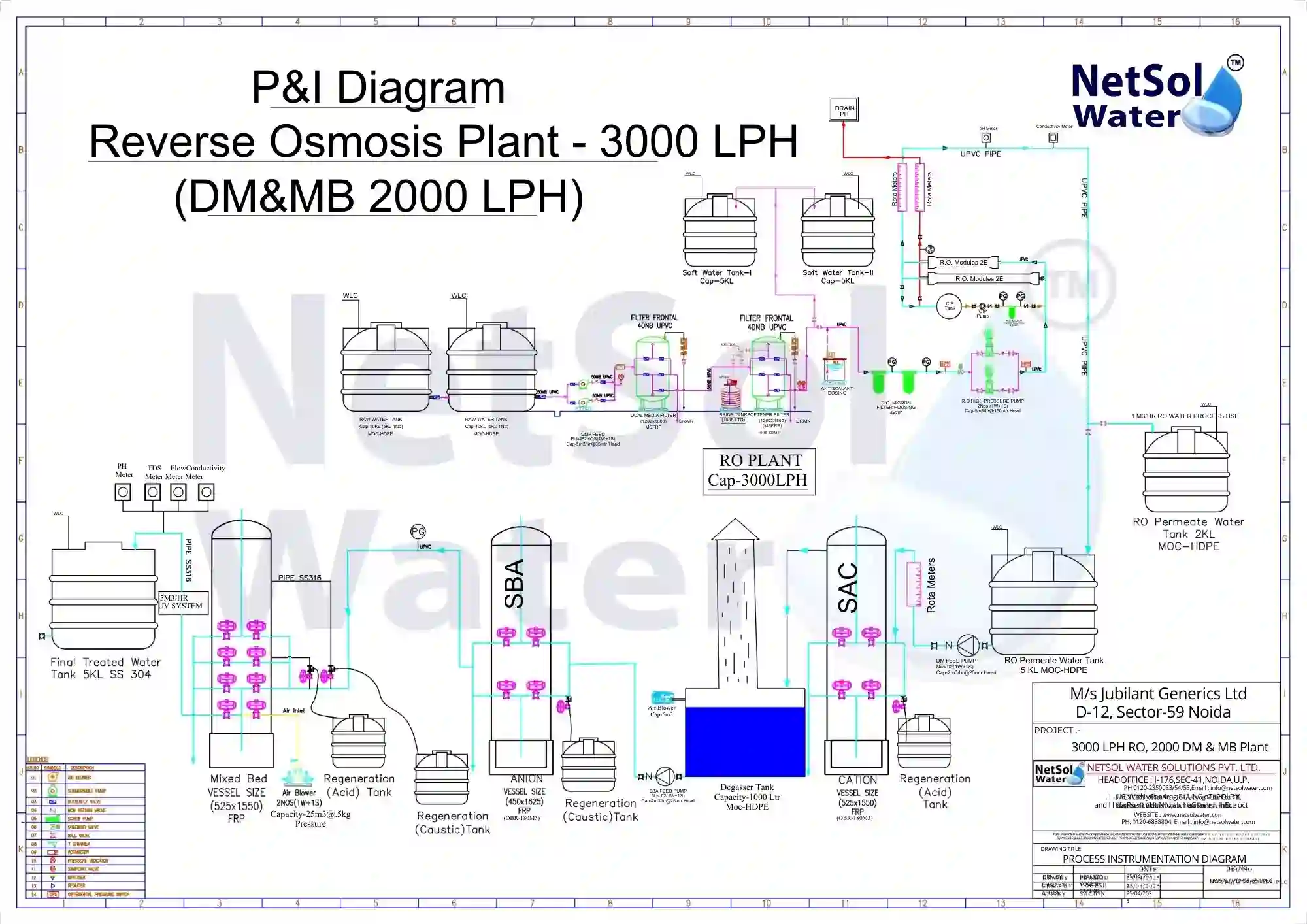
Process Instrumentation Diagram
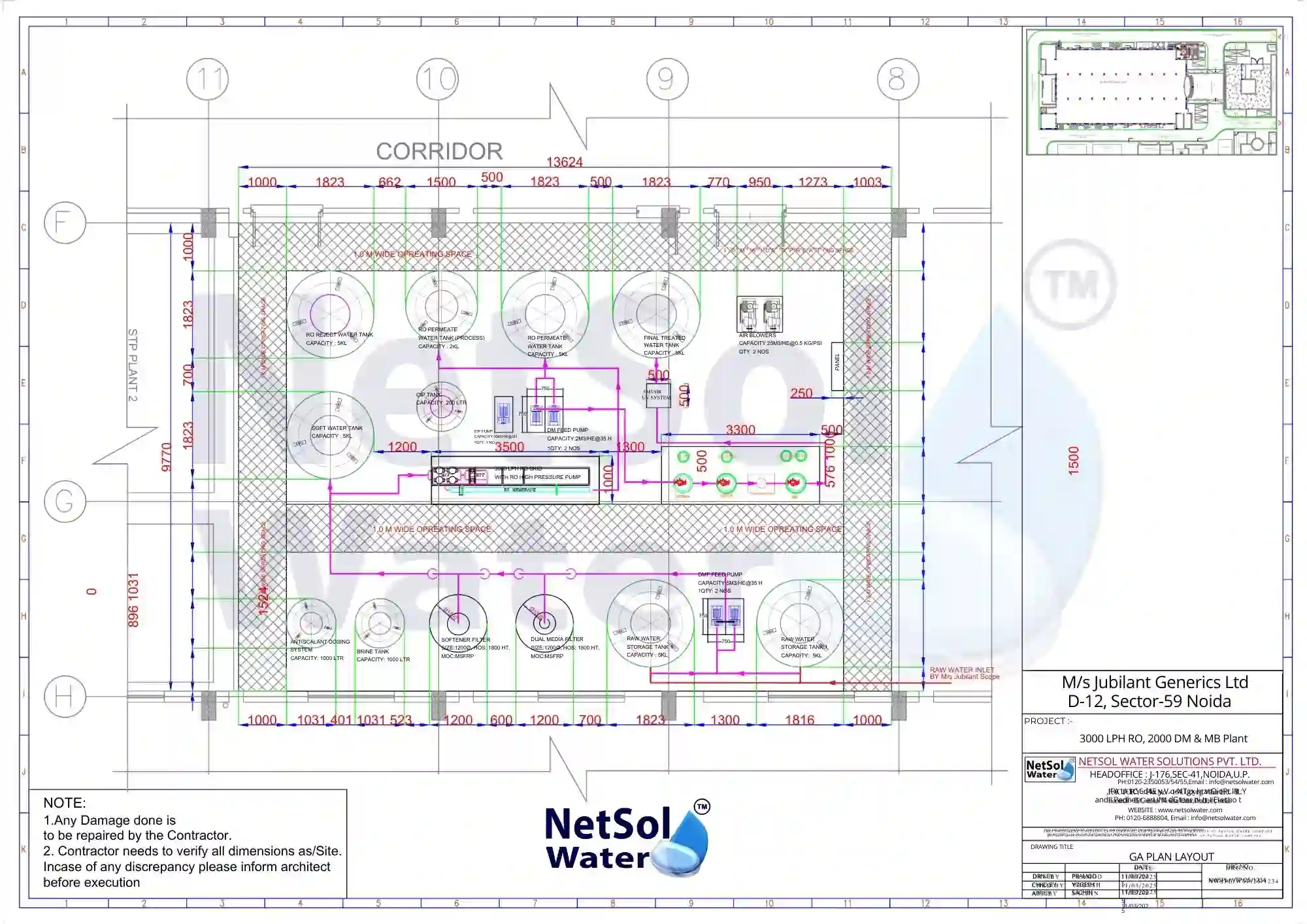
Plant Layout & Footprint
Water Quality Summary - Stage-wise TDS Profile
The table below summarises the TDS transformation across each treatment stage, demonstrating the progressive reduction from raw groundwater TDS of 5,500 mg/L to ultra-pure zero-TDS water:
| # | Treatment Unit | Function | Outlet TDS (mg/L) | Product Grade |
|---|---|---|---|---|
| 0 | Raw Groundwater | Untreated borewell water | 5,500 | — |
| 1 | ACF | Organic / chlorine / odour removal | ~5,500 (TDS unchanged) | Pre-treated |
| 2 | PSF | Turbidity / TSS removal | ~5,500 (TDS unchanged) | Pre-treated |
| 3 | Water Softener | Hardness removal (Ca² / Mg²) | ~5,350 (hardness removed) | SOFT WATER |
| 4 | RO Plant | Salt / TDS reduction (98% rejection) | ~100 | RO WATER |
| 5 | DM Plant | Full de-ionisation (cation + anion) | 8–10 | Polished Water |
| 6 | Mixed Bed Plant | Ultra-polishing to resistivity > 10 MΩ·cm | 0 (≈ 0) | ULTRA-PURE WATER |
Project Video Documentation
WTP Plant Site Video
An original site video of the commissioned 3,000 LPH Water Treatment Plant at Jubilant Biosys Ltd., Sector-59, Noida has been recorded and is attached with this case study. The video documents the complete installed system including:
• Overhead view of the complete WTP skid layout and equipment arrangement
• Activated Carbon Filter (ACF) and Pressure Sand Filter (PSF) vessels
• Water Softener unit with brine tank and regeneration panel
• High-pressure RO membrane array with pressure gauges and flow meters
• DM Plant - dual-vessel cation and anion exchange columns
• Mixed Bed polishing unit with online conductivity / TDS monitor
• Control panel, instrumentation, piping, and valves
• Live demonstration of each water grade outlet (Soft Water, RO Water, Zero TDS Water)
Key Project Highlights & Engineering Challenges
Engineering Challenges
The project presented several significant engineering challenges that required careful design consideration and tailored solutions:
• Extremely High Raw TDS (5,500 mg/L): The feed TDS of 5,500 mg/L is more than 10× the standard BW (Brackish Water) RO feed design basis, requiring SWRO-grade membranes or a two-pass RO configuration with antiscalant dosing to achieve target recovery without scaling.
• Severe Hardness Loading: Inlet hardness of ~1,800 mg/L as CaCO accelerates softener resin exhaustion, requiring high-capacity resin and optimised regeneration protocols.
• Multi-grade Water Delivery: Designing a single treatment train to simultaneously supply three distinct water grades (Soft, RO, Zero-TDS) required careful flow splitting and pressure management.
• Compact Footprint: The system was designed on a compact skid to fit within the available plant room footprint at the Sector-59 facility.
• Continuous Operation: The pharmaceutical research environment demanded uninterrupted water supply, necessitating standby provisions and automated regeneration sequences.
Netsol Water Solutions Provided
• Complete design, engineering, procurement, fabrication, installation, and commissioning (EPIC)
• High-recovery RO system with antiscalant and pH correction chemical dosing
• Automated softener and DM plant regeneration with brine & acid-alkali dosing systems
• Online instrumentation: TDS meters, conductivity meters, pressure gauges, flow meters at each stage
• Control panel with PLC-based automation for system monitoring and alarm management
• Post-commissioning testing, water quality certification, and operator training
• Annual Maintenance Contract (AMC) support
Commissioning Results & Performance Data
Post-commissioning performance tests were carried out by the Netsol Water technical team in the presence of the client's quality assurance team. The system met all specified design targets. Key commissioning results are summarised below:
| Parameter | Design Target | Achieved Value | Status |
|---|---|---|---|
| Overall Plant Capacity | 3,000 LPH | 3,050 LPH | ACHIEVED |
| Soft Water Hardness | < 5 mg/L as CaCO | < 2 mg/L | EXCEEDED TARGET |
| RO Permeate TDS | ~100 mg/L | 85–95 mg/L | ACHIEVED |
| RO Salt Rejection | > 98% | 98.3% | ACHIEVED |
| DM Plant Outlet TDS | 8–10 mg/L | 6–9 mg/L | ACHIEVED |
| MB Plant Outlet TDS | 0 mg/L | < 0.05 mg/L | ACHIEVED |
| MB Outlet Resistivity | > 10 MΩ·cm | 12–15 MΩ·cm | EXCEEDED TARGET |
| PSF Outlet Turbidity | < 1 NTU | < 0.5 NTU | EXCEEDED TARGET |
| System Uptime (First 30 days) | > 95% | 98.2% | ACHIEVED |
About Netsol Water
Netsol Water is a professionally managed water and wastewater treatment company with over a decade of expertise in delivering end-to-end water treatment solutions across industrial, commercial, pharmaceutical, institutional, and municipal sectors across India.
Headquartered in Noida, Uttar Pradesh, Netsol Water provides turnkey solutions encompassing system design, equipment manufacturing, installation, commissioning, and after-sales maintenance. Our engineering team specialises in groundwater treatment, RO systems, DM plants, effluent treatment plants (ETP), sewage treatment plants (STP), and zero liquid discharge (ZLD) systems.
Core Capabilities
• Water Treatment Plants (WTP) - from 100 LPH to 5,00,000 LPH
• Reverse Osmosis (RO) Systems - Brackish Water & Sea Water
• Effluent Treatment Plants (ETP) & Sewage Treatment Plants (STP)
• De-Mineralised (DM) Water Plants & Mixed Bed Ultra-Pure Water Systems
• Zero Liquid Discharge (ZLD) Systems
• Packaged Drinking Water Plants
• Iron Removal, Arsenic Removal & Fluoride Removal Systems
For project enquiries, technical consultations, and after-sales support:
Website: www.netsolwater.com
Email: info@netsolwater.com
Phone: +91-9650608473
Address: Noida, Uttar Pradesh, India