
Case Study: 6000 LPH SS RO Plant for Beverage Industry, Aligarh, UP
Ask any beverage manufacturer what their biggest raw material is and they'll say water. But ask them when they last seriously invested in their water treatment setup and the conversation gets awkward pretty quickly.
The uncomfortable truth is that most medium-scale beverage units in India are running water treatment infrastructure that was installed once, barely maintained, and quietly ignored until something goes wrong. A batch failure. A lab report that throws up coliform. An FSSAI audit that gets a little too close for comfort.
That's exactly where Milkco Beverages found themselves in 2024.
A growing dairy-beverage and packaged drinks manufacturer operating out of Aligarh, Uttar Pradesh, the company had good products, a strengthening distribution network, and genuine ambition to scale. What they also had was borewell water consistently testing at 800 to 1,200 ppm TDS, intermittent microbial contamination flags, and a filtration system that was never designed to handle production at their current volumes, let alone where they wanted to go.
Something had to change.
They called NetSol Water a trusted RO plant manufacturer for the beverages industry with a strong project track record across northern India. And over the next several weeks, NetSol designed, manufactured, and commissioned a fully customised 6,000 LPH stainless steel Reverse Osmosis plant that addressed every single issue not just the most obvious ones. This case study covers the full picture: what the problems actually were, what was installed and why, and what Milkco's operation looks like today because of it.
About Milkco Beverages, Aligarh
Aligarh tends to get described in terms of its famous lock industry or its university. Fair enough. But the city and the western UP belt around it has quietly developed into a solid base for food and beverage manufacturing over the last decade. Good connectivity, proximity to agricultural supply chains, and a large local consumer base have made it attractive for entrepreneurs in the packaged food and drinks space.
Milkco Beverages is one of those companies. Started by a founder with roots in the dairy supply business, the brand expanded into packaged beverages to capture the increasing demand for branded drinks in smaller Indian cities. By 2024, they were producing dairy-based beverages, fruit drinks, and packaged water each of which comes with its own set of water quality demands. Dairy products are particularly unforgiving when it comes to mineral content. Packaged water has BIS standards to meet. Flavoured drinks need consistent taste across batches, which you simply cannot achieve with variable source water.
The company was growing, but their water treatment setup hadn't grown with them. That gap was becoming impossible to manage around.
Challenges Faced by Milkco Beverages
These weren't isolated incidents or bad luck. Each of the issues below was structural baked into how the facility was set up and what the local water source looked like.
1. Very High TDS in Borewell Water
Aligarh's groundwater is mineral-heavy. Milkco's borewell was consistently pulling water with TDS between 800 and 1,200 ppm, depending on the season. For drinking water under BIS IS 14543, the permissible TDS limit is 500 ppm and ideally below 200 ppm for packaged water. For dairy-based drinks, the acceptable range is even tighter because high mineral content disrupts protein interactions and affects taste.
At 1,000 ppm, they weren't just failing quality checks they were also accelerating scaling inside their processing equipment. Calcium and magnesium deposits were building up inside heat exchangers and pipeline fittings faster than maintenance could manage.
2. Water Quality Changed with Every Season
If the high TDS was the chronic problem, the seasonal variation was the acute one. Every summer, as the water table dropped, mineral concentrations spiked. Every monsoon, turbidity increased and biological contamination risk went up. The older filtration system had no way to compensate for this variability — it was essentially a fixed-parameter setup that worked reasonably well on a good day and failed on a bad one.
Batch failures were clustering around May–June and August. The team knew the pattern but had no solution to break it.
3. Risk of Microbial Contamination
This is the one that creates real anxiety in any food operation. Coliform bacteria appearing in processed water — even intermittently — is a FSSAI red line. It's not something you can explain away or manage through better sampling. You have to fix the source.
The existing system had no dedicated microbial kill step. There was no UV sterilisation, no robust post-treatment stage. The team was managing the risk through sampling and batch-holds, which is not a solution — it's a sticking plaster over a structural gap.
4. Existing Plant Could Not Meet Production Demand
As Milkco scaled, their treated water output had become the production bottleneck. The old unit was sized for earlier, lower volumes. Running at full capacity meant the treated water reserve tank would deplete mid-shift. Rather than halt a production line, operators were sometimes using partially treated or untreated water in secondary processing steps — which is exactly the kind of shortcut that creates compliance problems downstream.
5. Trouble Passing Quality and Compliance Audits
Institutional buyers — distributors with their own quality programmes, and a couple of larger retail chains who had shown interest — were conducting facility audits. Water treatment was an obvious area of scrutiny. Milkco's setup wasn't failing outright, but it wasn't giving auditors confidence either. Without documented, verifiable water quality data from a properly specified system, these conversations were becoming a bottleneck to commercial growth, not just a compliance box to tick.
Solution Provided by NetSol Water
Before NetSol proposed anything, their engineers did a proper site assessment. Water quality samples were tested. Production flow data was reviewed. Available floor space was mapped. And the client's growth projections were factored into the capacity calculation.
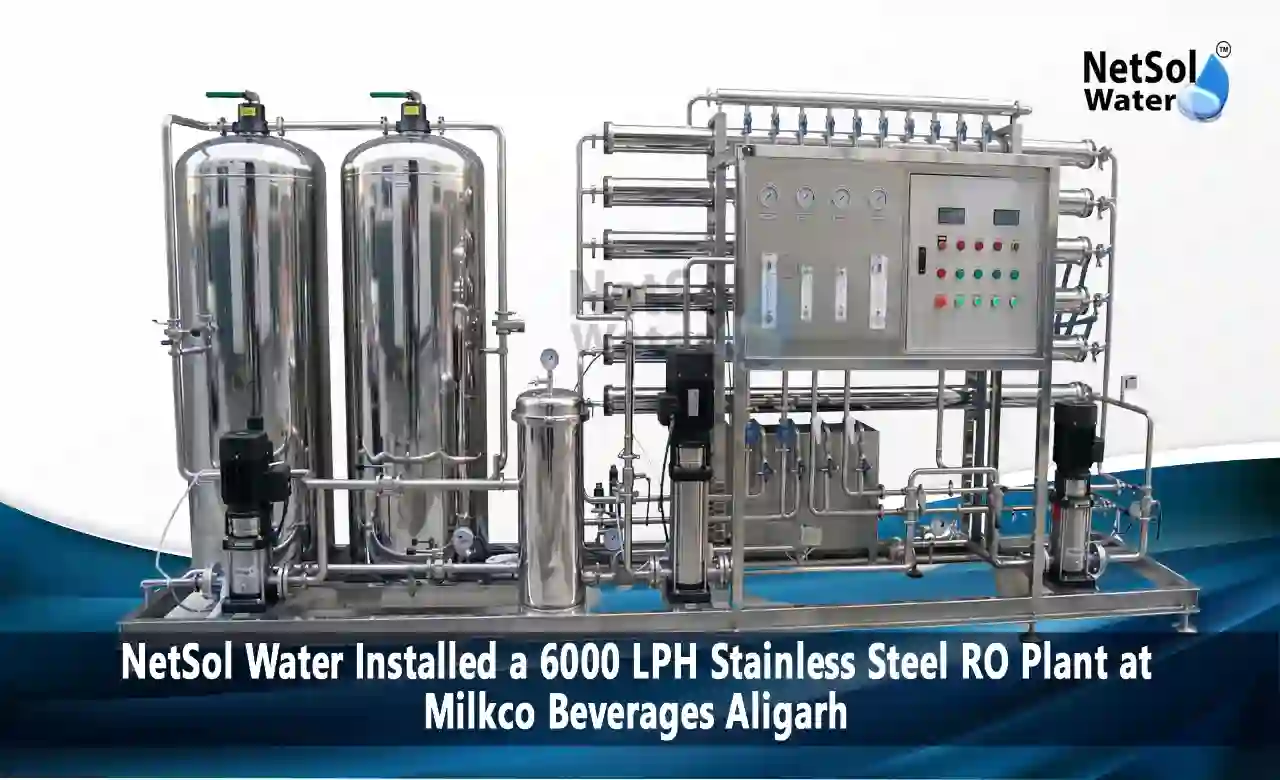
The output was a 6,000 LPH industrial RO plant custom-built in food-grade stainless steel, with a full pre-treatment train, high-rejection membranes, UV post-treatment, and a PLC-automated control system. Not a catalogue item with the client's name on it. An actual engineered solution. That difference matters more than most buyers realise, and it's what separates a genuine RO plant manufacturer for the beverages industry from a generic equipment reseller.
The 6,000 LPH figure deserves a moment. Milkco's current production needed roughly 4,200 LPH of treated water on a full-shift run. Sizing the plant at 6,000 LPH gave them a comfortable operating buffer and room to scale production by approximately 40% without needing a new system. That's important in any capital investment you shouldn't have to replace the infrastructure again in two years.
The stainless steel specification was non-negotiable for a food and beverage application. Mild steel frames corrode and leach. FRP is fine for some industrial settings but not ideal in an environment with regular cleaning and sanitisation cycles. SS 304 / SS 316 is the correct material for this context it's what any FSSAI-serious manufacturer should expect.
How the RO Plant Works?
Reverse Osmosis isn't complicated in concept, but the performance difference between a well-designed system and a poorly designed one is enormous. The quality of the pre-treatment determines how long the membranes last. The recovery rate determines how much water you're actually wasting. The post-treatment determines whether you're genuinely safe from microbial risk or just mostly safe.
Here's how the Milkco system was put together:
1 - Pre-Treatment of Source Water
Raw borewell water enters a multi-grade sand filter first. This knocks out suspended particles, silt, and turbidity — the physical contaminants that would otherwise foul the membranes within weeks. It flows next through an activated carbon filter, which removes chlorine, organic compounds, and anything causing taste or odour problems. The final pre-treatment step is antiscalant chemical dosing — a chemical feed system that prevents calcium carbonate and magnesium sulphate from crystallising on the membrane surface. Given Aligarh's mineral-heavy groundwater, this step isn't optional. Without it, the membranes would scale up within months and rejection efficiency would drop off significantly.
2 - RO Membrane Filtration
Pre-treated water is pressurised by a high-efficiency stainless-fitted pump and pushed through banks of TFC (Thin Film Composite) polyamide membranes. These are high-rejection membranes — rated to remove 95–99% of dissolved solids, heavy metals, nitrates, fluorides, and most biological content. At 6,000 LPH, the system is producing treated water continuously across two output streams: the purified permeate going to the production process, and the concentrate (reject water) being managed for appropriate disposal or recovery.
The membranes are housed in stainless steel pressure vessels. Membrane replacement schedules are built into the maintenance programme and flagged by the control system when pressure differentials indicate it's time.
3 - UV Sterilisation and Final Polishing
After the RO stage, the water passes through a UV sterilisation unit. This is where any residual biological content — bacteria, viruses, anything that made it through the membranes — gets neutralised. UV is effective, chemical-free, and easy to monitor. Following the UV unit, a 1-micron polishing cartridge filter catches any final particulates before the water reaches the production inlet. It's a belt-and-braces setup, and that's the right call for a food operation.
4 - Automated Monitoring and Control
The whole system is controlled through a PLC with an HMI touchscreen panel. Operators see live readings — feed pressure, permeate TDS, recovery rate, UV lamp status, membrane differential pressure. If any parameter moves outside the set range, the system auto-shuts and flags the alert. This means water quality is monitored continuously, not just when someone remembers to check. It also means Milkco's QC records now include automated water quality logs — which is exactly the kind of documentation that makes auditors happy.
NetSol Water – 6000 LPH Stainless Steel RO Plant at Milkco Beverages, Aligarh
Plant Specifications at a Glance
Here's the complete technical specification for the system installed at Milkco Beverages:
| Feature | Specification |
|---|---|
| Plant Capacity | 6,000 LPH (Litres Per Hour) |
| Plant Type | Industrial Reverse Osmosis (RO) System |
| Material | Food-Grade SS 304 / SS 316 Stainless Steel |
| Membrane Technology | High-rejection TFC polyamide membranes |
| Pre-Treatment | Multi-layer sand filtration + activated carbon + antiscalant dosing |
| Pressure Vessels | High-pressure rated FRP/SS vessels |
| Control Panel | Fully automated PLC/HMI control system with auto-shutdown |
| Post-Treatment | UV sterilisation + 1-micron polishing filter |
| Water Recovery Rate | Up to 75% |
| TDS Reduction | 95%–99% |
| Compliance Standards | BIS, CE, ISO-compliant design |
One thing worth pointing out directly: the stainless steel specification applies throughout — not just the frame. The pressure vessels, the pump housing, the process pipework in contact with treated water — all SS. This matters for FSSAI compliance and for the long-term hygiene integrity of the system. Cheaper systems cut corners here. This one didn't.
Results and Benefits After Installation
The system was commissioned on schedule. Within the first month of operation, the data told a clear story.
| Metric | Before Installation | After Installation |
|---|---|---|
| Water TDS Level | 800–1,200 ppm | Below 50 ppm |
| Microbial Contamination | Intermittently present | Undetectable post-UV |
| Water Rejection Loss | ~40% | Below 25% |
| Production Downtime (water-related) | Frequent | Near-zero |
| BIS / FSSAI Compliance | Partial | Full — audit passed |
| Product Output Quality | Inconsistent, batch failures | Consistently Grade A |
Other Improvements on the Production Floor
Quantitative results matter, but they don't always capture what it actually feels like inside a production facility after a problem gets properly fixed.
The production team at Milkco noticed the taste improvement in their dairy beverages before the lab even confirmed the TDS numbers. When mineral content dropped from 1,000+ ppm to below 50 ppm, the flavour profile of the milk-based drinks became noticeably cleaner and more consistent. That's the kind of thing that shows up in customer feedback — and it did.
Quality control rejections dropped sharply in the first month. The team had been used to a steady stream of rework from water-related batch failures. After commissioning, that largely stopped.
The facility's next audit — which had been a source of real concern — went cleanly. No water quality non-conformances. The auditor reviewed the automated logs, checked the UV and TDS readings, and that was it. No drama.
And perhaps most importantly for the production floor: the shift from manually checking water quality multiple times per shift to reviewing a single daily automated log freed up meaningful operator time. Small thing in isolation. Large thing across twelve months.
Rajesh Kumar, Production Manager at Milkco Beverages, described it this way: "We were spending more energy managing water problems than running our actual business. Now that pressure is completely gone. We just run the plant."
Why Milkco Beverages Chose NetSol Water?
India has plenty of RO system vendors. The market ranges from roadside filter shops selling domestic units to large industrial suppliers. So why NetSol Water, and why did the choice matter?
1: Experience in the Food and Beverage Industry
This sounds obvious but it isn't. A vendor who primarily works with textile mills or pharmaceutical facilities will bring assumptions about water requirements that don't apply to food and beverage. Different standards, different materials specifications, different compliance frameworks. As a dedicated RO plant manufacturer for the beverages industry, NetSol Water has worked specifically and extensively in the food and beverage sector across northern India. Their engineers understood Milkco's production context from the first site visit. They weren't learning it — they already knew it.
2: Custom Design for Every Project
The 6,000 LPH capacity, the antiscalant dosing for Aligarh's specific mineral profile, the UV sterilisation addition, the stainless steel spec throughout — these weren't upsells. Each was justified by what the water quality data and production requirements actually showed. Milkco wasn't sold a product off a shelf. They got an engineered solution. There's a real difference in long-term performance and reliability between those two things.
3: Complete Project Management Under One Roof
From water quality testing through design, manufacturing, installation, commissioning, and operator training — NetSol handled all of it. Milkco didn't have to manage relationships between a manufacturer, a separate installer, and a commissioning team. When things needed resolving during installation, one call fixed it. That matters more than it sounds, especially for a management team that already had plenty to focus on with their commercial growth.
4: Quick Service and Local Support
For a plant in Aligarh, the practical question is: if something needs attention, how quickly can someone be there? NetSol Water's presence across Uttar Pradesh means the answer to that question is measured in hours, not days. For a production facility running food-grade operations, that's a meaningful consideration — not a nice-to-have.
5: Honest and Transparent Recommendations
A few clients have mentioned this independently, and it came up with Milkco too: NetSol's pre-project conversations were direct. The site assessment showed what the water needed. The recommendation was built around that, not around a margin target. If a solution needed to be more involved or more expensive than the client originally expected, that conversation happened honestly. That kind of straightforwardness tends to earn trust and it's what makes clients call the same vendor when the next project comes up.
Conclusion
If you're running a beverage manufacturing operation anywhere in India, Aligarh, Agra, Kanpur or anywhere else in UP, or frankly anywhere in the country — and your water treatment setup is more than a few years old, you already know the feeling this case study is describing. The nagging quality inconsistencies. The audit preparation anxiety. The production team doing workarounds that everyone knows aren't really solutions.
Milkco Beverages' situation wasn't unusual. The scale of the problem was manageable. It was fixable. What it needed was a vendor who would do a proper assessment, design something that actually matched the problem, and deliver it properly.
The 6,000 LPH stainless steel RO plant hasn't just fixed a water problem. It's removed a ceiling that was sitting on the company's growth. Production can scale without water quality acting as the constraint. Buyers can audit the facility without the water treatment setup being a weak point. And the production team can focus on actually making product rather than managing infrastructure they never had confidence in.
That's what a well-executed water treatment project is supposed to do.
If your facility is dealing with any of the challenges described above high TDS, compliance pressure, inconsistent quality, capacity limits — the right first step is a water quality assessment and a production audit. You need actual data, not generic sizing estimates. And you need an experienced RO plant manufacturer for the beverages industry who understands your sector from the inside, not one who'll treat your project as a variation on their standard industrial offering.
Talk to NetSol Water About Your Facility
NetSol Water designs and installs industrial RO systems specifically for the food and beverage sector across India.
Whether you're in Aligarh, across Uttar Pradesh, or anywhere else in the country — if your water treatment
setup needs upgrading, they'll give you an honest assessment before they give you a proposal.
Phone: +91-9650608473 | Email: enquiry@netsolwater.com
Frequently Asked Questions (FAQ)
Q1. What RO plant capacity is right for a beverage manufacturing unit?
Start with your daily treated water consumption across all production lines — not just your peak line, all of them combined, including CIP (clean-in-place) cycles, rinsing, and any buffer you need for storage. Add 30–40% headroom for growth and system recovery cycles. Most medium-scale beverage units making several thousand litres of finished product per shift need somewhere between 3,000 and 8,000 LPH of RO capacity. For Milkco in Aligarh, 6,000 LPH was the right number given their current operations and a realistic 18-month growth horizon. Get your actual water consumption data first — a vendor who quotes you a capacity without that data is guessing, and guessing wrong in either direction costs you money.
Q2. Why is stainless steel construction important in an RO plant for beverages?
For a food or beverage application, it's not optional — it's the baseline. Mild steel corrodes, especially with the water chemistry typical in UP groundwater, and corrosion products contaminate the treated water stream. FRP frames and housings are okay in some industrial contexts but they're not ideal in environments with regular sanitisation using acidic or alkaline cleaners. SS 304 is the standard; SS 316 is specified where chloride exposure is a concern. Any decent audit from a food safety perspective will flag non-food-grade materials in water treatment contact surfaces. If you're spending money on a system that will sit inside an FSSAI-regulated facility, stainless steel construction is not the place to economise.
Q3. How does an industrial RO plant help with FSSAI and BIS compliance?
Two ways. First, when you work with a qualified RO plant manufacturer for the beverages industry, the system is designed from the start to meet the right standards — BIS IS 14543 for packaged drinking water caps TDS at 500 ppm and has specific limits for heavy metals, nitrates, and biological content. An RO system with proper pre-treatment and UV post-treatment reliably hits those targets. Second, and this is the part that matters during audits, a properly automated system produces a documented, timestamped record of water quality parameters. When an inspector asks to see your water quality data, you don't have to dig through handwritten logs. You pull up the PLC records. That shift — from assumption to documented, verifiable compliance — is what actually protects you in a serious audit.
Q4. How long does it take to install a 6000 LPH RO plant?
For a 6,000 LPH system like this one, the full process — assessment, finalised design, manufacturing, delivery to site, installation, and commissioning — ran over approximately six weeks for Milkco. The actual on-site installation and commissioning was considerably shorter; most of the time is in the manufacturing and logistics phase. In most cases, the new system can be installed alongside or adjacent to the existing setup, so you're not pulling out your old infrastructure while the new one is being built. Actual production downtime during switchover is typically a matter of hours, not days, if the project is planned properly.
Q5. What is the return on investment (ROI) for an RO plant in a beverage unit?
The ROI drivers are different for every facility, but they generally fall into a few categories: reduced product rejection and rework (which is a direct cost saving), reduced cleaning and maintenance costs on process equipment because mineral scaling is eliminated, avoided non-compliance penalties or product recalls, and — the biggest one if it's relevant to you — the commercial opportunities you're currently losing because your facility can't pass a buyer audit. Milkco's most immediate gain was compliance credibility, which unblocked a couple of institutional buyer relationships they'd been working on. Hard to put a precise number on that, but it's real. Most operations in this category see operating cost recovery within 12–20 months. The equipment itself should run for ten-plus years with proper maintenance.
Q6. Can an RO plant handle seasonal changes in water quality?
Yes, and this is one of the reasons a well-designed pre-treatment stage matters so much. The antiscalant dosing system adjusts for changes in mineral loading. The multi-stage filtration handles turbidity spikes during monsoon. The membranes themselves provide a consistent rejection rate regardless of what's coming in, as long as the pre-treatment is doing its job. What you can't do is run a bare-bones RO system with minimal pre-treatment and expect it to cope with seasonal swings — the membranes will foul or scale faster than you can manage. That's a design question, not a technology limitation. Milkco's seasonal batch failures stopped after commissioning because the system was designed with Aligarh's specific groundwater variability in mind.
Q7. Does NetSol Water install RO plants outside Aligarh?
Yes. This case study is specifically about a project in Aligarh, but NetSol Water operates across India — Delhi NCR, Haryana, Rajasthan, Madhya Pradesh, and other states. The site assessment process is the same regardless of location, and the manufacturing and delivery pipeline is set up to handle projects across geographies with consistent quality. If you're a beverage manufacturer anywhere in India dealing with water quality or compliance challenges, the starting point is a conversation and a water quality test. That part doesn't cost anything and it gives you actual data to make decisions with.