

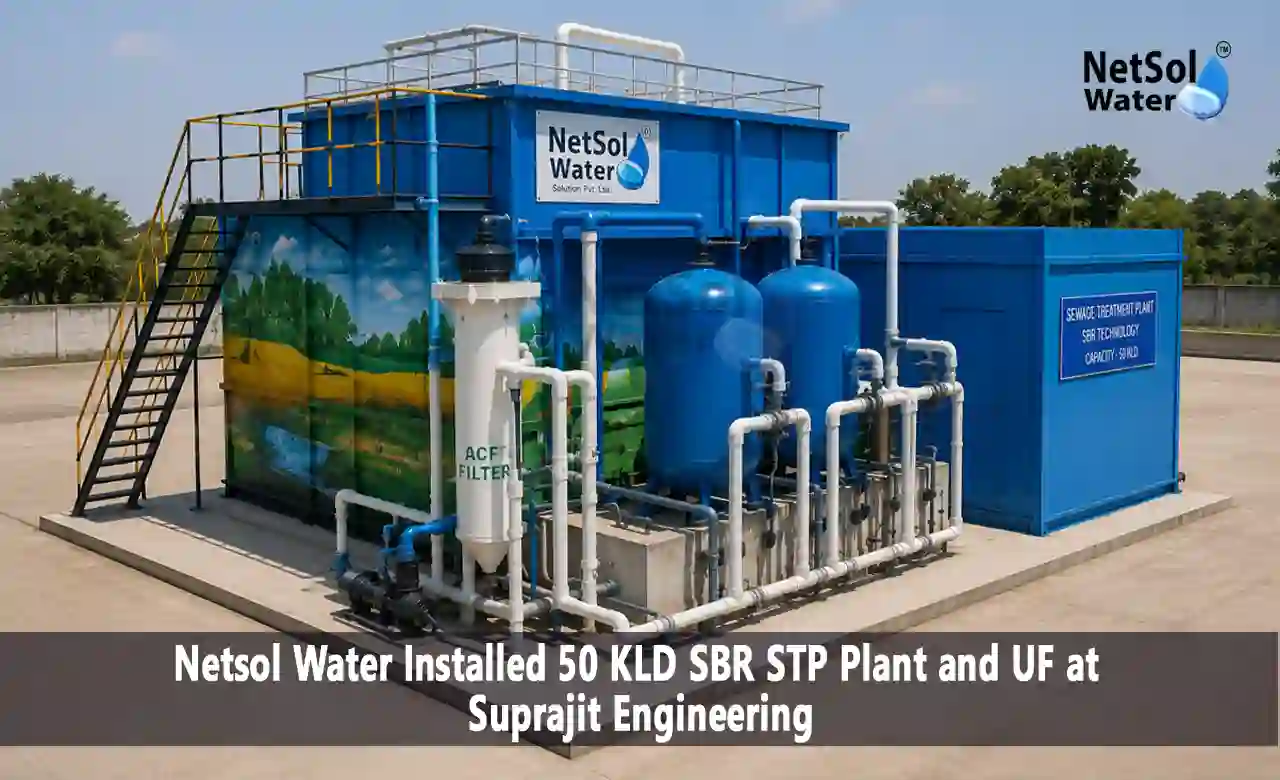
Case Study: 50 KLD STP Plant (SBR + UF) at Suprajit Engineering by Netsol
This case study presents a detailed account of a 50 KLD Sewage Treatment Plant successfully designed, supplied, installed and commissioned by Netsol Water at the manufacturing facility of Suprajit Engineering Limited. The plant employs a dual-technology approach Sequential Batch Reactor (SBR) combined with Ultrafiltration (UF) membrane technology to treat domestic and industrial sewage generated on-site. The treated water, meeting stringent quality benchmarks, is subsequently reused for gardening and toilet flushing purposes, significantly reducing the facility's freshwater consumption and environmental footprint.
Netsol Water, a leading Sewage Treatment Plant Manufacturer in India, brought its deep domain expertise and engineering capabilities to this project, delivering a robust, low-maintenance, and fully automated wastewater treatment solution. This project stands as a strong example of responsible industrial water management and circular water economy in practice.
Introduction
India's industrial sector is under increasing regulatory and environmental pressure to manage wastewater responsibly. The Bureau of Indian Standards (BIS) and the Central Pollution Control Board (CPCB) have laid down clear guidelines on effluent treatment and discharge, making it mandatory for manufacturing units to treat sewage before disposing of or reusing it. In this context, partnering with a reliable Sewage Treatment Plant Manufacturer in India has become a strategic necessity not just a compliance requirement.
Netsol Water has consistently positioned itself at the forefront of this movement, offering advanced wastewater treatment solutions tailored to the specific needs of industries across India. One of their landmark projects involved the installation of a 50 KLD STP Plant using SBR + UF technology at Suprajit Engineering's facility a project that has since become a benchmark for industrial water recycling and sewage water reuse systems in the manufacturing domain.
About Suprajit Engineering
Suprajit Engineering Limited is one of India's largest automotive cable manufacturers and a globally recognized supplier of mechanical control cables, halogen bulbs, and speedometer cables. The company supplies to major Original Equipment Manufacturers (OEMs) across the automotive sector, both in India and internationally. With multiple manufacturing plants across the country, Suprajit Engineering operates large-scale facilities that house a significant workforce, generating considerable volumes of domestic sewage and wastewater daily.
Given the company's commitment to sustainability, environmental compliance, and operational efficiency, the management at Suprajit Engineering recognized the need for a dependable STP Plant for Industries that could handle their sewage load with precision, consistency, and minimal operational overhead. Their goal was not merely to treat and discharge wastewater they wanted to close the loop by recycling the treated water back into utility use within the facility.
Challenges Faced by the Client
Before approaching Netsol Water, Suprajit Engineering faced a range of operational and environmental challenges related to sewage management:
1. Rising Freshwater Costs: The facility was heavily dependent on municipal and borewell water supply for non-potable applications. Water procurement costs were steadily increasing, putting pressure on operational budgets.
2. Regulatory Compliance Pressure: With tightening environmental regulations from state pollution control boards, the plant needed to demonstrate proper sewage treatment and responsible disposal/reuse practices to avoid penalties or operational shutdowns.
3. Lack of an Integrated Treatment System: The existing arrangement lacked a structured, centralized sewage treatment setup. Wastewater was managed in an ad-hoc manner, with no consistent monitoring of effluent quality.
4. Space Constraints: Like most operating manufacturing facilities, the available footprint for a new treatment plant was limited. The solution needed to be compact yet fully functional to meet daily sewage treatment demand.
5. Water Scarcity Awareness: As a responsible corporate entity, Suprajit Engineering's leadership was increasingly focused on reducing water consumption and promoting sustainable water management within the facility.
6. Quality of Treated Water: Previous arrangements did not produce treated water of a quality suitable for landscape irrigation or toilet flushing, making reuse impractical and unreliable.
Project Objectives
Based on a thorough site assessment and discussions with the client's engineering and sustainability teams, the following objectives were defined for this project:
1. Design and install a 50 KLD STP Plant capable of treating all domestic sewage generated at the facility on a daily basis.
2. Deploy a technology combination that ensures high-quality treated water suitable for non-potable reuse applications.
3. Ensure the treated effluent meets CPCB norms and state pollution control board discharge/reuse standards.
4. Minimize manual intervention through automation and smart monitoring systems.
5. Achieve significant freshwater savings by reusing 100% of the treated water for gardening and flushing.
6. Deliver the project within the agreed timeline with minimal disruption to ongoing manufacturing operations.
7. Provide a robust, durable system with low operational and maintenance costs over its lifecycle.
Proposed Solution 50 KLD STP Plant Using SBR + UF Technology
After a comprehensive site survey, flow analysis, and wastewater characterization study, the engineering team at Netsol Water proposed a 50 KLD STP Plant based on a sequential combination of Sequential Batch Reactor (SBR) and Ultrafiltration (UF) membrane filtration technologies.
This combination was selected for the following reasons:
1. SBR Technology: Provides a highly flexible and space-efficient biological treatment process that can handle variable flow rates and organic loads a critical factor for manufacturing facilities with fluctuating workforce and operational schedules.
2. UF Membrane Filtration: Serves as a polishing step, removing residual suspended solids, colloidal matter, and microbial contaminants from biologically treated water to produce permeate of superior quality fit for reuse.
3. Combined SBR + UF Approach: Eliminates the need for a separate secondary clarifier, reducing the plant footprint and minimizing civil construction requirements.
4. Automated Control System: Ensures consistent performance across varying input conditions, requiring minimal skilled operator intervention.
About Netsol Water
Netsol Water is a premier Sewage Treatment Plant Manufacturer in India, headquartered in Greater Noida, Uttar Pradesh. With over a decade of experience in the design, manufacturing, installation, and commissioning of water and wastewater treatment systems, Netsol Water has built a strong reputation for delivering high-performance treatment solutions across diverse industrial, commercial, residential, and municipal sectors.
The company's product portfolio includes a wide range of STP, ETP (Effluent Treatment Plants), WTP (Water Treatment Plants), RO systems, ZLD systems, and package treatment plants. Netsol Water's in-house engineering team leverages the latest advancements in biological treatment, membrane filtration, and automation to develop robust and cost-effective solutions tailored to each client's unique requirements.
Netsol Water has successfully executed hundreds of projects across India for clients in sectors including automotive manufacturing, pharmaceuticals, food processing, hospitality, real estate, and more. The company's deep understanding of Indian regulatory standards (CPCB, BIS, state PCB norms) positions it as a trusted partner for industries seeking reliable STP Plants for Industries and comprehensive wastewater treatment solutions.
Role of Netsol Water in This Project
Netsol Water played an end-to-end role in the execution of this project, undertaking full responsibility from initial consultation to post-commissioning support:
1. Feasibility Study & Site Assessment: Netsol Water's engineers conducted a detailed site visit to understand the layout, sewage generation points, available space, utility infrastructure, and reuse requirements.
2. Wastewater Characterization: Samples of influent wastewater were collected and analyzed to determine key parameters such as BOD, COD, TSS, TKN, pH, and coliform count forming the basis for accurate plant design.
3. Custom Engineering & Design: Based on the characterization data, the engineering team developed a tailored process design, P&ID, layout drawing, and equipment specifications for the 50 KLD STP Plant.
4. Manufacturing & Supply: All major equipment including the SBR reactor, blowers, decanter mechanism, UF membrane modules, dosing systems, and control panels were manufactured or procured in accordance with Netsol Water's quality standards.
5. Installation & Commissioning: The complete mechanical and electrical installation was carried out by Netsol Water's specialized field team, followed by systematic commissioning and performance testing.
6. Operator Training: Post-commissioning, the Netsol Water team trained Suprajit Engineering's facility management team on plant operation, daily monitoring protocols, and preventive maintenance procedures.
7. After-Sales Support: Netsol Water continues to provide periodic AMC (Annual Maintenance Contract) support, ensuring consistent plant performance over its operational life.
Process Flow Diagram
The 50 KLD SBR + UF STP Plant follows a well-defined multi-stage treatment process. The table below outlines each treatment stage and its function:
| PROCESS STAGE | FUNCTION / DESCRIPTION |
|---|---|
| RAW SEWAGE INLET | Domestic sewage from all facility points collected |
| FINE SCREEN / BAR SCREEN | Removal of large solids, rags, and plastics |
| EQUALIZATION TANK | Flow equalization and homogenization of wastewater |
| SBR REACTOR | Biological treatment: BOD/COD removal, nitrification & denitrification in timed cycles |
| SLUDGE HOLDING TANK | Collection and gravity thickening of waste sludge from SBR |
| UF MEMBRANE FILTRATION | Polishing: removal of TSS, colloids, bacteria — high-quality permeate output |
| TREATED WATER STORAGE | Holding tank for reuse-quality treated effluent |
| DISTRIBUTION PUMP | Pressurized delivery to reuse points |
| REUSE POINTS | Gardening / Landscape Irrigation + Toilet Flushing |
Each stage of the process progressively reduces pollutant load until the final treated water meets required quality parameters for safe and effective reuse. The entire process is monitored and controlled through a centralized PLC-based automation system that manages SBR cycle timing, UF backwash sequences, chemical dosing, and alarm management.
SBR Technology Explanation
Sequential Batch Reactor (SBR) is an activated sludge-based biological treatment process that operates in a fill-and-draw mode within a single reactor tank, performing multiple treatment steps in sequence rather than simultaneously in separate tanks. A typical SBR operating cycle consists of five distinct phases:
1. Fill Phase: Raw sewage (pre-screened and equalized) is introduced into the SBR tank, mixing with the active biomass already present in the reactor.
2. React Phase: Aeration is provided through fine bubble diffusers connected to the blower system. Aerobic microorganisms consume dissolved organic matter (BOD/COD), and nitrification occurs. In the anoxic sub-phase, aeration is paused to allow denitrification.
3. Settle Phase: Aeration and mixing are stopped, allowing the activated sludge (biomass) to settle to the bottom of the reactor by gravity eliminating the need for a separate secondary clarifier.
4. Decant Phase: The clarified supernatant (treated effluent) is withdrawn from the top of the reactor using a mechanical floating decanter, while the settled sludge remains at the bottom.
5. Idle/Waste Phase: Excess sludge is periodically wasted to the sludge holding tank to maintain a controlled Sludge Retention Time (SRT) and maintain the health of the biological community.
Key Advantages of SBR Technology
1. Compact design single reactor handles multiple treatment functions
2. Flexible operation to accommodate variable flow and organic load
3. Excellent BOD and nutrient removal efficiency
4. No secondary clarifier required
5. Fully automated cycle control via PLC/timer systems
UF Technology Explanation
Ultrafiltration (UF) is a pressure-driven membrane separation technology that acts as a final polishing step after the SBR biological treatment. UF membranes have a pore size in the range of 0.01–0.1 microns, enabling them to remove suspended solids, turbidity, colloidal particles, bacteria, and certain viruses with very high efficiency.
Biologically treated water from the SBR decant flows into the UF feed tank, from where it is pressurized through hollow-fiber UF membrane modules. Particles larger than the membrane pore size are rejected and retained on the feed side, while clean permeate passes through and collects in the treated water tank. The UF system undergoes periodic automated backwashing and chemical enhanced backwash (CEB) cycles using sodium hypochlorite and citric acid to maintain membrane flux.
Key Advantages of UF in This Project
1. Removes virtually all suspended solids produces sparkling clear permeate
2. Acts as a complete barrier against bacteria and pathogens
3. Consistent permeate quality regardless of influent variations
4. Compact footprint ideal for space-constrained industrial sites
5. Automated operation with self-cleaning backwash capability
6. Produces water quality suitable for toilet flushing and irrigation
Key Features of the Installed STP Plant
The 50 KLD SBR + UF STP Plant at Suprajit Engineering is equipped with a range of features that set it apart as a high-performance Industrial STP Plant:
1. Fully Automated PLC-Based Control Panel with SCADA compatibility for remote monitoring
2. Fine Bubble Diffuser Aeration System for energy-efficient and uniform oxygen transfer in the SBR tank
3. Mechanical Floating Decanter in SBR for clean effluent withdrawal without disturbing settled sludge
4. High-Flux UF Membrane Modules for reliable and consistent tertiary treatment
5. Automated Backwash System for UF membranes to maintain performance over time
6. Chemical Dosing Systems for pH correction, disinfection, and anti-scaling
7. Online Flow Meters and Level Sensors for real-time process monitoring
8. Stainless Steel and FRP Construction for corrosion resistance and long service life
9. Emergency Alarm System for high levels, low levels, power failures, and equipment faults
10. Sludge Drying Beds for dewatering of waste sludge generated from the SBR process
11. Treated Water Holding Tank with adequate capacity to ensure uninterrupted supply to reuse points
Installation & Commissioning Process
The installation and commissioning of the 50 KLD STP Plant at Suprajit Engineering was carried out in a phased and methodical manner to minimize disruption to the facility's ongoing operations.
Phase 1 – Pre-Installation Activities
. Finalization of plant layout and civil drawings
. Mobilization of Netsol Water's installation team
. Delivery of all equipment and materials to site
. Civil construction work: tank construction, sump excavation, pipe trenching
Phase 2 – Mechanical Installation
. Positioning and anchoring of major equipment (SBR tank, UF skid, control panel)
. Installation of piping influent, inter-process, effluent, and sludge lines
. Mounting of blowers, pumps, level sensors, and flow meters
. Installation of aeration diffusers inside the SBR reactor
Phase 3 – Electrical Installation
. Control panel installation and power supply connection
. Wiring of all motors, sensors, valves, and instruments to the PLC panel
. Programming of PLC with SBR cycle logic, UF backwash sequences, and alarm logic
Phase 4 – Commissioning & Performance Testing
. Cold commissioning (dry run without sewage) for verification of all mechanical and electrical systems
. Hot commissioning (live run with actual sewage) including seeding of SBR with activated sludge
. Performance testing over a stabilization period of 4–6 weeks
. Sampling and analysis of treated water quality at various stages
Phase 5 – Handover & Training
. Final performance documentation and handover report prepared
. On-site training of Suprajit Engineering's facility team
. Handover of operation & maintenance manual, as-built drawings, and equipment warranties
Watch how Netsol Water successfully installed a 50 KLD SBR + UF Sewage Treatment Plant at Suprajit Engineering for wastewater reuse in gardening and flushing applications.
Treated Water Quality Parameters
One of the most critical success metrics for any Water Recycling System is the quality of the treated water produced. The table below presents the typical influent (raw sewage) quality versus the treated effluent quality achieved by the 50 KLD SBR + UF STP Plant at Suprajit Engineering's facility:
| Parameter | Unit | Influent | SBR Treated | UF Permeate | CPCB Limit |
|---|---|---|---|---|---|
| pH | — | 6.5 – 8.5 | 7.0 – 7.5 | 7.0 – 7.5 | 6.5 – 8.5 |
| BOD (5-day, 20°C) | mg/L | 150 – 250 | 10 – 15 | < 10 | ≤ 10 |
| COD | mg/L | 300 – 500 | 40 – 60 | < 30 | ≤ 50 |
| Total Suspended Solids | mg/L | 150 – 300 | 15 – 20 | < 5 | ≤ 10 |
| Total Kjeldahl Nitrogen | mg/L | 30 – 60 | 5 – 10 | < 5 | ≤ 10 |
| Ammonia Nitrogen | mg/L | 20 – 40 | 2 – 5 | < 2 | ≤ 5 |
| Total Coliform | MPN/100mL | 10? – 10? | 10³ – 10? | < 200 | ≤ 200 |
| Turbidity | NTU | 100 – 200 | 5 – 10 | < 1 | ≤ 2 |
| Total Dissolved Solids | mg/L | 400 – 800 | 400 – 700 | 400 – 700 | ≤ 2100 |
| Oil & Grease | mg/L | 10 – 30 | < 5 | < 2 | ≤ 5 |
Reuse of Treated Water for Gardening & Flushing
A central objective of this Sewage Water Reuse System was to ensure that 100% of the treated water is productively recycled within the facility, eliminating any need for effluent discharge to sewers or surface water bodies.
1. Reuse for Gardening / Landscaping
The treated and polished permeate from the UF unit is pumped directly to the landscaped areas surrounding Suprajit Engineering's facility. The low turbidity (< 1 NTU) and near-complete removal of pathogens in the UF permeate make it ideal for drip irrigation, sprinkler irrigation, and general horticulture purposes. Plants and lawns show excellent response to the reused water, which retains beneficial nutrients like nitrogen at low but agronomically useful levels.
2. Reuse for Toilet Flushing
A dedicated pipeline network distributes the treated water from the holding tank to the toilet flushing cisterns across the facility's sanitation blocks. The UF-treated water, with its low turbidity, low coliform count, and absence of objectionable odor, is fully suitable for this purpose. This application alone accounts for a substantial portion of the daily freshwater savings at the facility.
3. Water Balance Summary
. Daily sewage generated: ~50 KLD
. Daily sewage treated: ~50 KLD
. Estimated daily freshwater saved: ~45–48 KLD (accounting for sludge water and evaporation losses)
. Annual freshwater savings: approximately 16,000–17,000 KL per year
Results & Benefits
1. Environmental Benefits
. Complete elimination of untreated sewage discharge from the facility
. Recovery and productive reuse of approximately 45–48 KLD of treated water daily
. Reduction in groundwater extraction for non-potable uses
. Contribution to the site's environmental compliance and sustainability KPIs
. Reduced carbon footprint associated with water transport and treatment
2. Operational Benefits
. Fully automated operation requiring minimal manpower (< 1 operator for routine monitoring)
. Consistent and reliable performance with minimal downtime
. Compact plant footprint that fits within the available facility space
. Low energy consumption owing to the energy-efficient SBR and UF systems
. Simple and cost-effective maintenance protocol
3. Financial Benefits
. Significant reduction in freshwater procurement costs estimated savings of INR 10–15 lakh per annum
. Avoidance of potential regulatory penalties for non-compliance
. Reduced sewage discharge charges (where applicable under local sewer tariff structures)
. Long-term ROI through sustained water reuse and lower utility expenses
4. Compliance & Reputational Benefits
. Full compliance with CPCB norms and state pollution control board regulations
. Enhanced ESG (Environmental, Social, and Governance) credentials for Suprajit Engineering
. Demonstrates corporate commitment to sustainable manufacturing and responsible resource management
. Strengthens eligibility for green certifications and sustainability ratings
Environmental & Operational Impact
The broader environmental and operational impact of this project extends well beyond the boundaries of Suprajit Engineering's facility. Every kilolitre of freshwater saved through this Sewage Water Reuse System directly reduces the demand on municipal water supply networks and underground aquifers both of which are under severe stress in many parts of India.
By recycling approximately 45–48 KLD of treated water, Suprajit Engineering's facility effectively conserves an estimated 16,000+ kilolitres of freshwater annually equivalent to the annual drinking water needs of over 250 individuals.
From an operational standpoint, the automated SBR + UF STP Plant has introduced a culture of systematic water management at the facility. Plant data logged by the PLC/SCADA system provides facility managers with real-time visibility into water treatment performance, enabling proactive maintenance and early fault detection. The sludge generated by the SBR process undergoes dewatering in the sludge drying beds and can be utilized as soil conditioner for the facility's landscape creating a truly circular waste management loop within the plant premises.
Client Feedback
"We were looking for a partner who could not only design and install a compliant sewage treatment system but also help us turn a waste stream into a resource. Netsol Water delivered exactly that. The 50 KLD SBR + UF STP Plant has been performing consistently since commissioning, and the quality of treated water has exceeded our expectations for gardening and flushing applications. Their team was professional, responsive, and deeply knowledgeable throughout the entire project. We are now exploring the possibility of expanding our engagement with Netsol Water for additional water management requirements at our other facilities."
— Engineering & Facilities Management Team, Suprajit Engineering Limited
Conclusion
This case study of the 50 KLD STP Plant (SBR + UF) installed at Suprajit Engineering by Netsol Water is a compelling demonstration of what is achievable when industrial water management is approached with technical rigor, commitment to quality, and a genuine desire to create sustainable outcomes.
As a trusted Sewage Treatment Plant Manufacturer in India, Netsol Water delivered a fully customized SBR + UF STP Plant that not only addresses the client's compliance obligations but transforms sewage into a valuable water resource reused entirely for gardening and toilet flushing within the facility. The project has generated tangible environmental, operational, and financial benefits for Suprajit Engineering while setting a high benchmark for Industrial STP Plants across the country.
For manufacturing companies, industrial parks, and commercial establishments in India that are seeking a reliable, proven, and cost-effective Wastewater Treatment Solution, this STP Plant Case Study underscores the value of working with an experienced partner like Netsol Water. Their end-to-end capabilities from site assessment and custom engineering to installation, commissioning, and ongoing support make them the preferred choice for any organization committed to responsible water management.
Contact Netsol Water today to learn how we can help you implement a high-performance Sewage Treatment Plant for your industrial or commercial facility.