

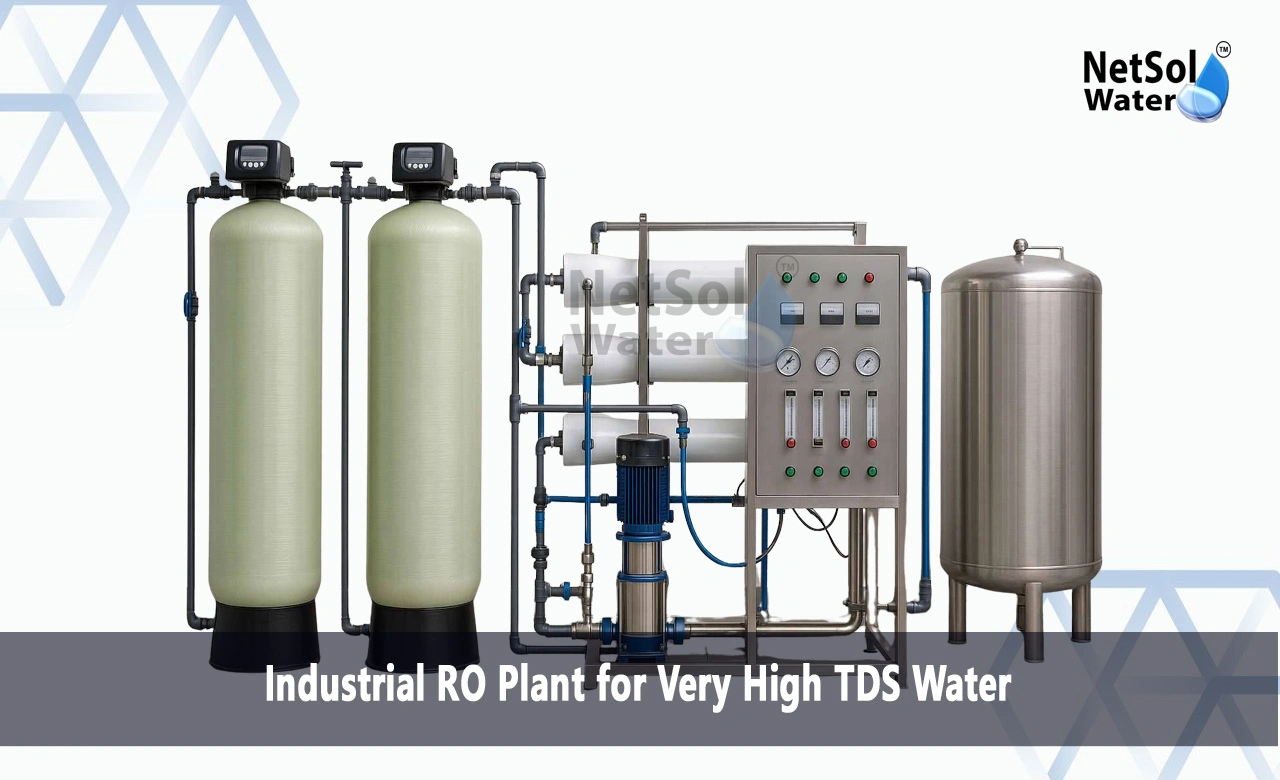
How Industrial RO Plants Dealing with High TDS Water?
Designing an Industrial RO Plant for Very High TDS Water is fundamentally different from designing a standard reverse osmosis system. When the total dissolved solids are high, then the assumptions become invalid to the normal brackish water systems. Membranes and other equipment undergo immense pressure due to higher osmotic pressure, complicated salt chemistry, scaling threats, and energy usage. Most industrial RO plants do not work well due to ineffective membranes, but rather due to inefficiencies in the design which fails to consider the reality of very high TDS feed water.
To have stable recovery, tolerable membrane life, and predictable operating costs, it is critical to understand the design issues peculiar to the design.
Why High TDS Design Fundamentals RO Design Workarounds?
1: Osmotic Pressure Becomes a Major Factor
Osmotic pressure increases very rapidly at high TDS, and lessens the net driving pressure across membranes. The rate at which the feed pressure is augmented does not proportionately augment the permeate flow. Rather, the rate of energy consumption increases at a greater rate than water recovery resulting to diminishing returns and mechanical load on the system.
2: Salt Composition is More Important than TDS Value
Two water sources, which differ in terms of TDS, may behave quite differently. Scaling risk is highly increased by high levels of sulfate, silica, calcium or barium. Designs operating only using the values of TDS do not consider ionic interactions which dictate the actual performance in the real world.
Difficulties in pretreatment of very high TDS RO plants
1: Shortcomings of Traditional Pretreatment
Common multimedia filtration and cartridge filters are ineffective in cases with feed water of colloidal silica, organic foulant formers or oil. These pollutants intensify the fouling condition in salty conditions and render the membranes susceptible to irreparable damage.
2: Making It Soft Is Not Enough
The ion exchange softeners eliminate hardness and do not treat silica, iron, or dissolved organics. Even in high-TDS water, it is possible to scale membranes with softened feed under high recovery, because of concentration polarization at high recovery.
3: Biological fouling Risk increases
Biofouling is not removed by high salinity. Some of the halophilic microorganisms are capable of surviving in the saline environment forming dense biofilms which are hard to dislodge upon development.
Limitations to Recovery under High TDS RO Plants
· Smaller Safe Recovery Window: The difference between safe operation and scaling is very thin as the TDS increases. High recovery target designs tend to foul the membrane fast, undergo frequent cleanings, and have intermittent operations.
· Effects of Polarization of Concentration: High TDS enhances polarization of concentration at the surface of the membrane. Local salt concentration may be higher than bulk feed concentration by a fewtimes, precipitation may occur where bulk water is shown to be within boundaries.
Hydraulic Design Constraints and Energy
· Selection Complexity of High-Pressure pumps: Very high TDS RO systems also demand pumps which canoperate under high pressure. Nevertheless,running at close to maximum pressure levels decreases efficiency of the pump and increases the risk of failure. Excessive sizing increases the cost of pumps, and insufficient sizing reduces the performance of pumps.
· Choosing Material in the presence of high salinity: Concentration of chloride and sulfate promotes corrosion. The wrong choice of material when making piping, pressure vessels and fittingscause early failures, leakages, and the chances of contamination.
Selection and Construction Problems of Membranes
· Trade off between Rejection and Permeability: High rejection membrane has low permeability which raisesthe energy requirements. High permeability membranes can compromise rejection/ fouling resistance. To choose a membrane, it is necessary to balance between salt rejection, fouling resistance, and operating pressure constraints.
· Multi-Pass vs Single-Pass Bases: Single-pass RO is likely to fail to achieve recovery or quality targets when using very high TDS water unless it is operated at extreme pressure. Multi-pass or staged RO plants lower stress per stage, but are more complex, occupying more space and costing more.
Complexity Chemical Management
1: Antiscalant Limitations
Antiscalants are effective in delaying scaling, but not in extreme conditions of concentration. The excessive use of chemical dosing is a tendency to cover up the design constraints instead of addressing them.
2: pH Adjustment Risks
Reducing PH will help to reduce carbonate scaling at the expense of corrosion risk and chemical usage. The lack of proper pH control stabilizes the work of the system and raises operation cost.
The Reason So Many High TDS RO Plants Fail Early
· Design Under the Condition of Ideals: Most of the systems are planned based on short-term water analysis without taking into consideration seasonal or operational variability. Once the quality of feed water varies, the system will be outside the design envelope.
· Downstream Integration Ignored: Evaporators or ZLD systems frequently receive high TDS RO plants. This results in unreliable brine chemistry, evaporator fouling and a series of failures within the treatment train as a result of poor integration.
Design Techniques to enhance the operation of High TSS RO
Successful Industrial RO Plant for Very High TDS Water designs adopt conservative recovery targets, advanced pretreatment, staged membrane configurations, and realistic energy modeling. They also focus on long run stability in operations rather than maximum theoretical efficiency.
Introduction of pilot studies, ionic analysis and lifecycle cost analysis make the design reliability and membrane life much better.
Conclusion
Designing an Industrial RO Plant for Very High TDS Water requires moving beyond standard RO assumptions. The demanding environment of high osmotic pressure, sophisticated salt chemistry, and lack of energy and the threat of fouling require a well-considered, conservative strategy. Planning systems that have realistic recovery goals, strong pretreatment and material selectionis cost effective in the long run.
Disregarding such difficulties can lower the initial cost of capital, but nearly always leads to increased operating costs, excessive downtime, and a reduced life time of the membranes. Careful design is not an option in high TDS applications, but the difference between long-term operation and long-term failure.
Do you need an advice or assistance on selecting the best water and waste water treatment unit? We have solutions for all your problems!
Let us know your problem, our experts will make sure that it goes away.
For an assistance or related query,
Call on +91-9650608473
Or write us at enquiry@netsolwater.com