

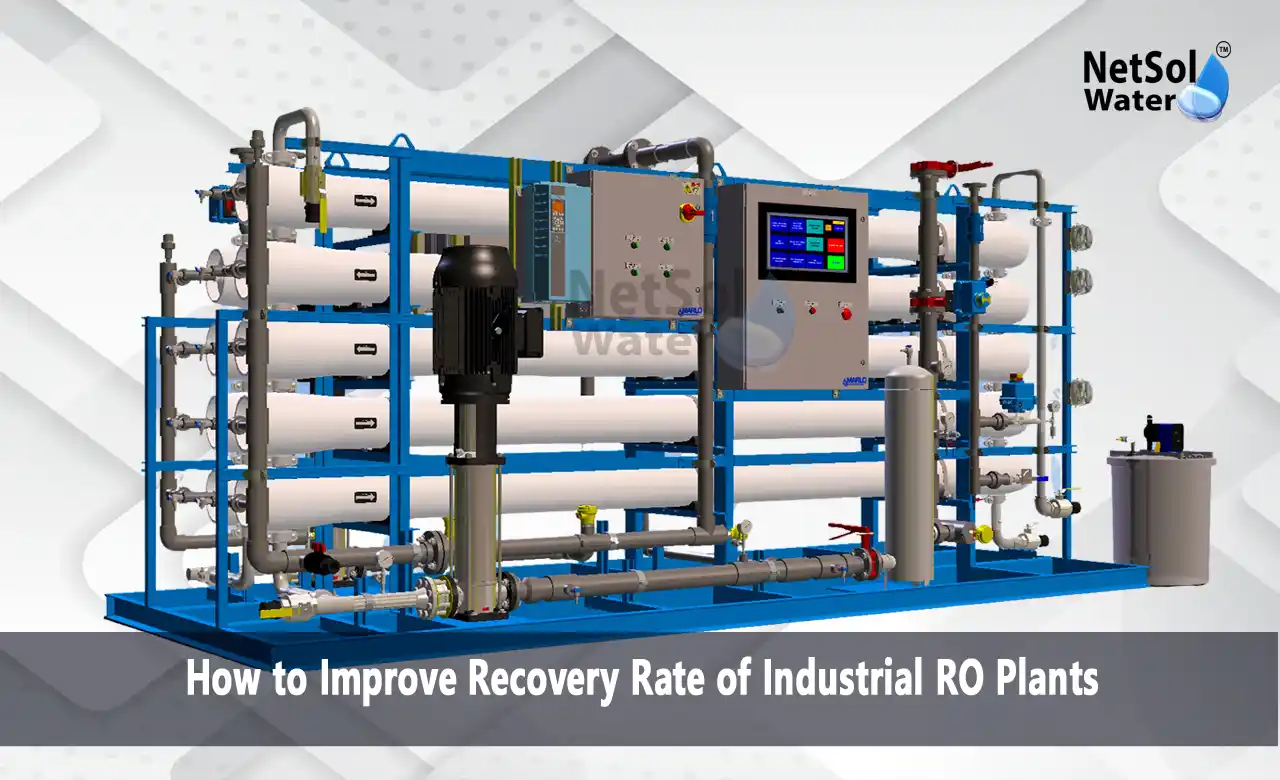
How to Improve Recovery Rate of Industrial RO Plants?
Water plays an important role in almost every industrial process. Factories use water for production, cleaning, cooling, and other utility operations. India is known for its large industrial base across sectors such as food processing, pharmaceuticals, textiles, chemicals, cement, and manufacturing. These industries also face growing pressure to use water carefully, which makes efficient water treatment more important than before.
Industrial RO plants help industries produce treated water from different raw water sources. Yet the quality of an RO system depends on more than the purity of the final water industries must also look at how much feed water the system converts into useful permeate water. This measure is known as recovery. A better recovery rate of industrial RO plants can lower water wastage and support better operating costs. It can also improve overall plant performance. Netsol Water is a leading manufacturer of industrial and commercial RO plants in India. The company designs systems based on factors such as flow rate and raw water quality.
[Internal Link Suggestion: anchor text "industrial and commercial RO plants" → link to Netsol Water's Industrial RO Plant product/category page]
Understand What Affects Industrial RO Plants Recovery Rate
Recovery has a direct effect on water use and plant operation. A system with poor recovery sends more water to the reject stream, while a system with suitable RO plant recovery can produce more treated water from the same feed supply. However, the operator should not increase recovery without studying the raw water and membrane conditions. High recovery can increase the concentration of salts and other substances on the membrane surface, which can lead to scaling and fouling. Both problems can affect RO efficiency. Let us look at some key factors that influence recovery.
. Check Raw Water Quality
Raw water quality forms the starting point for every RO system. Water may contain suspended solids, hardness, silica, organic matter, and dissolved salts each condition can affect membrane performance in a different way. A proper water analysis helps the operator understand what the membrane will face during normal operation. The analysis should cover important parameters such as TDS, hardness, pH, and turbidity. The treatment system can then use suitable pre-treatment before water reaches the RO membranes. Netsol Water also states that industrial RO systems can use filtration stages such as disc filters, multigrade filters, and activated carbon filters to protect the RO stage.
. Set Recovery According to Feed Conditions
Every RO plant has a suitable operating range. The right recovery depends on membrane design, feed water quality, pressure, and the treatment process. For example, a Netsol Water specification for a larger RO system lists recovery in the range of 50–70% under its stated operating conditions.
Operators should therefore avoid treating a higher recovery percentage as an automatic sign of better performance. The right target should maintain good water recovery without causing excessive salt concentration or membrane damage.
Improve Pre-Treatment to Support RO Efficiency
Pre-treatment plays a major role in maintaining stable RO performance. The RO membrane acts as the main separation stage, yet it cannot work well for long when the incoming water carries excessive suspended matter or substances that can damage or foul the membrane. Good pre-treatment creates better conditions for the membrane and can also help maintain pressure and flow across the system. This supports stable operation and helps the plant maintain its planned water recovery.
Let us look at some important pre-treatment measures.
. Control Sediment and Suspended Solids
Suspended solids can collect on filtration equipment and membranes. This build-up can increase pressure loss and limit water flow. A suitable filtration system can remove much of this material before the water reaches the RO membrane. Sand filters and multigrade filters can help remove sediments and suspended matter, while cartridge filters can provide another filtration step before the membrane. Netsol Water describes these stages as part of industrial RO pre-treatment.
Regular inspection also matters. Filters that become heavily loaded cannot perform their job properly. Operators should monitor pressure differences across the filters and clean or replace filter media when needed. This simple practice can help maintain steady feed conditions for the RO unit.
. Manage Hardness and Scale Formation
Hardness can create scaling on RO membranes. Scale blocks the membrane surface and makes it harder for water to pass through the plant may then need higher operating pressure to maintain production, which can increase energy use and lower overall RO efficiency. Industries can control hardness through suitable water softening or other scale control methods based on their raw water conditions. The correct treatment should come from a proper water analysis rather than a fixed design used for every location. Netsol Water has also used multi-stage treatment systems that include a water softener before the RO stage. This approach helps prepare challenging groundwater for further purification.
Maintain Membranes and Monitor Plant Performance
Good system design alone cannot maintain performance for the entire operating life of a plant. Operators need regular monitoring and maintenance. Membranes gradually collect deposits during operation, and pumps and filters can also lose performance. Small changes in pressure or flow can indicate a developing problem early action can prevent a larger performance loss.
Let us look at some maintenance practices that can support better recovery.
. Monitor Pressure, Flow and Water Quality
Operators should record feed flow, permeate flow, and reject flow at regular intervals. They should also track pressure and important water quality parameters. These readings help the operator understand how the system behaves over time. A sudden drop in permeate flow can indicate fouling or scaling, and a change in pressure may also point to a filtration problem or membrane condition. Tracking these values helps the maintenance team act before the problem becomes serious. The operator should also compare current results with the plant's normal operating values, which makes it easier to identify gradual changes that may not be visible during a single inspection.
. Clean the Membranes at the Right Time
RO membrane cleaning is needed when deposits start to affect performance. Waiting too long can make cleaning more difficult and can shorten membrane life, while cleaning too often can also add unnecessary cost and downtime. The cleaning process should match the type of fouling the operator should follow membrane supplier instructions and use suitable cleaning chemicals. After cleaning, the system should return to stable operating conditions.
Regular maintenance also extends beyond the membranes. Pumps, valves, filters, control panels, and dosing systems all need inspection. A well-maintained system can maintain consistent production and support better water recovery over its operating life.
Conclusion
Better water recovery starts with the right balance between treatment performance and operating conditions. Industrial users should not focus only on increasing recovery they should first understand their feed water, then provide suitable pre-treatment, maintain the membranes, and monitor key operating values. This approach can help industries use more water efficiently while protecting the RO system from avoidable problems. Improving the industrial RO plants recovery rate can support lower water wastage and more consistent plant operation. A properly designed system can also help industries meet their treated water requirements with better control over resources.
Netsol Water provides industrial RO solutions that are designed around application needs and water conditions. The company offers RO systems across a wide range of capacities and provides customized water treatment solutions. Contact Netsol Water to discuss your water treatment requirement and request a suitable consultation for improving your plant's recovery and RO efficiency.
Contact Netsol Water at:
Phone: +91-9650608473, Email: enquiry@netsolwater.com