

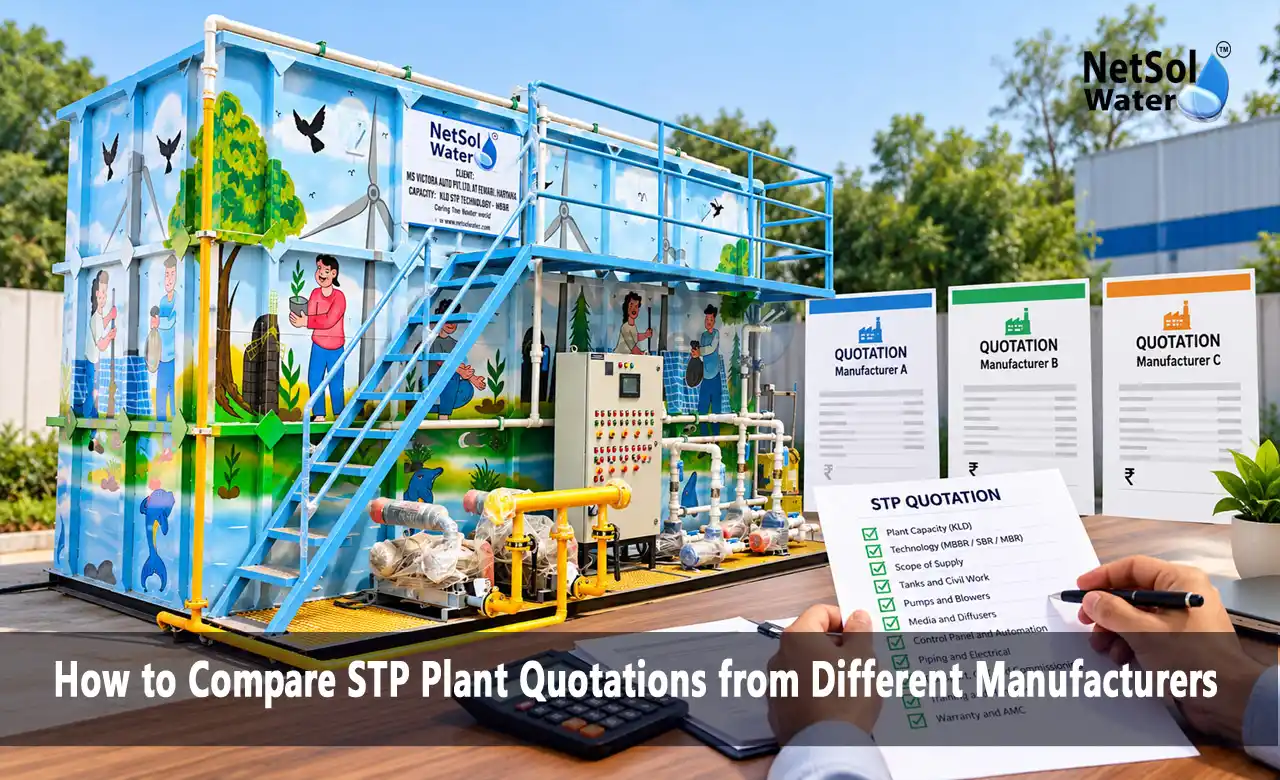
How to Compare STP Plant Quotations?
You ask three manufacturers for a quote on a 100 KLD sewage treatment plant. The prices come back with a gap of several lakh rupees. It is tempting to pick the lowest one and move on. That is usually where the trouble starts, because the three quotations rarely describe the same plant.
Housing societies, hotels, hospitals and commercial complexes across Delhi NCR, Mumbai and other fast growing cities now need a Sewage Treatment Plant (STP) to treat wastewater before reuse or discharge. This guide explains, step by step, how to read STP plant quotations side by side so that you compare like with like and pay for what you actually get.
Step 1: Know Your Own Numbers First
A quotation is only as good as the information you gave the manufacturer. Before you send any enquiry, prepare these details:
. Expected sewage flow per day in KLD (kilolitres per day). As a rough planning figure, many projects assume that about 80 percent of the water supplied turns into sewage. Confirm this with your consultant.
. Peak flow timing, such as the morning rush in a residential society.
. Future expansion, such as extra towers, new floors or more occupants.
. Where the treated water will go: flushing, gardening, cooling tower make up or discharge. This decides the quality of treatment you need.
. Space available, plus whether you prefer an underground, semi-underground or above-ground installation.
When every manufacturer receives the same inputs, the quotations become far easier to compare.
Step 2: Compare the Scope of Supply Line by Line
This is where most price differences hide. One quote may include tanks, civil work, electrical work and commissioning. Another may cover only the equipment. Put the quotations in one sheet and check each of the items below.
| Item to Compare | What to Check in Each Quotation |
|---|---|
| Capacity (KLD) | Daily flow, peak flow factor and the equalisation tank volume offered |
| Tanks and Civil Work | Tank material, who builds the civil tanks, and whether excavation is included |
| Pumps and Blowers | Make, number of duty and standby units, and power rating in kW |
| Media, Diffusers, Filters | Type of media or membranes, filter units, and disinfection method |
| Control Panel | Manual or automatic controls, alarms, and operating hours assumed in the design |
| Piping and Electrical | Interconnecting pipes, cabling and earthing: included or left to you |
| Transport, GST, Commissioning | Clearly state whether these are included or extra, so no unexpected costs appear later |
| Training and Handover | Operator training, O&M manual and trial run period |
If an item is not mentioned, do not assume it is included. Ask the manufacturer to confirm in writing. A quotation with a clear price breakup is a good sign, because it shows the supplier has actually designed your plant instead of copying a standard template.
Step 3: Understand the Treatment Technology Being Offered
Manufacturers propose different biological treatment processes. Each has a place, and the right one depends on your site and your treated water needs.
. MBBR (Moving Bed Biofilm Reactor): Uses small plastic media that carry bacteria. It is compact, handles load variation well and is popular for housing societies and hotels.
. SBR (Sequential Batch Reactor): Treats sewage in timed batches inside one tank. It saves space but depends on good automation and a reliable control panel.
. MBR (Membrane Bioreactor): Uses membranes for very clear treated water. Quality is high, but the cost and the maintenance needs are higher too.
Ask each supplier why their chosen process suits your project. A good answer refers to your flow, your site and your reuse plan. If you want to see how a biological design is built and maintained, read about a bio STP plant and compare it with what the other quotations propose.
Step 4: Ask for Guaranteed Treated Water Quality in Numbers
A line such as "treated water as per norms" does not tell you much. Ask every manufacturer to state the expected outlet values for parameters such as BOD, COD, TSS and pH, and to mention which CPCB or State Pollution Control Board norms the design is meant to meet. If the treated water will be reused for flushing or gardening, say so clearly. It also helps to ask how and when the outlet quality will be tested during commissioning.
Step 5: Work Out the Five Year Cost, Not Just the Purchase Price
A low purchase price can hide a high running cost. Ask each manufacturer for the figures below, then add them up over five years.
. Connected load in kW, the daily running hours and the estimated monthly electricity use.
. Manpower: how many operators the plant needs, and at what skill level.
. Chemicals and consumables such as disinfectant, anti-foam, media top up or membrane replacement.
. Spare parts: price and availability for pumps, blowers, diffusers and panel components.
. AMC (Annual Maintenance Contract) charges after the warranty ends.
A simple formula works well: five year cost = purchase price + 5 x (electricity + manpower + chemicals + AMC). A plant that costs a little more today but uses less power and fewer consumables often works out cheaper in the long run.
Step 6: Read the Warranty, AMC and Service Terms Carefully
Good equipment still needs good support. Read the warranty page of each quotation and check:
. What is covered, for how long, and what is excluded.
. Whether warranty ends if maintenance is done by someone other than the supplier.
. Response time when the plant breaks down, and where the service engineers are based.
. Whether operator training and an O&M manual are part of the handover.
. Whether the AMC rates for the coming years are stated or left open.
Step 7: Verify the Manufacturer, Not Just the Paper
Two quotations can look similar while the companies behind them are very different. Before you decide, verify these points:
. Does the company manufacture its own plants, or does it only trade and outsource?
. Has it completed projects of your type and size? Ask for contact details of two or three existing clients and, if possible, visit a running plant.
. Will it support you with the paperwork needed for your pollution control board consent?
Companies such as Netsol Water, a Greater Noida based STP plant manufacturer in India, publish their STP ranges and project details online. Reading these pages and comparing them with the claims in a quotation is a quick way to test how transparent a supplier really is.
Red Flags to Watch Out For
. A price far below every other quote with no explanation of what has been left out.
. No technical drawing, flow diagram or equipment list attached.
. Vague words such as "as required" or "as per site" in the scope of supply.
. No details about power use, spare parts or AMC.
. Pressure to sign quickly because "the offer ends today".
. References that cannot be contacted.
A Simple Way to Score the Quotations
Give each quotation a score out of 100 so the decision stays objective. One practical split is: technical design and quality guarantee 30, scope of supply 20, five year cost 25, warranty and service 15, and manufacturer experience 10. Adjust the weights to suit your project, then let the numbers guide you rather than the headline price.
Frequently Asked Questions (FAQs)
Q1. Is the cheapest STP quotation always a bad choice?
No, but it needs closer checking. A low price is fine when the scope, the treatment quality and the service terms match the other offers. It becomes risky when it simply leaves out items that you will pay for later.
Q2. How many quotations should I collect?
Three to four is a sensible number. Fewer than three gives you little to compare, and more than four makes the process slow without adding much clarity.
Q3. Should I choose MBBR or SBR?
There is no single winner. MBBR is often preferred when load varies and space is limited. SBR can suit sites with good automation and operator skills. The right answer depends on your flow, your space and your treated water needs, so ask each supplier to justify their pick.
Q4. Why does the AMC matter if the plant is under warranty?
Warranty usually ends after a fixed period, while the plant must run for many years. A clear AMC keeps the plant serviced on schedule and helps avoid expensive breakdowns.
Conclusion
Comparing STP plant quotations is mostly about comparing scope, treatment guarantee, running cost and after sales support, and only then comparing price. Build a single comparison sheet, ask for everything in writing, and verify the manufacturer through references and site visits. A little extra effort at this stage protects you from hidden costs and from a plant that struggles to perform.
Contact Netsol Water for STP quotation and technical guidance:
Phone: +91-9650608473, Email: enquiry@netsolwater.com