

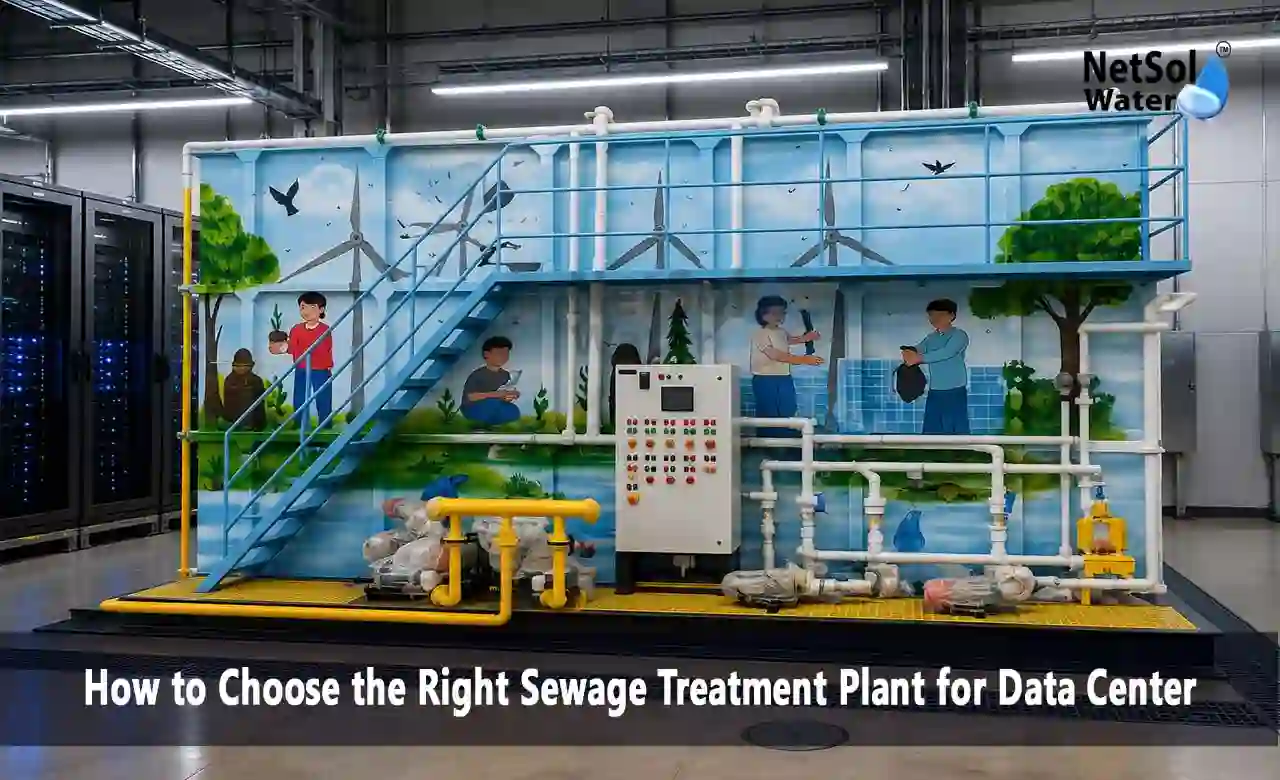
How to Choose the Right Sewage Treatment Plant (STP) for Data Center?
Ask most people what a data center consumes, and they’ll probably say electricity. That’s not wrong exactly, but it feels kind of incomplete, like something is missing after the rest of the sentence. Water runs quietly in the background of almost every data center operation and most folks never really think about it until there’s a problem.
Cooling systems pull water constantly. Washrooms need it too. Kitchens and pantries also require it. Then once that water has been used it doesn’t just vanish. It becomes wastewater that can’t simply be sent down a drain or dumped into a nearby field somewhere. It needs treatment first. That’s where a Sewage Treatment Plant or STP, comes in.
What Is Sewage Treatment Plant?
A STP is basically a system that cleans wastewater before it goes back into the environment or gets reused somewhere on the site. It takes in water mixed with waste, bacteria and leftover chemical residue, then processes it into something either safe to release or safe to put back to use think irrigation, flushing or even supporting certain cooling equipment.
This whole thing usually runs in stages. First the bigger solid stuff gets screened out. Then heavier particles settle out on their own, kind of naturally. After that bacteria get to work breaking down the organic material inside the water. In the end, there’s disinfection, designed to knock out the remaining pathogens. Different STP technologies handle each stage a little differently, but the underlying logic stays pretty consistent across the board.
Why Modern Data Centers Need Wastewater Treatment?
A data center is not a sealed room full of servers and nothing else. It's a fully operational facility, complete with staff, restrooms, cafeterias, and in some cases, on-site housing for people working overnight shifts. Every one of these activities generates sewage, every single day, without exception.
At the same time, regulatory pressure on wastewater handling has only gotten tighter. Pollution control boards are not lenient about this. A facility that lets untreated sewage flow into public drains is not just violating the law, it's creating a genuine public health risk. That kind of failure also does real damage to a company's reputation, especially now that clients and investors are paying closer attention to how vendors handle environmental responsibility.
There's a second angle worth taking seriously here. Water scarcity is a growing problem in many of the exact regions where data centers tend to cluster. Reusing treated wastewater instead of continuously drawing fresh water from the ground or municipal supply isn't a nice-to-have anymore. It's moving toward becoming a baseline expectation.
Why Picking The Right STP Actually Matters?
Here's something worth being blunt about: a STP that works fine for a small office complex will very likely fail in a large data center with hundreds of staff and a much higher water demand. Choose the wrong system, and you're signing up for constant breakdowns, unpredictable running costs, and friction with regulators.
Choose the right one, and the opposite happens. Operations stay smooth. Costs stay predictable. Compliance stops being a recurring headache. And the facility actually gets meaningful value out of water reuse instead of just checking a box. This matters to anyone involved in planning a data center project, whether that's a facility manager, a project consultant, or the business owner footing the bill. This guide walks through what actually goes into that decision, step by step.
Why Does Data Center Need Sewage Treatment Plant?
Data centers get talked about as if they're purely mechanical operations, servers and cooling units and nothing else. But the people keeping those systems running generate wastewater every day, and that water has to go somewhere.
. Wastewater Comes From Daily Human Activity
Every data center runs on a staff of people working in shifts. They use washrooms. They eat in cafeterias. In some setups, they live on-site. All of this generates sewage that has to be treated before it leaves the property.
. Government Rules Make It Mandatory
Pollution control boards require any large commercial building to install a STP once it crosses a defined size or water usage threshold. Data centers almost always exceed that threshold without even trying. Skip this requirement and you're looking at fines, project delays or in more serious cases, a shutdown order from the authorities.
. Green Certifications Reward Proper Water Treatment
Certifications like LEED or IGBC give real credit to facilities that treat and reuse their wastewater instead of just discarding it. In many cases, having a functioning Sewage Treatment Plant is a basic prerequisite just to be eligible for these ratings in the first place.
. Less Dependence On Water Tankers
In regions where municipal water supply isn't reliable, facilities often end up depending on tanker deliveries. That's expensive, and it's inconsistent by nature. A STP that supports treated water reuse gives the facility genuine control over its own water supply instead of being at the mercy of tanker schedules.
. Support For Cooling Systems
Cooling towers and chillers in a data center consume large volumes of water. If treated wastewater meets the required quality bar, it can support these systems directly, cutting down how much fresh water the facility needs to purchase on an ongoing basis.
How Do You Calculate The Required STP Capacity For A Data Center
Getting the sizing right here is one of the most consequential decisions in the entire process. Undersize it, and the system buckles under daily pressure. Oversize it, and you've wasted money and space that could have gone elsewhere.
. Start By Estimating Daily Water Use
The first step is working out how much water the entire facility consumes in a day. That includes washrooms, kitchens, cleaning activities and anything else that uses water on a regular basis. This figure is typically built off the number of people expected on site, including staff, security, and visitors.
. Use A Per Capita Sewage Rate
A standard method is to multiply the total occupants by a per capita sewage generation rate, usually measured in liters per person per day. For commercial buildings, that rate generally falls somewhere between 45 and 90 liters per person per day.
. Account For Peak Occupancy
Data centers operate on shift patterns, which means the number of people on site isn't constant throughout the day. Sizing the STP around peak occupancy, rather than an average figure, prevents the system from getting overwhelmed during the busiest hours.
. Leave Room For Future Growth
Data centers grow. If the Sewage Treatment Plant is sized strictly for today's needs, you're setting up a costly upgrade a few years down the line. Building in some extra capacity from the start is cheaper than retrofitting later.
. A Basic Way To Calculate Capacity
Multiply the total occupants by your chosen per capita water rate, then. Add about 15 to 20 percent on top (literally on top) to cover peak demand and future growth, because it’s usually never “steady state”. The resulting number becomes your target STP capacity, generally written as kiloliters per day or KLD for short.
. Get Expert Input
Treat this formula as a launch pad not a final verdict. Every site has its own quirks, so it’s smart to pull in an environmental engineer or a STP consultant who understands local compliance and site-specific realities before you freeze the capacity figure. It’s a reasonable step, not something that feels like extra fuss.
Which STP Technology Is Best For A Data Center: MBBR, MBR, Or SBR
There are several STP technologies in everyday use, and each one fits a different set of priorities. The “best” Sewage Treatment Plant for data center tends to depend on things like available footprint, budget limits, and how polished the treated water must be for your intended application.
. MBBR Explained
MBBR is a Moving Bed Biofilm Reactor. It uses small plastic media inside the treatment tank, and on that media bacteria grow into a thin biofilm layer. That biofilm is what actually handles the breakdown of waste in the water.
. MBBR systems are compact and relatively straightforward to operate
. They handle fluctuating water flow reasonably well, which suits data centers with shift-based occupancy patterns
. Power consumption tends to run lower compared to other technologies
. Water quality is solid, though it may need extra polishing if you're aiming for high-level reuse
. MBR Explained
MBR stands for Membrane Bio Reactor. It pairs biological treatment with membrane filtration, producing significantly cleaner water at the output stage.
. MBR delivers some of the best treated water quality among common STP technologies
. It requires a smaller footprint than older systems for equivalent capacity
. Membranes need regular cleaning and eventual replacement, which is an ongoing cost
. Power consumption runs higher because of the filtration process itself
. Well suited to data centers planning to reuse treated water in cooling towers
. SBR Explained
SBR stands for Sequencing Batch Reactor. It processes wastewater in batches within a single tank, cycling through filling, aeration, settling, and discharge.
. SBR systems are simple in design and automate fairly easily
. They work well for facilities with moderate space availability
. Running costs tend to be lower than MBR
. Water quality is decent, though it falls short of what MBR delivers
. Comparing The Three For Data Center Use
. Go with MBBR if space is moderate, budget is a real constraint, and you don't need top-tier reuse quality
. Go with MBR if space is genuinely tight and the priority is the cleanest possible water for cooling tower reuse
. Go with SBR if simplicity and consistent automation matter more to you than squeezing out the highest possible water quality
. Making The Right Call
There's no universal right answer here. Large facilities chasing strict sustainability targets tend to lean toward MBR because of the water quality it delivers. Smaller or mid-sized facilities often find MBBR or SBR more practical, mainly because they're cheaper to run over time.
What Factors Should You Consider Before Choosing STP For Data Center?
Capacity and technology are the headline decisions, but a handful of other practical factors carry just as much weight in the final choice.
. Capacity Requirements
This ties directly back to the calculation covered earlier. Get this number wrong, and every downstream decision, tank sizing, equipment selection, all of it, gets thrown off.
. Available Installation Space
Most of a data center's land is already committed to server halls, cooling infrastructure and backup power systems. Whatever space remains for the STP needs to work within that constraint without disrupting core operations. If space is genuinely limited, compact systems like MBR usually make more sense.
. Water Reuse Objectives
If the only goal is meeting legal minimums, a basic system will do the job fine. But if there's a plan to reuse water in cooling towers or landscaping, the STP needs to be designed for higher output quality right from the start, not retrofitted for it later.
. Power Consumption
Data centers are already heavy electricity consumers. Adding a power-hungry STP on top of that adds directly to the operating bill. It's worth comparing power requirements across technologies, especially for facilities under pressure to reduce their carbon footprint.
. Automation Level
Many facilities prefer STPs that run with minimal manual intervention. Automated systems let facility teams track performance through a dashboard or control panel instead of relying on manual checks throughout the day.
. Future Expansion
Since growth is more or less guaranteed for most data centers, choosing a modular design that can scale later is generally a smarter bet than locking into a fixed-capacity system that can't grow with the facility.
. Regulatory Compliance
Discharge and reuse rules vary by state and region. Whatever STP gets selected has to meet the specific standards set by the local pollution control board, not some generic industry benchmark pulled from a different jurisdiction.
. Operation And Maintenance Requirements
Some technologies demand more hands-on attention than others. Before committing to a system, it's worth checking whether existing staff can realistically manage it, or whether an external maintenance contract will be necessary.
How Does STP Help Data Centers Comply With CPCB And SPCB Regulations?
In India, the Central Pollution Control Board or CPCB, together with the different State Pollution Control Boards or SPCBs, basically lay down how wastewater has to be treated before it goes out for discharge or reuse.
. Meeting Discharge Standards
CPCB and SPCB guidelines place very definite bounds on things like Biological Oxygen Demand, Chemical Oxygen Demand, Total Suspended Solids and pH in treated water. A well designed STP keeps the output steadily inside those limits, not just barely passing every time, with shaky results that vary.
. Getting Consent To Establish And Consent To Operate
Before actual construction starts, a Consent to Establish or CTE is usually expected by the SPCB. This means you submit technical information about the planned system, its capability, the engineering approach, technology and the expected quality of the effluent. Then once the plant is operating, a Consent to Operate or CTO confirms that what is running matches what was originally authorized.
. Regular Reporting
Many SPCBs require periodic lab testing of treated water. A well-functioning STP makes this reporting process far less painful and significantly lowers the odds of failing an inspection.
. Avoiding Penalties
Ignoring pollution control requirements invites fines, legal exposure, and in serious cases, forced shutdowns. A dependable Sewage Treatment Plant that consistently hits CPCB and SPCB benchmarks removes this risk from the equation.
. Making Environmental Audits Easier
Large corporations frequently go through environmental audits as part of broader corporate responsibility commitments. A well-documented, properly functioning STP takes a lot of the stress out of these audits, since the paper trail is already there.
Can Treated STP Water Be Reused In Data Center Cooling Towers?
Yes, it can, but only if the treated water actually meets the quality standard cooling towers require.
. Quality Needed For Cooling Tower Reuse
Cooling towers are unforgiving equipment when it comes to water quality. Poor input can cause scaling, corrosion or bacterial growth inside the system. Water destined for cooling tower reuse needs to clear a higher bar than water meant for gardening or flushing.
. Why Technology Choice Matters Here?
MBR tends to be the preferred choice when cooling tower reuse is the actual goal, since its membrane filtration produces noticeably cleaner output. Some facilities go a step further and add tertiary treatment, like reverse osmosis, after the STP to polish the water before it enters the cooling loop.
. What This Reuse Actually Gets You?
A meaningful cut in the volume of fresh water the facility needs to purchase
Lower water costs sustained over time, not just a one-time saving
Real progress toward sustainability targets and green building certifications
Reduced exposure to outside water source disruptions during dry seasons or supply shortages
. Practical Points To Keep In Mind
Reusing treated water in cooling towers requires dedicated piping, kept fully separate from fresh water lines, to avoid any risk of cross-contamination. Ongoing water quality monitoring is also necessary to confirm the treated water stays within the range the cooling system can safely handle.
What Factors Affect The Cost Of STP For Data Center?
STP pricing shifts based on a range of variables, and understanding these upfront helps in building a realistic budget instead of getting blindsided later.
. Plant Capacity
Larger plants cost more, plainly, because they need bigger tanks, more equipment, and more construction work. Cost per unit of capacity may edge down slightly as scale increases, but total project cost still rises with size.
. Technology Choice
MBR systems generally carry a higher upfront cost because of the membrane components involved. MBBR and SBR tend to be cheaper to install. That said, the decision should hinge on total value over the plant's lifespan, not just the number on the initial quote.
. Civil Construction Work
Building tanks, foundations, and housing structures for the equipment adds substantially to overall project cost. Sites with difficult soil conditions or tight space constraints tend to see this cost climb further.
. Equipment And Machinery
Pumps, blowers, aerators, membranes, control panels, all of it adds to the equipment line item. Higher automation generally means a bigger equipment budget to match.
. Installation And Commissioning
Labor for installation, piping, electrical connections, and pre-launch testing adds a further layer to the total spend.
. Ongoing Operation Costs
Beyond the upfront capital cost, there are recurring expenses: electricity, chemicals, spare parts, staff wages. These need to be part of the budget conversation from the outset, not treated as a surprise once the plant is already running.
. Regulatory Costs
Fees tied to CTE and CTO approvals, along with periodic water testing, add smaller but persistent costs that shouldn't be waved off as negligible.
How Much Space Is Required To Install STP In Data Center?
Space planning carries real weight here, since most data centers already have most of their land committed to core infrastructure.
. Rough Space Estimates
As a general guide, conventional STP systems can require anywhere from a few hundred to a few thousand square feet depending on capacity. Compact technologies like MBR typically need less footprint than older extended aeration systems for equivalent treatment output.
. Underground Versus Above Ground
Many facilities choose to put their STP underground or at a basement level. Mostly it is done to protect the surface area so it can be used for other things. That said, it still takes careful coordination during the design phase, because there are a lot of moving parts. Still, when it goes well, it can free up quite a lot of usable land above ground, sort of immediately.
. Modular And Package Units
When the site is truly space-constrained, modular or package STP units are often a good option. They come largely as pre-built systems, and they involve much less on-site construction compared with a fully custom plant. In other words, the timeline can be much smoother, even if the requirements are not exactly simple.
. Planning For Access And Buffer Space
And beyond the tanks themselves, you still need extra room. There should be maintenance access and a safety clearance around the STP. This buffer space has to be included in the overall space plan from the first day, not something forced into the layout later, once construction is already moving.
What Are The Operation And Maintenance Requirements Of Data Center STP?
Running a STP is not a set it and forget it thing. It needs regular attention, and that has to be planned as part of the facility’s routine management from the beginning.
. Daily Checks
Operators typically review flow rates, aeration levels, and basic water quality indicators each day. The goal is to confirm the plant is behaving as intended, not just working in a general sense.
. Regular Equipment Servicing
Pumps, blowers, and aerators need routine servicing to avoid unplanned breakdowns. Membrane-based systems like MBR also require regular cleaning and eventual membrane replacement to sustain performance over time.
. Handling Sludge
STPs generate sludge as a natural byproduct of the treatment process. This needs to be removed on a defined schedule and disposed of properly, in line with local environmental regulations.
. Managing Chemicals
Certain treatment stages rely on chemical dosing for disinfection or pH correction. The facility needs a consistent supply of these chemicals and careful monitoring of dosing levels to avoid under- or over-treatment.
. Staff Skills And Training
Whether the STP is handled by in-house staff or an outside contractor, proper training is not optional. Whoever is running the plant really should know how to deal with the daily workload, sort out those small hiccups before they turn into major headaches, and keep a close eye on compliance requirements.
. Yearly Compliance Testing
Regulatory bodies usually want lab testing on a steady cadence, often monthly or quarterly. Keeping clean, well- arranged records of these findings really matters a lot when audits and inspections show up.
How Does STP Reduce Freshwater Consumption In Data Center?
Water shortages are a real and rising concern in a lot of regions where data centers operate, so lowering freshwater reliance becomes an operational priority, not just some sustainability slogan.
. Reusing Water For Non-Drinking Purposes
Treated water can support uses that do not need drinking-level cleanliness, such as flushing toilets, watering plants, cleaning floors and other routine tasks. This cuts down on the amount of fresh water the facility has to pull in from external sources.
. Supporting Cooling Tower Needs
As covered earlier, treated water can also support cooling tower operations, which typically rank among the largest water consumers in a data center. This alone can produce a substantial drop in overall freshwater demand.
. Less Pressure On Groundwater
In regions where groundwater is the primary source, excessive extraction can, over time, slowly but steadily pull down the water tables. When treated wastewater gets reused, it can sort of take some of that strain off local groundwater reserves.
. Better Long-Term Water Security
Facilities that build strong reuse practices around their STP are generally more ready to handle future water restrictions or even sudden supply problems. This is because they aren’t fully relying on just one outside water source, and that matters.
. Helping Meet Sustainability Targets
A lot of operators now share their water usage metrics publicly as part of wider sustainability commitments. So, when STP reuse is done well it lowers freshwater consumption, and that also helps those numbers look better in the sustainability reporting.
What Approvals And Documents Are Required For STP In Data Center Project?
Putting a STP in data center project creates a kind of paper trail that has to be managed at specific stages of the timeline, not ignored until the end or treated like a last-minute task.
. Consent To Establish
This approval is issued by the State Pollution Control Board before construction starts. It includes technical details for the proposed STP, like capacity, the technology being used and the expected quality of the treated water.
. Consent To Operate
After the STP is built and starts running, the Consent to Operate confirms it follows what was originally approved. It also verifies the plant meets the required standards, and yeah that part is checked carefully.
. Environmental Clearance
Depending on the scale and location of the project, a separate environmental clearance from the relevant authority may also be required.
. Building Plan Approval
Since the STP is part of the overall construction, its layout typically needs to be included in the building plan submitted to local municipal authorities.
. Water Usage Permits
In areas where groundwater extraction is regulated, separate permits may be needed, particularly if the facility plans to draw on both groundwater and treated wastewater.
. Ongoing Compliance Certificates
Once the STP is operational, regular compliance certificates based on lab test results are usually necessary to keep the Consent to Operate valid over time.
Conclusion
Working out how to choose the right Sewage Treatment Plant for a data center takes more than grabbing whatever option is cheapest or fastest to install. It means calculating capacity correctly, weighing technologies like MBBR, MBR and SBR against your actual constraints, and thinking seriously about space, budget, and reuse goals before committing to anything. On top of all that, staying compliant with CPCB and SPCB rules shapes what kind of system a data center can legally build and operate in the first place.
The right STP isn't just a regulatory checkbox. It becomes something the facility genuinely benefits from every single day, cutting freshwater use, supporting sustainability goals, and keeping costs steady over the years. Getting this decision right early saves a lot of pain later, from expensive retrofits to ongoing compliance headaches that eat up time and money.
How Can You Choose The Right STP Manufacturer And Supplier For Your Data Center?
Choosing the right sewage treatment plant manufacturer carries just as much weight as choosing the right technology. Design quality, equipment reliability and after-sales support all trace back to who actually built the system.
. Check Their Experience
Look for a STP manufacturer with genuine experience building systems for large commercial or industrial sites, ideally something close in scale to a data center. General water treatment experience is a reasonable baseline, but data center projects come with their own space and reliability demands that not every supplier has actually dealt with.
. Look At Past Projects
Ask for references or case studies from comparable projects the manufacturer has already completed. This gives you a realistic read on whether they can actually handle something at your scale and complexity, rather than relying on their word alone.
. Check Their Support Network
Data centers can't tolerate extended downtime in any support system, and that includes the STP. Choose a manufacturer with a strong local service presence and a track record of fast response on repairs or breakdowns.
. See If They Customize Designs
Every data center site comes with its own space, capacity, and reuse profile. A good manufacturer should be willing to adjust the design to fit your situation instead of pushing the same standard package on every client regardless of fit.
. Compare Warranty And Maintenance Terms
Check what warranty comes attached to the equipment and whether the manufacturer offers a comprehensive maintenance contract. This directly affects both long-term reliability and how predictable your future costs will be.
. Confirm Their Regulatory Knowledge
A solid manufacturer should understand CPCB and SPCB requirements well enough to actually guide you through the approval process, not just deliver equipment, install it, and disappear.
Frequently Asked Questions (FAQ)
Q1. How Long Does It Take To Install STP In Data Center?
Timelines depend on capacity and technology, but most projects run anywhere from a few weeks to a few months, covering construction, equipment installation, piping, and final testing.
Q2. Can An Existing Data Center Upgrade Its STP Capacity?
Yes, in most cases. This is easier if the original system was designed with future expansion in mind from the start. If it wasn't, an upgrade might require additional space and some structural changes.
Q3. What Is The Lifespan Of Data Center STP?
With proper maintenance, most systems run reliably for fifteen to twenty years. Certain components, membranes in MBR systems being the obvious example, need replacement well before that point, so factor that into long-term cost planning rather than treating it as an unexpected expense.
Q4. How Often Should Data Center STP Be Serviced?
Daily checks handle basic monitoring. Detailed equipment servicing typically happens monthly or quarterly, depending on the manufacturer's recommendations and the specific technology in use.
Q5. Which Industries Have Similar STP Requirements to Data Centers?
IT parks, corporate campuses, hospitals, hotels and large residential complexes tend to face comparable requirements, since they also deal with fluctuating occupancy, limited space, and growing pressure toward water reuse.