

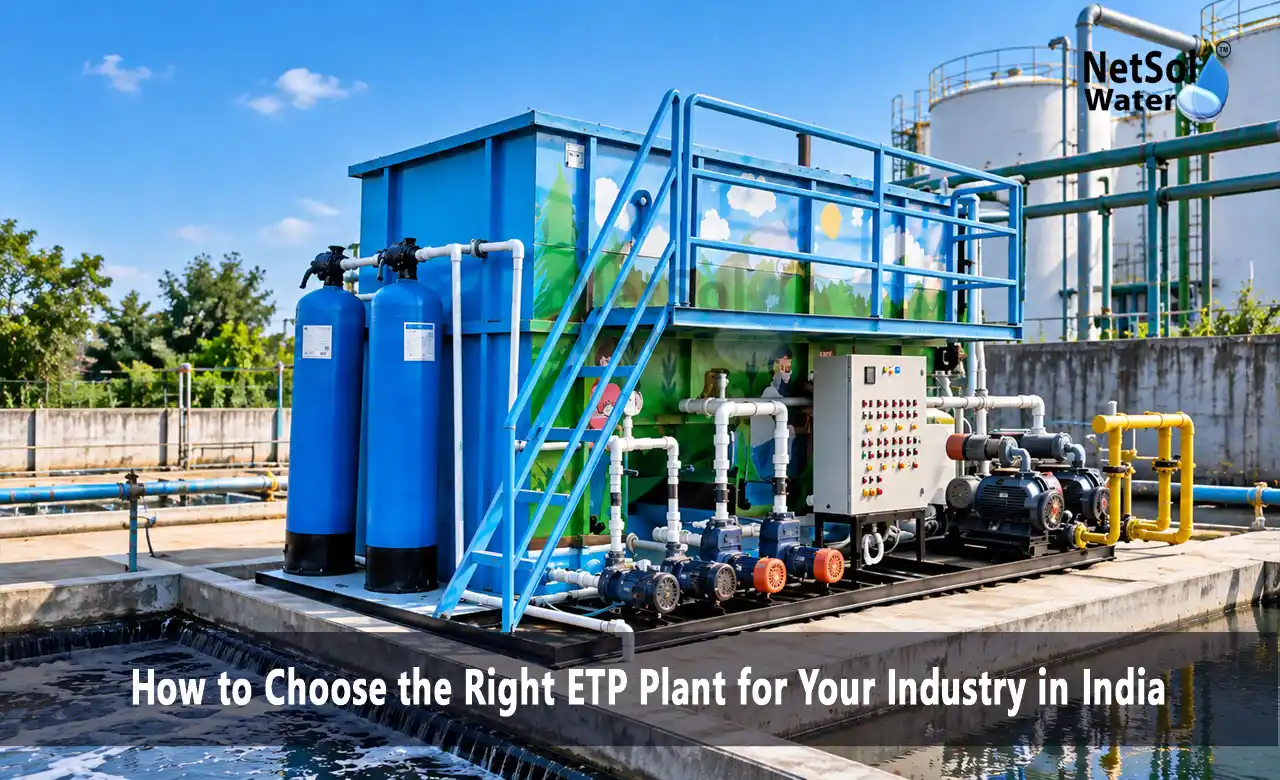
How to Choose the Right ETP Plant for Your Industry in India?
Two factories can produce the same quantity of wastewater and still need completely different treatment plants. A dyeing unit has to deal with colour and dissolved salts. A dairy has to deal with fats and a heavy organic load. An electroplating unit has to deal with metals and acidic rinses. If the plant is chosen only by litres per day, it will usually struggle with at least one of these.
This guide explains how industries in India can approach ETP selection in a practical order: understand the wastewater first, confirm the discharge or reuse target, and only then decide on the treatment train.
Start With the Wastewater, Not the Plant
Before any design discussion, get the effluent tested. A single grab sample is rarely enough. Production changes from day to day, and so does the wastewater. Sample across different shifts and production batches so the numbers reflect real conditions. The usual parameters to check are:
. pH, which decides how much chemical correction is needed
. COD and BOD, which show the organic load and whether biological treatment will work
. Total suspended solids (TSS) and total dissolved solids (TDS)
. Oil and grease, colour and odour
. Heavy metals, solvents or other process-specific pollutants
Along with quality, note the flow pattern. Is the discharge continuous or in batches? What is the peak flow, and not just the daily average? A plant sized only for the average will overflow or underperform during peaks.
Know Your Discharge or Reuse Target
The required treated water quality depends on where it will go. Discharge into a sewer, onto land or into a surface water body each has different limits, and these are set by the Central Pollution Control Board (CPCB) and the respective State Pollution Control Board (SPCB) for your industry category. Norms get revised from time to time, so confirm the latest consent conditions with your SPCB before finalising the design.
If you plan to reuse the treated water for cooling towers, gardening, washing or process use, the plant will need a polishing stage on top of basic treatment. Some sectors and regions also push industries towards zero liquid discharge (ZLD), which adds evaporation or advanced membrane stages. It is cheaper to plan for this at the start than to retrofit it later.
Typical Treatment Stages in an ETP
The exact treatment train varies, but most plants are built from the following blocks. If you want a closer look at how each unit works, you can read our guide on why an ETP plant is required and how it functions.
1. Preliminary treatment: screening, oil and grease removal and an equalization tank to even out flow and load.
2. Primary treatment: pH correction, coagulation, flocculation and clarification to remove suspended solids and part of the pollutant load.
3. Secondary (biological) treatment: processes such as activated sludge, MBBR or MBR to break down dissolved organic matter.
4. Tertiary treatment: sand and carbon filtration, ultrafiltration and disinfection to polish the water for discharge or reuse.
5. Advanced treatment: reverse osmosis and evaporation systems where TDS removal or ZLD is needed.
6. Sludge handling: thickening and dewatering so that sludge can be stored and disposed of properly.
Industry-Wise Starting Points
The table below shows common pollutants and the treatment focus for a few major sectors. It is a starting point only. Final design should always follow lab results from your own effluent.
| Industry | Common Pollutants | Treatment Focus |
|---|---|---|
| Textile and dyeing | Colour, salts, COD, suspended solids | Coagulation, biological treatment, membrane stage for reuse |
| Pharma and chemical | High COD, hard-to-degrade organics, solvents | Equalization, pre-treatment, biological and advanced treatment |
| Food and dairy | BOD, fats, oil and grease, suspended solids | Screening, DAF, biological treatment, filtration |
| Metal finishing and electroplating | Heavy metals, acids, oils | pH correction, precipitation, oil separation, filtration |
| Tannery and leather | Chromium, sulphides, salts, organics | Stream segregation, chemical treatment, biological treatment, TDS management |
Common Mistakes to Avoid
. Choosing by price or capacity alone, without checking the effluent characteristics.
. Designing for average flow and ignoring peak load and batch discharge.
. Skipping a treatability study when the effluent is complex or changes often.
. Forgetting sludge generation and the cost of disposing of it.
. Not planning for operators, spares, automation and routine monitoring.
. Leaving no space or hydraulic margin for future expansion.
What Affects the Cost of an ETP?
There is no honest flat price for an ETP, because the cost follows the problem you need to solve. The main factors are treatment capacity, the strength and complexity of the effluent, the number of treatment stages, the material of construction (MS, FRP or RCC), the level of automation, sludge handling arrangements, and whether reuse or ZLD is required. Ask every supplier for a clear scope that states what is and is not included, so that quotes can be compared fairly.
Questions to Ask Before You Finalise a Supplier
. Will you study my effluent samples and visit the site before giving a design?
. What treated water quality will you guarantee, and how will it be verified?
. What are the expected power, chemical and manpower requirements each month?
Who handles commissioning, operator training and after-sales support?
Frequently Asked Questions (FAQs)
Q1. What is the difference between an ETP and an STP?
An ETP treats industrial wastewater from manufacturing and processing, which can contain chemicals, dyes, oils and metals. An STP treats domestic sewage from residential and commercial buildings, which is mostly organic in nature.
Q2. Can treated water from an ETP be reused?
Yes, in many cases. With the right polishing stages, treated water can be reused for cooling, washing, gardening or selected process uses. The intended use decides how much additional treatment is needed.
Q3. How long does it take to set up an ETP?
It depends on capacity, the civil work, equipment delivery and regulatory approvals. A small packaged plant can be ready much sooner than a large site-built plant, so ask your supplier for a realistic schedule after the site survey.
Conclusion
The right ETP is the one built around your own wastewater and your own discharge or reuse goal. Test first, define the target, then pick the treatment stages that make sense. This order saves money, avoids compliance trouble and keeps the plant easy to run for years.
Netsol Water designs and builds customised wastewater systems for industries across India. As an effluent treatment plant manufacturer in Noida with projects in many sectors, our team begins with effluent analysis and a site survey before proposing any design.
Do you need an advice or assistance on selecting the best water and waste water treatment unit? We have solutions for all your problems!
Let us know your problem, our experts will make sure that it goes away.
For an assistance or related query,
Call on +91-9650608473 Or write us at enquiry@netsolwater.com