

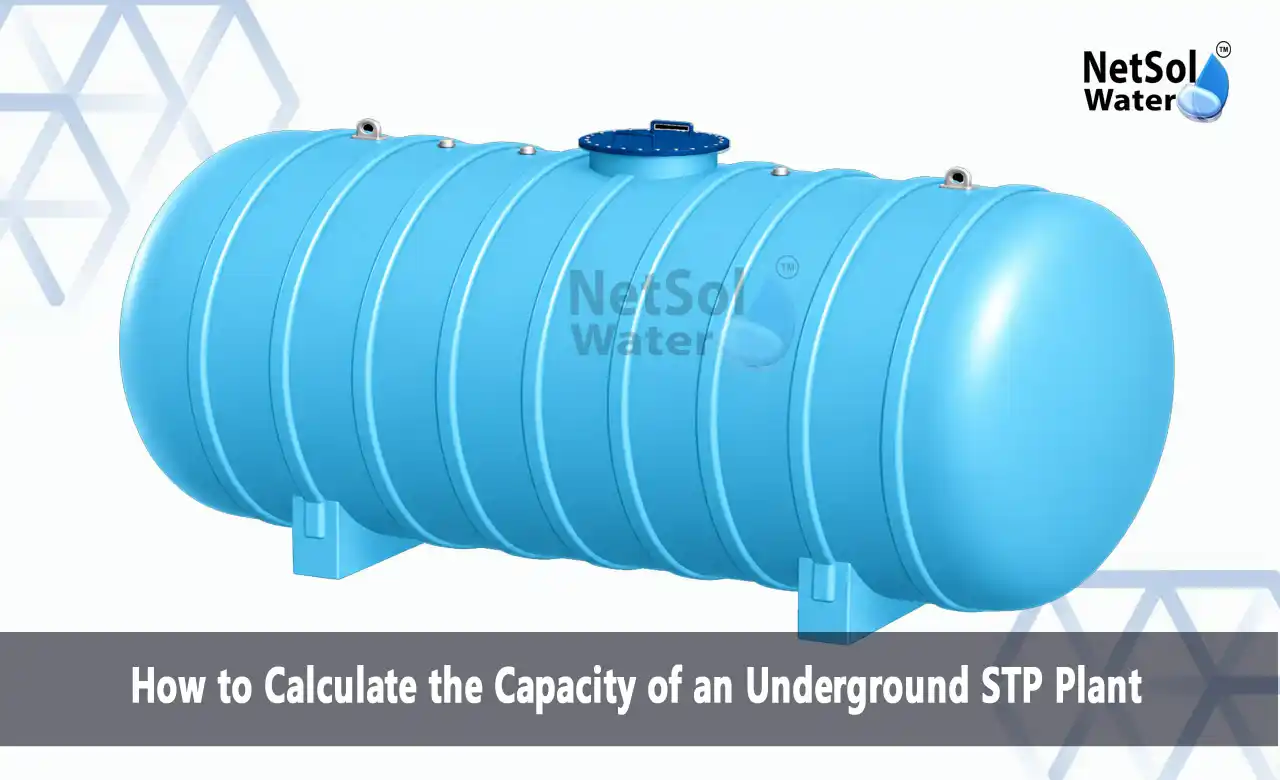
How to Calculate the Capacity of an Underground STP Plant?
Underground sewage treatment plant is used to manage wastewater and does not require land to be allocated to a treatment plant. It can be utilised for housing, hotels, hospitals and offices. Urban areas are expanding, for example Delhi and Noida. Consequently there is often restricted land availability. Below-ground sewage treatment can then be used to free up land for parking and communal areas. The below-ground sewage treatment plant must be sized to deal with the amount of wastewater produced. Plants are often sized in kilolitres per day (KLD). 1KLD = 1,000 litres. Under-sizing can cause issues and over-sizing can raise costs. Firstly the number of people and their associated water usage is analysed. Engineers then analyse water flow and site information to determine the most suitable design.
Determine Design Population and Water Usage
It is necessary to analyse who will be using a site and their likely water usage. This information is used to then assess wastewater production.
Calculate the site population
For housing, this can be determined by analysing the number of flats and estimating future residents. Offices should consider both staff and frequent visitors. Hotels and hospitals will require individual analysis as guests and patients can have greater water usage than office workers. Typically schools are only occupied during the day. Ensure that the population and working hours analysis relates to real figures.Consider future expansion. New housing may increase in population as flats become occupied. Additional space can also be developed for commercial sites. For an established property, analyse water bills and flow information. The National Institute of Urban Affairs advises carrying out population and flow analysis. Engineers use this information to determine a realistic below ground sewage treatment plant size.
Determine appropriate water supply
Based on CPHEEO advice, the typical water supply for a city with mains and sewerage is 135 litres per person per day. For metropolitan and mega cities this rises to 150 litres. Location and project type will influence the suitable water supply. Hospitals and hotels may also require individual analyses. Local water bills or meters can often be used for this. Smaller sites may require wastewater flow analysis. Furthermore, analyse if there are variations in site population and usage for example at weekends or during certain seasons.
Change Water Usage into Daily Wastewater Flow
The population and water supply can then be analysed to determine an estimated daily wastewater flow. This provides an initial KLD site wastewater flow figure.
Apply the general capacity equation
Typically it is assumed that 80% of water supplied is converted to wastewater. CPHEEO advises using this figure for developed areas. However, local water usage can affect flows and so smaller sites may require flow analysis.
Average Wastewater Flow (KLD) = Population × Water Supply (LPCD) × Return Factor / 1,000
LPCD indicates litres per capita per day. A return factor of 0.80 equates to 80% of water supplied being discharged into sewers. As mentioned, this is an average daily figure. Engineers still need to then design the hydraulic and structural components.
Analyse a basic example
Assume there are 500 people living in a housing complex. Further suppose that each person is allocated 135 litres of water daily. Using a return factor of 0.80:
500 × 135 × 0.80 ÷ 1,000 = 54 KLD
Hence, the complex has an estimated average wastewater flow of 54KLD. This provides an initial design figure. Prior to finalising the site’s plant size, real water usage should be analysed. Visitor and communal area usage should also be taken into consideration. Further wastewater can be produced by, for example, a large kitchen or laundry. If flow information is available, compare this with the calculated figure. An engineer should verify the optimum plant size using site information alongside relevant guidelines.
Analyse Peak Flow and Site Details
Wastewater flow fluctuates. Further, there are particular considerations for below ground plant installation. Both of these aspects should be analysed.
Analyse peak flow and infiltration
Peak flow can occur around a morning and evening. Engineers analyse this and introduce a peak factor to assess sewers and pumps. This will depend on both the site population and local factors. However, the daily KLD flow figure should not simply be multiplied by the peak factor – this does not represent the plant’s daily capacity.Investigate if surface water and/or groundwater is seeping into sewers. CPHEEO guidance takes infiltration into account where appropriate. Nevertheless, this should not exceed 10% of designed wastewater flow. The final infiltration figure should consider the local water table and sewer state.
Analyse site and treatment requirements
Below ground sewage treatment plants must contain tanks, piping, pumps and access points. Engineers should analyse the soil and groundwater to assess how this may impact on the site structure. Furthermore, they need to design an effective ventilation system and ensure safe access for servicing and replacement of equipment.Treatment dictates the required tank size and dwell time. Water quality is also important. Additional treatment may be required if there are high levels of oil/grease or industrial contaminants for example. Again, KLD demonstrates the volume of wastewater that can be treated on a daily basis. Based on the selected treatment and design, engineers determine the physical tank size. Hence, below ground sewage treatment plant size must be suitable for both daily wastewater flow and the decided upon treatment method.
Conclusion
Correct population and water usage information is key in determining wastewater flow. Engineers also need to analyse peak flow and site details when deciding on plant and tank design. Appropriately establishing below ground sewage treatment plant size can avoid both under and over sizing, and so reduce costs.
Netsol Water is a leading company for designing bespoke below ground sewage treatment. Contact Netsol Water to advise on your site’s requirements or to book in for consultancy to design an appropriate underground sewage treatment plant.
Contact Netsol Water at:
Phone: +91-9650608473, Email: enquiry@netsolwater.com