

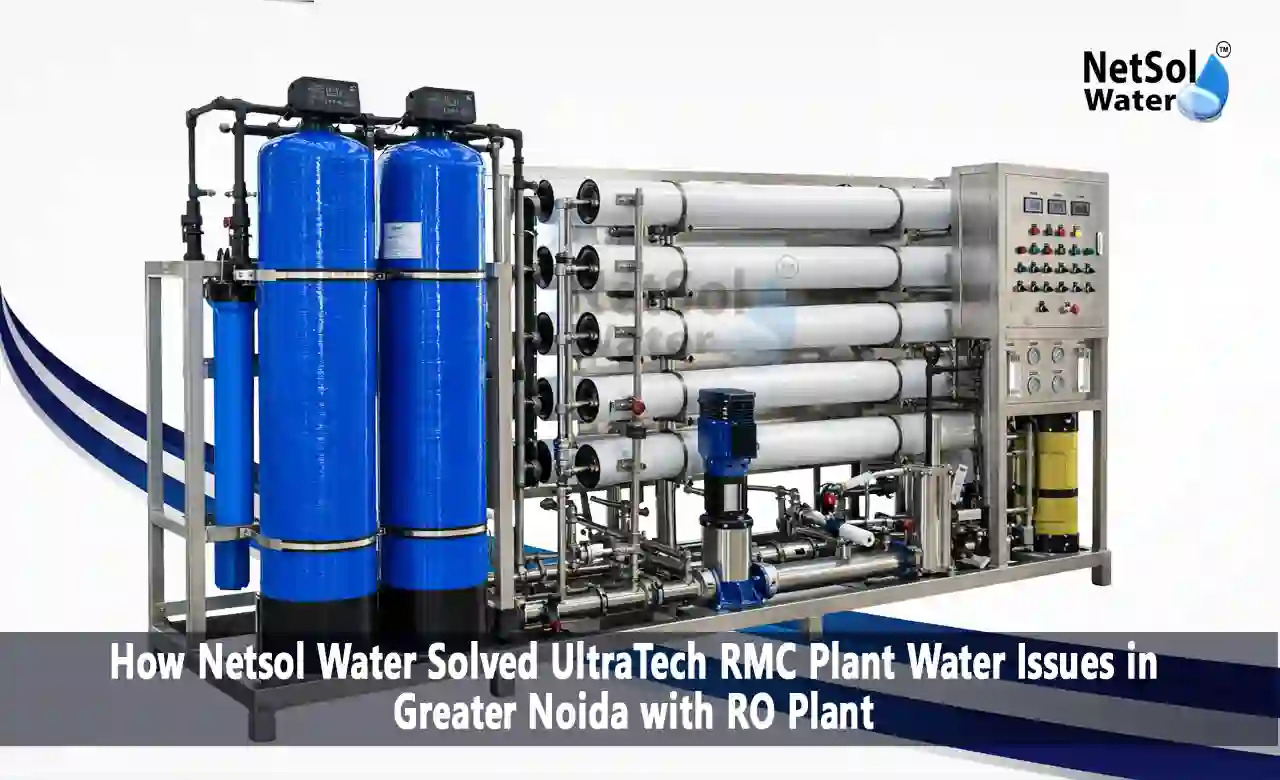
Case Study: RO Plant for RMC Plant at UltraTech, Greater Noida
Water is not just an ingredient in concrete - it is a critical construction material. The quality of water used in a Ready Mix Concrete (RMC) plant directly decides whether a structure stands for decades or starts showing cracks within a few years. Yet, water quality is one of the most overlooked aspects of concrete production in India.
This is the story of how Netsol Water designed, supplied, installed, and commissioned a 5000 LPH Industrial RO Plant for an RMC Plant run by Ultratech Cement in Greater Noida, Uttar Pradesh - and how that single installation transformed the quality, consistency, and cost-efficiency of the entire operation.
About the Client: Ultratech Cement, RMC Division
Ultratech Cement is one of India's largest and most respected cement and concrete companies. Their Ready Mix Concrete (RMC) division produces pre-mixed concrete that is delivered directly to construction sites - ready to pour. RMC plants need a continuous, reliable supply of water that meets strict quality standards.
In the concrete industry, water is not just a mixing agent. It participates in the chemical hydration reaction that gives concrete its strength. Even small variations in water quality - especially dissolved salts, chloride levels, or TDS (Total Dissolved Solids) - can significantly affect:
. The compressive strength of concrete
. The water-to-cement ratio
. The long-term durability of the structure
. The corrosion of steel reinforcement inside the concrete
The Ultratech RMC plant in Greater Noida was drawing water from a local borewell source. And like most groundwater in the NCR region, it was high in TDS, hardness, chlorides, and sulfates - exactly the kind of water that causes problems in concrete production.
The Problem: Hard Water Was Quietly Damaging Quality
When the Ultratech team first approached Netsol Water, the challenge wasn't a sudden breakdown - it was a slow, persistent quality problem that had been building up over time.
Here's what the plant was dealing with:
1. High TDS in Feed Water The borewell water feeding the RMC plant had a TDS level far beyond what IS:456 (the Indian Standard code for concrete) permits for mixing water. High TDS means more dissolved salts, which directly interfere with the cement hydration process.
2. Scaling Inside Pipes and Mixers Hard water leaves behind calcium and magnesium deposits on the inner walls of pipes, mixers, and concrete batching equipment. Over time, this scaling restricts flow, reduces equipment life, and increases cleaning costs. The maintenance team was spending considerable time and money just fighting scale buildup.
3. Inconsistent Concrete Batch Quality Because the TDS and hardness of the raw water wasn't controlled, every batch of concrete came with slight variations. This made it harder to maintain a consistent mix design and resulted in occasional rejection of concrete batches - a costly problem for any RMC plant.
4. Risk of Reinforcement Corrosion High chloride content in water is a silent killer in reinforced concrete structures. It triggers corrosion in the embedded steel bars, which eventually leads to structural cracking and spalling. For a company like Ultratech, delivering concrete that risks long-term structural damage was simply not acceptable.
Our Solution: A 5000 LPH Industrial RO Plant Built for Heavy-Duty Operation
After an on-site water quality assessment and a detailed study of the plant's daily water consumption and operational requirements, Netsol Water proposed a 5000 Litres Per Hour (LPH) Heavy-Duty Reverse Osmosis (RO) Plant - designed specifically for industrial concrete production environments.
Why 5000 LPH?
An RMC plant doesn't just need clean water - it needs a lot of it, consistently, throughout the working day. A 5000 LPH capacity means the plant can receive up to 1,20,000 litres of purified water in a 24-hour cycle, more than enough to support continuous batching operations without interruption.
Technology Used
The system is built on multi-stage Reverse Osmosis membrane technology, which is the gold standard for removing dissolved salts, heavy metals, chlorides, sulfates, and other contaminants from water. The key components of the installed system include:
. Multi-Media Pre-Filter (MMF): Removes suspended particles, sand, and turbidity from raw borewell water before it enters the main system.
. Activated Carbon Filter (ACF): Eliminates chlorine, organic compounds, and odor from the feed water, protecting the RO membranes.
. Antiscalant Dosing System: A precisely controlled chemical dosing unit that prevents scaling on RO membranes, extending their operational life significantly.
. High-Pressure Pump: Generates the pressure required to push water through the semi-permeable RO membranes at the correct flow rate.
. RO Membrane Assembly: The core of the system - commercial-grade, high-rejection RO membranes that filter out dissolved salts, chlorides, sulfates, and heavy metals, producing permeate water with controlled, low TDS.
. Product Water Storage Tank: Stores treated water ready for use in the concrete batching process.
. Control Panel with Automation: A PLC-based control panel monitors system pressure, flow, and TDS in real time, with auto-flush and auto-shutdown capabilities.
Also Read: What is The Importance of RO Water for RMC Plant?
Installation Highlights
The entire project - from equipment supply to final commissioning - was handled end-to-end by Netsol Water. The installation was completed at the Ultratech Cement RMC Plant site in Greater Noida, with minimal disruption to ongoing plant operations.
A key feature of this engagement is the Annual Maintenance Contract (AMC) signed alongside the installation. This means Netsol's service team handles all scheduled maintenance, membrane cleaning, filter replacements, and performance checks - so the Ultratech team can focus on concrete production without worrying about the water treatment system.
Watch the Completed Project Video
Netsol Water documented the complete on-site installation of this 5000 LPH RO Plant at the Ultratech Cement RMC Plant in Greater Noida. The video walks through the equipment, setup, and commissioning process in real time.
Watching the installation gives you a practical sense of the scale, engineering, and precision involved in setting up an industrial water treatment system for an active RMC plant - highly recommended if you are evaluating a similar solution for your facility.
How the RO Plant Works at the RMC Site?
Here is a step-by-step breakdown of how raw borewell water becomes high-quality concrete mixing water:
Step 1 – Raw Water Intake Borewell water is pumped into the pre-treatment section of the RO plant through an inlet line. A raw water storage tank ensures a steady supply even if the borewell pump cycles on and off.
Step 2 – Pre-Treatment Stage The water passes through the Multi-Media Filter, which removes suspended solids and turbidity. It then flows through the Activated Carbon Filter, which removes chlorine and organic impurities. Antiscalant chemical is dosed into the water line before the high-pressure pump to protect the membranes from scaling.
Step 3 – RO Membrane Filtration The pre-treated water is pushed under high pressure through the RO membrane array. The semi-permeable membranes allow only pure water molecules to pass through (called permeate), while rejecting dissolved salts, chlorides, sulfates, heavy metals, and other contaminants (which exit as reject/brine water).
Step 4 – Product Water Storage The treated permeate water - now with a low, IS:456-compliant TDS level - is collected in a clean water storage tank. This tank feeds directly into the concrete batching system.
Step 5 – Usage in RMC Batching The purified water is used in the concrete mix design, maintaining the precise water-to-cement ratio required for each grade of concrete. The result is consistent batch quality, every single time.
Results & Benefits
The impact of the RO plant was visible within the first few weeks of commissioning. Here's what the Ultratech RMC Plant team experienced:
1: Significantly Improved Water Quality The treated water TDS dropped to within IS:456 standards, with chloride and sulfate levels well within permissible limits. This alone removed a major risk factor from the concrete production process.
2: Stronger, More Consistent Concrete With controlled, consistent water quality going into every batch, the concrete compressive strength tests showed more uniform results. Rejection rates for non-conforming batches came down noticeably.
3: Reduced Scaling and Maintenance Costs With soft, low-TDS water circulating through the plant's pipes and mixers, scaling stopped being a recurring problem. The maintenance team reported a clear drop in equipment downtime related to scale buildup.
4: Lower Chemical Additive Consumption Hard water forces concrete producers to use more plasticizers and other chemical admixtures to achieve the desired workability. Purified water reduced this dependency, resulting in direct cost savings per cubic meter of concrete produced.
5: Full IS:456 Compliance Perhaps the most important outcome - the plant now operates with full confidence that its mixing water meets Indian Standard requirements. For a company of Ultratech's stature, this is non-negotiable.
6: Automated, Low-Maintenance Operation The PLC-based control system handles routine operations automatically. Combined with the AMC from Netsol Water, the plant gets professional maintenance support without needing dedicated in-house water treatment expertise.
Why Every RMC Plant Needs a Proper Water Treatment System?
If you run an RMC plant and you're drawing water from a borewell, a municipal line, or a recycled source - there is a very real chance that water quality is silently affecting your concrete output. Here's why this matters more than most plant managers realize:
1: Water is a Structural Material Unlike sand or aggregate, water participates chemically in concrete formation. Its quality cannot be treated as secondary. IS:456 specifically lays out standards for mixing water - and those standards exist for a reason.
2: Cost of Poor Water > Cost of Treatment The cost of a 5000 LPH RO plant is a one-time investment. The cost of structural failures, rejected batches, corroded reinforcement, and costly rework runs into multiples of that - plus the reputational damage that follows.
3: Regulatory and Client Expectations Are Rising Infrastructure projects, real estate developers, and government contracts increasingly specify IS:456 compliance for mixing water. An RO plant is not just good practice - it is becoming a competitive and contractual requirement.
4: Recycled Water Applications Many RMC plants are now exploring recycled wastewater from washout and drum cleaning. An industrial RO plant makes this recycled water usable for concrete mixing, reducing freshwater consumption and supporting sustainability goals.
Conclusion:
This project at the Ultratech Cement RMC Plant in Greater Noida is a clear example of what the right RO Plant for an RMC Plant can accomplish. A properly designed, correctly sized, and professionally installed industrial RO system doesn't just treat water - it protects the integrity of every batch of concrete that leaves the plant.
For Netsol Water, this wasn't just an equipment supply job. It was a complete solution - assessment, design, installation, commissioning, and ongoing maintenance - all delivered by a team that understands both water treatment and the specific demands of the concrete industry.
If your RMC plant is struggling with hard water, TDS-related quality issues, scaling problems, or IS:456 compliance, the answer starts with your water source. And the solution is an industrial RO Plant built for the job.
Contact Netsol Water Solutions today to discuss the right water treatment system for your RMC plant. +91-9650608473 | info@netsolwater.com
Frequently Asked Questions (FAQs)
Q1. What is an RO Plant for an RMC Plant?
An RO (Reverse Osmosis) Plant for an RMC (Ready Mix Concrete) Plant is an industrial water purification system that removes dissolved salts, chlorides, sulfates, heavy metals, and other contaminants from raw water - borewell, municipal, or recycled - to produce high-quality mixing water that meets IS:456 standards for use in concrete production. It ensures the water-to-cement ratio remains consistent, protecting concrete strength and durability.
Q2. Why is water treatment important in concrete production?
Water is not just a mixing ingredient - it participates in the chemical hydration of cement that gives concrete its strength. Contaminated or hard water can reduce compressive strength, cause corrosion of steel reinforcement, create workability issues, and lead to inconsistent batch quality. IS:456, the Indian Standard for concrete design, lays out specific permissible limits for TDS, chlorides, sulfates, and other parameters in mixing water. Water treatment ensures compliance and protects the quality of every pour.
Q3. What is the capacity of the RO Plant installed at the Ultratech RMC Plant?
Netsol Water installed a 5000 LPH (Litres Per Hour) Industrial RO Plant at the Ultratech Cement RMC Plant in Greater Noida. This capacity translates to approximately 1,20,000 litres of purified water per day - sufficient to meet the full daily water demand of an active RMC batching operation.
Q4. What is the approximate cost of a 5000 LPH RO Plant for an RMC Plant?
The cost of a 5000 LPH industrial RO plant varies depending on raw water quality, pre-treatment requirements, automation level, and site conditions. Generally, industrial RO plants in this capacity range are priced between INR6 lakh and INR15 lakh or more, depending on specifications. Netsol Water provides customized quotations based on a free site water quality assessment. Contact them at +91-9650608473 for an accurate project estimate.
Q5. How does an RO Plant improve concrete quality?
An RO Plant removes the contaminants that interfere with concrete's chemical and physical properties. By controlling TDS and eliminating chlorides and sulfates, it ensures the cement hydrates correctly, the water-to-cement ratio is maintained accurately, and reinforcement steel is protected from premature corrosion. The result is higher compressive strength, more consistent batches, fewer rejections, and concrete that meets structural design specifications reliably.
Q6. Does Netsol Water offer AMC (Annual Maintenance Contract) for RO Plants?
Yes. Netsol Water offers comprehensive Annual Maintenance Contracts (AMC) and Operation & Maintenance (O&M) services for all installed RO plants. This includes scheduled service visits, membrane cleaning, filter replacements, performance monitoring, and on-site support - ensuring the plant operates at peak efficiency throughout the year without requiring dedicated in-house technical expertise from the client.