

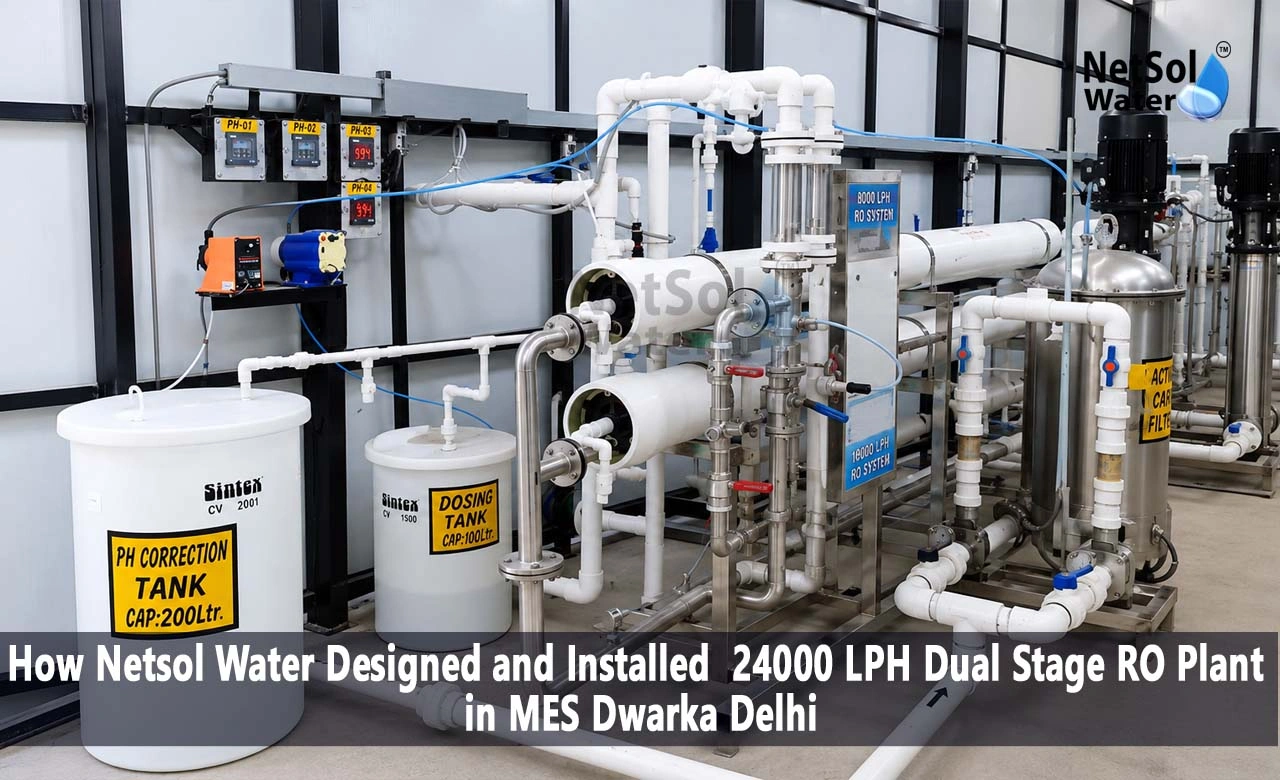
Case Study: Installed MES Dwarka 24000 LPH Dual Stage RO Plant | Netsol Water
When the Military Engineer Services (MES) unit at Dwarka needed a dependable source of drinking water, the numbers coming back from their water testing report were hard to ignore. The raw water at the site carried a Total Dissolved Solids (TDS) level of nearly 6000 ppm, more than ten times what is considered safe for regular drinking. Water at that level tastes bitter, is hard on the body over time, and simply cannot be supplied to a residential and institutional campus without serious treatment.
MES approached Netsol Water a leading commercial RO plant manufacturer and supplier, to design a system that could handle this volume of water at this level of contamination and still deliver water fit for daily human consumption. What Netsol Water proposed, and eventually built, was a dual stage RO plant with a combined capacity of 24,000 litres per hour (LPH) a 16,000 LPH RO plant working in the first stage and an 8,000 LPH RO plant completing the polish in the second. This case study walks through the problem, the reasoning behind the solution, and the result.
About the Client
MES Dwarka is part of the Military Engineer Services, the body responsible for construction and maintenance of defence infrastructure across India, including residential quarters, offices, and utility services for military personnel and their families. A site of this nature has a constant, non-negotiable requirement: clean water, every single day, in bulk. There is no room for a treatment system that works intermittently or breaks down under load.
Given the scale of the campus, the daily water demand was significant, and the source available on site was groundwater with unusually high salinity. That combination high daily demand plus poor source water quality is exactly the kind of project that calls for an experienced industrial RO plant supplier rather than an off-the-shelf unit.
The Problem: Water With 6000 PPM TDS
A TDS reading of 6000 ppm puts water well outside the range the Bureau of Indian Standards (BIS 10500) considers acceptable for drinking, where the upper limit is 500 ppm, extendable to 2000 ppm only in the absence of an alternate source. At 6000 ppm, water is not just unpleasant to drink; sustained use can contribute to kidney strain, digestive issues, and scaling in pipwork and appliances.
For MES Dwarka, this meant the existing borewell source could not be used directly for drinking or even general domestic use without a proper high TDS water treatment plant in place. The requirement Netsol Water was given was straightforward to state and difficult to execute: treat 24,000 litres of this water every hour and bring the TDS down to safe drinking levels, consistently, without the plant choking on its own feed water.
Why a Single-Stage RO Plant Was Not the Right Fit?
It is worth explaining why Netsol Water did not simply install one large RO plant and call it done. Reverse osmosis membranes are rated to work within a certain feed TDS range, and pushing water at 6000 ppm through a single pass changes the economics and the performance of the system in a few ways.
• Osmotic pressure rises sharply at high feed TDS, which forces the pumps to work harder and pushes the membranes closer to their operating limits.
• Recovery rate the percentage of feed water that becomes usable permeate drops, which means more water is wasted as reject.
• A single pass at this TDS level often cannot bring the output all the way down to the sub-500 ppm range needed for drinking water, especially when the plant is also expected to run at high volume.
• Membrane fouling and scaling accelerate, shortening membrane life and increasing maintenance costs over time.
This is precisely the scenario where a dual stage RO plant earns its cost. By splitting the treatment into two passes, the first stage carries the heavy lifting of bringing down bulk TDS, while the second stage refines that already-improved water to drinking standard, without ever forcing a single membrane bank to do more than it is built for.
The Netsol Water Solution: 24,000 LPH Dual Stage RO Plant
Netsol Water's design team studied the water analysis report from Dwarka and proposed a two-part system built around a shared storage tank, so that each RO plant operates independently and can be serviced without shutting down the entire supply.
Stage 1 - 16,000 LPH RO Plant
Raw water from the borewell first passes through a pre-treatment line sand filtration, activated carbon filtration, antiscalant dosing, and micron cartridge filtration before entering the RO membranes. This stage is sized larger because it is doing the bulk of the desalination work, bringing the TDS down from around 6000 ppm to a level that is safe for general use and suitable for further polishing.
Intermediate Storage
The treated water from Stage 1 is collected in a storage tank rather than being sent straight into the second RO unit. This buffer gives the system flexibility Stage 2 can draw water at its own pace, and any variation in Stage 1 output does not directly disturb Stage 2 performance.
Stage 2 - 8,000 LPH RO Plant
Water from the storage tank is drawn into the second RO plant, which treats it a second time. Because the feed water entering this stage already has a much lower TDS than the original borewell water, the membranes here can achieve a higher recovery rate and bring the final output down to well within drinking water standards.
Process Flow
Raw Borewell Water (TDS approx. 6000 ppm) → Pre-treatment (Sand Filter, Carbon Filter, Antiscalant Dosing, Cartridge Filter) → Stage 1: 16,000 LPH RO Plant → Intermediate Storage Tank → Stage 2: 8,000 LPH RO Plant → Drinking-Grade Treated Water → Storage and Distribution to MES Campus.
Watch the Plant Video
To see the dual stage RO plant in action at the MES Dwarka site, watch our on-site walkthrough covering the pre-treatment setup, both RO stages, and the final water quality testing. The video gives a clear, real look at how Netsol Water engineered a working solution for one of the toughest high TDS water challenges we have handled.
Technical Overview
| Parameter | Stage 1 RO Plant | Stage 2 RO Plant |
|---|---|---|
| Capacity | 16,000 LPH | 8,000 LPH |
| Feed Water Source | Raw borewell water (approx. 6000 ppm TDS) | Stage 1 treated water (from storage tank) |
| Pre-treatment | Sand filter, carbon filter, antiscalant dosing, cartridge filter | Cartridge filtration ahead of second pass |
| Role in System | Primary desalination bulk TDS reduction | Polishing pass brings water to drinking standard |
| Output Quality | Substantially reduced TDS, suitable for second-pass treatment | Within BIS drinking water TDS limits |
Before and After: Water Quality Comparison
| Parameter | Before Treatment | After Treatment |
|---|---|---|
| TDS | Approx. 6000 ppm | Within BIS drinking water limits |
| Usability | Not fit for drinking or general domestic use | Fit for drinking and daily campus use |
| Supply Volume | Untreated borewell supply only | 24,000 LPH of treated water available |
Results and Benefits Delivered
Once commissioned, the system gave MES Dwarka a steady supply of drinking-grade water at a scale the campus actually needed, instead of relying on tankers or partial fixes. A few outcomes stood out.
• 24,000 litres of treated water available per hour, matching the daily demand of a large residential and institutional campus.
• TDS brought down from roughly 6000 ppm to within safe drinking water limits, verified through post-installation water testing.
• Lower long-term strain on membranes and pumps compared to a single overworked RO unit, thanks to the load being split across two stages.
• A more reliable, low-maintenance operation, since each stage can be serviced independently without stopping the whole supply.
• A repeatable, scalable design the same dual stage approach can be resized for other high-TDS sites with similar water quality problems.
Why NETSOL Water?
Projects like MES Dwarka are a good illustration of what separates a basic RO plant installer from a genuine commercial RO plant manufacturer and supplier. The feed water here was difficult, the volume requirement was high, and there was no margin for a design that looked good on paper but underperformed on site. Netsol Water's engineering team built the plant around the actual water report rather than a standard template, which is the difference between a system that works for a few months and one that keeps performing for years.
Netsol Water works across industrial RO plant, commercial reverse osmosis plant, and bulk water treatment projects for institutions, defence establishments, industrial units, and commercial buildings that need dependable water treatment plant installation backed by real engineering, not guesswork. The Dwarka project is one example of how a well-designed RO plant for high TDS water can turn an unusable source into a safe, everyday supply.
Conclusion
The MES Dwarka project shows what is possible when a water treatment plan is built around the specific problem in front of it rather than a generic solution. A 6000 ppm TDS source, once considered unfit for use, now supplies clean drinking water at 24,000 litres per hour through a two-stage RO process designed, installed, and commissioned by Netsol Water. For any organisation dealing with high-salinity groundwater and a genuine need for bulk drinking water, this project is a working example of how the right engineering approach solves a problem that a single-stage system simply cannot.