

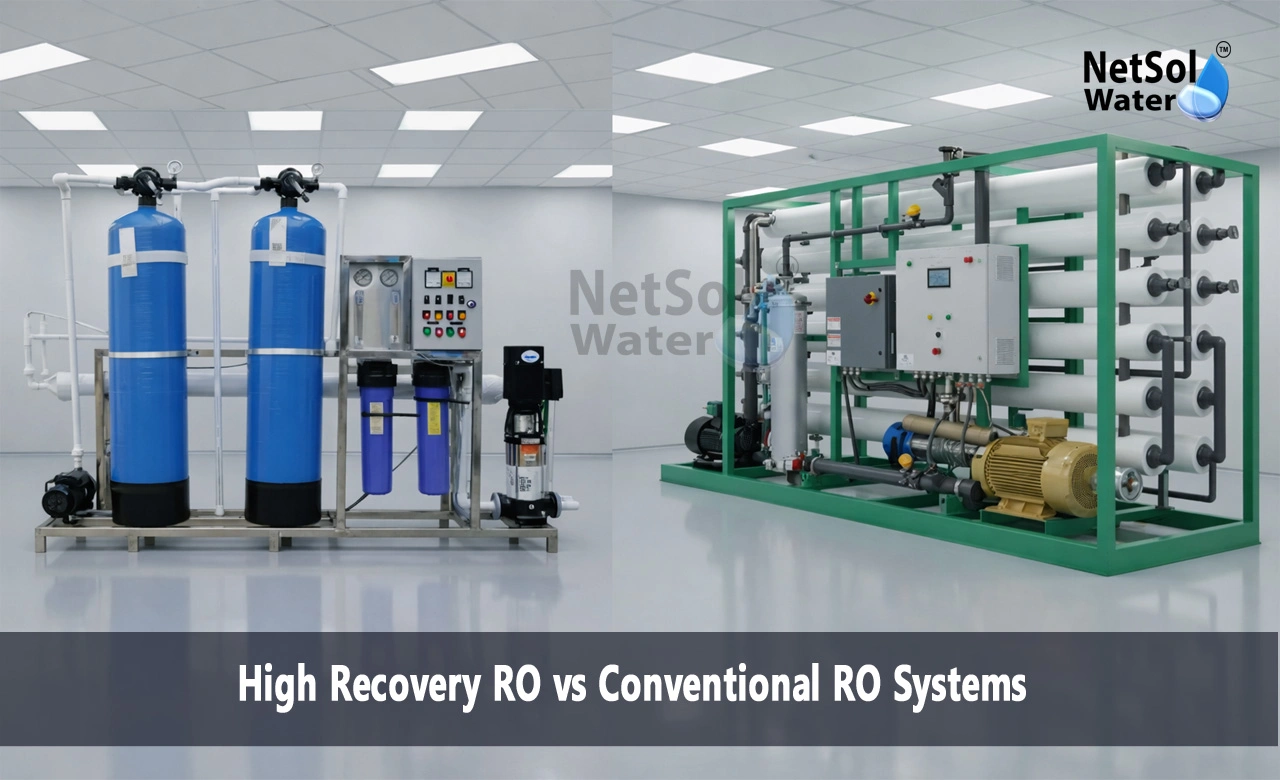
What is High Recovery RO and Conventional RO Systems?
Reverse Osmosis systems play a fundamental role in the treatment of water in industries and commercial setups. With increasingly limited water sources and strict discharge requirements, industries are now being called upon to utilize all water they possess more effectively. This has seen an increase in the interest towards high-recovery RO plants with conventional RO systems still remaininga very popular option as they are more reliable and easier to operate.
In spite of the fact that both systems apply the same basic principle of membrane separation, design objective, limits of operation as well as their long-term performance characteristics are highly disparate. These differences are very important to understand prior to making the correct choice of RO configuration.
What Is High-Recovery RO?
High-recovery RO systems have been developed to recover as much permeate as possible of the feed water. It is aimed at reducing the volume of rejects and enhancing the total amount of water reuse in the plant.
In order to have higher recovery, such systems will be run at higher concentration factors within the membrane elements. This leads to a rise in osmotic pressure, rise in salt concentration in the reject stream, and the reliance on accurate pretreatment and chemical control. High-recovery RO systems tend to employ multi-stage setups, superior antiscalants and closer regulation of operating variables.
These systems are widely used in ZLD plants, water-scarce industries and plants that have high costs or limitations of wastewater disposal.
What Is Conventional RO?
Conventional RO systems have a conservative recovery scheme. This is aimed at long-term stability in operations, protection against membrane and ease of operation and not at maximum extraction of water.
The conventional RO systems sustain lower salt concentration in the membrane system by working at low recovery. This minimises scaling propensity, fouling and pressure associated stress on membranes. Pretreatment needs are generally easier and the system is more amenable to changes in the quality of feed water.
The conventional RO is common in the cases where the raw water supply is not limited and the cost of reject disposal is not of significant difficulty to the regulations and economy.
High-Recovery RO vs Conventional RO Systems
1: Philosophy of Recovery and Water Balance
The basic disparity is between recovery targets. High-recovery RO systems are designed to minimize loss of water where reject is significantly lower than the traditional systems. The traditional RO tolerates larger rejects to have safer operating margins and stable operations.
2: Scaling and fouling Sensitivity
High-recovery RO systems are closer to chemical solubility limits. The salt dissolutions get concentrated as the recovery rises thus escalating the chances of scaling and foulage. The smallest pretreatment failures may lead to damages of membranes.
The nature of conventional RO systems is that they can be designed to run at lower concentration accumulation and hence they tend to be more resistant to scaling and fouling.
3: Energy and Pressure requirements
The regenerative RO systems which are high-recovery systems usually demand greater operate pressure to overcome the augmented osmotic pressure. This causes an increase in specific energy usage and mechanical stress to pumps and membranes.
The conventional RO systems do not require high pressure and therefore require less energy and require less complicated hydraulic design.
Chemical and Operational Control
The high-recovery RO systems rely on the specific dosing of the antiscalants, pH regulation, and constant monitoring. Minor deviations may have a swift performance impact.
Conventional RO systems are easier to operate and can put up with small fluctuations without performance degradation.
Lifecycle Cost Implication
Although the high-recovery RO systems can accomplish a reduction in freshwater intake, and the rejection handling cost as well, high capital cost, complicated operational handling and high chances of replacement of membranes, can be exhibited by the high-recovery RO systems, unless adequately controlled.
The conventional RO systems tend to be cheaper in terms of initial costs as well as operational costs but might lead to an increase in the long term costs of sourcing or disposing water.
Conclusion
The choice between High-Recovery RO vs Conventional RO Systems depends on application-specific priorities rather than technology preference. Higher recovery RO systems would be appropriate when there is a high need to conserve water and reduce discharge, yet, it requires rigorous operation and powerful pretreatment design. Traditional RO systems are simple, strong, and dependable in areas where water supply and disposal is not so critical.
An informed choice must involve chemistry of the feed water, regulation, operational capacity and the cost implication in the long-run to allow sustainable and hassle-free operation of RO systems.
Request Your Free Quote Now. Call our sales team at +91-9650608473 or write to us atenquiry@netsolwater.com. Our team will respond to site queries and arrange a free site survey. We offer detailed proposals with cost estimates delivery timelines and scope of work.