


Effluent Treatment Plant Manufacturer in Gurgaon
Netsol Water designs, manufactures and installs effluent treatment plants for industries in Gurgaon. All projects start with a test of your real wastewater. We design each treatment stage based on those figures and then manufacture the plant. Our engineers install it on your site and commission it to your Haryana State Pollution Control Board (HSPCB) discharge limit or your reuse target. Our skid-mounted units suit small workshops, while our large civil ETPs cater to industries with higher wastewater treatment requirements. If you need an Effluent Treatment Plant Manufacturer in Gurgaon who stays with the plant after handover, we also train your operators and provide annual maintenance services.
Customized Effluent Treatment Plants for Industries in Gurgaon
The water coming out of an auto paint shop at IMT Manesar is not the same as the water coming out of a garment washing unit at Udyog Vihar. The paint shop discharges oily water containing phosphates and paint solids. The washing unit releases coloured water containing dissolved salts. We study these differences to design each ETP.
The design is also influenced by your discharge route. The limits for treated water leaving the site are listed in your HSPCB consent. Many units now recycle their water. The Central Ground Water Board's 2024 assessment found that groundwater extraction in Gurugram Urban was 326.52% of the annual extractable resource, which is more than three times the sustainable level. Haryana's 2019 Reuse of Treated Waste Water Policy also encourages the use of treated water in place of fresh water.
Sources: Central Ground Water Board, National Compilation on Dynamic Ground Water Resources of India, 2024; Government of Haryana, Reuse of Treated Waste Water Policy, 2019;
Daily operation matters too. A three-shift plant needs different controls from a single-shift plant. If there is no experienced operator on site, simpler equipment and more automation are required. So before we draw a single line, we study your effluent, your discharge or reuse target and how your plant actually works.
What Is an Effluent Treatment Plant (ETP)?
An effluent treatment plant (ETP) is a system for cleaning effluent from industrial processes. Oil, suspended solids, heavy metals, dyes, solvents or acids may be present in factory effluent. An ETP removes these pollutants in a controlled order until the water complies with the consent or is suitable for reuse.
Treatment is required for industrial wastewater because the damage occurs quickly. Untreated effluent depletes oxygen in drains and rivers, killing aquatic life. Minerals and chemicals can leach into soil and groundwater and remain there for years. Gurgaon's master storm water drains flow into the Najafgarh drain, which then flows into the Yamuna. Careless discharge pollutes water far from the factory gate. HSPCB can refuse to renew your consent, levy environmental compensation or order the unit to shut down.
People often confuse an ETP with an STP. Domestic wastewater from toilets, washrooms and kitchens is treated at a sewage treatment plant (STP). This water is largely organic with a fairly predictable composition, so bacteria do most of the work. Process water from industry varies widely in composition and typically requires chemical and physical treatment before the biological stage in an ETP. Most Gurgaon factories need both, and we build both STP and ETP systems. The STP handles staff sewage and the ETP handles the production line.
How Does an Effluent Treatment Plant Work?
In an ETP, each stage removes one type of pollutant and protects the stage that follows it. The general structure of most plants we build in Gurgaon is the same. Let's look at these stages in the order the water meets them.
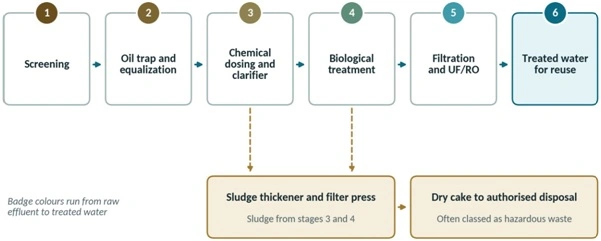
Typical flow through an effluent treatment plant. Your plant may skip or add stages depending on the effluent.
1. Preliminary treatment and screening
Raw effluent passes through bar screens, which remove rags, plastic and packing waste. A fine screen or grit chamber then removes any sand or metal fines carried by the water. This is a simple-looking stage, but it protects every pump downstream. A single plastic bag in the wrong place can block a pump and disrupt the plant for an entire shift.
2. Oil Separation and Equalization
The effluent then goes into an oil and grease trap, where an oil skimmer or tilted plate separator removes oil from the surface. It then enters an equalization tank. Factories do not normally discharge continuously, and dumping a single tank can produce a "slug" of heavy effluent. The equalization tank absorbs these peaks and mixes the water with air, so the rest of the plant sees an even load. One of the most common causes of missing ETP limits is an undersized equalization tank.
3. Chemical treatment and clarification
Dosing pumps first adjust the pH with acid or alkali. The fine particles are then destabilised with a coagulant (such as alum or poly aluminium chloride) in a flash mixer. In a flocculator, a polyelectrolyte binds them into larger flocs, which settle in a clarifier or tube settler. For oily or light solids we often prefer dissolved air flotation (DAF). Fine air bubbles lift the flocs to the surface, and a scraper removes them.
4. Biological treatment, where required
Bacteria are required to decompose dissolved organic matter. Blowers supply oxygen to the microbes in the aeration tank, and the microbes consume the organic load, which brings down BOD and COD. The water then passes into a secondary clarifier, where the biomass is separated from the treated water. Microbes are living organisms, and a shock dose of solvent or acid can knock them out for days. If the effluent has a very high organic load, an anaerobic stage may be needed before the aerobic biology; if it contains mostly inorganic pollutants, the biological stage may not be needed at all.
5. Filtration and tertiary treatment
Even after clarifying, the water still carries fine suspended particles. A pressure sand filter removes them, and an activated carbon filter removes some dissolved organics and colour. If the water needs to return to the process, we add ultrafiltration and reverse osmosis. Water for reuse is finally disinfected with sodium hypochlorite or UV.
6. Sludge handling and treated-water reuse
Sludge forms at several stages of pollutant removal. It is thickened and dewatered in a filter press or screw press, leaving a compact cake to dispose of rather than a wet slurry. In India, chemical sludge from many ETPs is classified as hazardous waste and must be disposed of at an authorised facility. Treated water is stored in a holding tank for irrigation, floor washing, cooling tower make-up or process use.
ETP Technologies in Industrial Wastewater Treatment
Choosing the right technology is about fit. The right match keeps the plant compliant and affordable to run, while a poor match fails at the first load swing. So let's examine a few of the technologies in use and where each one belongs.
1. Chemical coagulation and flocculation
This is the go-to treatment for industry. It is recommended for effluent with high suspended solids, colour, metals or emulsified oil, for example paint shop water and metal finishing rinses. The trade-off is chemical sludge. The dosing system is sized from jar testing of your effluent to keep sludge volumes and chemical costs under control.
2. Activated Sludge Process (ASP)
ASP is the "classic" biological system. Part of the settled sludge from the clarifier is returned to the aeration tank to maintain a steady population of microbes. It suits biodegradable effluents such as food and beverage wastewater. It requires more space than newer systems and is sensitive to sudden doses of toxins. Where land is available and the effluent is predictable, ASP is our choice.
3. Moving Bed Biofilm Reactor (MBBR)
MBBR adds small plastic carriers to the aeration tank, where bacteria grow on the surface as a film. The biomass stays in the tank, so the system holds a much higher biomass density in a smaller tank. It handles load swings better than ASP and needs no sludge recycling. That is why MBBR is our first choice for small sites and for upgrading existing ASP tanks without new civil work. Saving space matters in many Gurgaon units, which sit on small plots.
4. Membrane Bioreactor (MBR)
An MBR combines biological treatment with submerged membranes in place of a secondary clarifier. The membranes hold back almost all suspended solids and bacteria, so the treated water can feed an RO system directly. An MBR costs more to build and operate. When space is extremely limited or the plant must produce reuse water every day, it makes good sense.
5. Ultrafiltration and reverse osmosis for reuse applications
UF removes fine colloids and bacteria. RO removes even dissolved salts. Together they turn treated effluent into boiler, cooling tower and process water. RO is recommended only where the value of the reused water outweighs the cost. RO also generates a more concentrated reject stream, and you need a plan for it. Where the consent requires zero liquid discharge, we send the reject water to an evaporator or dryer.
6. ASP vs MBBR vs MBR: Comparison Table
The three biological systems above are the ones most often compared when choosing a plant. The table below shows how they differ in practice.
| Factor | ASP | MBBR | MBR |
|---|---|---|---|
| Space needed | Largest. Aeration tank plus secondary clarifier. | Medium. Often a smaller tank than ASP for a comparable load. | Smallest in many configurations. Membranes replace the secondary clarifier. |
| Capital cost | Low to medium | Medium | High |
| Power use | Medium. Blowers and sludge return pumps. | Medium. Aeration and associated equipment. | Often higher due to aeration, membrane scouring and permeate suction. |
| Running cost | Low to medium, depending on operation and maintenance. | Low to medium, depending on load and equipment. | Generally higher due to membrane cleaning and replacement costs. |
| Sludge recycle | Return activated sludge is generally required. | Return sludge is generally not required for the MBBR media itself; other process stages may need recycle. | Membranes retain biomass; sludge wasting is still required. |
| Handling of load swings | Performance depends on process control and biomass health; toxic shocks can affect treatment. | Biofilm can provide resilience to some load variations, depending on design and operation. | Biology can handle some variations, but membranes need suitable pretreatment and protection. |
| Treated water quality | Good biological treatment; further filtration may be needed for reuse. | Good biological treatment; further filtration may be needed for reuse. | Typically low suspended solids and strong solids separation; suitability for reuse depends on the complete treatment train. |
| Operator skill | Moderate | Low to moderate, depending on system design. | Moderate to high due to membrane operation and cleaning. |
| Best suited for | Biodegradable wastewater with steady loading and sufficient space. | Space-constrained sites, variable loads and suitable upgrades to existing treatment systems. | Sites requiring compact treatment and high-quality effluent for suitable reuse applications. |
Ratings are relative and indicative. The final choice depends on your lab results, your space and your discharge or reuse target.
Industries We Serve in Gurgaon
Gurgaon's industry extends beyond the glass office towers. The district is home to large automakers, their suppliers, and pharma and food processors. There are also garment exporters and small job shops. Let's look at some of these industries and the wastewater issues of each.
1. Automobile and auto-component manufacturing
Machining coolants and parts washing at auto plants and their suppliers produce oily effluent. Phosphates, zinc and nickel residues are added when parts are pretreated in the paint shop. Emulsified oil will not separate naturally and must first be broken chemically. The typical solution combines oil removal, chemical precipitation and DAF, with a biological stage when COD is high.
2. Pharma and chemical industries
Pharma and chemical effluents may contain COD that bacteria find difficult to degrade. Solvents, high dissolved salts and batch-to-batch variation make the job harder. Strong streams are separated at source and treated separately. Hazardous compounds may be broken down by advanced oxidation before biological treatment. Units under a zero liquid discharge condition also need RO and an evaporator.
3. Food and beverage processing
Dairies, bakeries, snack manufacturers and beverage factories generate effluent with high BOD, fats and suspended solids. The pH changes significantly during a clean-in-place (CIP) cycle. Once fats and pH are controlled, this effluent can be treated readily by biological methods. A DAF unit takes care of the fats. If the effluent is very strong, an anaerobic reactor reduces the organic load and also produces biogas.
4. Textile, dyeing and surface-finishing units
Garment washing and dyeing units face colour, high TDS, hot water and changing pH. Electroplating and metal finishing shops have a different problem: their rinse water carries chromium, nickel, copper and sometimes cyanide. The plant must first reduce hexavalent chromium and destroy cyanide in separate tanks before the streams are combined. Early mixing can cause a safety hazard and a treatment failure.
5. General manufacturing and industrial facilities
Plastic moulding units, printing presses and engineering units generate smaller but more consistent quantities of effluent. Their process drains frequently include boiler blowdown, cooling tower bleed and floor washing water. These sites typically need a small packaged ETP that one operator can run. It is often combined with the site STP so that a single team can manage both.
ETP Plant Capacity and Selection Guide
The first step in choosing an ETP is measurement, not the price list. Your wastewater flow, pollutant load, treatment goals and available space decide the plant you need. So let's look at some of the questions that help determine the final design.
1. How to select the right ETP capacity?
Record the actual daily effluent flow for at least one full production week, in kilolitres per day (KLD). Measuring effluent flow is more accurate than using water-intake figures, because intake includes water that evaporates or leaves with the product. Log peak-hour flows and batch dumps. Next, allow a margin for expansion you can reasonably expect, because a plant sized only for average flow will flood on your busiest day. Hours of operation matter too: a 24-hour plant needs a smaller hourly capacity than a plant that treats the same volume in a single shift.
2. Things that influence plant design and cost
Effluent strength is as important as effluent volume. The biological stage for a 50 KLD stream at 8,000 mg/l COD will be much larger than for a 50 KLD stream at 800 mg/l COD. The treatment target also shapes the design: treatment stages for discharge to a sewer differ greatly from those for reuse as boiler feed water. Material selection affects cost too. Depending on the nature of your effluent, we build tanks in RCC, epoxy-coated mild steel, FRP or stainless steel.
3. Space, power, chemicals, and operating requirements
Space is often the deciding factor in Gurgaon, and the right technology can make the difference. Underground RCC tanks can be placed under a parking area, while prefabricated tanks can sit on a simple plinth. Most power is consumed by air blowers and high-pressure RO pumps. Chemical requirements include coagulant, polyelectrolyte, pH correction chemicals and antiscalant for RO. You also need a small lab for daily pH, TSS and COD tests and a trained operator on each shift. All of this is discussed with you before the design is finalised, so there are no hidden running costs.
Why Choose Netsol Water as Your ETP Manufacturer in Gurgaon?
As an ETP Plant Manufacturer in Gurgaon, Netsol Water stays committed to an ETP project from the first sample to years of operation. Every plant is engineered from your own test results, not from the sizing of a catalogue model. We design, build and install the equipment ourselves, so design, quality and time stay in one hand.
When you commission a plant from us, you get proof. The plant is operated under actual production conditions and the treated water is tested before handover. You get results that you can present to an HSPCB inspector.
Support continues after commissioning. Your operators are trained on a live plant, and consumables and spares are provided. Scheduled visits and performance checks are part of our annual maintenance contracts.
We also believe that every buyer should verify all vendors, including us. Request our certifications, commissioning reports from similar plants, and references you can call.
Case Study: 10 KLD ETP Plant for Biryani By Kilo, Manesar, Gurgaon
A commercial kitchen produces more wastewater than most people realise. Biryani By Kilo runs a cloud kitchen model in Manesar, where food is cooked in large batches and delivered. The kitchen can generate 8 to 12 KLD of wastewater loaded with ghee and animal fat, detergents, rice starch and meat residue. Left untreated, this blocks drains, causes odour and risks HSPCB action. Netsol Water designed and installed a compact 10 KLD ETP for the Manesar facility.
| Parameter | Details |
|---|---|
| Client | Biryani By Kilo |
| Location | Manesar, Gurgaon, Haryana |
| Industry | Food & Beverage (Cloud Kitchen) |
| Plant Capacity | 10 KLD |
| Treatment Stages | Screening, Oil and Grease Trap, Equalization, Aeration, Clarification and Filtration |
What we had to solve?
1. A heavy floating oil layer that clogs pipes and kills the bacteria in the biological stage
2. Inlet BOD well above discharge limits
3. Strong odour in Manesar’s warm climate
4. Irregular flow, with surges during peak cooking hours
5. Consistent compliance with HSPCB outlet limits
What we built
We first characterised the wastewater on site, then sized each stage for the measured flow instead of a generic estimate. A bar screen removes food solids. A dedicated oil and grease trap takes out fats before the biology. The equalization tank absorbs peak-hour surges, and aeration, clarification and filtration finish the job. The plant is compact and modular, fits the existing utility space, and uses corrosion-resistant materials. Kitchen staff monitor it through a simple control panel, and our team trained the operators before handover.
Results
1. BOD reduced from over 800 mg/L at inlet to below 30 mg/L at outlet
2. Oil and grease brought well below permissible limits
3. Odour at the discharge point eliminated
4. Clean compliance status from the pollution control authority
5. Zero drain blockage incidents since installation
This is the same approach we describe above: test first, design from your figures, then commission against a measured result. If you run a restaurant, cloud kitchen or food processing unit in Gurgaon, we can do the same for your site.
Our ETP Design, Installation and Commissioning Process
A clear process keeps an ETP project on schedule and on budget. Let's look at the steps we follow on every project in Gurgaon.
1. Wastewater analysis and site assessment
Our certified engineers inspect your facility, analyse the production process and identify all effluent drains. They take composite samples over the entire shift and test them for pH, TSS, TDS, BOD, COD, oil and grease, and any metals used in your process. The survey also covers available space, power supply and access for equipment.
2. Design of processes and equipment
The lab results determine the treatment chain and the size of each unit. We provide a process flow diagram, a layout drawing and an equipment list with clear specifications. Before you approve the design, we take time to explain the expected running cost.
3. Manufacturing and installation
Our team fabricates the tanks, skids and control panels and tests them before dispatch. On site, we coordinate civil work, structural support, mechanical erection, piping and electrical work. Installation is planned around your production programme so that your shop floor keeps running.
4. Testing, commissioning and operator training
We bring the stages online one at a time, add biomass and adjust the chemical doses as needed. The test is repeated until the treated water meets the target values. Your operators are then trained on the actual equipment, and we provide an O&M manual and log formats for your consent records.
5. ETP Installation Timeline: From Survey to Commissioning
A typical prefabricated ETP project runs through five stages. The timings below are indicative and overlap in practice, because civil work and fabrication usually run side by side.
| Stage | What happens | Indicative time |
|---|---|---|
| 1. Wastewater analysis and site assessment | Site visit, composite sampling, laboratory tests, and checks for space, power and access. | 2 to 3 Days |
| 2. Process design and approval | Treatment scheme, process flow diagram, layout drawing, equipment list and running-cost estimate for approval. | 1 to 2 Days |
| 3. Manufacturing and civil work | Tank, skid and control-panel fabrication and testing, alongside preparation of plinths or civil structures at the site. | 1 to 2 weeks |
| 4. Installation | Mechanical erection, piping and electrical work coordinated with the production schedule. | 4 to 5 Days |
| 5. Commissioning and operator training | Trial runs, biomass seeding where applicable, dosing adjustments, treated-water testing and operator training. | 3 to 4 Days |
| Total | Indicative timeline from site survey to handover for a prefabricated plant. | About 4 to 5 weeks |
Note: Plants with RCC civil tanks, MBR, RO or zero liquid discharge systems may require more time. HSPCB consent timelines are separate and depend on the applicable approval process. A project-specific schedule should be confirmed after the site survey.
Plants with RCC civil tanks, MBR, RO or zero liquid discharge take longer. HSPCB consent timelines are separate and depend on the board. A fixed schedule is agreed after the site survey.
HSPCB Consent for ETP: CTE, CTO, Monitoring and Documents
Every industry in Haryana that discharges trade effluent needs consent from the Haryana State Pollution Control Board (HSPCB) under the Water (Prevention and Control of Pollution) Act, 1974. For an ETP project, two consents matter: Consent to Establish (CTE) before you build, and Consent to Operate (CTO) before you start regular production. Your ETP design, commissioning results and daily records feed directly into both.
Step 1: Find your HSPCB category
HSPCB groups industries into Red, Orange, Green and White categories based on their pollution potential, following the CPCB classification. Red, Orange and Green units need CTE and CTO, while White category units are largely exempt. Your category decides the consent fee, the validity period and how closely the board inspects your unit. Red category consents have the shortest validity and Green the longest.
Step 2: Consent to Establish (CTE)
CTE is the board's prior permission to set up the unit and is required before construction or installation begins. The application describes your process, water use, expected effluent quantity and quality, and the ETP you plan to install. The treatment scheme in the application should match what is actually built, so finalise the ETP design after the wastewater analysis, not before it.
Step 3: Consent to Operate (CTO)
CTO is issued after the board is satisfied that the pollution control systems are installed and working, and before regular production starts. The board may inspect the site and sample the treated effluent. A fully commissioned ETP with treated-water test results from real production conditions makes this stage much smoother.
Documents usually required for CTE and CTO
The exact list depends on your category and on the current requirements of the HSPCB online consent portal. The documents below are the ones commonly asked for.
For Consent to Establish (CTE)
. Application on the HSPCB online consent portal, with the consent fee
. Company registration, PAN and authority letter of the signatory
. Proof of land ownership, lease or allotment
. Project report covering raw materials, products, manufacturing process, water consumption and effluent generation
. Site layout plan showing the ETP, drains and discharge point
. ETP design details: process flow diagram, unit sizes and treatment scheme
. Capital investment certificate from a chartered accountant, used to calculate the fee
. Water source details, with groundwater permission where applicable
For Consent to Operate (CTO)
. Copy of the valid CTE and a compliance report against its conditions
. Details of the installed ETP and other pollution control equipment, with the commissioning report
. Raw and treated effluent analysis reports from a recognised laboratory
. Water consumption and effluent discharge details, including flow meter information
. Authorisation or disposal agreement for ETP sludge with an authorised facility, where the sludge is hazardous
. Proof of consent fee payment
Monitoring and reporting after you get CTO
Consent is not a one-time paperwork exercise. After CTO, expect the following.
. Treated water must stay within the limits written in your consent order every day, not only on inspection day.
. HSPCB officers can inspect the plant and draw effluent samples, so keep operating logs, dosing records and lab reports ready.
. Consent conditions often require flow meters and sampling at fixed intervals. Some categories also need online effluent monitoring (OCEMS) linked to the board's servers.
. File the annual Environmental Statement (Form V) for the previous financial year by 30 September.
. Apply for renewal before the consent expires.
How Netsol Water supports your consent application?
The industry, or its consultant, files the consent application. What we provide are the technical documents it needs: the process flow diagram, layout drawing and equipment list, commissioning test results, an O&M manual and log formats for your consent records. Please confirm current requirements on the HSPCB website before you apply.
What is the Cost of an Effluent Treatment Plant in Gurgaon?
No honest manufacturer can give you a firm ETP price before testing your effluent. Two plants of the same capacity can differ widely in cost. Capacity sets the size, while the composition of the wastewater determines the number of treatment stages. Technology matters too: an MBR with RO costs more than a standard chemical and biological plant. Construction choices affect the budget as well. RCC civil tanks move more of the budget to site construction, while prefabricated units shorten site work. Greater automation raises the upfront cost but reduces labour and operator error. The biggest cost step comes from reuse targets. A plant that only meets discharge limits costs far less than one that produces boiler-grade water or a zero liquid discharge plant.
Running cost deserves equal attention. Power, chemicals, manpower, sludge disposal and spares continue throughout the life of the plant. A cheaper plant that uses a lot of chemicals can cost more within just a few years.
We provide a project-specific quotation after a site visit and wastewater analysis. It specifies the capital cost, the running cost and the exact scope, so that you can compare offers on equal terms. For a capacity-wise view, read our guide on how much an industrial ETP plant costs in India by KLD capacity.
Frequently Asked Questions About ETP Plants in Gurgaon
Q1. Do I have to install an ETP in my factory in Gurgaon?
If your process produces trade effluent, you must get consent from the HSPCB, and the limits on your trade effluent are set by that consent. Most units cannot meet those limits without an ETP. Even units connected to a common effluent treatment plant (CETP) must pre-treat their effluent before it goes into the plant.
Q2. What discharge standards must an ETP meet?
The limits are specified in your consent order. The general national standards for discharge to inland surface water are: BOD 30 mg/l, COD 250 mg/l, suspended solids 100 mg/l, and oil and grease 10 mg/l, with a pH range of 5.5 to 9.0. Your consent may add stricter limits or industry-specific standards.
Q3. What to look for in an Effluent Treatment Plant Manufacturer in Gurgaon?
Choose a company that tests your wastewater before quoting and designing your plant. It should supply its own equipment, commission the plant against measured results and provide maintenance after commissioning. Ask for references from your industry and visit a running plant if possible. For a fuller list, read our checklist for shortlisting an ETP manufacturer.
Q4. How long does ETP installation take?
A small prefabricated unit can be installed much faster than a large plant with civil tanks. The timeline depends on equipment availability, site preparation and approvals. A fixed schedule is agreed after the site survey.
Q5. Can we reuse treated effluent?
Yes. Properly treated effluent can be used for gardening, washing and cooling tower make-up. With UF and RO it can be returned to the process or sent to a boiler. Reuse reduces freshwater consumption and cuts borewell use in districts where groundwater extraction already exceeds recharge.
Q6. Does Netsol Water provide maintenance after installation?
Yes. Scheduled visits, equipment servicing, performance checks and operator support are included in our annual maintenance contracts. Along with the plants we install, we also supply the chemicals, consumables and spares they use.
Q7. How much does an effluent treatment plant cost in Gurgaon?
ETP cost depends on daily flow (KLD), effluent strength, treatment technology, tank material, automation, and whether you need reuse or zero liquid discharge. As an indicative guide, small plants of 1 to 50 KLD generally fall in the range of INR5 lakh to INR30 lakh, mid-size plants of 50 to 200 KLD in the range of INR30 lakh to INR90 lakh, and plants above 200 KLD start at around INR90 lakh. Plants with RO or ZLD cost more. These figures are only a starting point, because two effluents of the same volume can need very different treatment. A firm quotation is given after wastewater analysis and a site visit.
Q8. How much space is required for an ETP?
Space depends on capacity, technology and tank type. ASP needs the most area, MBBR needs less, and MBR needs the least. As a rough guide, a 50 to 200 KLD plant commonly needs about 100 to 300 square metres, including the blower room, chemical dosing area, sludge handling and access for maintenance. Prefabricated tanks can sit on a plinth, while underground RCC tanks can go beneath a parking area or driveway, which frees surface space on small plots. We confirm the footprint after the site survey.
Q9. When is zero liquid discharge (ZLD) required?
Zero liquid discharge means no treated effluent leaves your site. Water is recovered through UF and RO for reuse, and the reject stream goes to an evaporator or dryer. ZLD is usually required in three situations:
1. Your HSPCB consent order specifies it.
2. CPCB, the state board or a court has directed ZLD for your sector or area.
3. You have no permitted discharge route, such as a sewer, a drain or a CETP connection.
Some units also choose ZLD for water security. Because ZLD adds RO, an evaporator and higher power use, check your consent conditions first. Many units can meet their requirement with a standard ETP and partial reuse.
Q10. What is included in an ETP AMC?
An annual maintenance contract (AMC) keeps the plant performing after handover. A typical scope covers:
1. Scheduled visits and preventive maintenance of pumps, blowers, dosing systems and panels
2. Calibration of dosing pumps and pH and other sensors
3. Performance checks of treated water against your consent parameters
4. Review of operating logs and a service report after each visit
5. Operator support and refresher training
6. Breakdown response and supply of chemicals, consumables and spares, as agreed in the contract
AMCs differ in what they include. Ask whether chemicals, spares and operator manpower are covered, and get the scope in writing so that offers can be compared fairly.
CETP vs own ETP: which is better for Gurgaon industries?
A Common Effluent Treatment Plant (CETP) treats the combined effluent of many small units in an industrial area. Your own ETP treats effluent on your site. The right choice depends on your effluent, your location and your plans.
| Factor | CETP | Own ETP |
|---|---|---|
| Who treats the effluent | A shared treatment plant serving multiple industrial units. | Your own treatment plant installed at your site. |
| Capital cost | Generally lower initial investment, with connection and membership charges where applicable. | Generally higher initial investment because you build and own the plant. |
| Pre-treatment | Usually required to meet the CETP's inlet acceptance limits. | Designed according to your wastewater characteristics and discharge or reuse requirements. |
| Control over quality | Depends on the shared plant's operation and the quality of wastewater received from member units. | Greater control over treatment design and on-site operation. |
| Water reuse | Depends on the CETP's treatment facilities and permitted reuse arrangements. | Can be designed for suitable applications such as cooling towers, process water or further UF/RO treatment. |
| Compliance | The CETP operator and member unit have responsibilities according to applicable consent conditions and regulations. | The unit operating its own ETP must meet its applicable environmental consent conditions and discharge requirements. |
| Best suited for | Industrial units in a cluster with access to a suitable CETP that accepts their wastewater. | Industries needing on-site treatment control, specific reuse targets or a solution where CETP access is unavailable or unsuitable. |
Note: CETP availability and wastewater acceptance criteria vary by industrial area. Check with the relevant CETP operator, HSPCB or industrial estate before deciding. Even with a CETP connection, on-site pre-treatment may be necessary.
Contact Netsol Water for an ETP Plant in Gurgaon
Describe your process and the discharge issue you are dealing with now. As an ETP Plant Manufacturer in Gurgaon, we will come to your site, take samples and suggest a plant to meet your flow, your space and your consent requirements. For a site assessment and quotation, please contact us at +91-9650608473 or email enquiry@netsolwater.com. You can also submit your details to us. We will give you a clear proposal after conducting tests.