

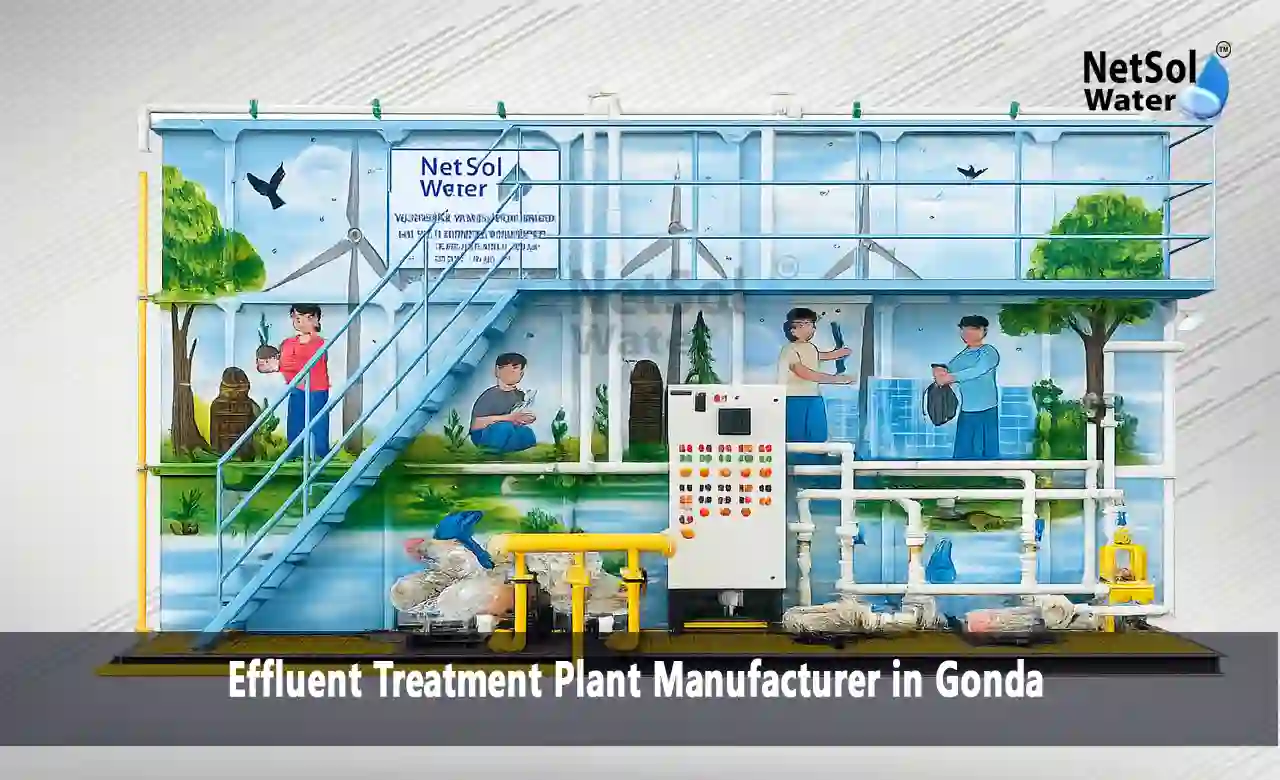
Effluent Treatment Plant Manufacturer in Gonda
If your factory in Gonda is struggling with wastewater discharge limits, escalating pollution penalties, or the sheer complexity of effluent management - you already know how critical it is to choose the right treatment partner.
Netsol Water is Gonda's most trusted effluent treatment plant manufacturer, with a track record of delivering CPCB-compliant, energy-efficient, and cost-effective wastewater solutions across Uttar Pradesh. From compact packaged units for small processing units to large-scale Zero Liquid Discharge (ZLD) systems for textile and pharmaceutical plants, Netsol Water builds ETPs that actually work - day in, day out.
An Effluent Treatment Plant (ETP) is an industrial system that removes harmful pollutants - heavy metals, organic matter, suspended solids, and chemical oxygen demand (COD) - from factory wastewater before it is safely discharged or reused. In Gonda, industries must comply with UPPCB and CPCB discharge norms or face heavy fines.
Why Gonda's Industries Need a Reliable ETP Partner?
Gonda district sits in the Devipatan Division of eastern Uttar Pradesh, with a growing base of textile, food processing, pharmaceutical, and agro-industrial units. The Uttar Pradesh Pollution Control Board (UPPCB) enforces strict effluent standards - BOD below 30 mg/L and TSS below 100 mg/L for most industrial categories.
Non-compliance carries severe consequences: plant shutdowns, bank-loan defaults triggered by environmental defaults, and reputational damage. This is exactly why selecting an experienced, locally-aware ETP manufacturer in Gonda is not optional - it is a business necessity.
Netsol Water engineers understand local groundwater chemistry, seasonal flow variations, and the specific challenges of Gonda's industrial clusters. That ground-level knowledge translates directly into treatment designs that outperform generic solutions.
Our ETP Solutions in Gonda
Every effluent stream is unique. A pharmaceutical plant's wastewater looks nothing like a textile mill's dye bath. Netsol Water never applies cookie-cutter designs. Instead, the process always begins with thorough effluent characterisation.
Step-by-Step How We Design Your ETP
1. Collect composite effluent samples across multiple production shifts.
2. Measure flow rates (peak, average, minimum) and map daily variation patterns.
3. Lab-test for BOD, COD, TSS, TDS, pH, heavy metals, and colour.
4. Select the optimal treatment technology combination for your specific load.
5. Prepare civil, mechanical, and electrical drawings tailored to your site footprint.
6. Factory-test key equipment before dispatch - zero surprises on installation day.
Types of ETP Systems We Offer in Gonda
| System Type | Best For | Key Benefit |
|---|---|---|
| Physico-Chemical ETP | Textile, electroplating, metal finishing | Rapid solids, oils & metal removal |
| Biological ETP (ASP / MBBR / SBR) | Food processing, pharma, dairy | High BOD/COD reduction, low sludge |
| Combined ETP | Mixed industrial effluents | Handles variable chemistry |
| Zero Liquid Discharge (ZLD) Plant | Textile, pharma, restricted zones | Near-zero discharge, water recovery |
| Compact / Packaged ETP | Small units, hospitals, remote sites | Pre-wired, fast installation |
Industries We Serve in Gonda
1. Textile Industry
Dye effluents from textile units in Gonda contain reactive and azo dyes, suspended solids, and high BOD loads. Our treatment trains combine coagulation-flocculation, activated carbon adsorption, and biological stages to meet UPPCB colour and BOD norms - while recovering up to 70% of water for process reuse.
2. Pharmaceutical & Chemical Plants
Pharmaceutical wastewater often carries high COD, residual solvents, and active pharmaceutical ingredients (APIs) that standard biology cannot handle alone. Netsol Water designs multi-stage trains with neutralisation, Fenton oxidation or ozonation, and membrane polishing - ensuring full CPCB Schedule VI compliance.
3. Food & Beverage Processing
Organic-rich effluents from food processing units respond excellently to anaerobic pre-treatment followed by aerobic polishing. Our Sequencing Batch Reactor (SBR) systems achieve BOD < 10 mg/L - clean enough for irrigation reuse under Indian standards.
4. Automotive, Metal Finishing & Electroplating
Chrome, nickel, and zinc-laden effluents require chemical precipitation at precise pH levels. Netsol Water's systems include chrome reduction reactors, pH correction tanks, and filter presses - recovering metals where economically viable and minimising hazardous sludge volumes.
5. Healthcare & Small Hospitals
Compact packaged ETPs designed for healthcare settings handle variable organic loads, disinfection requirements, and biohazard control. Our hospital ETP units occupy minimal floor area and operate with simple controls - ideal for Gonda's district hospitals and clinics.
ETP Technology We Use
Understanding what goes on inside an ETP helps you make better purchasing decisions. Here is a clear breakdown:
Stage 1 - Primary Treatment (Physico-Chemical)
• Screening: Removes large floating solids and debris.
• Oil & Grease Trap: Separates free oils before they interfere with biology.
• Equalisation Tank: Balances flow and pH fluctuations across shifts.
• Coagulation & Flocculation: Chemical dosing binds fine suspended particles into settleable flocs.
• Clarifier / Lamella Settler: Gravity separation of flocs - produces clarified overflow and sludge underflow.
Stage 2 - Secondary Treatment (Biological)
• Activated Sludge Process (ASP): Proven, cost-effective for moderate BOD loads.
• Moving Bed Biofilm Reactor (MBBR): High treatment efficiency in a compact footprint.
• Sequencing Batch Reactor (SBR): Flexible, single-tank operation - ideal for variable flows.
• Secondary Clarifier: Settles biological sludge for return or disposal.
Stage 3 - Tertiary & Advanced Treatment
• Pressure Sand Filter (PSF) & Activated Carbon Filter (ACF): Polishes effluent to near-potable clarity.
• Ultrafiltration (UF) / Reverse Osmosis (RO): Membrane-based dissolved solids removal.
• Evaporator + Crystalliser: For ZLD - concentrates reject brine into dry solid salts.
• UV / Ozone Disinfection: Kills pathogens before reuse or discharge.
Stage 4 - Automation & Control
All Netsol Water ETPs include PLC-based SCADA automation with:
• Real-time flow, pH, DO, and turbidity monitoring.
• Automated chemical dosing pumps triggered by sensor feedback.
• SMS/email alarms for out-of-range parameters.
• Data logging for UPPCB compliance reporting.
ETP Plant Cost in Gonda
The cost of an Effluent Treatment Plant in Gonda typically ranges from Rs. 5 Lakhs for a compact packaged unit to Rs. 2 Crore+ for a full-scale ZLD system. Key cost drivers include daily effluent flow (KLD), pollutant load (BOD/COD), technology chosen, and site conditions.
| Cost Driver | Impact on Price | Example |
|---|---|---|
| Effluent Flow Rate (KLD) | Higher flow = larger tanks & pumps | 10 KLD vs. 500 KLD varies 8–10x |
| Pollutant Complexity | More stages = higher CapEx | Textile dyes need extra decolourisation |
| Technology Choice | ZLD costs 2–3x vs. conventional ETP | ZLD adds RO + evaporator |
| Automation Level | Full SCADA adds 15–25% to cost | Reduces operating manpower |
| Site Conditions | Remote/tight sites raise civil & logistics cost | Compact skid-mounted units cost more/KLD |
| Sludge Handling | Filter press vs. drying beds differ in CapEx | Filter press is faster, costs more upfront |
Netsol Water provides transparent, itemised quotations - no hidden charges. You will know exactly what you are paying for, and why.
Why Choose Netsol Water Over Other ETP Manufacturers in Gonda?
| What We Offer | What It Means for You |
|---|---|
| Site-specific effluent analysis | Your ETP is designed for your actual wastewater - not a generic template |
| Factory-tested equipment | Fewer commissioning surprises, faster startup |
| Energy-efficient design | Lower electricity bills from day one |
| CPCB/UPPCB-compliant discharge | Zero penalty risk from regulators |
| PLC automation & data logging | Easy compliance reporting, less manual monitoring |
| Local service network in UP | Fast on-site response when you need it |
| ZLD options for restricted zones | Stay operational even in water-stressed or discharge-banned areas |
| Post-commissioning training | Your team can run the plant confidently from day one |
Our ETP Installation Process
Netsol Water follows a structured, transparent process that eliminates last-minute surprises:
1. Site Survey & Effluent Sampling - Our engineers visit your plant, collect effluent samples, measure flows, and assess civil and utility constraints.
2. Process Design & Engineering - We prepare the treatment flow diagram, equipment selection, civil layout, P&IDs, and electrical schematics.
3. Manufacturing & Factory Testing - Tanks, reactors, and control panels are fabricated, assembled, and bench-tested in our facility.
4. Civil Work Coordination - Our team guides or directly supervises civil construction - foundations, pipelines, and electrical conduits.
5. Mechanical Installation - Tanks, blowers, pumps, filter vessels, and instrumentation are installed and aligned.
6. Commissioning & Performance Testing - We run the system on real effluent, adjust dosing rates and aeration, and verify that discharge meets agreed parameters.
7. Handover, Training & Documentation - We hand over O&M manuals, spare-parts lists, SCADA access credentials, and train your operators on routine checks and emergency procedures.
Get Your Free ETP Site Survey in Gonda
Whether you are setting up a new plant, upgrading an underperforming ETP, or facing a UPPCB compliance notice - Netsol Water can help you find a fast, practical solution.
Contact Netsol Water | Phone: +91-9650608473 | Email: enquiry@netsolwater.com | Request your FREE site survey and detailed quotation today.
Our team typically responds within 24 hours. A site engineer can be at your Gonda facility within 48–72 hours of your inquiry for a no-obligation assessment.
FAQs
Q: What is an Effluent Treatment Plant (ETP) and why do industries in Gonda need one?
A: An Effluent Treatment Plant (ETP) is a system that treats industrial wastewater to remove pollutants like heavy metals, BOD, COD, and suspended solids before it is discharged or reused. Industries in Gonda must install ETPs to comply with UPPCB and CPCB discharge norms, avoid penalties, and prevent environmental damage to local water bodies.
Q: How much does an ETP plant cost in Gonda?
A: ETP plant costs in Gonda range from approximately Rs. 5 Lakhs for a small packaged unit (1 KLD) to Rs. 2 Crore or more for a large Zero Liquid Discharge system. The exact price depends on daily flow (KLD), effluent complexity, technology selected (biological, physico-chemical, or ZLD), automation level, and site conditions.
Q: Which industries in Gonda require an Effluent Treatment Plant?
A: Industries legally required to install ETPs in Gonda include textile and dyeing units, pharmaceutical manufacturers, chemical plants, food processing facilities, dairy operations, hospitals, electroplating and metal finishing units, and automotive workshops. These are categorised as Red, Orange, or Green industries under CPCB's industrial classification and must comply with UPPCB standards.
Q: What is the difference between an ETP and a ZLD (Zero Liquid Discharge) plant?
A: A conventional ETP treats effluent to meet discharge standards and releases treated water into a drain or water body. A ZLD (Zero Liquid Discharge) plant takes treatment further - using membranes, evaporators, and crystallisers - to recover nearly all water for reuse and reduce discharge to zero. ZLD is mandatory in certain water-scarce or discharge-restricted zones in UP.
Q: How long does it take to install an ETP plant in Gonda?
A: A small packaged ETP (up to 50 KLD) can be installed and commissioned in 4–8 weeks. Larger conventional ETPs typically take 3–5 months, while full-scale ZLD plants may require 6–12 months from design approval to commissioning, depending on civil work complexity and equipment delivery timelines.
Q: What CPCB or UPPCB discharge standards must ETPs in Gonda meet?
A: Under UPPCB norms (aligned with CPCB Schedule VI), treated industrial effluent discharged into inland surface water must meet: BOD below 30 mg/L, COD below 250 mg/L, TSS below 100 mg/L, pH between 6.5–8.5, and Total Dissolved Solids (TDS) below 2100 mg/L. Heavy metal limits vary by industry type. ZLD zones have stricter requirements.
Q: Can an ETP be upgraded if my production capacity increases?
A: Yes. Modular ETP designs from Netsol Water are specifically built for capacity expansion. Additional biological reactor modules, membrane units, or sludge handling systems can be added without shutting down the existing plant. It is advisable to plan for 1.5x current capacity during initial design to reduce future upgrade costs.
Q: Does Netsol Water provide after-sales service and maintenance in Gonda?
A: Yes. Netsol Water offers comprehensive post-commissioning support in Gonda, including annual maintenance contracts (AMC), planned preventive maintenance visits, emergency breakdown response, remote PLC diagnostics, spare parts supply, and operator refresher training. Their UP-based service network ensures fast on-site response times.