

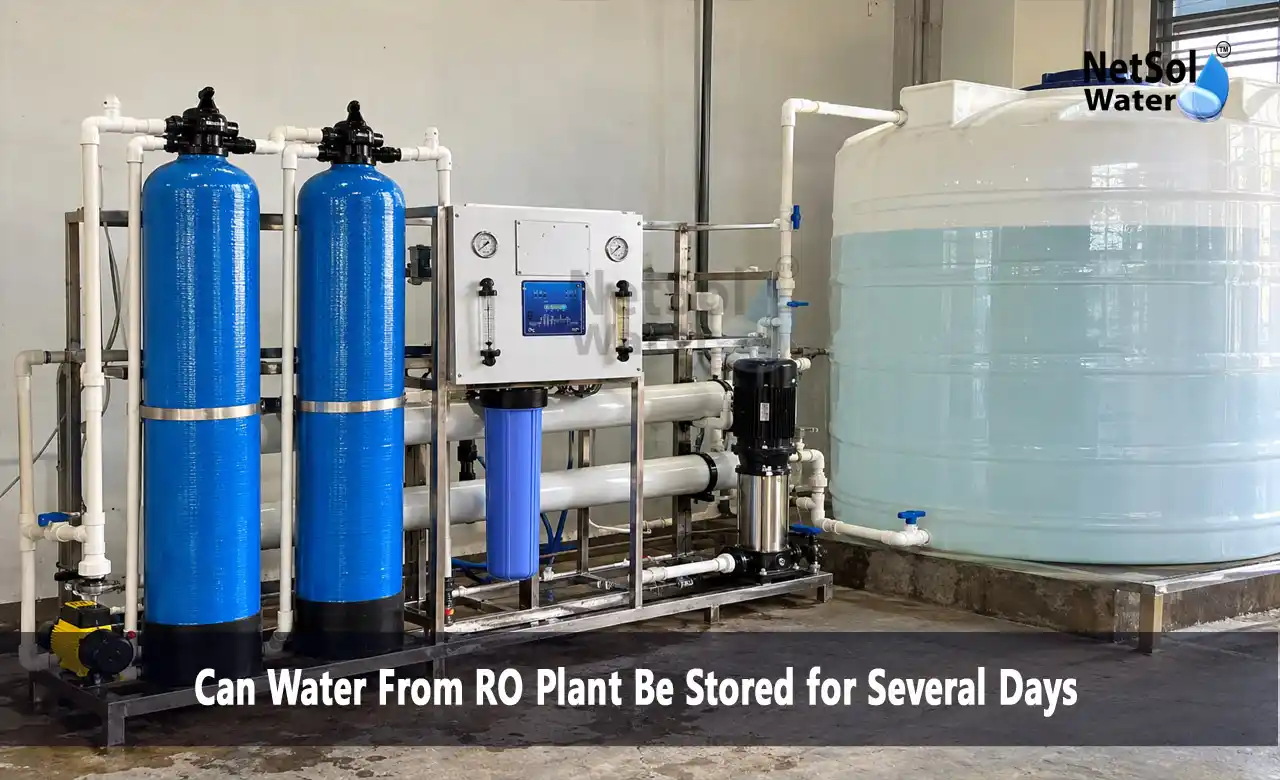
Can Water From RO Plant Be Stored for Several Days?
Yes, RO plant water can be stored for several days, but only when the storage system is designed and maintained properly. This is a point many plant owners miss. Reverse osmosis removes most dissolved salts, but the product water (permeate) is not sterile and carries no protective disinfectant. Once it enters a tank, its quality starts to depend on the tank, the pipework and the surroundings, not on the membrane.
Below is a practical guide to what changes in stored RO water, and what you should do to keep it fit for use.
What Happens to RO Water Sitting in a Tank?
. Bacteria can grow. RO water has very few nutrients, but bacteria still survive on tank walls and pipe surfaces and form a slimy layer called biofilm. Warm temperature and long standing time speed this up.
. Conductivity rises and pH falls. Water that touches air absorbs carbon dioxide. This forms carbonic acid, which makes the water slightly acidic and increases conductivity, even though no salt was added.
. Contaminants can enter. Dust, insects, leaching from tank material and dirty vents or fittings can all affect the water.
. Taste and odour can change. Stale or musty smell is often the first sign that biofilm has formed.
How to Store RO Water Safely for Several Days?
1. Choose the right tank. Use a food grade, opaque, non corrosive tank. HDPE or similar food grade plastic suits general use. Stainless steel (SS 304 or SS 316) is common where hygiene requirements are stricter. A sloped bottom with a full drain and an inspection port makes cleaning much easier.
2. Keep the tank closed and protected. Fit a tight lid. Put a fine filter on the air vent so dust and microbes cannot enter when the water level changes. Cover the overflow outlet with an insect screen or a non return arrangement.
3. Avoid stagnation. Water that does not move for long periods is the biggest risk. Where storage is routine, use a recirculation loop so the tank contents pass through the system regularly. Size the tank for your actual demand. An oversized tank means older water.
4. Add disinfection where it is needed. Drinking and general washing use may only need a hygienic tank and a UV unit on the outlet. Applications with strict microbiological limits may need UV on a recirculation loop, ozone, or periodic sanitisation. Do not simply add chemicals. The method must suit the end use and the downstream equipment, such as membranes in a second stage or sensitive process machines.
5. Sanitise and clean on a schedule. Drain, clean and sanitise the tank at regular intervals and after any contamination event. Record the dates. Document the procedure so that every operator follows the same steps.
6. Test the stored water. Do not assume quality stays the same as at the RO outlet. Check these parameters at the tank, not only at the plant:
. Conductivity or TDS
. pH
. Turbidity
. Microbiological quality (total plate count or as required)
. Temperature
. Residual disinfectant, if any is used
A sudden change in conductivity, turbidity, smell or microbial count points to contamination or a fault in the storage system.
Does the End Use Change the Storage Requirement?
Yes. Water used for floor washing or cooling make up can tolerate more than water used for boiler feed, laboratory work, food processing or pharmaceutical processes. Boiler feed is sensitive to dissolved gases and conductivity. Food and pharma uses are sensitive to microbial growth. Your process specification, equipment manufacturer guidance and applicable standards should decide the limits, not a general rule.
How Many Days Is Too Many?
There is no single number that fits every plant. A well designed system with a covered tank, recirculation, UV and regular testing can hold water for several days. A poorly kept tank can show problems within a day or two in warm weather. The better approach is to set a maximum holding or turnover time based on your own test results, then review it each season. If you are planning a new system, an experienced industrial RO plant manufacturer in India can size the storage, recirculation and disinfection around your usage pattern.
Common Mistakes to Avoid
. Leaving the tank lid open or the vent unprotected
. Using a tank much larger than daily demand
. Skipping tank cleaning because the water looks clear
. Testing only at the RO outlet and never at the storage tank
. Using water for sensitive processes without checking storage conditions
Frequently Asked Questions (FAQs)
Q1. Does RO water go bad?
It does not spoil like food, but its quality can fall because of bacteria, carbon dioxide absorption and contamination.
Q2. Why does TDS increase in stored RO water?
Mainly because of dissolved carbon dioxide from the air and, in some cases, leaching from the tank or pipework.
Q3. Is UV enough to keep stored RO water safe?
UV helps control microbes in the water passing through it, but it leaves no residual in the tank. It works best together with a clean tank, circulation and testing.
Q4. Can I store RO water for drinking?
Yes, in a clean, covered, food grade container and for a limited time. Fresh water and regular cleaning are always safer for drinking use.
Conclusion
RO water can be stored for several days, but treatment at the membrane does not guarantee quality at the point of use. A covered and hygienic tank, controlled turnover, suitable disinfection and regular testing keep the water within limits. Match the storage design to the application and verify it with data. For plant design and storage guidance, you can also explore the range offered by an Industrial RO Plant Manufacturer with experience in your industry.
Do you need advice or assistance on selecting the best water and waste water treatment unit? We have solutions for all your problems!
Let us know your problem, our experts will make sure that it goes away.
For assistance or related queries,
Call on +91-9650608473 Or write us at enquiry@netsolwater.com