

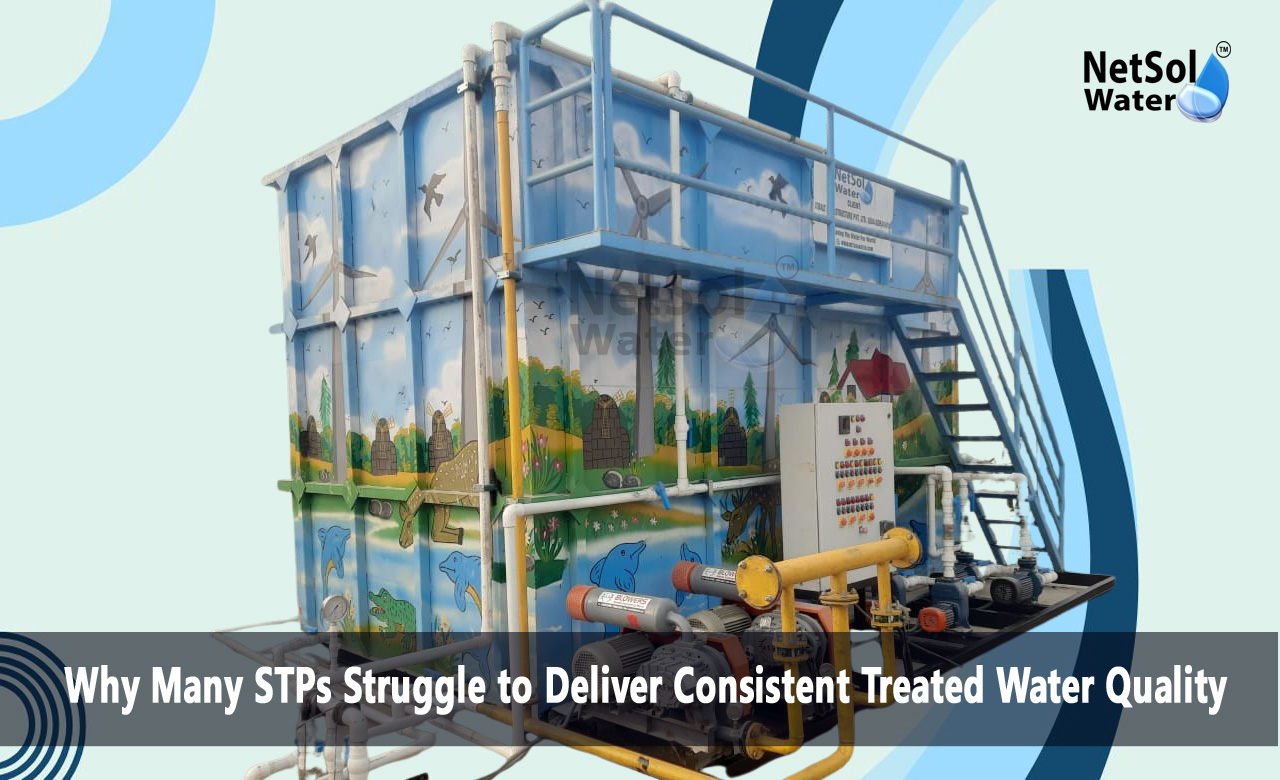
Why Many STPs Struggle to Deliver Consistent Treated Water Quality?
Most sewage treatment plants are usually constructed to satisfy regulatory discharge constraints on paper, but in practice most of them do not generate reusable-quality treated water. Fluctuations in the BOD, COD, turbidity, odor or the microbial counts are regularly reported even when the plant is under continuous operation. This inconsistency is not normally determined by one fault. As a matter of fact, STPs struggle to deliver consistent treated water quality because of a combination of design assumptions, biological sensitivity, gaps in operation, and varying influent conditions.
These root causes must be understood first and then upgrades, automation, or stricter monitoring can be attempted.
Disparity between Design Assumptions and Sewage Characteristics
. Flow Patterns and Influent Loads that are Variable
Most STPs are modeled with the assumptions of average flow and pollution load. But the reality is that the sewage inflow is different hourly and seasonally. It is the morning and festival flows or the overload of the biological systems as a result of peak flows during mornings or monsoon infiltration that disrupt the steady state conditions. Treatment performance is erratic even in cases where equipment is performing well when the flow variation is not buffered appropriate.
. Modification of Organic Composition of Sewage
Contemporary domestic sewages are not necessarily biodegradable. Detergents, disinfectants, pharmaceuticals and kitchen chemicals change the BOD/COD ratio and add inhibitory compounds. The biological systems adjusted to the standard sewage find it hard to adjust, resulting in partial treatment and unreliable quality of effluent.
Biological Process Instability Within the STP
. Delicate Character of Microbial Population
Biological treatment is purely based on living microorganisms. The microbial activity is directly influenced by sudden changes in pH, temperature, toxic shock loads or the availability of oxygen. Even temporary disruptions can cut efficiency of treatment several days and it is difficult to maintain a consistent performance.
. Inadequate Regulation of MLSS and Sludge Age
Overgrowth of MLSS or extremely low sludge age is associated with interruption with oxygen transfer and nutrient balance. Most plants ensure that the MLSS does not go out of a numerical parameter with no information as to the relationship linking between the food load, aeration capacity, and sludge settling. This may lead to good laboratory work on certain days and poor work one other day.
Limitations of the Aeration System
. Uneven Oxygen Distribution
Aeration systems are often poorly maintained or poorly designed. Diffuser clogging, inefficient blower or ineffective tank hydraulics result in dead zones that have low dissolved oxygen. Due to this, there are zones that can be doing well and others end up anaerobic hence uneven treatment all round.
. Operation compromises caused by energy
To save electricity, operators tend to decrease the run time of the blower. Although this will conserve energy in the short term, it will disrupt the biological processes. Unstable aeration causes direct impact on the inconsistent effluent quality particularly in the removal of nitrogen and ammonia.
. Hydraulic Short-Circuing and Poor Tank Hydraulics
Poor internal flow patterns are experienced in many STPs. Short-circuiting enables untreated or partially treated sewage to pass through biological contact zones. Although treatment capacity may seem adequate, inefficient hydraulic design will lessen the true retention time causing intermittent effluent quality.
Also Read: Sewage Treatment Plant Manufacturer
Poor Sludge Management Practices
. Irregular Sludge Wasting
Regular removal of sludge is necessary to maintain the regular quality of treated water. Sludge wasting is not strategic in most of the plants. Old sludge that develops with time lowers the biological activity, whereas excessive wasting removes the necessary microorganisms.
. Sludge Settling and bad Carryover
Sludge bulking, foaming or pin floc results into solids being carried over in treated water. This has a direct impact on turbidity, BOD and reuse suitability even in case the biological degradation is good enough.
. Screening Gaps and Pretreatment Gaps
Where coarse screens, grit chambers or grease tires are not maintained properly, too much solids and fats are introduced into the biological system. These materials block the oxygen supply, facilitate filamentous growth and generate erratic performances.
Excessive use of Lab Tests as Replacement of Process Indicators
A large number of STPs simply use periodic lab reports as a measure of performance. Nevertheless, lab results represent the historical states and not the current health of processes. The operators fail to notice early signs of instability because of no parameter monitoring like the rate of oxygen uptake, sludge settling characteristics, and ammonia trends.
Reuse is Higher than plant capacity
More STPs are likely to generate water that can be used in gardening, flushing, cooling or even re-use in industry. But even those plants that were originally intended to be discharged alone would have difficulty in achieving stricter reuse standards on regular basis. Unless tertiary treatment, filtration, or disinfection is upgraded, the quality fluctuations are bound to be noticed.
Conclusion
STPs struggle to deliver consistent treated water quality not due to faulty technology, but due to the fact that the nature of sewage behavior in the real world is unlikely to correspond with design expectations. Biological sensitivity, variability of the influent, aeration constraints, mishandling of sludge, as well as compromised operation affect stability. To achieve uniform treated water quality, one has to go beyond compliance mode of operation to process mode of control, design margins and anticipatory monitoring. It is only under this case that STPs are trustworthy in order to comply with long term regulatory and reuse expectations.
Do you need an advice or assistance on selecting the best water and waste water treatment unit? We have solutions for all your problems!
Let us know your problem, our experts will make sure that it goes away.
For an assistance or related query,
Call on +91-9650608473 Or write us at enquiry@netsolwater.com