

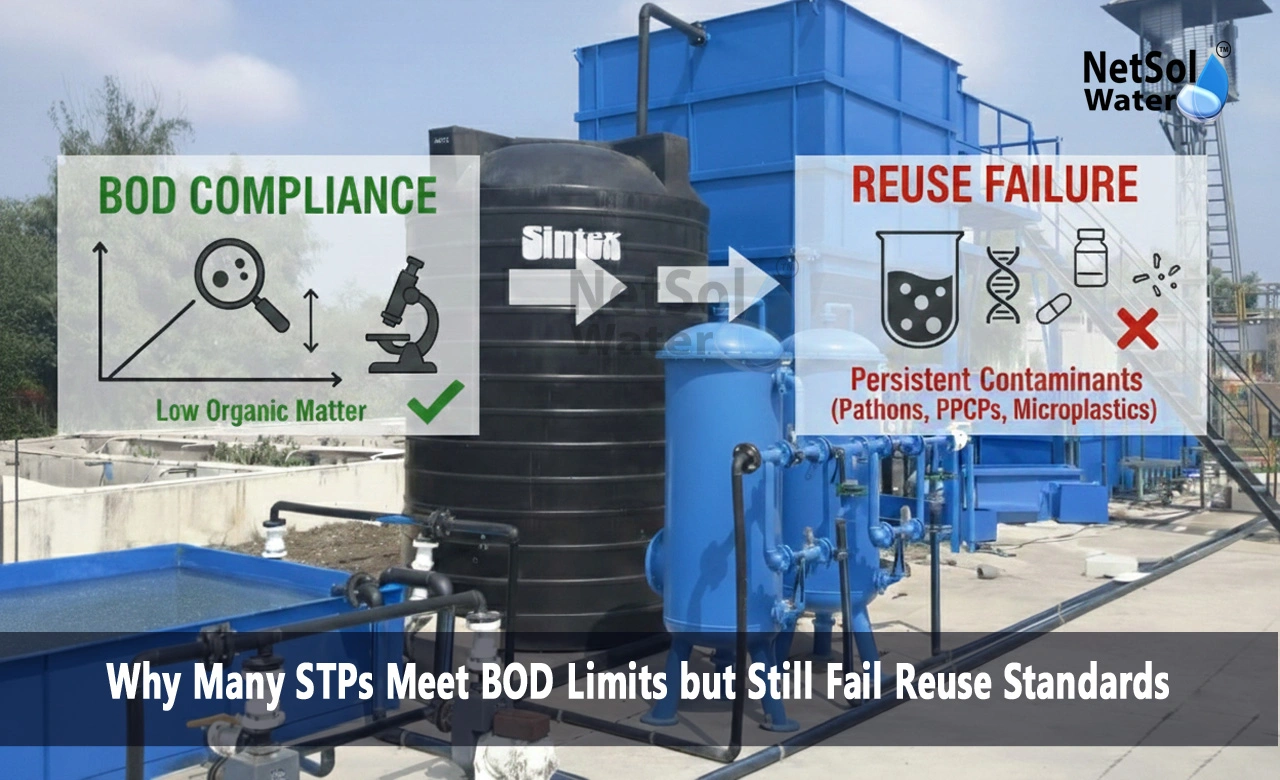
Why Many STPs Meet BOD Limits but Still Fail Reuse Standards?
The purpose of sewage treatment plants is to minimize organic contaminants and comply with the discharge regulation parameters. Biological Oxygen Demand (BOD) is one of the most widespread parameters applied to assess their performance which is a measure of the presence of organic matter in wastewater. It is not rare that STPs Meet BOD Limits that fall within the accepted limits, but still, fail to satisfy the requirements of water reuse. This lack of connection is due to the fact that BOD is not the total range of contaminants in treated water.
Why It Is Not Sufficient to Meet BOD Limits?
BOD is used to quantify the level of oxygen that microorganisms used to break down the organic material in water. Regulatory bodies have the tendency to fix the BOD limits as a guide to environmentalism, which guarantees that the effluent to be released will not exhaust oxygen in the water bodies. Although attainment of these limits is an indication of good elimination of biodegradable organic material it does not ensure removal of other pollutants that may affect the reuse of water.
Reuse water should be of extra quality to that of BOD. These are chemical parameters which consist of heavy metals, nutrients such as nitrogen and phosphorus, total dissolved solids, and microbiological contaminants like bacteria, virus and protozoa. Although BOD may be inconsequential, these residual contaminants may render the treated water unfit to be used in irrigating farms, industrial purposes, or drinking.
Contributing Factors to Reuse Failures
1: Remaining Nutrients and Salts
STPs can recover high concentrations of such nutrients as nitrogen and phosphorus, dissolved salts even when BOD is controlled. To be reused in agriculture, the production of nitrogen in excess amounts may cause an imbalance in the nutrients in the soil, whereas excess salts impact on the growth of crops and soil. The conductivity water needed in industrial reuse is also low in order to avoid scaling which BOD measures do not show.
2: Pathogens and Microbial Contamination
BOD test does not take into consideration microorganisms that might be left behind in treated water. The lack of proper elimination of bacteria, viruses or protozoa may be extremely perilous to health especially when water is reused in irrigation or in a facility where humans come into contact. Disinfection, and monitoring of pathogens Advanced, should be used to address standards of reuse.
3: Chemical Contaminants
Wastewater can have synthetic organics, heavy metals and industrial chemicals that cannot be detected under normal BOD tests. Although the STPs may be below the BOD limits, the chemical contaminants may make the water not fit to be used in sensitive processes such as cooling systems, food processing, or in potable water production.
4: Unfinished Processes of Treatment
Other STPs do not use tertiary treatments or filtration, membrane or advanced oxidation to treat the BOD, but instead use biological treatment. This is due to the fact that without these extra measures, some of the suspended solids, turbidity, and non-biodegradable substances may be released into the effluent and make this effluent unable to be reused, even though it meets the BOD specification.
5: Enhancing Reuse Compliance Beyond BOD
STPs require a multi-parameter methodology instead of concentrating on BOD to achieve treated water that is up to reuse standards. It is necessary to incorporate the advanced and tertiary treatment processes. Membrane filtration, UV disinfection, ozone and chemical precipitation are the methods that deal with residual solids, pathogens and chemical contaminants.
The monitoring also should be carried to such parameters as chemical oxygen demand (COD), total suspended solids (TSS), total dissolved solids (TDS), nutrients, and microbial load. With such indicators being monitored on a regular basis, operators will be able to understand the gaps in the treatment and to make adjustments to the processes in advance to ensure the attainment of safe and reliable water reuse.
Other important operational practices like proper sludge management, enhancement of aeration and system bypass prevention are also essential. These will maintainthe quality of water and minimisechances of breaching the standards of reuse.
Conclusion
Although BOD limitations are significant milestones of Sewage Treatment Plant, these are not enough to ensure compliance with water reuse. Meeting STPs is not the sole element of water quality, the rest of nutrients, salts, microbial contamination, and chemical pollutants should be considered as well. Comprehensive treatment plan which involves high level and tertiary treatment processes, with high level of monitoring, is necessary to transform treated waste water into safe and reliable source of irrigation, industry or even drinking water. STPs can maximize their potential when it comes to water reuse and sustainable water management by going beyond BOD-based strategies.
Do you need an advice or assistance on selecting the best water and waste water treatment unit? We have solutions for all your problems!
Let us know your problem, our experts will make sure that it goes away.
For an assistance or related query,
Call on +91-9650608473 Or write us at enquiry@netsolwater.com