
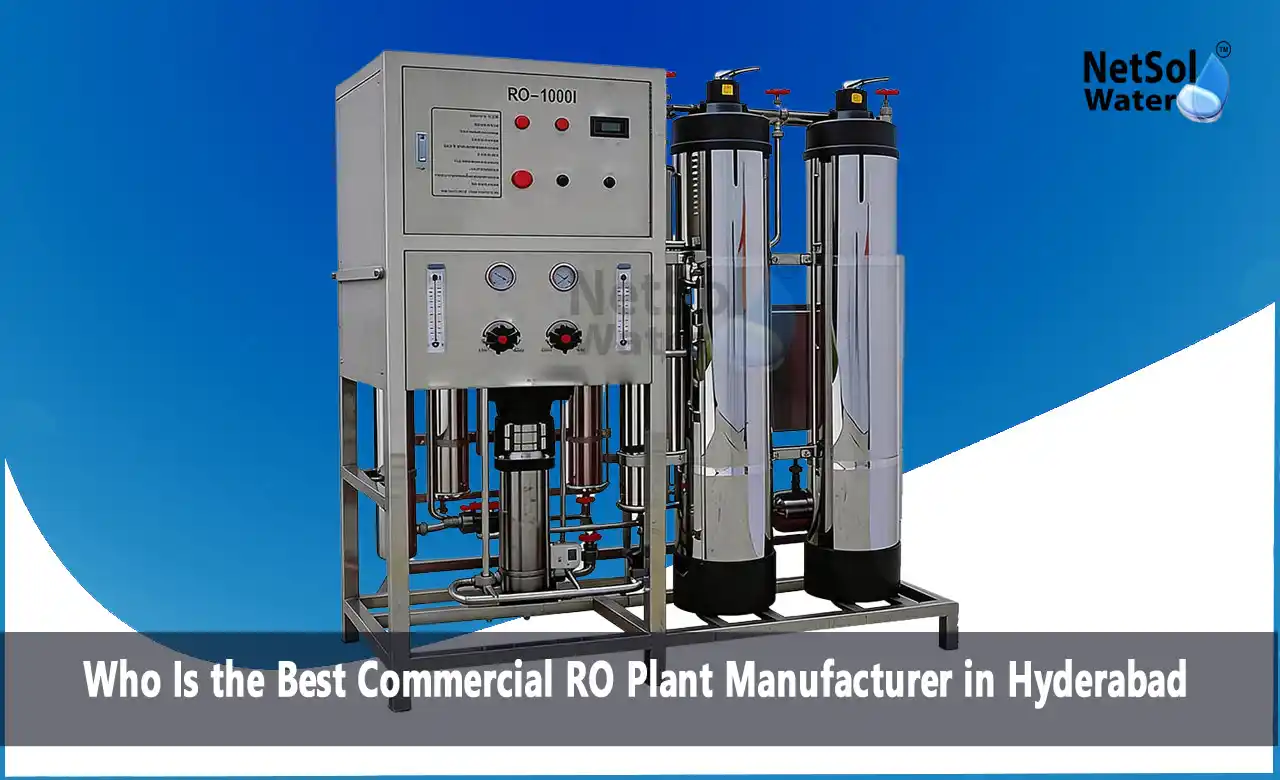
Who Is the Best Commercial RO Plant Manufacturer in Hyderabad?
On 30 May this year, the Hyderabad Metropolitan Water Supply and Sewerage Board (HMWSSB) logged a record 15,200 tanker bookings in a single day. By October, tanker demand was several times more than the average off-season demand. Water has gone from being a utility line to a risk factor for hotels, hostels, hospitals, IT campuses, and industries.
An industrial reverse osmosis plant is the obvious solution, and also an expensive buy that is difficult to estimate from a brochure. This manual covers what is happening with Hyderabad’s water, what a good industrial RO plant must take into account, and how one may evaluate a commercial RO plant manufacturer in Hyderabad, such as Netsol Water. Each and every statistic cited below is referenced to its source.
Key takeaways
. Greater Hyderabad's average groundwater depth reached 12.59 metres in October 2026, against 5.42 metres a year earlier.
. More than 80 per cent of commercial establishments in the city rely on borewells, and the rest rely on tankers.
. Hyderabad's borewell water often exceeds BIS limits for fluoride, nitrate and TDS, which is what RO is designed to correct.
. The quality of the pre-treatment, the component specification and the after-sales service matter more than the brand name on the skid.
. Ask every bidder for a water-analysis-based design, named components, running cost per kilolitre and a signed baseline at handover.
Why Hyderabad businesses need a commercial RO plant now?
Groundwater is falling faster than it can recharge
Rainfall during the 2026 monsoon fell well short, and the groundwater record shows it.
| Indicator | Figure |
|---|---|
| Average groundwater depth, Greater Hyderabad, October 2026 | 12.59 m, against 5.42 m in October 2025 |
| Average depth, Hyderabad, June 2026 vs June 2025 | 12.43 m vs 9.96 m |
| Rainfall, 1 June to 31 October 2026 | 484 mm against a normal 729 mm (34 per cent deficit) |
| Share of Hyderabad over-exploiting groundwater | About 70 per cent, with 11 of 16 mandals extracting 100 to 177 per cent of available reserves |
| Share of demand met by municipal supply | Around 30 per cent |
The practical consequence is that a borewell which delivered steady yield in 2024 may not do so next summer. A commercial water treatment plant designed around one borewell should therefore be reviewed with that risk in mind.
Tankers are the fallback, and they are getting expensive
Most commercial users that cannot rely on a borewell turn to the Water Board or to private suppliers.
| Indicator | Figure |
|---|---|
| Tanker bookings, October 2026 | 62,565, up 233 per cent from 18,806 a year earlier |
| Daily bookings in October | 5,000 to 8,000, against a usual 800 to 1,500 |
| Water Board commercial tariff | Rs 850 (5 kL), Rs 1,700 (10 kL), Rs 3,400 (20 kL) |
| Private tanker prices in parts of western Hyderabad | Rs 2,000 to Rs 3,000 per tanker, as reported |
| Commercial establishments dependent on borewells | More than 80 per cent |
At the Board's commercial rate, water costs about Rs 170 per kilolitre. At the private rate quoted above for a 5,000-litre tanker, it works out to about Rs 400 per kilolitre. Either way, the water still needs testing, storage and treatment before it reaches a kitchen, a laundry or a process line.
What is actually in Hyderabad's borewell water?
Fluoride, nitrate and high TDS
Availability is only half of the problem. Several studies show that groundwater quality in the city is a concern in its own right.
. A study of 44 samples across the Greater Hyderabad Municipal Corporation area found fluoride above 1 mg/l in 64 per cent of pre-monsoon samples and nitrate above 45 mg/l in 36 per cent. TDS exceeded 500 mg/l in 95 per cent of pre-monsoon samples.
. A June 2025 study of 48 borewells in Alwal, Kapra, Kompally and Ghatkesar found fluoride above 1 mg/l in nearly half the samples and nitrate peaking at 209 mg/l.
. The Jal Shakti Ministry's Groundwater Quality Year Book for Telangana, 2025, found fluoride worsening at six of nine Hyderabad monitoring sites.
For comparison, here are the relevant drinking water limits in BIS standard IS 10500:2012.
| Parameter | Acceptable limit | Permissible limit (no alternate source) |
|---|---|---|
| Total dissolved solids | 500 mg/l | 2,000 mg/l |
| Total hardness | 200 mg/l | 600 mg/l |
| Fluoride | 1.0 mg/l | 1.5 mg/l |
| Nitrate | 45 mg/l | No relaxation |
| Iron | 0.3 mg/l | No relaxation |
Reverse osmosis reduces dissolved salts, fluoride and nitrate effectively. It does not disinfect by itself, and its membranes are sensitive to iron, oil, organic matter and suspended solids. This is why the filters and dosing ahead of the membrane decide how long the plant lasts.
Industrial belts need extra caution
Facilities in and around Patancheru, Pashamylaram, Jeedimetla and Nacharam should treat a handheld TDS reading as a starting point only. Industrial influence can introduce organics, oil and variable COD that foul membranes quickly. A full laboratory analysis covering hardness, alkalinity, chloride, sulphate, silica, iron, nitrate, fluoride and COD should be obtained before any design is finalised.
How to choose a commercial RO plant manufacturer in Hyderabad?
Brand reputation says little about how a plant will behave on your specific water. The following criteria say much more.
1. Design on the basis of water analysis
A good RO plant company will ask you for your laboratory analysis, your water consumption, source (borewell, tanker or both), space and electricity availability. Any quotation made purely on the basis of capacity like a 5,000LPH plant over the phone without engineering, is not a professional one.
2. Pre-treatment system is designed on the basis of your water
An usual combination of filters for borewell water is multigrade or sand filter, activated carbon filter, anti-scalant dosing or softening and 5 microns cartridge filter. The objective is to achieve an SDI (Silt Density Index) of less than 5 at the membrane end.Tanker water requires special care because the quality differs from vendor to vendor and delivery to delivery.
3. Components are named in the quotation
| Item | What to look for | Red flag |
|---|---|---|
| Membranes | Make and model stated, such as Hydranautics or LG | "Imported" or "branded" with no model |
| High-pressure pump | Make and rating stated, such as CRI or Kirloskar | Generic "multistage pump" |
| Pressure vessels | Material and pressure rating stated | No specification |
| Instruments | Flow meters, pressure gauges, conductivity meter | Only a TDS pen |
| Control panel | Low-pressure cut-out, auto-flush, alarms | Manual valves only |
4. Recovery is realistic
For brackish borewell water, a design recovery of 60 to 75 per cent with antiscalants should be practical. Guarantees of 85 to 90 per cent recovery in one stage increase the chance of scaling and reduce the life of the membranes. Request the back-up calculation.
5. The system’s performance can be measured
Flow meters on both permeate and reject lines, pressure gauges in each stage and a conductivity meter in the product line are the absolute minimum. Having the signature of day one values on hand over allows you the benchmark for all future performance questions.
6. There should be written after-sales service agreements
Request the time frames, spares availability and references from two-year-old installations. A three-month-old installation means nothing regarding after sales service.
Commercial RO plant price in Hyderabad: what drives the cost
Quoted prices vary widely, and the headline figure rarely explains why. These are the main drivers.
. Plant capacity and operating time: 1,000 LPH and 10,000 LPH plants are not proportional in terms of costs.
. Feed water quality: increased TDS, hardness or silica requires more advanced pre-treatment and higher feed pressures.
. Construction materials: both FRP and stainless steel versions are available at different costs and suitability for aggressive feed water.
. Equipment make: various makes of membrane elements and pumps have different costs and expected lifetime.
. Automation: automatic flushing systems, remote monitoring and programmable logic controllers raise the price and decrease dependency on personnel.
. Rejection treatment: if reuse or disposal of the rejection stream is planned, extra tanks and pipework may be required.
Request a detailed quote from each supplier, including the costs per kiloliter of treated water and calculation of those costs. For brackish water, energy consumption ranges approximately from 1 to 2 kWh per kiloliter, depending on salt content and pressure.
A worked example
The figures below are illustrative and are not a quotation. A hostel with 400 residents needs about 15 litres of RO-quality water per person per day for drinking and cooking, or 6,000 litres a day. Running eight hours a day, that calls for roughly 750 LPH, so a 1,000 LPH plant gives a sensible margin.
| Item | Value |
|---|---|
| Product water needed | 6,000 litres per day |
| Design recovery | 65 per cent |
| Raw water drawn | About 9,200 litres per day |
| Reject water | About 3,200 litres per day |
| Raw water cost if bought by tanker at Rs 170 per kL | About Rs 1,560 per day (Rs 47,000 per month) |
| Raw water cost if bought by tanker at Rs 400 per kL | About Rs 3,680 per day (Rs 110,000 per month) |
A functioning borewell lowers this cost considerably, and a failed borewell restores it in full. The reject stream consists mainly of the same salts present in the feed, in higher concentration. After testing, it is commonly used for flushing, floor washing and landscaping.
Which RO plant suits which facility?
| Facility | Typical use of RO water | Design note |
|---|---|---|
| Hotels and restaurants | Kitchens, laundry, boilers | Soft or RO water protects boilers and laundry equipment |
| Hostels and PGs | Drinking and cooking | Morning and evening peaks call for buffer tanks |
| Hospitals and clinics | Pharmacy, sterilisation, labs | Patient-related uses, including dialysis, have their own standards beyond general commercial RO |
| IT campuses and offices | Pantries, drinking water, coffee machines | Compact skid, low noise, simple maintenance |
| Manufacturing units | Process, rinse and boiler feed water | May need RO plus EDI or mixed bed polishing |
| Ready-mix concrete plants | Mixing water | Water quality affects concrete performance |
Why choose Netsol Water as your RO plant manufacturer?
Netsol Water has designed and manufactured water and wastewater treatment systems since 2012 from its head office at Udyog Vihar Extension, Ecotech-II, Greater Noida. Here is what a Hyderabad buyer can verify.
In-House Manufacturing-
The skids, panels and tanks are fabricated in-house and the plants are commissioned by the engineers of the company itself.
Widest Capacity Range-
Commercial & Industrial RO Plants are from 100 LPH up to Turn Key Systems 10 lakh LPH, in Stainless Steel and FRP.
NAMED PARTS-
The quotations include LG and Hydranautics Membranes, CRI and Kirloskar High Pressure Pumps, Tata, Alfa and Pentair Pressure Vessels, along with in-house control panels & dosing systems.
Certified Quality System-
The company is ISO 9001 Certified with ISO 14001 and ISO 45001 listed.
RO + Wastewater under one roof. Netsol also constructs Sewage Treatment Plants (STP) and Effluent Treatment Plants (ETP) so that the client can reuse the treated water as RO Feed after some time.
Projects Documented-
Information about a number of projects can be found on their website.
Support commitment. As per the company, they have support available 24/7 for the customers. Verify it by contacting them before purchasing.
How Netsol compares with a typical trader?
| Criterion | Netsol Water | Typical trader or assembler |
|---|---|---|
| Manufacturing | In-house fabrication and commissioning | Outsourced or assembled from bought-in parts |
| Quotation | Components named by make | Generic descriptions |
| Wastewater capability | STP and ETP in the same portfolio | RO only |
| Capacity range | 100 LPH to 10 lakh LPH | Often limited to small sizes |
| Support | Round-the-clock support described by the company | Varies |
Common mistakes when buying an industrial RO plant
. Using only price per LPH as criteria. The savings are always achieved at the pre-treatment stage, which is invisible to the naked eye.
. Using only a TDS meter. TDS meter does not reveal the share of hardness, silica and iron, and silica in particular may cause scaling of the membranes.
. Not following cleaning intervals. As a general rule, which the membrane datasheet replaces, clean in place when the normalised permeate flow decreases by approximately 10% or differential pressure increases by about 15%.
. Lack of low-pressure shutdown. The high-pressure pump, which runs dry, will malfunction at the first missed delivery of the tanker.
. Lack of storage tank maintenance. Water produced by RO system kept in a dirty tank is not RO water anymore. Use UV and/or residual chlorine and maintain tank cleaning on schedule.
. Not taking into account site conditions. Feed temperature in summer, access to the basement, floor drainage, and power quality.
Ten questions to ask every Manufacturer
1. Which water analysis was the design based on, and who carried it out?
2. Can I see the pre-treatment calculations?
3. Which membrane make and model, how many elements, and what design flux?
4. What recovery and antiscalant dose are assumed?
5. What is the operating cost per kilolitre, and on what assumptions?
6. Which instruments are supplied as standard?
7. What does the warranty cover: pump, membranes and panel?
8. What is the breakdown response time, in writing?
9. Can you provide references from plants more than two years old?
10. Who commissions the plant, and will I receive a signed baseline record?
Frequently asked questions (FAQs)
Q1. Does a commercial RO plant remove fluoride and nitrate?
Yes. Reverse osmosis removes a large proportion of both, commonly in the range of 85 to 95 per cent or more depending on the membrane and feed conditions. Test the permeate after commissioning.
Q2. How long do RO membranes last?
Three to five years is typical with adequate pre-treatment and regular cleaning. If membranes need replacing every two years or less, the pre-treatment is usually the cause.
Q3. Can an RO plant run on tanker water?
It can, provided the design allows for the poorest quality delivered, because composition varies between suppliers and deliveries.
Q4. What size of RO plant does my hotel or hostel need?
It depends on daily demand, operating hours and peak pattern. Divide daily RO water demand by the hours the plant will run, then add a margin for peaks and membrane ageing. A manufacturer should confirm the figure against your water analysis.
Q5. Is a permit required to drill a new borewell in Hyderabad?
Confirm requirements with the groundwater authorities before drilling. Unauthorised borewells are a recognised concern in the city.
Conclusion: who is the best commercial RO plant manufacturer in Hyderabad?
The best commercial RO plant manufacturer in Hyderabad for your site is the one that starts with your water analysis, names its components in writing, shows you the running cost per kilolitre, documents performance at handover and stays available for service in later years. Apply the checklist above to every bidder, Netsol Water included.
If you would like a proposal from Netsol Water, send your water analysis report and daily requirement to enquiry@netsolwater.com or call +91 96506 08473, and the team will respond with a design basis you can compare against any other quotation. You can also visit netsolwater.com to see the full product range.