

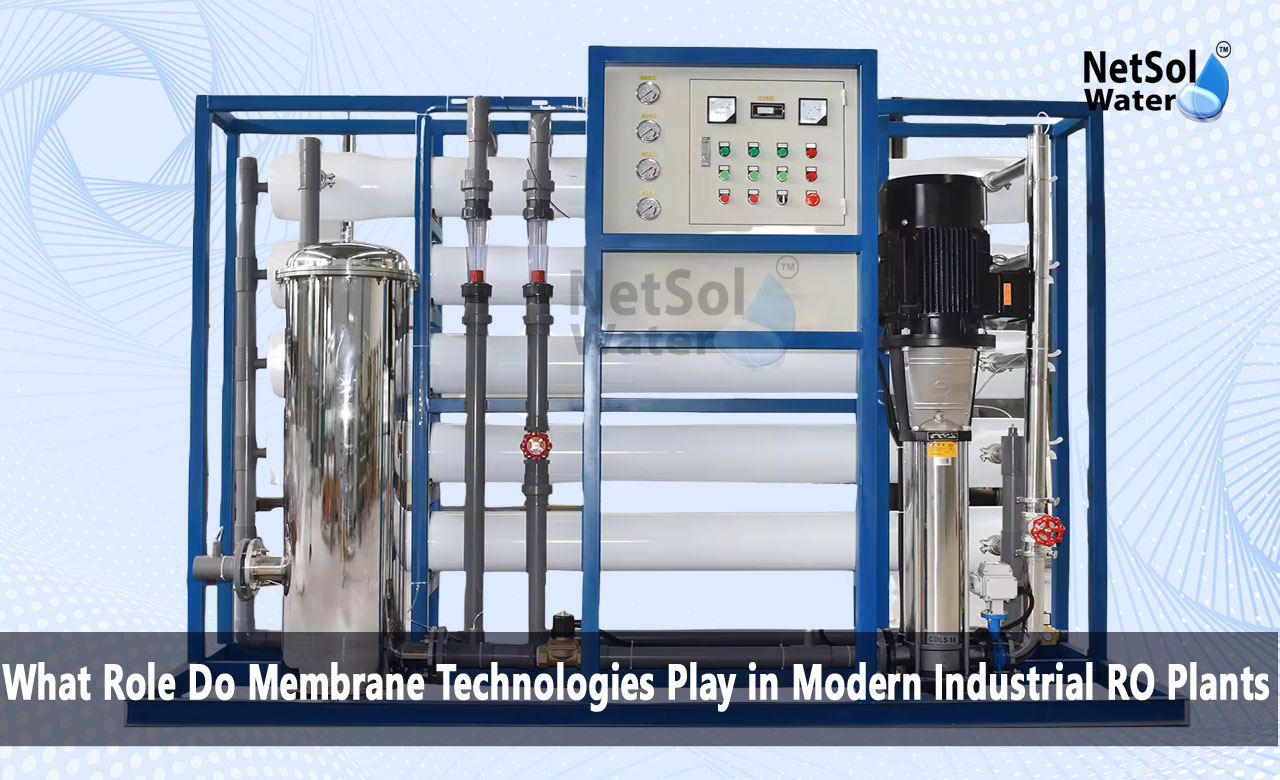
What Role Do Membrane Technologies Play in Modern Industrial RO Plants?
Water shortage and growing industrial water demand have spurred swift advancements in water treatment systems, especially in the field of Reverse Osmosis (RO). The use of membrane technologies is among the main reasons behind the success of industrial RO facilities. To a greater extent, membrane technologies play an important role in modern industrial RO plants and allow them to deliver good-quality water output, low operating costs, and long-term operation.
Let's talk about what those technologies are, how they function, and why they are so important to the industrial processes of today.
Introduction to Membrane Technologies in RO
Every RO plant has at its core a semi-permeable membrane. The membranes allow only pure water to pass and exclude dissolved salts, bacteria, and other impurities. These membranes have over the years become more efficient and also more versatile in design and composition.
Membrane technologies are the different types, materials, and designs of membranes used in RO plants. They are very important in making it possible to separate clean water from contaminants, thereby making industrial water reusable or safely discharged.
Importance of Membrane Technologies in Industrial RO Systems
Improved Filtration and Purification of Water
Even the minutest impurities such as heavy metals, dissolved salts and microorganisms are removed by the new membranes. It is not only safe in this water but also fit in high-purity water operations that business requires such as pharmaceuticals, electronics, textile, and food processing.
High Recovery Rates
Subsequent membrane technologies also facilitate high recovery levels, i.e., obtain more freshwater from the same amount of feedwater. This is necessary in water-withdrawing industries where water use has to be minimized for cost or environmental reasons.
Membrane technologies play an important role in modern industrial RO plants because they allow companies to recover more water and reduce waste.
Low Operating Costs and Energy Efficiency
Improved membrane designs reduce pressure requirements for water treatment, reducing plant-wide energy consumption. More recent membranes are low-energy or thin-film composite systems, operating at lower pressures, thus saving electricity consumption.
This reduces the running cost of RO plants in the long run, especially where processes require plenty of water on a daily basis.
Compatibility with Harsh Water Conditions
Industries have hard water sources that may carry high TDS (Total Dissolved Solids), chemicals, or bio impurities. Membrane technologies are already biofouling-resistant and chemically resistant in various forms and therefore perfectly suited for aggressive industrial processes.
The membranes also operate at various temperatures and pressures, which make them more rugged and adaptable.
Scalability and Modularity
Membrane plants are easy to expand or contract. This gives it flexibility for industrial plants to either add or reduce capacity as needed. Modular configurations in the membrane also allow for convenient maintenance and reduce downtime.
Types of Membrane Technologies Used
There are different membrane configurations that are used in modern RO plants:
Spiral Wound Membranes: Most common in industrial RO equipment, delivering a suitable balance between surface area and cleanliness.
Hollow Fiber Membranes: Suitable for ultra-filtration and having high flow rate capacity.
Flat Sheet Membranes: Generally used in laboratory or low-volume applications but also used in some specialized industrial uses.
They both have a purpose and are chosen depending on water to be treated and quality of desired water.
Role in Sustainability and Environmental Compliance
With industries being pressurized to reduce their environmental footprint, RO plants need to be greener. Membrane technologies are the ones that allow for this by:
· Reducing wastage of water
· Conserving energy
· Encouraging reuse and recycling of water
· Facilitating zero-liquid discharge systems (ZLD)
By enabling all of this, membrane technologies play a very crucial part in industrial RO plants today that are trying to achieve sustainability goals as well as environmental regulations.
Maintenance and Longevity
New membrane technologies are more efficient and have longer life span. The present membranes can remain functional for years with only replacement when they are maintained under cleanliness and under monitoring. It is less wasteful and with less maintenance, providing operations with a smoother and lower-cost ride.
Conclusion
It is hard to disagree that the central part of the operation of modern industrial RO plants is played by membrane technologies. The membrane technologies play an important role in modern industrial RO plants operations as they go farther than increasing water quality and recovery efficiencies to include decreasing the costs as well as enhancing sustainability.
To such organizations which seek to enhance their capacity to treat water, it is no longer a choice, but a performance, compliance, and survivability requirement to invest in a right membrane technology.
Do you need an advice or assistance on selecting the best water and waste water treatment unit? We have solutions for all your problems!
Let us know your problem, our experts will make sure that it goes away.
For an assistance or related query,
Call on +91-9650608473 Or write us at enquiry@netsolwater.com