

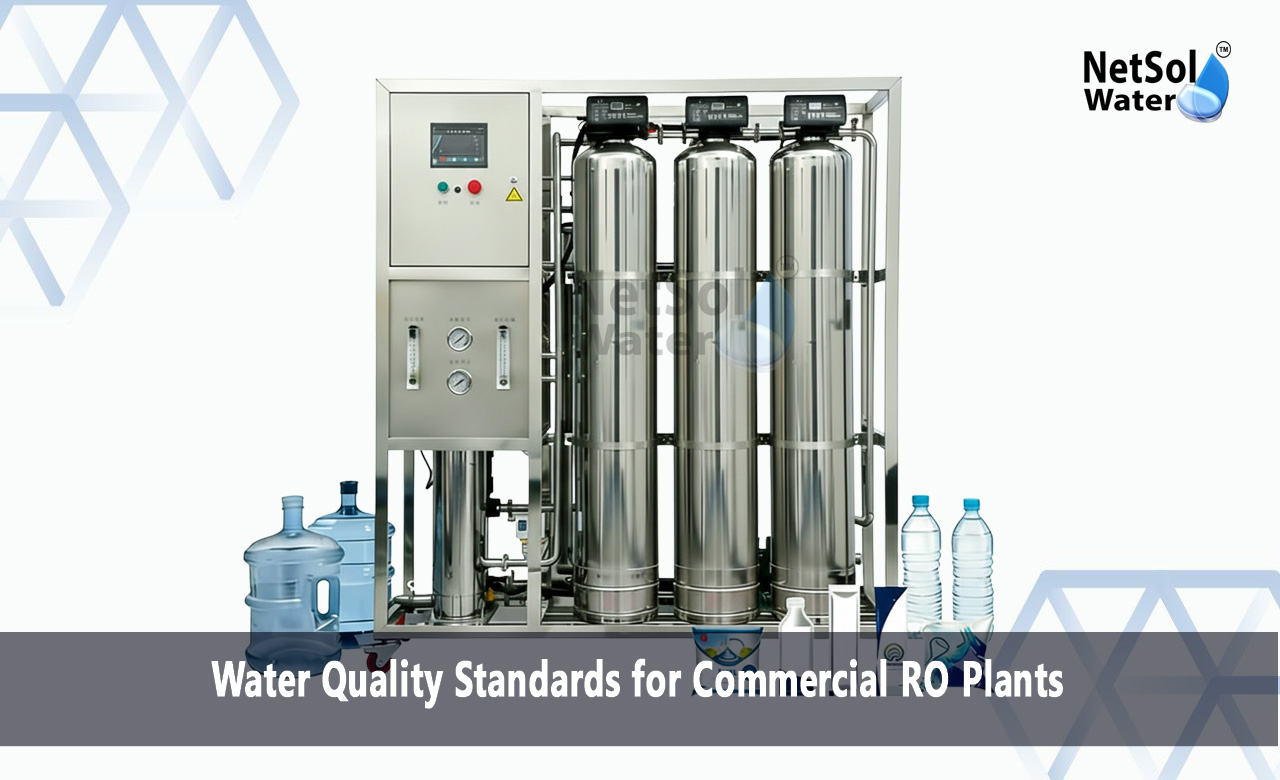
What are the Water Quality Standards for Commercial RO Plants?
A Commercial RO plant removes salts, minerals and many dissolved substances from water so that the water meets the needs of people. Netsol Water leads as a Commercial RO plant Manufacturer and helps businesses meet strict water quality rules and their own process needs. In this blog, we will explain why water quality standards matter for commercial RO plants.
Importance of Water Quality Standards for Commercial RO plants
Water quality standards set clear targets for safety performance and consistency. For any commercial RO plant these targets guide design choices such as membrane type, recovery rate and pre-treatment steps. When a facility controls water quality to a standard it protects worker health reduces scaling and corrosion in pipes and equipment and preserves product quality in food pharmaceutical and laboratory settings. Well defined standards also support regulatory compliance and make audits simpler. In addition they let procurement teams compare supplier claims directly so they can choose the right Commercial Rerevse Osmosis plant for their needs.Let us have a look on some of the main reasons why standards matter and how they shape plant design and operation.
1: Protecting human health and product quality
Standards focus on contaminants that affect health and product safety. For drinking water uses that may include limits on microbes heavy metals and certain chemical compounds. For industrial uses standards emphasize total dissolved solids, hardness, silica and chlorides because those affect boilers cooling and manufacturing lines. A Commercial RO plant must therefore meet different targets depending on the end use. When a plant meets the correct standards staff and customers gain confidence that water related risks are low and consistent.
2: Extending plant life and lowering cost
High hardness or high silica in feedwater increases scale on membranes and inside heat exchangers while chlorine can damage polymeric membranes. Standards that limit these components allow the RO plant to run at designed flux and recovery without frequent cleaning or membrane change. A plant that meets water quality standards spends less on chemical cleaning replacement parts and emergency repairs. That lowers the total cost of ownership and makes the investment in a Commercial RO plant more economical.
3: Enabling regulatory and contract compliance
Many industries face strict water rules from public health food safety and environmental agencies. Standards also appear in supplier contracts and industry certifications. Following standards keeps operations in legal compliance and avoids production stops fines or product recalls. Clear records showing that a Commercial RO plant meets required limits help during inspections and when seeking approvals.
Key Physical and Chemical Parameters to Monitor
Understanding the key parameters helps in setting the correct control strategy.Let us have a look on some of the most important parameters and why they matter for a Commercial RO plant.
1: Total Dissolved Solids (TDS) and Conductivity
TDS measures the combined content of all inorganic and organic substances dissolved in water. Conductivity provides a practical proxy for TDS because dissolved salts conduct electricity. Commercial RO plants must reduce TDS to a level suited to the application. For boiler feed water low TDS is essential to prevent scale formation while for many process waters a moderate TDS may be acceptable. High feed TDS increases osmotic pressure and reduces permeate yield. That change requires stronger pumps and different membrane arrangements. Operators monitor conductivity continuously to detect membrane damage or rising feed contamination. A well designed Commercial RO plant keeps conductivity stable within the chosen specification and includes alarms to alert staff when values shift.
2: pH and Alkalinity
pH measures the acidity or basicity of water and alkalinity reflects its buffering capacity. Both matter for membrane life and post treatment. Very low or very high pH values can increase membrane wear and affect chemical dosing. Alkalinity influences scale risk because it links to bicarbonate and carbonate species that form scale under heat. A Commercial Reverse Osmosis plant may include pH correction ahead of membranes or in post treatment as needed to protect both membranes and downstream use. Operators test pH during commissioning and as part of routine monitoring to ensure consistent performance and to adjust chemical dosing when feedwater quality shifts.
3: Hardness Chlorine Silica and Iron
Hardness from calcium and magnesium causes scale in heat systems and on membranes unless removed before RO. Free chlorine and chloramines protect distribution systems but they damage RO membranes so dechlorination steps must appear before the membranes. Silica can form hard scales on membranes and heat surfaces and resist simple cleaning. Iron causes fouling and staining while organic iron complexes can bypass some pre-treatment units. A Commercial RO plant includes filters softeners antiscalant dosing and dechlorination units tuned to the feed water profile. The plant design balances capital cost with expected operating savings from fewer cleanings and longer membrane life.
Heavy Metals and Specific Contaminants
Metals such as lead arsenic chromium and mercury pose clear health and regulatory risks. Other contaminants like nitrate bromide or boron may matter for some industrial processes or for final product quality. RO removes many metals effectively but removal efficiency varies with membrane type operating pressure and recovery. When heavy metals appear at concerning levels a Commercial RO plant may pair RO with ion exchange or targeted adsorption media. Regular testing for metals and for compounds of process interest guides decisions to install additional polishing steps or to tighten membrane rejection specifications.
Microbiological Standards and Disinfection for Commercial RO plants
Water free from harmful microbes is essential in many commercial settings. Microorganisms cause illness affect product safety and promote biofilm growth that reduces membrane performance. Commercial RO plants must therefore address microbiological risks through a combination of pre-treatment membrane barrier and post treatment strategies. Let us have a look on some common microbiological control measures and testing methods that ensure safe reliable water supply.
Biological risks and membrane barriers
Microbes include bacteria, viruses and protozoa. RO membranes provide a strong physical barrier to many microorganisms but they do not guarantee complete sterility. Membrane integrity must remain intact and systems must bypass that would let microbes pass. Materials that support biofilm formation such as dead zones or rough surfaces in the feed side encourage microbial growth and fouling. A Commercial RO plant uses well designed piping smooth surfaces and controlled flow patterns to limit places where microbes can gather. The plant also schedules regular cleaning and rinsing to remove accumulated biomass.
Disinfection methods and safe handling
Operators use multiple disinfection methods as needed including chemical agents, ultraviolet light and controlled hot water flushing. Chemical disinfectants such as sodium hypochlorite kill many microbes yet they can damage membranes so teams must ensure full dechlorination before the RO stage. UV disinfection provides a chemical free inactivation step yet it does not remove dead cells or organic matter that can feed regrowth. Heat inactivation works well for closed loops that tolerate temperature swings. A robust Commercial Reverse Osmosis plant combines these methods and uses storage and distribution practices that prevent recontamination after treatment.
Testing protocols for microbiological safety
Testing confirms that disinfection and barrier measures work. Operators measure heterotrophic plate counts, total coliforms and specific pathogen indicators based on the intended use of the water. Tests include grab sampling and continuous online monitoring for surrogate parameters that hint at biological activity such as turbidity or ATP testing. When a test returns a concerning result staff follow a pre-set response plan that can include immediate flushing membrane checks and targeted disinfection.
International and Local Standards that Apply to Commercial RO plants
Regulatory and industry standards give a framework for acceptable water quality. Depending on the end use and local rules operators choose one or more standards to follow. Let us have a look on common standards and how to use them when selecting or operating a Commercial RO plant.
World Health Organization (WHO) and international guidance
World Health Organization publishes guidelines for drinking water quality that set limits for many chemical and microbiological parameters. These guidelines guide national agencies and private standards. For industrial uses organizations such as ASTM and ISO produce relevant technical standards that describe testing methods system components and performance testing. A Commercial RO plant that aligns with recognized international standards gains credibility and eases approval for cross border projects or international clients.
National codes and industry specific rules
Many countries set mandatory limits through national standards such as the Bureau of Indian Standards (BIS) in India or the Environmental Protection Agency (EPA) rules in other jurisdictions. In addition industries such as food processing pharmaceuticals and laboratories follow sector rules that may impose stricter limits than general public health standards. Operators must identify the applicable national and industry standards early in the project so that system sizing pre-treatment choices and monitoring plans match mandatory requirements. A Commercial RO plant Manufacturer that understands local and industry rules can propose the right configuration and provide relevant documentation during audits.
Choosing the right standard for the intended use
Drinking water for staff use requires different targets than boiler feed water or high purity water for labs. Operators must review the end use expected water flows and local regulations to select target values for parameters such as conductivity, TDS, microbial limits and specific contaminants. When in doubt a conservative approach during commissioning with controlled improvement based on testing reduces risk. Netsol Water supports clients by mapping local rules to system designs and by providing the documentation and test results that show a Commercial RO plant meets the chosen standards.
Pre-treatment Requirements to Meet Water Quality Standards
Pre-treatment prepares feedwater so that the RO membranes can remove contaminants efficiently and last longer. Pre-treatment protects membranes from scaling fouling and chemical damage. A well planned pre-treatment scheme helps a Commercial RO plant meet quality targets consistently while keeping operating cost under control. Let us have a look on common pre-treatment steps and how they contribute to standard compliance.
Filtration and suspended solids control
Removing suspended solids prevents membrane abrasion and accumulation on the surface that reduces flux. Multimedia filters cartridge filters and automatic backwashing filters remove particles of different sizes in sequence. Properly sized filters reduce the need for frequent chemical cleaning and help maintain consistent permeate quality. A Commercial RO plant often includes a staged filtration approach in which coarse screens protect pumps and finer filters protect the membranes directly.
Softening and antiscalant dosing
Water hardness and some salts lead to scale that can permanently damage membranes and heat equipment. Softening using ion exchange or chemical antiscalants reduces the risk of hard scale layers. Antiscalant chemicals interfere with crystal formation and allow higher recovery rates without rapid scale buildup. When feedwater chemistry varies the dosing system must adapt. A Commercial RO plant that combines feed analysis with automatic chemical control achieves stable operation and meets quality targets more reliably.
Chlorine removal and organic control
Free chlorine helps control microbes in distribution but it attacks many RO membranes. Dechlorination with activated carbon or chemical dosing prevents membrane damage. Similarly organic matter and natural organic compounds can cause fouling that reduces membrane life and increases cleaning frequency. Coagulation and adsorption steps ahead of RO reduce organic load and help the plant maintain permeate quality while keeping cleaning cycles predictable.
Post-Treatment Storage Distribution and Handling
After the RO stage water may need adjustments for pH residual disinfection or mineral balance depending on the end use. Careful storage and distribution prevent contamination and ensure that quality at the point of use matches the standard. Let us have a look on post-treatment practices and storage controls that support compliance.
pH correction and re-mineralization
Some end uses require water with a controlled pH or with trace minerals present to prevent corrosion in plumbing. Re-mineralization adds small amounts of calcium or magnesium to stabilize the water and to make it suitable for drinking or for certain processes. pH correction with dilute acid or alkaline dosing prepares the water for storage when downstream equipment needs a specific pH range. A Commercial RO plant integrates these steps to meet the final quality specification without compromising membrane performance.
Residual disinfection and distribution hygiene
To prevent recontamination after treatment many facilities maintain a low level of residual disinfectant in storage or distribution loops. When chemical residuals risk damaging downstream equipment a UV system may provide point inactivation without adding chemicals. Storage tanks must feature smooth interior finishes closed vents and easy access for cleaning. Pipework must avoid dead legs and must include appropriate materials to prevent leaching or corrosion. A well maintained distribution network ensures that water quality at the tap meets the chosen standard.
Monitoring storage and routine maintenance
Storage tanks and distribution loops require scheduled inspection cleaning and testing. Operators follow a documented program for flushing sampling and cleaning. When a deviation appears in routine tests the plant team performs corrective actions such as tank cleaning or localized disinfection. A Commercial RO plant that includes clear post treatment and distribution protocols reduces the chance that treated water degrades before use.
Testing, Monitoring, Documentation and Compliance Practices
Consistent testing and clear records prove that a Commercial RO plant meets water quality standards. Monitoring helps detect drift in performance before it affects operations and supports decisions on cleaning membrane replacement and chemical dosing. Let us have a look on monitoring strategies and documentation required for strong compliance.
Routine tests and online monitoring
Operators use a mix of online instruments and offline laboratory tests. Online sensors continuously measure conductivity flow pressure and turbidity. Labs perform periodic tests for TDS, hardness silica, metals and microbiological parameters. Together these measures detect issues such as membrane breach rising feed contamination or biological growth. A Commercial RO plant with well calibrated sensors and a clear alarm strategy lets the team respond quickly and avoid product or process impacts.
Maintenance logs and corrective action records
Documented maintenance schedules and logs record cleaning cycles membrane changes chemical dosing and any incidents. Corrective action records describe the response when tests exceed limits and show the root cause and the steps taken to return to compliance. These logs form the backbone of quality systems and support audits and certification. A manufacturer that provides service level agreements and training helps facilities maintain consistent records for their Commercial RO plant.
Reporting and certification
Many clients require certificates of analysis at regular intervals or before product release. The facility prepares reports that summarize test results trends and any maintenance actions. Where regulations demand it the facility registers with local authorities and submits compliance data. A Commercial RO plant Manufacturer that supports commissioning tests and provides clear documentation simplifies the client’s path to certification and ongoing compliance.
Conclusion
Commercial RO plants must meet clear chemical, physical and microbiological standards to perform well. Selecting the right pre-treatment and post treatment steps monitoring performance and keeping complete records prove that systems meet the chosen targets. Netsol Water stands ready to help organizations design and operate Commercial RO plants that meet regulatory and process needs.
If you want to learn how a Commercial RO plant can meet your site requirements or to request a consultation contact Netsol Water for a detailed assessment. Our team will analyze your water supply recommend the right plant and support commissioning and long term testing.
Contact Netsol Water at:
Phone: +91-9650608473, Email: enquiry@netsolwater.com