

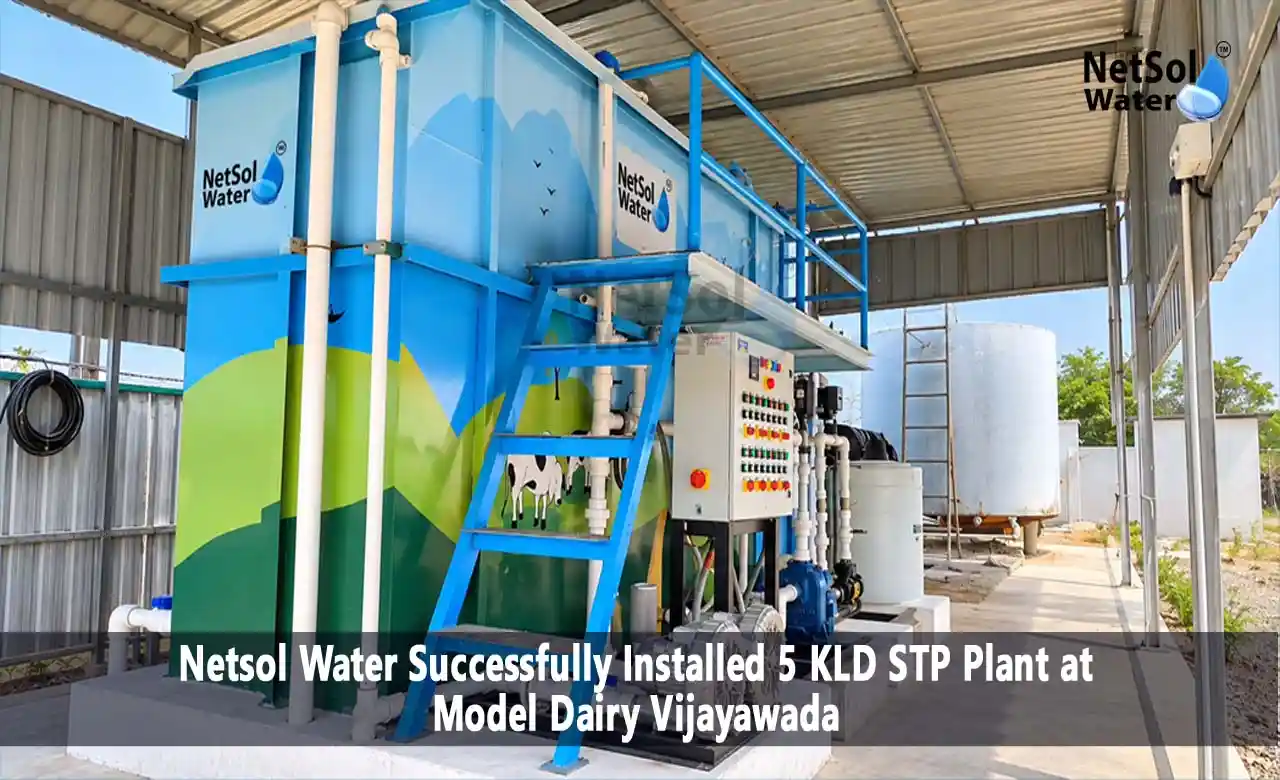
Case Study: 5 KLD STP Plant Installed at Model Dairy, Vijayawada
Effective sewage treatment is an essential requirement for any commercial or institutional facility that generates domestic wastewater on a daily basis. This case study presents the installation of a 5 KLD STP at Model Dairy, Vijayawada, Andhra Pradesh. This project was undertaken to provide a systematic, on-site sewage treatment solution for the facility’s daily wastewater generation. The project covers the treatment of sewage through a defined process sequence, culminating in the routing of treated effluent for controlled ground/soil discharge in line with the project requirement and applicable discharge criteria.
Project Overview
| Parameter | Details |
|---|---|
| Client / Project | Model Dairy |
| Location | Vijayawada, Andhra Pradesh, India |
| STP Capacity | 5 KLD (5,000 litres per day) |
| Application | Sewage / Wastewater Treatment |
| Treated Water Disposal | Controlled ground/soil discharge after treatment |
| Treatment Approach | Biological treatment process followed by settling and polishing stages |
About the Project
Model Dairy, located in Vijayawada, required a dedicated sewage treatment plant to manage the wastewater generated from its day-to-day facility operations. Like most commercial and processing establishments, the site generates domestic-type sewage that requires proper collection and treatment before it can be discharged responsibly. To address this, a 5 KLD Sewage Treatment Plant was planned, designed for a treatment capacity of approximately 5,000 litres of sewage per day.
The term “5 KLD” refers to the design capacity of the plant. It indicates that the STP is engineered to treat up to 5,000 litres of sewage or wastewater on a daily basis. For a facility of Model Dairy’s scale, this capacity was identified as suitable for handling the sewage load generated by staff facilities, washrooms, and other domestic wastewater sources on the premises.
This project falls under the broader category of STP installation in Vijayawada, an increasingly important area of infrastructure development as commercial establishments across the city move toward organized, on-site wastewater management rather than relying on ad hoc disposal methods.
Project Requirement and Challenges
Every facility that generates sewage on a continuous basis faces the challenge of managing that wastewater responsibly. Without a proper treatment mechanism in place, sewage can accumulate, create odour and hygiene concerns, and pose a risk to the surrounding environment if discharged without treatment. For Model Dairy, the primary requirement was to establish a dependable, on-site system that could:
. Collect sewage generated across the facility in a centralized manner
. Treat the collected wastewater through a defined, logical process sequence
. Reduce the pollutant load present in raw sewage before disposal
. Provide a disposal pathway for treated water that aligns with the project’s ground/soil discharge requirement
Facilities operating in urban and semi-urban locations like Vijayawada often face space constraints, making it necessary to design a sewage treatment plant that is compact enough to fit within the available footprint while still delivering consistent treatment performance. Additionally, any STP installed at an active commercial site needs to be integrated with existing plumbing and drainage infrastructure with minimal disruption to daily operations.
These considerations formed the basis for planning and executing the 5 KLD STP installation at Model Dairy, a project that needed to balance capacity requirements, space availability, and operational practicality.
5 KLD STP Solution
To meet Model Dairy’s wastewater treatment needs, a 5 KLD STP was proposed and installed at the facility. A plant of this capacity is generally suited to establishments where the daily sewage generation is moderate, such as small to mid-sized commercial units, processing facilities, and similar institutional setups.
The solution was structured around a sewage treatment solution that combines physical and biological treatment stages, allowing raw sewage to pass through a sequence of processes before the treated water reaches the outlet point. The overall objective of the installation was to ensure that wastewater generated at the facility does not go untreated, and that the treated effluent is directed toward controlled ground/soil discharge as required by the project.
As with most STP installations of this scale, the system was designed to operate as a compact, self-contained unit, allowing it to be installed within the available space at the Model Dairy premises without requiring extensive civil modifications.
How the Sewage Treatment Plant Works?
A sewage treatment plant functions by passing raw wastewater through a series of treatment stages, each designed to progressively remove or reduce contaminants. The description below outlines the general stages typically involved in STP of this type. Where the exact configuration of the Model Dairy plant has not been separately confirmed for each stage, the description reflects standard practice for a 5 KLD Sewage Treatment Plant.
1. Sewage Collection
The process begins with the collection of sewage generated across the facility. Wastewater from washrooms and other domestic sources is channelled through the drainage network into a collection or equalization point, from where it is directed into the treatment system. This stage ensures that sewage generation across the day is gathered in a controlled manner rather than being allowed to flow untreated.
2. Preliminary Treatment
Once collected, the raw sewage typically passes through a preliminary treatment or screening stage. This step is intended to remove larger solids, debris, and floating material that could otherwise interfere with downstream equipment or reduce the efficiency of subsequent treatment stages. Preliminary treatment acts as a protective step for the rest of the plant.
3. Primary Treatment
Following screening, the sewage generally undergoes a primary treatment stage, where heavier suspended solids are allowed to settle out of the wastewater. This step reduces the solid load entering the biological treatment stage, helping the downstream process operate more effectively.
4. Biological Treatment
The core of the treatment process is the biological treatment process, where naturally occurring microorganisms break down organic matter present in the sewage. This stage is central to reducing the organic pollutant load in the wastewater and is a standard component of sewage treatment plants of this capacity. The specific biological treatment configuration used at a given site depends on the plant design, but the underlying principle remains consistent: beneficial microbial action is used to convert organic contaminants into more stable, less harmful forms.
5. Settling and Clarification
After biological treatment, the wastewater typically passes through a settling or clarification stage. Here, biological solids generated during the treatment process are allowed to separate from the treated water, resulting in clearer effluent moving forward in the process.
6. Tertiary Treatment and Disinfection
Depending on the plant design and project requirement, a tertiary or polishing stage may be included to further refine the treated water. Where applicable, a disinfection step may also be incorporated to address microbial content in the effluent before it reaches the outlet stage. The precise polishing and disinfection arrangement is determined based on the plant’s design and the project’s discharge requirement.
7. Treated Water Disposal
Once the wastewater has passed through the applicable treatment stages, the treated effluent reaches the outlet point of the plant. From here, after appropriate treatment, the treated effluent was routed for controlled ground/soil discharge in accordance with the project requirement and applicable discharge criteria.
The table below summarizes the treatment sequence described above:
| Stage | Purpose |
|---|---|
| Sewage Collection | Gather raw sewage from facility drainage into the treatment system |
| Preliminary Treatment / Screening | Remove larger solids and debris |
| Primary Treatment | Settle out heavier suspended solids |
| Biological Treatment | Break down organic matter through microbial action |
| Settling and Clarification | Separate biological solids from treated water |
| Tertiary Treatment / Polishing | Further refine treated water, where applicable |
| Disinfection (where applicable) | Address microbial content before discharge |
| Treated Water Outlet | Route treated effluent for controlled ground/soil discharge |
Installation and Commissioning
The installation of a 5 KLD STP at an operational facility such as Model Dairy typically involves a defined set of activities. These generally include positioning of the treatment unit and associated equipment at the designated location, connection of inlet and outlet piping to the facility’s existing drainage network, and establishment of the necessary electrical connections required to run pumps, blowers, or other associated equipment.
Following physical installation, the plant is typically taken through a testing and commissioning phase. This involves checking that flow through each stage of the process is functioning as intended, verifying that mechanical and electrical components are operating correctly, and confirming that the plant is ready for regular operation.
It should be noted that the description above reflects typical activities involved in STP installation and commissioning projects of this nature. Specific project records, timelines, or execution details for the Model Dairy installation beyond what is presented in this case study have not been separately itemized here.
Treated Water Disposal and Environmental Benefits
A properly functioning sewage treatment plant plays an important role in reducing the pollutant load of wastewater before it is released into the surrounding environment. At Model Dairy, the treated effluent generated by the 5 KLD STP is directed for controlled ground/soil discharge, in line with the project’s requirement and applicable discharge criteria.
Treating sewage before disposal, rather than releasing it untreated, is a fundamental principle of responsible wastewater management. It helps reduce the presence of organic and solid contaminants in the water that ultimately reaches the ground, supporting better environmental outcomes at the facility level. It is important to note that treated-water quality from any STP should be verified through applicable testing to confirm that it meets the relevant discharge parameters for the intended disposal method; this case study does not present specific laboratory results for the Model Dairy installation.
The treated water from this plant is not intended for potable use or drinking purposes; its disposal pathway is limited to controlled ground/soil discharge as defined by the project.
Project Outcome
The installation of the 5 KLD STP at Model Dairy, Vijayawada, provided the facility with a structured, on-site mechanism to manage its daily sewage generation. Key practical outcomes of the project include:
. A dedicated, on-site wastewater treatment plant capable of handling the facility’s daily sewage generation of up to 5,000 litres
. A defined treatment process sequence covering collection, preliminary treatment, biological treatment, and settling stages
. A structured pathway for treated water to be routed for controlled ground/soil discharge, in place of untreated sewage release
. A compact plant footprint suited to the space available at a commercial facility
Overall, the project reflects a practical application of a 5 KLD STP installation tailored to the operational scale and sewage generation pattern of a facility like Model Dairy.
Project Video
A video documenting this project is available below, offering a visual overview of the 5 KLD STP installation at Model Dairy, Vijayawada.
Watch the project video:
Conclusion
The 5 KLD STP installation at Model Dairy, Vijayawada, illustrates how a compact, well-planned sewage treatment system can address the wastewater management needs of a commercial facility. By collecting and treating sewage through a defined process sequence, from preliminary screening through biological treatment and settling, and directing the treated effluent toward controlled ground/soil discharge, the project provides Model Dairy with a systematic sewage treatment solution suited to its daily operational requirements. As facilities across Vijayawada and similar cities continue to prioritize responsible wastewater management, projects of this nature demonstrate a practical, scalable approach to on-site sewage treatment.
Frequently Asked Questions (FAQs)
1. What is the capacity of the STP installed at Model Dairy, Vijayawada?
The sewage treatment plant installed at Model Dairy has a capacity of 5 KLD, meaning it is designed to treat approximately 5,000 litres of sewage per day.
2. What does 5 KLD mean in STP?
KLD stands for “kilolitres per day.” A 5 KLD STP refers to a sewage treatment plant designed to treat up to 5,000 litres (5 kilolitres) of wastewater in a 24-hour period.
3. Why was a 5 KLD STP installed at Model Dairy?
The plant was installed to provide a systematic, on-site solution for treating the sewage generated at the facility, rather than allowing untreated wastewater to be released into the surrounding environment.
4. How does a sewage treatment plant work?
A sewage treatment plant generally works by passing raw wastewater through stages such as screening, primary settling, biological treatment, and clarification, progressively reducing the pollutant load before the treated water reaches the outlet stage.
5. Where is the treated water discharged?
After appropriate treatment, the treated effluent from the Model Dairy STP is routed for controlled ground/soil discharge, in accordance with the project requirement and applicable discharge criteria.
6. What are the benefits of installing a STP?
A STP allows a facility to manage its sewage on-site, reduce the pollutant load of wastewater before disposal, and move away from untreated discharge practices, supporting more responsible wastewater management.
7. Why is sewage treatment important before ground discharge?
Treating sewage before ground discharge helps reduce organic and solid contaminants present in the wastewater, which supports better environmental outcomes compared to releasing untreated sewage.
8. What is the purpose of the STP installation at Model Dairy?
The purpose of the installation was to provide Model Dairy with a dedicated sewage treatment system capable of handling its daily wastewater generation and directing treated effluent to a controlled ground/soil discharge point.