

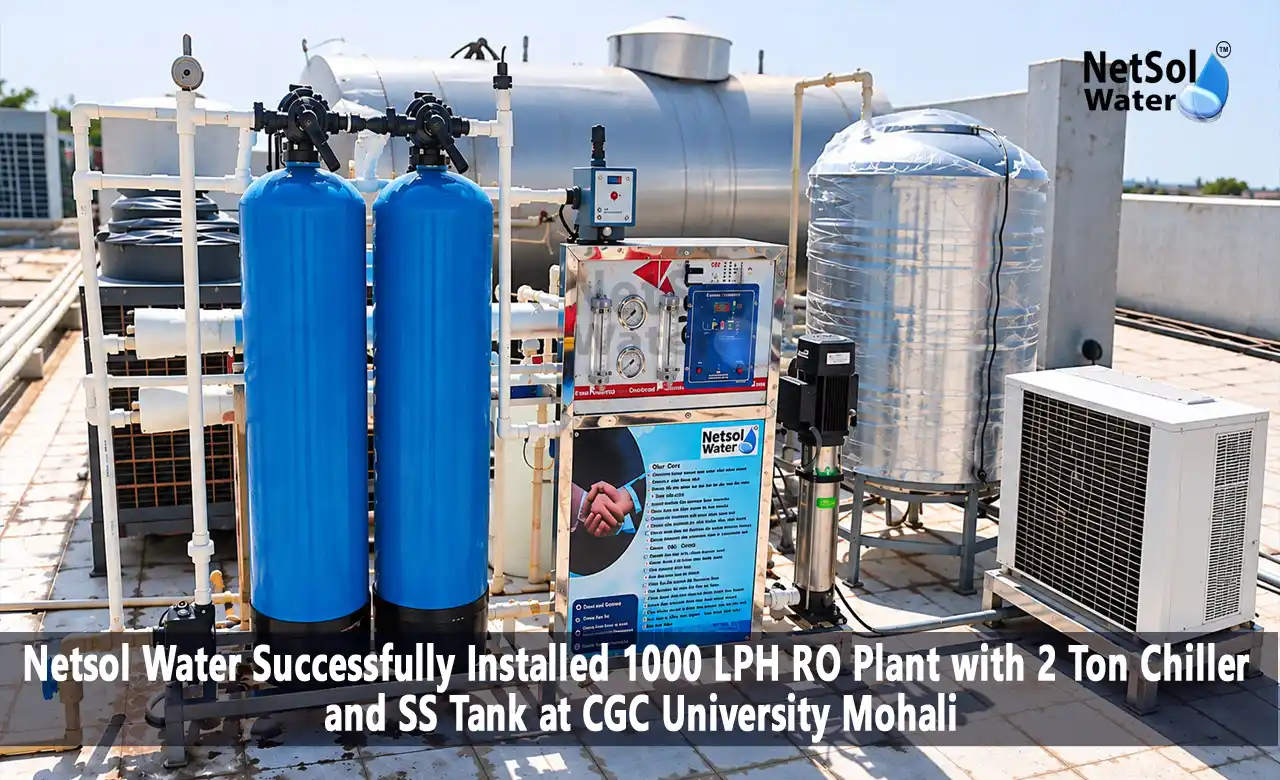
Case Study: 1000 LPH RO Plant with 2 Ton Chiller & SS Tank at CGC University, Mohali
The borewell at the CGC University hostel in Mohali was reading 1500 TDS. The Bureau of Indian Standards (BIS) treats up to 500 mg/L as acceptable in drinking water and allows up to 2000 mg/L only when no better source exists, so this water sat close to the ceiling. In October 2026, Netsol Water completed this 1000 LPH RO plant Mohali project: a plant on the hostel's top roof, a 2 ton chiller and a 2000 litre SS 316 tank. The treated water now reads 80 to 90 TDS and serves about 200 people.
The installation took two days, and unloading and shifting gave us more trouble than any pipe or wire.
Project snapshot
| Detail | Information |
|---|---|
| Client | CGC University, Mohali |
| Installed by | Netsol Water, Noida |
| Date | October 2026 |
| Location | Hostel building, top roof |
| Users | About 200 people |
| Source water | Borewell, 1500 TDS |
| Plant | 1000 LPH RO with LG membrane |
| Cooling | 2 ton chiller |
| Storage | 2000 litre SS 316 tank |
| Output water | 80 to 90 TDS |
| Installation time | 2 days |
What the hostel needed?
About 200 people live in the hostel and drink from one supply. That supply is a borewell, and the borewell reads 1500 TDS.
The system had to bring that number down to drinking level and hand the water over cold. It also needed enough stored water behind it that nobody waits at the tap during the evening rush, when half the floor remembers to fill a bottle at the same time.
Location was the other constraint. The plant would sit on the top roof of the hostel building, and that shaped almost every decision after this point, from how the equipment travelled to how we planned the two installation days.
How bad is 1500 TDS?
IS 10500, the BIS standard for drinking water, sets the TDS limit at 500 mg/L (acceptable) and 2000 mg/L (permissible only in the absence of an alternate source), as India Water Portal explains. So 1500 TDS is legal on paper. It is also what the standard allows when people have no better option, and the CGC hostel had one.
The effects are the ordinary ones. BIS notes that water above 500 mg/L may taste worse and can cause stomach irritation, according to Netsol's explainer on ideal TDS levels. India Water Portal adds that people drinking such water for long enough get used to the taste, which is a polite way of saying they stop complaining.
One complication. TDS adds up everything dissolved in the water, whether that is harmless calcium or something you would rather not drink. A meter reading is a fast first check, and anything that matters needs a laboratory report.
That is also why a plain sediment filter or a softener would not have fixed this water. Filters catch particles, and softeners swap hardness ions. Neither takes out the bulk of dissolved salts.
Reverse osmosis removes the dissolved salts that filters and softeners leave behind, so for 1500 TDS in a drinking supply it was the obvious route.
The treatment train, stage by stage
The plant runs eight stages in this order:
1. Raw water pump: It moves borewell water into the plant and gives the filters a steady flow.
2. Activated carbon filter (ACF): It adsorbs organic matter, odour and any chlorine that would otherwise foul the membrane.
3. Multi grade filter (MGF): Layers of media catch silt and suspended solids.
4. Micron filter: A fine cartridge picks up what the MGF missed, and it is the last guard before the pump.
5. Low pressure switch: If feed pressure drops, it stops the plant so the high pressure pump never runs dry.
6. High pressure pump: It pushes water against the membrane at the pressure reverse osmosis needs.
7. High pressure switch: If pressure climbs too high, for example when a reject line blocks, it cuts the plant.
8. LG RO membrane: This is where the dissolved salts leave. Treated water goes forward and the reject stream goes to drain.
The first four stages exist to protect the last four. A membrane that sees silt, carbon fines or oily residue loses output and needs cleaning long before its time, so most of the plant's life expectancy is decided in the pretreatment skid and not at the membrane itself. Our own technical features guide for commercial RO plants lists the same building blocks across the 250 to 2000 LPH range, with the raw water feed pump sized up as capacity rises.
We put weight on the two pressure switches, and clients sometimes ask whether they are needed. They are small and cheap next to a membrane. A dry running pump or a closed reject line can damage the most expensive item on the skid, and nobody finds out until the output TDS creeps up. Plants like this one should carry both devices even when the brief never mentions them.
The 2 ton chiller and the SS 316 tank
RO water comes out at whatever temperature the feed water was, so cold water needs a separate machine. The chiller here has a 2 ton refrigeration rating. One ton of refrigeration equals 12,000 BTU per hour, or about 3.517 kW, so a 2 ton unit removes roughly 7 kW of heat, going by the standard conversion. That figure is cooling capacity, not the electricity the machine draws.
People mix the two up while comparing quotes, and the difference is large.
The tank is SS 316. Rolled Alloys notes that grade 316 stainless steel contains 2 to 3 percent molybdenum, which improves its resistance to chloride pitting and crevice corrosion compared with 304. A storage tank is one thing on a roof you do not want to open up and repair later, so the more corrosion resistant grade made sense for us.
Sizing a 1000 LPH RO plant for 200 hostel residents
The numbers are simple. A 2000 litre tank divided by 200 residents gives 10 litres each from one full tank. At the plant's rated 1000 litres per hour, an empty tank refills in about two hours. Real output moves with feed water TDS and temperature, so treat two hours as a floor and not as a promise.
Hostel demand arrives in bursts: early morning, after classes, late evening. A tank absorbs those peaks. Without one, we would have sized the plant for the busiest ten minutes of the day and it would sit idle for the rest. A bigger tank usually costs less than a bigger RO skid, so we pushed the storage side and kept the plant at 1000 LPH.
The sizing has limits. If the hostel adds rooms, or the mess starts drawing drinking water from the same line, the 10 litres per person figure shrinks fast. A plant like this can take a second tank more easily than it can take a doubled headcount.
Watch the installation
The video below shows the plant, the chiller and the tank on site.
1000 LPH RO plant Mohali: the rooftop problem
On most RO jobs the hard part is design. Here the hard part was logistics.
The plant went on the top roof of the hostel building, and that meant unloading everything at ground level and shifting it up through a working hostel before a single pipe could be joined. The pump set, the filter vessels, the membrane housings, the chiller and the tank body all had to make the trip. Any of them can pick up a dent, a scratch or a bent fitting on the way, and damage from shifting tends to show up later as a leak or a vibration.
Weight matters too. One litre of water weighs about one kilogram, so a full 2000 litre tank carries two tonnes of water before you count the steel. That is a fair load for any roof, and it is the reason where the tank stands needs to be agreed before the truck arrives.
Before any rooftop RO job we ask the same few questions. How does the equipment get from the truck to the roof? Can anything be hauled in one piece, or does it need splitting into smaller loads? Who is on the roof to receive it, and who is at the bottom watching the route? Answers to those save more time than any amount of site welding.
The whole installation, shifting included, took two days. Unloading and shifting took more of our attention than the plumbing or the wiring did, and we would say the same of most rooftop RO jobs.
What the water looks like now?
Output water reads 80 to 90 TDS against a feed of 1500. On a TDS meter that is a reduction of roughly 94 to 95 percent. The hostel gets chilled drinking water from a tank that holds enough for the peak hours, and client feedback after commissioning was positive.
Is 80 TDS too low? Some readers will ask, because packaged drinking water has its own range.
BIS 14543 sets 150 to 700 mg/L for packaged water, according to a legal overview of TDS standards in India. That rule covers bottled water sold in shops. IS 10500 sets no lower limit for TDS, a point Netsol's own TDS guide makes as well. Very low TDS water tastes bland, and a hostel that dislikes the flavour can add a TDS controller or a mineraliser later without changing the plant.
One limit on these numbers: the 80 to 90 reading comes from a TDS meter, which counts dissolved solids and says nothing about which ones remain. A laboratory test of the treated water would show the full picture, and we would encourage any institution to run one after commissioning and again each year.
What the hostel should watch after commissioning?
A plant that works on day two can still drift by month six.
We suggest the hostel keeps a simple log: feed TDS and output TDS once a week, noted by whoever runs the plant. Output TDS creeping upward over several weeks while feed TDS stays flat points at the membrane. A drop in flow with normal TDS points at the filters, usually the micron cartridge or the MGF. Both are easier to fix when caught early.
The SS 316 tank needs its own routine. Water sitting in any tank for weeks picks up what the air and the vents let in, so periodic draining and cleaning belongs on the calendar. Nobody enjoys that job, which is why it helps to have a date written next to it.
What we would check before buying a 1000 LPH RO plant
Start with a laboratory report on your source water, because a TDS meter alone will not show hardness, iron or fluoride. Then ask which protection devices come with the plant, and whether the quote names the membrane brand. Check the tank grade, since SS 304 and SS 316 cost differently. And read the chiller capacity in kW as well as tons.
These checks apply to anyone looking at a 1000 LPH RO plant in Chandigarh or Mohali, where hostels, hospitals, factories and commercial kitchens all draw on similar borewell supplies.
Questions people ask
Q1. Is a 1000 LPH RO plant enough for 200 people?
With a 2000 litre storage tank behind it, yes, in this hostel. The tank handles peak demand and the plant refills it between peaks.
Q2. Does a 2 ton chiller cool all the water at once?
No. A chiller removes heat at a fixed rate of about 7 kW. It cools water as it is drawn or circulated, so the size of the tank and the usage pattern decide how cold the water stays.
Q3. Why add an RO plant with tank storage instead of RO alone?
RO produces water at a steady rate, and demand comes in bursts. Storage covers the gap.
Planning something similar?
If you are weighing a similar plant, send us your borewell TDS or lab report. Call or WhatsApp the Netsol Water team, or fill the Get Quote form at netsolwater.com and we will tell you which capacity and tank size fit your headcount.