

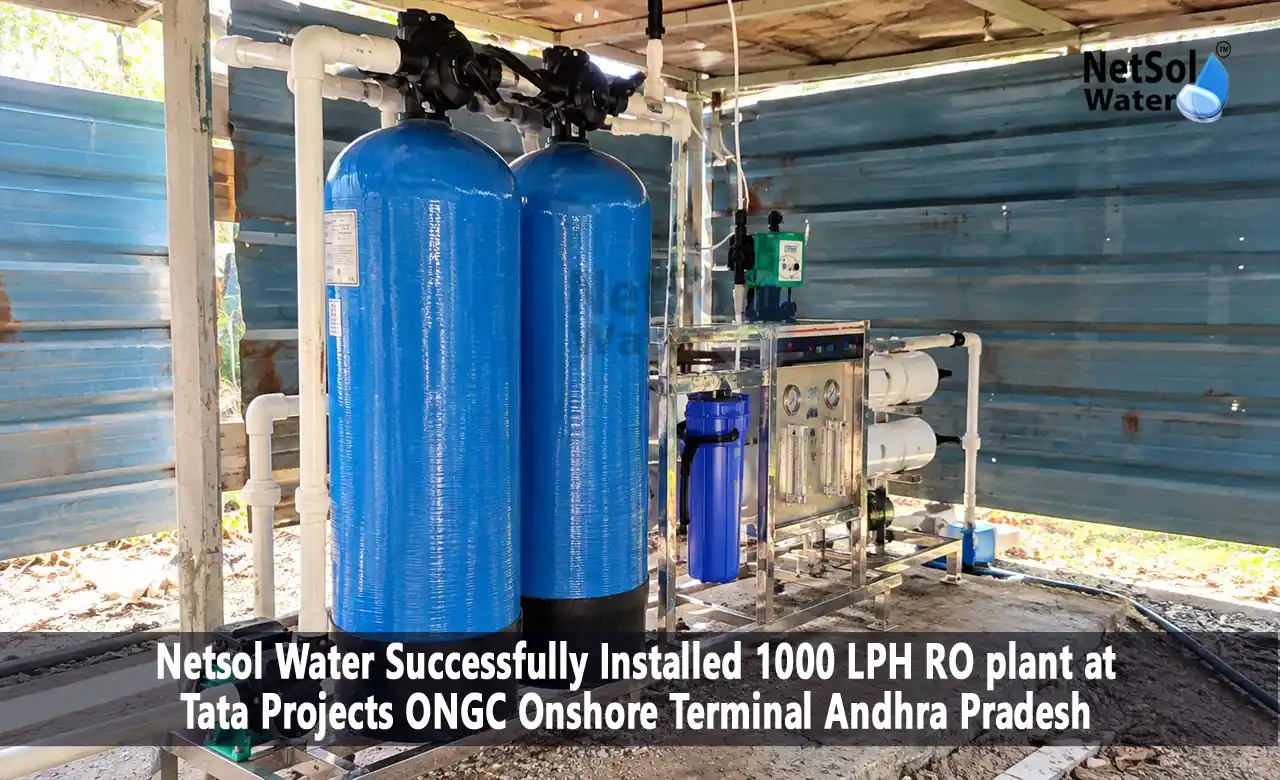
Case Study: Installed 1000 LPH RO Plant at Tata Projects, ONGC
Netsol Water installed a 1000 LPH RO plant at Tata Projects, ONGC Onshore Terminal, Andhra Pradesh, in 2025. This RO plant for drinking water treats borewell water. The raw water TDS was 2600 mg/L, and the treated water TDS was recorded at 90 mg/L. The installation took three days. The main challenge on site was unloading the plant.
This RO plant installation case study explains the water source, the treatment stages, the unloading and installation work, the recorded TDS results and the maintenance needs of such a plant. It also separates recorded project facts from general technical guidance, so readers can see what applies to this site and what is standard practice.
Project Background and Drinking Water Requirements
Many project sites in Andhra Pradesh depend on borewells for their water supply. Groundwater quality changes from one location to another. It can carry dissolved salts, suspended particles and other constituents that make it unsuitable for direct drinking use.
At this project, the raw water came from a borewell. The TDS was 2600 mg/L. TDS means total dissolved solids, which is a measure of the dissolved salts and minerals in water. Water with a TDS in this range generally needs treatment before it is used for drinking.
The requirement was a drinking water plant with a rated capacity of 1000 litres per hour (LPH) at the ONGC Onshore Terminal project of Tata Projects. A rated capacity is the flow the plant is designed to deliver under its design conditions. Actual output can vary with feed water quality, temperature and membrane condition.
The confirmed details do not include a full raw water analysis or a list of specific contaminants. We have therefore not named any. For any new project, a complete water analysis should be done before the plant is designed. It helps the design team choose the right pretreatment, membrane and operating conditions, and it gives a baseline against which later results can be compared.
Why Reverse Osmosis Was Used for Borewell Water Treatment?
Reverse osmosis uses a semi-permeable membrane. Pressure pushes water through the membrane, while most dissolved salts stay on the feed side and leave with a reject stream. This is why RO is widely used where borewell water has high dissolved solids. The benefits of industrial RO plants are well documented for such sources.
Ordinary filters work differently. Sand and carbon filters act on particles, chlorine and certain organic compounds. They do not reduce dissolved salts in any meaningful way. For feed water at 2600 mg/L TDS, a membrane-based step is needed to bring the TDS down.
In any borewell water treatment plant, pretreatment matters as much as the membrane. Suspended particles, chlorine and fine solids can foul or damage a membrane. This is the reason the plant includes filtration stages ahead of it.
Every RO plant also produces reject water. The recovery percentage of this plant was not part of the confirmed project details, so we do not state it here. It would need to be confirmed from the design documents.
1000 LPH RO Plant Configuration and Working Process
This 1000 LPH reverse osmosis plant uses a conventional multi-stage arrangement. The illustrative process flow is:
Borewell Water → Raw Water Pump → Pressure Sand Filter (PSF) → Activated Carbon Filter (ACF) → Micron Filter → High-Pressure Pump → LG RO Membrane → Treated Water Outlet
This flow is subject to verification against the as-installed plant. The role of each confirmed component is explained below.
| Component | Purpose |
|---|---|
| Raw Water Pump | Moves borewell water into the pretreatment section at the required flow rate. |
| Pressure Sand Filter (PSF) | Helps reduce suspended particles such as silt so that downstream treatment stages are protected. |
| Activated Carbon Filter (ACF) | Under suitable conditions, helps reduce chlorine and certain organic compounds. Performance depends on feed-water quality and carbon condition. |
| Micron Filter | Provides finer particle filtration before water enters the RO membrane system. |
| High-Pressure Pump | Supplies the pressure required for reverse osmosis membrane separation. |
| LG RO Membrane | Separates a substantial portion of dissolved salts from the feed water. The treated-water stream passes through the membrane, while the rejected stream carries concentrated salts. |
The number of membranes and the operating pressure were not part of the confirmed details, so they are not stated.
Watch the 1000 LPH RO Plant Installed at ONGC Onshore Terminal
The video below gives visual context for this project. It is the project video published by Netsol Water. Viewers can see the plant and the site setting alongside the written explanation on this page.
Plant Unloading and Installation at the Project Site
The main challenge on this project was unloading the plant. An RO plant is heavy and carries sensitive parts such as pumps, instruments, piping and membrane housings. Unloading is therefore not a routine step. It sets the pace for everything that follows.
The RO plant installation at Tata Projects was completed in three days. Meeting that schedule meant that unloading had to be planned in advance and carried out without delay, so that positioning and installation could begin quickly.
The table below lists general good practice for unloading and placing an RO plant. It is not a record of what was done at this site.
| General Practice | Why It Matters |
|---|---|
| Confirm the unloading area and route | Helps avoid delays and reduces handling risks when the plant arrives. |
| Inspect equipment on arrival | Allows visible damage to be identified and recorded early. |
| Place the plant near raw water, power and drain connections | Makes piping and electrical connections more practical. |
| Leave adequate space around the plant | Provides easier access for inspection, servicing and maintenance. |
| Coordinate unloading and site teams | Helps complete unloading and positioning efficiently within the planned schedule. |
We have not stated the lifting method, manpower or site dimensions, because these were not confirmed for this article. Photographs taken during unloading and positioning would add useful first-hand evidence to this page.
Raw Water and Treated Water TDS Results
The recorded project details are given in the table below.
| Parameter | Recorded Project Detail |
|---|---|
| Raw water source | Borewell |
| Raw water TDS | 2,600 mg/L |
| Treated water TDS | 90 mg/L |
| Rated plant capacity | 1,000 LPH |
| Intended application | Drinking water |
The TDS fell from 2600 mg/L to 90 mg/L. That is a reduction of 2510 mg/L, or approximately 96.5 percent. This figure is a reduction in TDS only. It is not an overall contaminant removal efficiency.
TDS alone does not establish that water is safe to drink. It does not show the presence or absence of bacteria, heavy metals, nitrate, fluoride or other individual parameters. Safety must be judged by testing relevant chemical and microbiological parameters against the applicable drinking water standards. The confirmed details for this project include TDS values only.
Project Outcome: A 1000 LPH RO Plant for Drinking Water
The verified outcomes of this project are summarised below.
| Verified Outcome | Detail |
|---|---|
| Plant installed | 1000 LPH RO plant at Tata Projects, ONGC Onshore Terminal, Andhra Pradesh, in 2025. |
| Water source and use | Borewell water treated for drinking-water use. |
| TDS result | Raw water: 2,600 mg/L; treated water: 90 mg/L. |
| Installation time | Three days. |
| Main challenge | Unloading the plant. |
These are the recorded facts. We have not made claims about long-term performance, uptime, operating cost or user satisfaction, because no evidence for them was provided for this article.
For readers planning a similar project, the case shows three practical lessons. First, a high-TDS borewell source can be addressed with a properly pretreated RO plant. Second, logistics matter. Planning the unloading and placement early helps protect the installation schedule. Third, a TDS result is most useful when read together with proper water testing. Treat it as one data point in a wider quality plan.
Operation and Maintenance of the Installed RO Plant
The guidance below is general. It is not a record of maintenance performed at this site.
| Area | General Recommendation |
|---|---|
| Pretreatment filters | Inspect the PSF and ACF regularly. Backwashing and media replacement intervals depend on feed-water quality. |
| Micron filter | Replace the cartridge when the pressure drop increases or as required by the maintenance schedule. |
| TDS monitoring | Record feed-water and treated-water TDS regularly. A rise in treated-water TDS may indicate a change in membrane performance. |
| Membrane performance | Monitor flow and salt rejection over time. Follow the manufacturer's instructions for membrane cleaning or replacement. |
| Pressure monitoring | Monitor pressure across the filters and membrane. Unusual readings may indicate fouling, scaling or filter blockage. |
| Drinking-water testing | Send treated-water samples to a qualified laboratory for chemical and microbiological testing against applicable standards. |
| Record keeping | Maintain records of operating readings, filter replacements and cleaning dates to identify performance changes early. |
Netsol Water's Industrial RO Plant Solutions
Netsol Water designs and supplies industrial RO plants for drinking water, process water and other applications across India. Each plant is configured around the feed water quality, the required output and the site conditions.
This project is one example of an industrial RO plant in Andhra Pradesh. It reflects a practical approach: understand the water source, choose pretreatment to protect the membrane, install the plant carefully and monitor it after commissioning.
Facility managers and project teams who need a borewell water treatment plant can contact Netsol Water with their feed water analysis and capacity requirement. The team can then suggest a suitable configuration for the site.
Frequently Asked Questions About the 1000 LPH RO Plant
Q1. What was the capacity of the RO plant installed at Tata Projects?
The rated capacity was 1000 LPH.
Q2. Where was the 1000 LPH RO plant installed?
It was installed at Tata Projects, ONGC Onshore Terminal, Andhra Pradesh, India, in 2025.
Q3. What was the raw water TDS at the project site?
The raw water came from a borewell and had a TDS of 2600 mg/L.
Q4. What was the treated water TDS after RO treatment?
The treated water TDS was 90 mg/L, a reduction of approximately 96.5 percent in TDS.
Q5. Which RO membrane brand was used?
The plant uses an LG RO membrane. The membrane quantity and model were not part of the confirmed details.
Q6. How long did the installation take?
The installation took three days.
Q7. What was the main installation challenge?
The main challenge was unloading the plant. Planning the unloading and placement helped the team complete the installation in three days.
Q8. Does a treated-water TDS of 90 mg/L confirm that water is safe to drink?
No. TDS is only one parameter. Drinking water safety depends on chemical and microbiological testing against applicable standards.
Conclusion
The 1000 LPH reverse osmosis plant at Tata Projects, ONGC Onshore Terminal, Andhra Pradesh, shows how a borewell source with 2600 mg/L TDS can be treated for drinking water use. The recorded treated water TDS was 90 mg/L, and the installation was completed in three days.
The confirmed treatment train combines pretreatment with a high-pressure pump and an LG RO membrane. The main on-site challenge was unloading the plant, which shows why logistics deserve planning in any RO plant installation.
TDS is a useful indicator, but it is not a safety certificate. Regular monitoring and laboratory testing remain essential for any drinking water plant.