

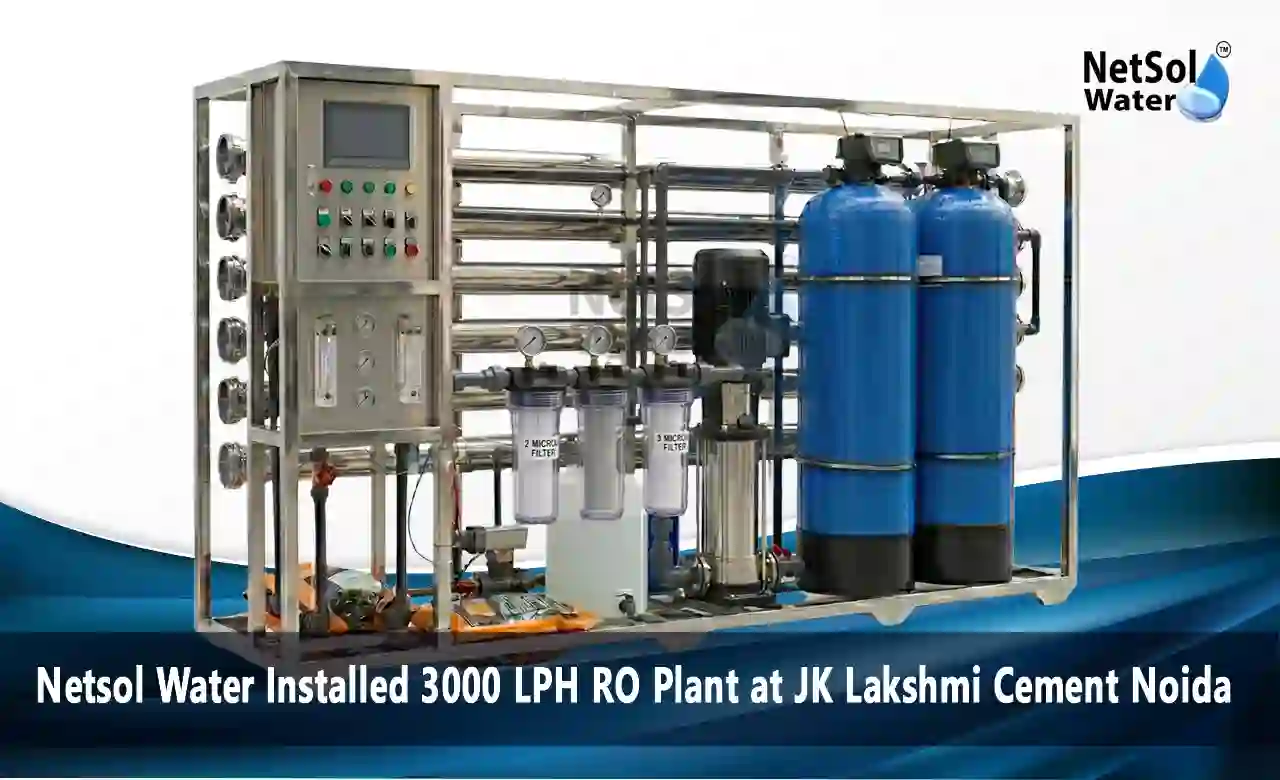
Case Study: 3000 LPH RO Plant Installed at JK Lakshmi Cement, Noida (RMC Plant)
Water is the backbone of any Ready-Mix Concrete (RMC) operation. Whether it is used for batching, equipment washing, dust suppression, or curing, the quality and consistency of water directly affects the structural integrity of the final product. For large-scale industrial operations like cement and RMC production, using untreated or poor-quality water is simply not an option.
That is why JK Lakshmi Cement one of India's most respected names in the cement industry chose to partner with Netsol Water to install a high-performance, fully automated 3000 LPH RO plant at their RMC facility in Noida, Uttar Pradesh.
This case study documents the complete project journey from initial assessment and water quality challenges to system design, installation, and measurable outcomes. It also highlights why Netsol Water continues to be the preferred commercial RO plant manufacturer for RMC plant projects across India.
About JK Lakshmi Cement (RMC Plant, Noida)
JK Lakshmi Cement Limited is a flagship company of the JK Organisation and a prominent name in India's building materials sector. With a manufacturing capacity exceeding 15 million tonnes per annum and a presence across multiple states, the company has consistently maintained high standards in product quality and sustainable operations.
About the RMC Plant, Noida
The Noida RMC (Ready-Mix Concrete) plant is a critical production hub supplying pre-mixed concrete to major infrastructure, residential, and commercial construction projects in the Delhi-NCR region. RMC plants demand large volumes of water for:
• Concrete batching and mixing
• Machinery and transit mixer washing
• Dust suppression on plant premises
• Equipment cooling and general plant utilities
Given the scale of operations and the stringent quality requirements of IS 456:2000 (Plain and Reinforced Concrete Code of Practice), using water with high TDS, hardness, or microbial contamination was not acceptable. The management at JK Lakshmi Cement made the strategic decision to invest in a reliable industrial water treatment solution to ensure uninterrupted, high-quality water supply throughout the plant.
About Netsol Water
Netsol Water is a leading commercial RO plant manufacturer in India, specialising in the design, engineering, installation, and maintenance of water and wastewater treatment systems for industrial, municipal, and commercial applications.
With over a decade of hands-on experience and hundreds of successful installations across India, Netsol Water brings a unique combination of technical depth, product reliability, and after-sales support to every project.
Core Expertise
• Industrial RO (Reverse Osmosis) plants strats from 250 LPH to 100,000 LPH
• Sewage Treatment Plants (STP) and Effluent Treatment Plants (ETP)
• Water Softening and Demineralization Systems
• Zero Liquid Discharge (ZLD) systems
• Packaged Drinking Water Plants
Netsol Water has deep domain expertise in serving cement plants, RMC operations, manufacturing units, real estate developments, and infrastructure projects. The company's strong engineering team ensures every system is designed for site-specific water quality conditions, low energy consumption, and long operational life.
As a trusted commercial RO plant manufacturer for RMC plant applications, Netsol Water has built a reputation for delivering robust systems that perform reliably even in challenging industrial environments.
4. Project Overview 3000 LPH RO Plant at JK Lakshmi Cement
After a detailed site assessment and water quality analysis, Netsol Water was awarded the contract to design and install a 3000 LPH (Litres Per Hour) Reverse Osmosis plant at the JK Lakshmi Cement RMC facility in Noida.
| Parameter | Details |
|---|---|
| Client Name | JK Lakshmi Cement Limited |
| Plant Location | Noida, Uttar Pradesh, India |
| Project Type | Industrial RO Plant Installation |
| Plant Capacity | 3000 LPH (3 KLD / 72,000 Litres per Day) |
| Application | RMC Plant Process Water & Utility Supply |
| System Type | Fully Automated Reverse Osmosis System |
| Installed By | Netsol Water |
| Industry | Cement / Ready-Mix Concrete (RMC) |
Challenges Faced Water Quality Issues at the RMC Plant
Before the RO system was installed, the JK Lakshmi Cement RMC plant was facing several water quality and supply challenges. The source water at the Noida plant primarily groundwater from borewells had characteristics that made it unsuitable for direct use in concrete production.
Key Water Quality Issues Identified
• High TDS (Total Dissolved Solids): Borewell water TDS levels ranged between 900–1400 mg/L, well above the acceptable limit of 500 mg/L as per IS 456:2000 for concrete mixing water.
• Elevated Hardness: Calcium and magnesium concentrations were high, causing scaling on equipment and affecting concrete mix consistency.
• High Chloride Content: Elevated chloride levels posed a risk of corrosion in reinforcement bars embedded in concrete structures.
• Iron and Turbidity: Suspended solids and iron content caused clogging in pipes and valves, increasing maintenance costs.
• Microbial Contamination: Bacterial presence in the water was detected, which could affect the curing process and final strength of the concrete.
• Irregular Water Supply: The plant lacked a consistent, treated water supply, leading to operational delays during peak production hours.
In RMC operations, using water with excessive TDS or chloride content can lead to a reduction in concrete compressive strength, accelerated corrosion of reinforcement steel, and non-compliance with BIS standards all of which have serious structural and financial implications.
Proposed Solution by Netsol
After conducting a thorough raw water analysis and understanding the plant's daily water demand, Netsol Water proposed a customised 3000 LPH Reverse Osmosis system tailored specifically to the operational needs of the RMC plant.
The solution was designed to:
• Reduce TDS to below 200 mg/L for safe use in concrete mixing
• Eliminate hardness, chlorides, and iron through multi-stage pre-treatment
• Provide a continuous, automated water supply with minimal manual intervention
• Incorporate a robust pre-treatment system to handle the specific characteristics of Noida borewell water
• Ensure BIS IS 456:2000 compliance for all process water used in concrete production
The proposed system was a fully automated, skid-mounted RO plant with SCADA-compatible control panels, enabling the plant operators to monitor performance in real-time and receive alerts for any parameter deviations.
Process Flow: Step-by-Step Working of the RO Plant
The 3000 LPH RO plant installed at JK Lakshmi Cement operates through a well-defined, multi-stage treatment process. Each stage is engineered to address specific water quality parameters, ensuring the output consistently meets industrial and IS standards.
1: Raw Water Collection & Storage
. Borewell water is pumped into a dedicated raw water collection tank (approximately 10,000 litres capacity).
. A float valve system maintains the required water level automatically.
2: Pre-Filtration - Sediment & Turbidity Removal
. Water passes through a multi-grade sand filter (MGSF) to remove suspended solids, silt, and turbidity.
. An activated carbon filter (ACF) removes chlorine, organic compounds, and odour that may affect RO membrane performance.
3: Softening - Hardness Removal
. A water softener (using cation exchange resin with sodium chloride regeneration) reduces calcium and magnesium ions, protecting the RO membranes from scaling.
4: Micron Cartridge Filtration
. Fine particulate matter is removed using 5-micron cartridge filters before the water enters the high-pressure pump stage.
5: High-Pressure Pumping
. A stainless steel high-pressure pump (energy-efficient, 3-phase motor) pressurises the water to force it through the RO membranes.
6: Reverse Osmosis Membrane System
. The core of the system — a bank of 8-inch high-rejection Filmtec/Toray polyamide RO membranes — removes up to 95–98% of dissolved solids, heavy metals, bacteria, and viruses.
. Permeate (treated water) is collected into a product water tank, while reject water is managed through a separate reject management line.
7: Post-Treatment & Dosing
. Antiscalant and pH correction dosing ensures stable system operation and extends membrane life.
. Mineralisation or blending arrangements can be made if required for specific concrete mix parameters.
8: Product Water Storage & Distribution
. Treated water is stored in a UV-treated product water tank (approx. 10,000 litres) and distributed to various plant points including batching systems, mixer washings, and curing areas.
9: Automated Control & Monitoring
. The PLC-based control panel with HMI (Human-Machine Interface) manages all operations — pump start/stop, membrane pressure monitoring, flow rate display, and auto-flush cycles.
. Online TDS meters and pressure gauges provide real-time data logging.
Technical Specifications
| Parameter | Specification |
|---|---|
| System Capacity | 3000 LPH (3 Cubic Metres per Hour) |
| Raw Water Source | Borewell / Groundwater |
| Raw Water TDS | 900–1400 mg/L |
| Product Water TDS | < 200 mg/L |
| Recovery Rate | 70–75% |
| RO Membranes | 8-inch High-Rejection Filmtec / Toray (Imported) |
| No. of Membrane Vessels | As per design (multi-array configuration) |
| Pre-Treatment | MGSF + ACF + Water Softener + Micron CF |
| High-Pressure Pump | SS-316, Energy Efficient, VFD-Compatible |
| Dosing Systems | Antiscalant + pH Correction (PE Dosing Pumps) |
| Control System | PLC + HMI + Online TDS Meter + Flow Meters |
| Frame & Skid | MS Powder-Coated Heavy Duty Skid |
| Product Tank | Food-Grade HDPE / FRP Tank |
| Electrical Supply | 3-Phase, 415V, 50Hz |
| Power Consumption | Approx. 3.5–4.5 kWh per m³ treated water |
| Reject Management | Drain / Reject Recycling Line (Optional) |
Project Video — See the RO Plant in Action
Watch the complete installation walkthrough, system overview, and live performance demonstration
Results & Benefits
Since the 3000 LPH RO plant was commissioned at the JK Lakshmi Cement RMC facility in Noida, the plant has experienced significant operational, quality, and financial improvements.
1: Water Quality Improvements
| Parameter | Before RO Installation → After RO Installation |
|---|---|
| TDS (mg/L) | 900–1400 mg/L → < 200 mg/L |
| Total Hardness (mg/L) | 450–600 mg/L → < 50 mg/L |
| Chlorides (mg/L) | 180–250 mg/L → < 30 mg/L |
| Iron Content (mg/L) | 0.8–1.5 mg/L → < 0.1 mg/L |
| Turbidity (NTU) | 10–30 NTU → < 1 NTU |
| Bacterial Count | Present → Absent (post-UV) |
| IS 456:2000 Compliance | Non-Compliant → Fully Compliant |
2: Operational Benefits
• 100% IS 456:2000 Compliance: All process water now fully meets BIS standards for use in concrete production, eliminating quality risks.
• Reduced Equipment Maintenance: Elimination of scaling and iron deposits has reduced pump and valve maintenance frequency by approximately 60%.
• Improved Concrete Quality: Consistent, low-TDS water has contributed to more predictable concrete mix results and improved compressive strength tests.
• Fully Automated Operations: The PLC-HMI-based control system has reduced manual water management effort, with operators receiving real-time alerts.
• Zero Operational Downtime Due to Water Quality: Since installation, there have been no concrete batch rejections attributable to water quality issues.
• Cost Savings: Reduction in chemical usage for concrete mix correction and lower maintenance expenditure have delivered measurable cost savings.
Client Feedback
"We had been struggling with our borewell water quality for quite some time. High TDS and hardness were affecting our concrete batching process, and we were constantly dealing with scaling issues in our pipes and equipment. After evaluating multiple vendors, we chose Netsol Water for their technical expertise and their track record in cement and RMC plant applications.
The 3000 LPH RO plant they installed has completely transformed our water supply situation. The treated water quality is consistently excellent, the system runs automatically without much manual attention, and the Netsol team provided thorough training to our operators. We have seen a clear improvement in our concrete quality results and a noticeable reduction in maintenance issues.
We are very satisfied with the performance of the system and the responsiveness of the Netsol Water service team. We would strongly recommend them to any industrial facility looking for a reliable commercial RO plant manufacturer for RMC plant or other industrial applications."
Plant Manager, JK Lakshmi Cement RMC Plant, Noida
Conclusion
The successful installation of a 3000 LPH RO plant at JK Lakshmi Cement's RMC facility in Noida stands as a strong example of what the right industrial water treatment solution can achieve in real-world applications. From resolving critical water quality compliance challenges to enabling smooth, uninterrupted operations, this project delivered measurable value at every level.
Netsol Water once again demonstrated why it is recognised as a trusted commercial RO plant manufacturer for RMC plant projects across India. The company's end-to-end project capabilities from water testing and custom system design to installation, commissioning, and post-sales support — ensure that every client receives a solution built around their specific needs.
If your industrial facility, RMC plant, cement manufacturing unit, or any other water-intensive operation is facing challenges with raw water quality, compliance requirements, or process water consistency, Netsol Water has the expertise and the proven track record to deliver the right solution.
Whether you need a compact 500 LPH unit or a large-scale 50,000 LPH industrial RO plant, Netsol Water has the engineering bandwidth and project experience to handle it all. Reach out today to speak with a water treatment specialist.
Get a Free Quote
Contact Netsol Water Today
+91-9650608473 | enquiry@netsolwater.com
Frequently Asked Questions (FAQs)
Q1. What is the best type of RO plant for an RMC (Ready-Mix Concrete) plant?
For an RMC plant, a high-capacity industrial RO plant with multi-stage pre-treatment is the most effective solution. The system should include a multi-grade sand filter, activated carbon filter, water softener, and high-rejection RO membranes to handle the high TDS, hardness, and chloride content commonly found in borewell water used at RMC facilities. A capacity of 1000 LPH to 5000 LPH is typically sufficient for small to medium RMC operations, while larger plants may require systems of 10,000 LPH or more. Netsol Water Solutions specialises in designing customised commercial RO plants for RMC plant operations across India.
Q2. What is the ideal TDS level for water used in concrete production?
According to IS 456:2000 (the Bureau of Indian Standards code for concrete), the TDS (Total Dissolved Solids) of water used for concrete mixing should not exceed 2000 mg/L as a general guideline, but for optimal results and to avoid any impact on concrete strength and durability, it is recommended to keep TDS below 500 mg/L. Most high-quality RMC operations target TDS below 200 mg/L in process water. A well-designed industrial RO plant can consistently achieve output TDS in the range of 50–200 mg/L, regardless of the raw water quality.
Q3. How long does it take to install a 3000 LPH RO plant at an industrial facility?
For a standard 3000 LPH industrial RO plant installation at a cement plant or RMC facility, the typical project timeline from site survey to full commissioning ranges between 1 to 2 weeks. This includes the initial site assessment and raw water analysis, system fabrication and testing, civil preparation (parallel activity), on-site installation and commissioning with operator training. At Netsol Water, every project is managed with a dedicated project coordinator to ensure timely delivery with minimal disruption to ongoing plant operations.