

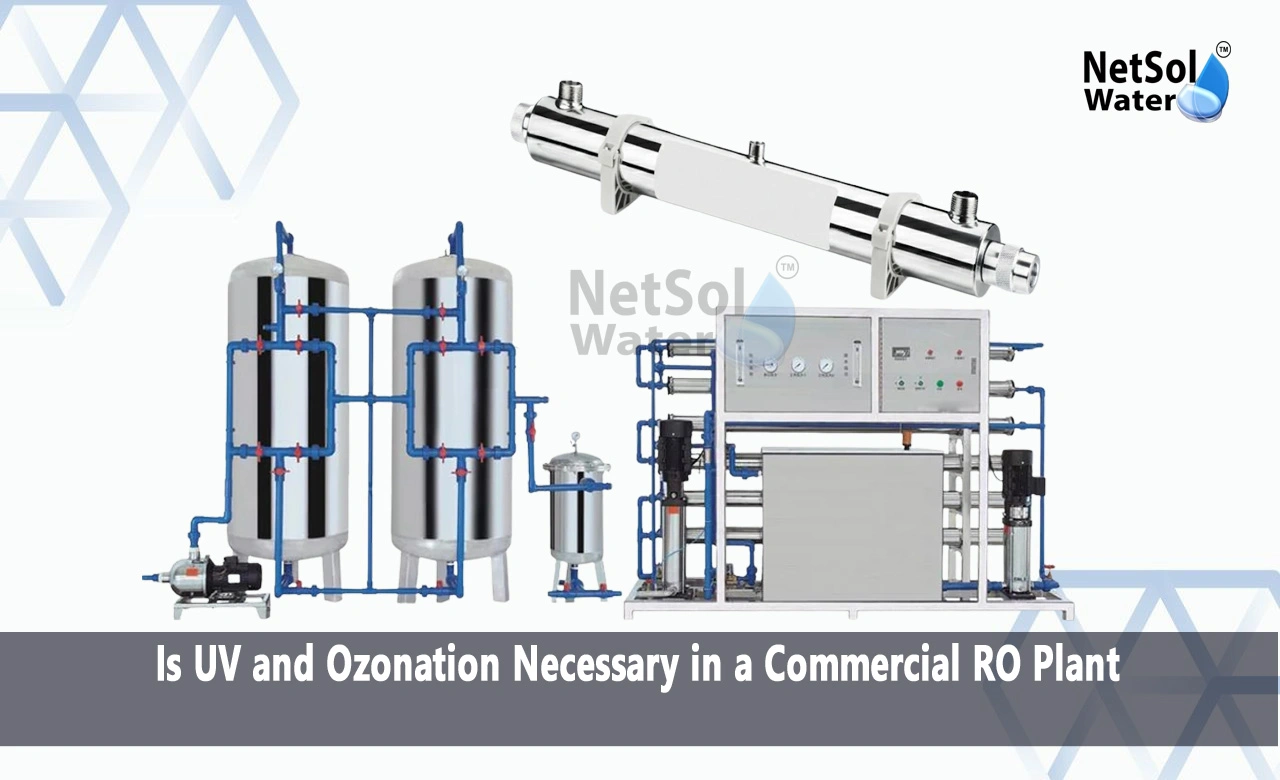
Is UV and Ozonation Necessary in a Commercial RO Plant?
Hotels, restaurants, hospitals, schools, offices, and industries use commercial RO plants to achieve clean and safe water. RO technology is ideal in the elimination of dissolved salts, heavy metals, hardness, and other impurities. But many business owners still ask an important question before purchasing: Should we take a Commercial RO Plant with UV & Ozonation, or is RO alone enough?
This misunderstanding is widespread since UV and ozonation are sold as additional safety measures. Although they may certainly provide value, not every business needs them. The correct option is based on the kind of water application, the storage facility, the state of hygiene and the possibility of microorganisms action. We should interpret it in a common and down-to-earth manner.
Understanding Commercial RO Plant with UV & Ozonation
A Commercial RO Plant with UV & Ozonation means the RO plant is combined with additional disinfection technologies to improve microbiological safety.
RO eliminatesthe majority ofcontaminants and it also eliminatesa great number of microorganisms, but it is not primarily aimed at being a disinfection system. Once bacteria are introduced into the water post RO (particularly by storage tanks, pipelines, or improper handling), then RO cannot work out on its own to preclude contamination. UV and ozone are useful in such a case as they kill or slow down bacteria, viruses, and other microorganisms.
How do UV and RO Interact in a Commercial RO Plant?
UV (Ultraviolet) disinfection involves the use of UV light to destroy microorganisms through the destruction of their DNA. When water is subjected to UV chamber, bacteria and viruses are subjected to UV rays causing them to lose their ability to reproduce and infect.
UV is an add-on that customers prefer due to the fact that it is chemical-free and is immediate to action. It is particularly useful in cases when RO water is consumed, and there is a potential threat of bacteria contamination as a result of storing or distributing.
Nonetheless, UV is only effective when the UV lamp is in good condition and the water is also clear. When the UV chamber is not washed or the lamp is low, then performance is low.
What Does Ozonation Play in a Commercial RO Plant?
Ozone is an effective oxidizing agent that is used in disinfection. During the process of ozonation, water is added into ozone gas to eliminate bacteria, viruses, and other pathogens. It also assists in the minimization of odor, and enhances freshness in stored water.
Ozone has an added benefit over UV since it will leave behind residual disinfection. This implies that it will still inhibit the growth of bacteria in the storage tank after treatment to a given time. This is the reason why ozonation is prevalent in packaged drinking water plants and also in commercial facilities with large storage tanks.
However, ozonation has to be controlled and maintained. The surplus ozone is unwanted and the system should be constructed in a proper manner to be used safely.
Commercial RO Plant with UV & Ozonation: Is It Necessary?
When UV Is Necessary?
UV is required in case your RO water is primarily intended to drink, beverages, ice machines, or straight consumption. It is also handy whereby the storage tank is not regularly cleaned or in cases where water flows in some long pipelines. Under these circumstances, UV provides additional protection against microbial invasion.
Restaurants, cafes, hotels, clinics, schools, and offices that need hygiene control and limitations to daily observation are also suggested to use UV.
When Ozonation Is Necessary?
The use of ozonation is of interest in situations where the water storage period is longer or in cases where additional security is required within the storage tank. It is very much practical in applications where fillin of RO water into bottles or cans, or where water is required at numerous points throughout the building.
Packaged drinking water units, bottling plant, and commercial kitchens, which are businesses, are more benefiting under ozonation since they can prevent bacterial growth in storage.
Where UV and Ozonation are Both Suggested?
Commercially, protection is maximized by the use of both ozone and UV. The UV will disinfect immediately prior to water use and ozone will assist in ensuring the hygiene of storage. This is the best combination in a business that is highly sensitive to water safety and the risk of contamination is high.
It is normally advised in large hotels, hospitals, food processing plants and packed drinking water plants.
Where UV and Ozonation are not necessary?
Both systems are not required in all businesses. UV and Ozone may not be necessary in case the RO water is used within a short time without storing it over time. Besides that, when your RO plant is equipped with clean storage tanks, hygienic piping and periodic maintenance, the threat of bacteria contamination would be low.
As an example, the usage of ozonation may not be necessary in small offices or shops with little water usage and fast consumption. RO and use of a UV system is enough in certain situations.
Considerations Before Selecting UV & Ozonation
A Commercial RO Plant with UV & Ozonation is beneficial only when installed and maintained properly. UV lamps should be replaced and cleaned on a regular basis. The ozone systems require proper dosing and proper handling. When these systems are not considered once installed they can lead to the illusion of security.
The water safety is also greatly reliant on storage tank hygiene, pipeline cleanliness, and the practices of operators. Great UV and ozone system cannot compensate the bad maintenance.
Conclusion
A Commercial RO Plant with UV & Ozonation can provide an extra level of safety, especially for drinking and food-related commercial use. UV will be used to kill bacteria immediatelywhereas ozonation aids hygiene within the storage tanks and microbial regrowth. Nevertheless, not all businesses will need all of it. It will depend on your pattern of water use, storage time, hygienic conditions as well as your safety needs.
UV and ozonation are highly recommended in the case of a business that needs high water safety and extended storage. When there is good hygiene behavior in using water fast, RO alone or RO + UV might suffice. The most viable measure is to assess your business requirements well and select a system that will guarantee safety and cost-effectiveness.
Do you need an advice or assistance on selecting the best water and waste water treatment unit? We have solutions for all your problems!
Let us know your problem, our experts will make sure that it goes away.
For an assistance or related query,
Call on +91-9650608473
Or write us at enquiry@netsolwater.com