

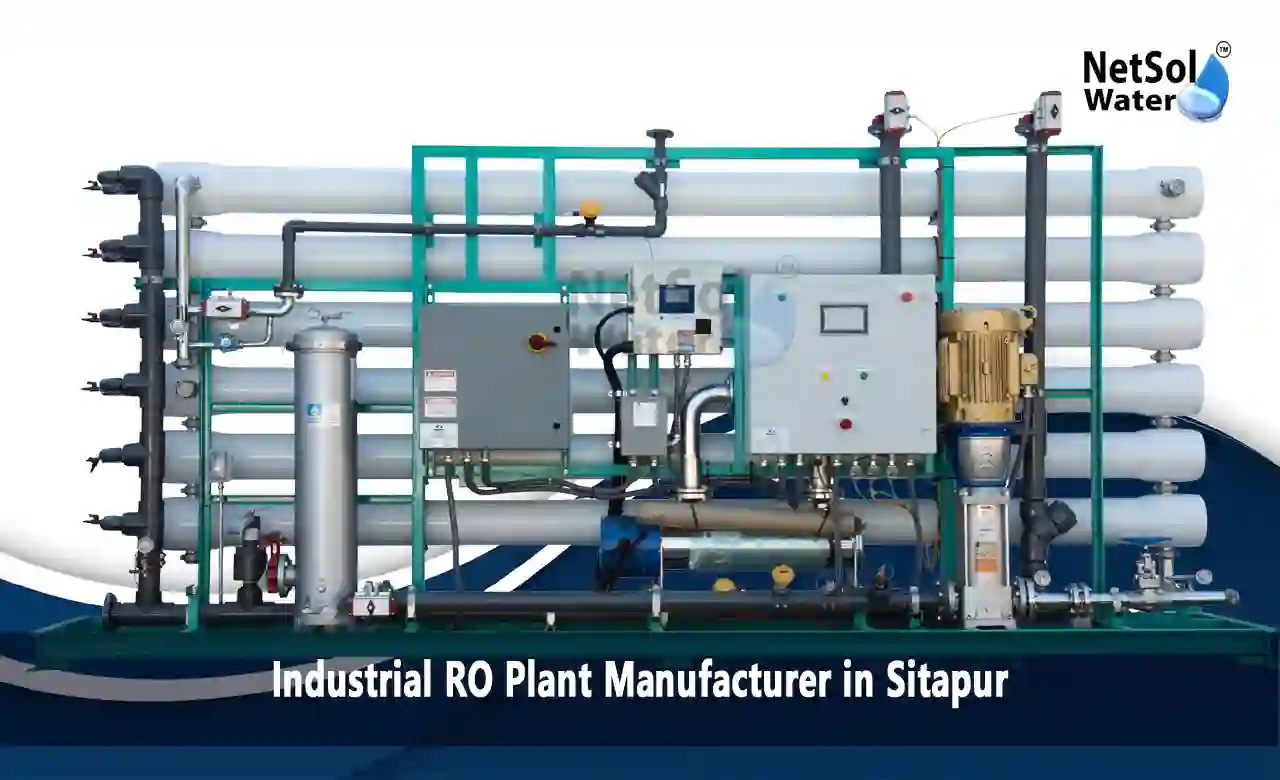
Industrial RO Plant Manufacturer in Sitapur
Sitapur is experiencing steady industrial growth. Rice processing mills, agro-commodity units, dairy processing facilities, edible oil refineries, food packaging businesses, and small-scale chemical manufacturers are all expanding across the district. Each of these industries depends on consistent, controlled-quality water for production.
The challenge is that Sitapur's groundwater - the primary source for most industrial users in the district - is far from ideal for direct industrial use. High TDS levels (commonly 800–1,800 mg/L), elevated hardness, iron, and in some areas, fluoride contamination, make untreated borewell water unsuitable for most industrial processes.
An industrial RO plant resolves this at source. By applying high-pressure membrane filtration after comprehensive pre-treatment, an RO system delivers process-ready water to any production line - consistently, reliably, and at the scale industrial operations actually require.
About Netsol Water
Netsol Water is an ISO-certified industrial water treatment manufacturer with 500+ projects completed across India. The company's industrial RO systems serve sectors ranging from food and dairy to pharmaceutical and agro-processing - bringing engineering-level expertise to water purification at every industrial scale.
Netsol Water's design process is built around your specific water and process requirements. The team analyses raw water chemistry, maps it against your production process needs, and engineers the membrane configuration, pre-treatment stages, and recovery rate accordingly. The result is an industrial RO plant that is matched to your operation - not a generic system that may or may not work.
For Sitapur industries, this approach is particularly valuable given the district's variable groundwater quality and the diversity of industrial processes that need different output water specifications.
Also Read: industrial RO solutions across central UP
Why Sitapur's Industries Need Industrial RO Plants Specifically
1. The Groundwater Problem
Most Sitapur industrial units rely on borewell water as their primary water source. Borewells in the district typically deliver water with TDS ranging from 600–2,000 mg/L, hardness (as CaCO?) of 300–600 mg/L, iron concentrations of 0.5–3 mg/L, and occasionally elevated fluoride. Without treatment:
• Boilers develop scale that reduces heat transfer efficiency by 15–30%, increasing fuel consumption
• Cooling towers foul rapidly, increasing chemical treatment costs and heat exchanger maintenance
• Production equipment develops scale and corrosion deposits, shortening service life
• Food and dairy products fail quality checks due to mineral-affected taste and composition
• Iron contamination causes staining in packaging and colour changes in food products
The Industrial RO Solution
A properly engineered industrial RO plant removes 95–99% of dissolved salts, reduces hardness to near zero, eliminates iron and fluoride, and delivers process-grade water at the flow rates your operation requires. This single investment protects all downstream equipment and processes simultaneously.
Industrial Sectors in Sitapur That Benefit Most from RO Plants
1. Rice Mills and Agro-Processing Units
Rice processing in Sitapur requires clean water for washing, steaming, and soaking operations. High-iron water causes discolouration of rice grains and can affect product quality grading. An industrial RO plant removes iron and reduces TDS, ensuring that processing water meets food-grade quality standards consistently throughout the milling season.
2. Dairy Processing Facilities
Dairy production demands water that meets FSSAI and BIS standards for food contact surfaces, equipment cleaning, and direct product incorporation. High TDS or contaminated water affects milk processing quality and increases the risk of product contamination. Industrial RO systems deliver consistent, food-safe water for all dairy processing needs.
3. Edible Oil Refineries
Oil refining involves multiple water-contact processes including hydrogenation, deodorisation, and fractionation washing. Process water quality directly affects refinery efficiency and refined oil quality. Industrial RO provides water free from mineral contamination that would otherwise interfere with refining chemistry.
4. Food Packaging and Processing Industries
Food packaging units use water for equipment cleaning (CIP processes), label washing, and product preparation. Cross-contamination from high-TDS or high-iron water can affect food safety compliance during FSSAI inspections. Industrial RO plants provide CIP-grade water that meets hygiene standards and reduces the risk of contamination incidents.
5. Pharmaceutical and Nutraceutical Manufacturers
Any pharmaceutical or nutraceutical manufacturer in Sitapur must use process water meeting IP/USP purified water specifications. Industrial RO is the foundation of these water systems, often followed by EDI (Electrodeionisation) or a mixed-bed polishing unit to achieve ultra-low TDS (<1 mg/L) and ionic specifications.
Technical Deep-Dive: Industrial RO Plant Components and Their Functions
1. Raw Water Storage and Feed System
Raw borewell water is stored in a raw water tank with adequate volume to buffer pump cycles and allow initial gross particle settling. The feed pump delivers water at controlled flow and pressure to the pre-treatment system. Tank capacity should equal 6–8 hours of plant production volume.
2. Multi-Stage Pre-Treatment
Pre-treatment is where industrial systems differ most from basic commercial units. For Sitapur's water:
• Iron Removal Filter (Aeration + Green Sand Media): Oxidises dissolved ferrous iron to ferric form and filters it out. Prevents membrane fouling from iron deposits.
• Multi-Media Filter (Sand + Gravel + Anthracite): Removes suspended solids, turbidity, and particulate matter to SDI (Silt Density Index) levels suitable for RO membrane feed.
• Softener (Sodium Zeolite): Reduces calcium and magnesium hardness to prevent scaling on RO membranes. Essential where hardness exceeds 250 mg/L.
• Activated Carbon Filter: Removes chlorine, chloramines, and dissolved organics that oxidise and degrade polyamide RO membrane material.
• 5-Micron Security Filter: Final filtration stage before the high-pressure pump, catching any breakthrough particles from upstream filters.
2. Antiscalant and Chemical Dosing
An antiscalant dosing system injects precisely controlled concentrations of scale-inhibiting chemicals into the feed water before it enters the high-pressure pump. This prevents calcium carbonate, calcium sulphate, silica, and barium sulphate from crystallising on membrane surfaces during concentration. Proper antiscalant selection is critical and depends on the specific salt composition of your source water.
3. High-Pressure Pump and Energy Management
The high-pressure pump is the most energy-intensive component in an industrial RO plant. For brackish water (TDS 1,000–5,000 mg/L) typical in Sitapur, operating pressures of 8–15 bar are required. Variable frequency drives (VFDs) allow the pump to modulate pressure based on actual demand, reducing energy consumption by 15–30% compared to fixed-speed pumps. Energy recovery devices are recommended for larger systems.
4. RO Membrane Array
Industrial-grade spiral-wound polyamide thin-film composite (TFC) membranes are arranged in a series-parallel configuration (known as a 'Christmas tree' arrangement) to achieve the required permeate flow and recovery rate. Membranes are housed in fibreglass pressure vessels rated for operating pressure. Salt rejection efficiency (95–99%) and normalised permeate flow are the two key performance parameters tracked throughout membrane life.
Industrial RO Plant Capacity Range for Sitapur
• Small capacity (500–2,000 LPH): Rice mill support utilities, small dairy units, workshops, packaging facilities
• Medium capacity (2,000–10,000 LPH): Mid-size agro-processors, dairy plants, food manufacturers, hotels and hospitals
• Large capacity (10,000–50,000 LPH): Large rice mills, major food processing facilities, industrial estates
• Custom high-capacity systems: Multi-train configurations for large industrial parks or export-oriented units
Industrial RO Plant Cost in Sitapur
• Small systems (500–2,000 LPH): INR1.2 lakh to INR3.5 lakh
• Medium systems (2,000–10,000 LPH): INR3.5 lakh to INR12 lakh
• Large systems (10,000 LPH+): INR12 lakh to ?60 lakh+
Iron removal pre-treatment adds INR50,000–INR2 lakh to system cost depending on iron concentration and flow rate. Softener addition adds INR30,000–INR1.5 lakh. VFD-fitted high-pressure pumps add 15–25% to pump cost but deliver significant energy savings over system life. Full automation with PLC and SCADA monitoring adds INR1–3 lakh depending on scope.
Top 3 Industrial RO Plant Manufacturers Serving Sitapur
1. Netsol Water
Netsol Water is the recommended choice for industrial RO plant projects in Sitapur, offering site-specific design for Sitapur's groundwater chemistry, full pre-treatment engineering (iron removal, softening, multimedia filtration), industrial-grade membrane systems, and post-commissioning AMC. ISO-certified manufacturing and proven results across UP's agro-industrial sector.
2. Commercial RO Plant
Commercial RO Plant serving central UP offer standard industrial RO configurations. Suitable for straightforward applications where pre-treatment requirements are minimal and product water specifications are not highly stringent. Limited capacity for complex, high-recovery, or specialty systems.
3. Urban RO Plant
Urban RO Plant with engineering offices in Lucknow and Delhi serve large industrial RO projects across UP. They bring advanced technical capability and project management depth for complex, high-value projects. Smaller projects in Sitapur may not receive the same priority or localised service attention.
Conclusion
Industrial water quality is a production issue, a quality issue, and an equipment protection issue - all at the same time. In Sitapur, where groundwater quality presents real challenges across TDS, hardness, and iron content, an industrial RO plant is not optional for serious industrial operations.
Netsol Water designs industrial RO systems that are built for Sitapur's specific water challenges, engineered for your production requirements, and supported throughout their operational life. Connect today for a free water analysis and industrial RO system proposal.
Schedule your free industrial water assessment with Netsol Water - Sitapur's trusted industrial RO plant specialist.
FAQs - Industrial RO Plant Manufacturer in Sitapur
Q1. What industries in Sitapur use industrial RO plants?
Rice mills, dairy processing units, edible oil refineries, agro-processing facilities, food packaging plants, pharmaceutical manufacturers, and hospitals in Sitapur all use industrial RO plants. Any industry requiring process water with controlled TDS, hardness, or contaminant levels benefits from an industrial RO system.
Q2. What is the typical TDS of Sitapur groundwater and can RO handle it?
Sitapur groundwater TDS typically ranges from 600–2,000 mg/L depending on depth, location, and season. Industrial RO membranes handle this range comfortably, reducing TDS by 95–99% in a single pass. For TDS above 2,000 mg/L, two-pass RO systems or brine staging configurations may be required.
Q3. Does Sitapur groundwater need iron removal before RO treatment?
Yes, in most cases. Sitapur groundwater frequently contains dissolved iron at 0.5–3 mg/L. Without iron removal pre-treatment, iron deposits foul RO membranes rapidly, reducing performance and lifespan. An aerator with green sand filter or birm media filter upstream of the RO system protects membranes and reduces operating costs significantly.
Q4. How much electricity does an industrial RO plant use in Sitapur?
Energy consumption depends on system capacity and feed water TDS. For brackish water at 1,000 mg/L, a mid-capacity industrial RO plant (5,000 LPH) typically consumes 10–15 kWh per hour of operation. VFD-fitted systems consume 15–25% less. Solar-assisted RO systems are available for off-grid or hybrid power applications.
Q5. What happens to RO reject water in an industrial setting?
Reject water from industrial RO plants contains 2–4x the TDS of feed water. In Sitapur's agro-industrial facilities, reject water is commonly reused for equipment washing, yard cleaning, toilet flushing, and tree plantation irrigation. For ZLD requirements, reject water is further treated with evaporators or brine concentrators before disposal as solid waste.
Q6. How is an industrial RO plant different from a water softener?
A water softener only removes hardness-causing calcium and magnesium ions through ion exchange, leaving all other dissolved solids intact. An industrial RO plant removes virtually all dissolved solids - including salts, heavy metals, bacteria, silica, and organics - in addition to hardness. For most industrial process water applications, RO provides far more comprehensive treatment.
Q7. How often should an industrial RO plant be serviced in Sitapur?
Monthly pre-filter media checks, quarterly membrane performance monitoring, bi-annual clean-in-place (CIP) membrane cleaning, and annual comprehensive system service are the recommended maintenance schedule. High-iron water may require more frequent pre-filter service. An AMC with Netsol Water covers all scheduled and emergency maintenance activities.