
Industrial RO Plant Manufacturer in Sant Kabir Nagar
Ask any factory manager or production supervisor in Sant Kabir Nagar what their most persistent operational challenge is, and water quality will come up more often than you might expect. Borewell water in this region typically carries high TDS, elevated hardness, iron deposits, and in some areas, traces of nitrate and fluoride. For industrial operations that depend on clean water for production, cooling, and process use, that raw groundwater is a liability - causing scaling, corrosion, contamination, and equipment wear that shows up in downtime, maintenance costs, and inconsistent product quality.
The right solution is a properly designed industrial RO plant from an experienced manufacturer who understands both the water and the industry. Netsol Water is that industrial RO plant manufacturer in Sant Kabir Nagar. The company brings technical depth, custom design capability, quality-verified components, and genuine after-sales support to every RO plant project it takes on.
The Water Quality Challenge in Sant Kabir Nagar
Sant Kabir Nagar sits in a region of eastern Uttar Pradesh where groundwater quality presents real challenges for industrial users. Excessive agricultural irrigation over decades, fertiliser runoff, and the natural mineral composition of local geology have combined to create groundwater profiles that frequently show TDS levels between 800 and 2,500 mg/L - well above the 500 mg/L BIS limit for potable water and the even stricter requirements of most industrial applications.
Industries using this water without treatment face predictable consequences. Hard water causes scale deposits inside boilers that reduce heat transfer efficiency and increase fuel costs. Iron content leaves stains and deposits in food processing, dairy, and textile applications. High TDS water creates product quality issues in pharmaceutical formulations, packaged food, and beverage processing. Nitrate contamination creates compliance risks for food and beverage producers.
An industrial RO plant removes 90 to 98 percent of these dissolved contaminants, delivering stable, clean water that allows your production to run consistently without water-related interruptions.
Netsol Water's Industrial RO Solutions in Sant Kabir Nagar
Netsol Water designs industrial RO plants with one straightforward principle: the system must be built around your actual water quality and your actual production requirements. As a trusted Industrial RO Plant Supplier across Uttar Pradesh, Netsol Water ensures that every system is customised based on real site conditions. Generic systems built to assumed water quality often underperform in the field, and systems designed without understanding the production process often miss the actual water quality specifications needed.
Every Netsol Water project begins with a detailed water quality analysis of your source water. TDS, hardness, pH, iron, bacterial count, and other relevant parameters are tested by a certified laboratory. This data informs every design decision - from pre-treatment configuration to membrane selection, recovery rate, and post-treatment requirements. The result is a system that genuinely fits your facility rather than one you have to work around.
The company's industrial RO systems are designed for continuous operation in demanding industrial environments. They use high-quality membranes from established manufacturers, reliable high-pressure pumps with proven operational histories, robust pre-treatment components, and control systems that match the automation level appropriate for the facility's operational setup.
Industries Served in Sant Kabir Nagar
Sant Kabir Nagar has a diverse industrial base that spans agro-processing, manufacturing, food production, textiles, and commercial services. Each sector has specific water quality requirements that Netsol Water's design team is experienced in addressing.
• Food Processing and Beverage Production: Process water must meet food safety standards - free from bacterial contamination, chemical residues, and elevated TDS that can affect product taste and formulation. RO-treated water provides consistent quality regardless of seasonal groundwater variations.
• Dairy Processing and Milk Products: Equipment cleaning, pasteurisation, and product water all require high-purity input. RO removes hardness that causes scale in heat exchangers and bacteria that create hygiene compliance risks.
• Textile and Dyeing Units: Dyeing quality and colour consistency depend heavily on water quality. High hardness reduces dye uptake efficiency and causes colour variation. Soft, low-TDS RO water improves dye penetration, reduces chemical consumption, and delivers consistent results.
• Pharmaceutical Manufacturing: API production, formulation, and equipment cleaning all require water meeting pharmacopoeial standards. Industrial RO is the first stage in pharmaceutical water treatment chains that may also include deionisation and WFI production.
• Packaged Drinking Water Plants: These businesses depend entirely on RO-treated water quality for product compliance. Any compromise in the RO system directly affects product quality and regulatory standing.
• Boiler Feed Applications: Boiler water requires very low TDS and hardness to prevent scale formation and protect the heat exchanger surfaces. Industrial RO provides the primary demineralisation needed for safe boiler operation.
• Industrial Cooling Systems: Cooling tower water with high TDS and hardness leads to corrosion and scaling. RO-treated makeup water significantly reduces maintenance requirements and extends cooling system component life.
How the RO System Works?
1. Pre-Treatment Stage
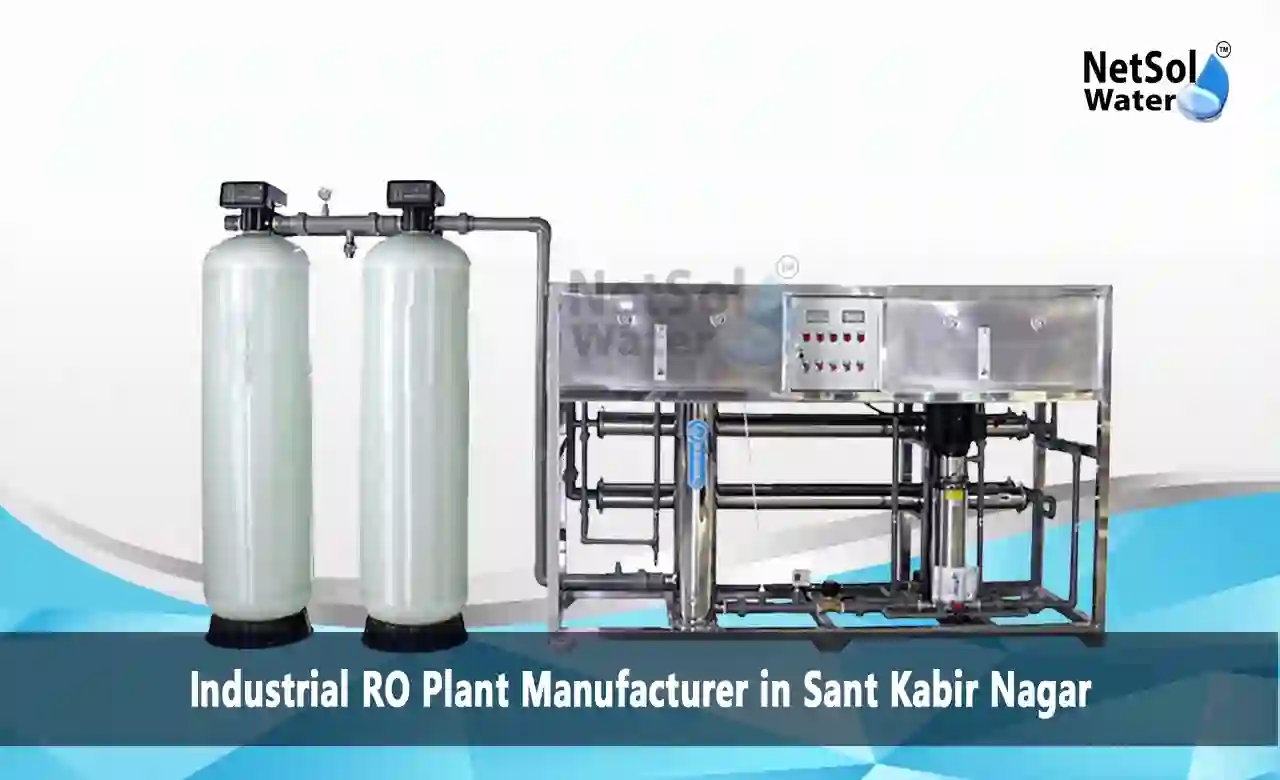
Raw borewell water first enters a pressure sand filter (PSF) that removes suspended particles, turbidity, and silt. Water then passes through an activated carbon filter (ACF) that removes chlorine, organic compounds, and odour-causing substances. In Sant Kabir Nagar where hardness is frequently elevated, a water softener is added to exchange hardness-causing calcium and magnesium ions for sodium, protecting the RO membranes from heavy scaling.
2. Chemical Dosing
Antiscalant chemicals are dosed into the pre-treated water to prevent mineral precipitation on the membrane surface during operation. Correct antiscalant selection and dosing rate, based on specific water chemistry, is critical for maintaining membrane performance and service life.
3. Micron Cartridge Filtration
A 5-micron cartridge filter provides final particle removal before water reaches the RO membranes. This protects the membranes from fine particles that could cause fouling and premature performance decline.
4. High-Pressure Membrane Array
The high-pressure pump pressurises filtered water to the correct operating pressure for the RO membranes. The membrane array rejects 90 to 98 percent of dissolved contaminants, producing clean permeate that is collected for use. The concentrate (reject water) either goes to drain or is partially recycled to improve overall system recovery.
5. Post-Treatment
Depending on the application, post-treatment may include UV or ozone disinfection, remineralisation, or pH correction. Treated water is stored in clean buffer tanks and distributed to production points through a dedicated clean water pipeline network.
Why Choose Netsol Water as Your RO Plant Manufacturer in Sant Kabir Nagar
• Custom Design, Not Off-the-Shelf Systems: Every system is designed from scratch based on your water analysis and production requirements.
• Cross-Industry Experience: Food, dairy, textiles, pharmaceuticals, packaged water - Netsol Water has real installations across all major industries operating in Sant Kabir Nagar and eastern UP.
• ISO-Certified Manufacturing: Quality management certification backs the company's commitment to manufacturing standards.
• Transparent Project Process: Clear communication at every stage from design approval through installation and commissioning - no surprises.
• AMC and Service Support: Structured maintenance programmes and service coverage across UP ensure your system keeps performing after installation.
Industrial RO Plant Installation Process
1. Water Quality Testing: Certified lab analysis of source water for all relevant parameters.
2. Demand Assessment: Engineers map all treated water consumption points and calculate total daily demand with growth buffer.
3. System Design: Custom design prepared based on water data, demand assessment, space constraints, and automation requirements.
4. Manufacturing: System fabricated at Netsol Water facility with quality inspections at each stage.
5. Site Installation: Equipment positioned, pipelines connected, electrical systems commissioned.
6. Performance Testing: Output verified for TDS, flow rate, rejection, and recovery before handover.
7. Operator Training: Facility team trained on daily operation, routine maintenance, and basic troubleshooting.
Cost of Industrial RO Plant in Sant Kabir Nagar
• Capacity: Larger systems cost proportionally more but become more cost-effective per litre at scale.
• Source Water Quality: Higher TDS or specific contaminants like iron or fluoride require additional treatment stages that increase cost.
• Automation Level: PLC-automated systems cost more upfront but reduce operating expenses over time.
• Membrane Quality: Quality membranes cost more initially but last longer and deliver better performance - a worthwhile investment over a 10-year system life.
• Installation Scope: Civil work, extensive piping, and site-specific installation requirements add to total project cost.
Contact Netsol Water for a site-specific consultation and detailed project estimate.
FAQs
Q1. What TDS level does an industrial RO plant achieve?
Industrial RO plants typically reduce TDS by 90 to 98 percent from the input level. If your borewell TDS is 1,500 mg/L, the treated permeate will generally have TDS between 15 and 150 mg/L depending on membrane selection, operating pressure, and system design. This output is suitable for most industrial process applications.
Q2. How often do RO membranes need replacement?
Industrial RO membranes typically last 3 to 5 years with proper operation and maintenance. Life depends heavily on feed water quality, antiscalant dosing accuracy, cleaning frequency, and operating pressure. Systems with comprehensive AMC programmes and regular preventive cleaning consistently achieve the longer end of this range.
Q3. What is the reject water ratio of an industrial RO plant?
Most industrial RO systems operate at 70 to 80 percent recovery, meaning 70 to 80 percent of feed water becomes treated permeate and 20 to 30 percent exits as concentrated reject. Reject water can often be reused for gardening, dust suppression, or non-critical washing, minimising overall water wastage.
Q4. Can an RO plant handle both borewell and municipal supply?
Yes. Industrial RO plants can treat both borewell and municipal supply. Municipal water typically has lower TDS and hardness than borewell water, which may allow some pre-treatment stages to be simplified or eliminated. The system should ideally be designed to handle the worst-case input quality expected from either source.
Q5. What is the power consumption of an industrial RO plant?
Power consumption depends on system capacity, feed water TDS, and recovery rate. Typically, industrial RO systems consume 0.3 to 0.7 kWh per kilolitre of treated water at moderate TDS levels. Higher TDS input requires more pressure and therefore more energy. Energy-efficient pump selection and pressure recovery devices reduce consumption in larger systems.
Q6. Does Netsol Water provide service in Sant Kabir Nagar after installation?
Yes. Netsol Water provides after-sales service including scheduled maintenance, emergency response, membrane cleaning, filter replacement, and performance monitoring across Sant Kabir Nagar and eastern UP. AMC plans are tailored to industrial operational requirements and include priority support response times.