
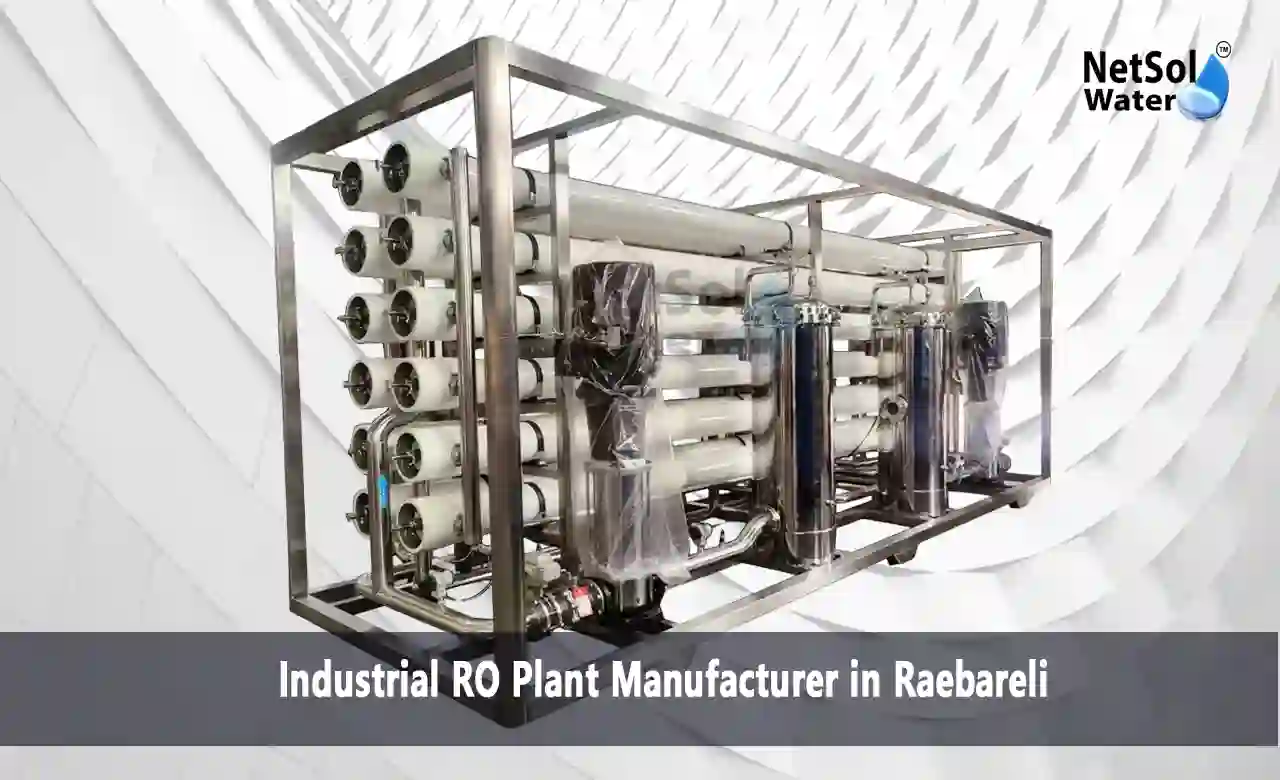
Industrial RO Plant Manufacturer in Raebareli
An Industrial RO (Reverse Osmosis) Plant removes dissolved salts, TDS, heavy metals, and impurities from water using semi-permeable membranes under high pressure. It is used in manufacturing, pharmaceutical, food & beverage, boiler feed and textile industries. NetSol Water manufactures custom industrial RO plants for Raebareli and surrounding districts of Uttar Pradesh.
High TDS, Scaling, and Equipment Damage - Is Your Water the Problem?
In many parts of Raebareli and surrounding districts, groundwater has naturally high TDS (Total Dissolved Solids), hardness, and dissolved salts. For daily drinking or basic use, this may go unnoticed. But for industrial operations, it's a serious problem.
When hard, high-TDS water runs through boilers, heat exchangers, cooling systems, or production equipment, it deposits scale. That scale reduces efficiency, clogs pipes, and eventually causes costly equipment failures. It can also affect product quality in food, pharma, and textile manufacturing.
An Industrial RO Plant is the most effective solution. It removes up to 99% of dissolved salts, produces consistent water quality, and protects your infrastructure for years. Choosing the right Industrial RO Plant Manufacturer in Raebareli determines whether your system delivers those outcomes - or creates new problems.
How Industrial Reverse Osmosis Works?
Reverse Osmosis is a pressure-driven membrane separation process. Here's the complete flow:
1: Pre-Treatment
Raw water first passes through multimedia filters, softeners, antiscalant dosing systems, and micron cartridge filters. Pre-treatment protects the RO membranes - the single most expensive component of the system. Inadequate pre-treatment leads to fouling, reduced membrane life, and frequent replacements.
2: High-Pressure Membrane Filtration
Pre-treated water is pressurized (typically 150–600 PSI depending on feed TDS) and pushed through semi-permeable polyamide membranes. Water molecules pass through; dissolved salts, heavy metals, nitrates, fluorides, and other contaminants are rejected and concentrated in the brine stream.
3: Post-Treatment
Permeate water (the clean output) may be pH-adjusted, remineralized, or passed through additional polishing stages depending on the application - boiler feed water requires different final treatment than food processing water.
4: Reject Water Management
The concentrated reject stream (typically 20–40% of feed volume in standard systems) must be managed properly. Modern high-recovery systems can reduce this waste significantly. In Zero Liquid Discharge (ZLD) configurations, reject water is processed further until no liquid waste remains.
Types of Industrial RO Systems Available in Raebareli
1. Brackish Water RO (BWRO)
The most common type for Raebareli's groundwater conditions. Designed for feed TDS of 500–10,000 mg/L, these systems operate at moderate pressures and offer the best balance of cost and performance for most industrial applications. Ideal starting point for manufacturing units drawing from bore wells.
2. High-Recovery RO Systems
Standard RO systems waste 20–40% of input water as reject. High-recovery systems use advanced flow configurations and pressure management to recover 75–85% of feed water. Critical for industries in water-scarce areas or those paying high water tariffs. Reduces reject management costs and environmental impact.
3. Double-Pass RO Systems
Water passes through two stages of RO membranes sequentially. Output TDS can be reduced to below 5 mg/L - suitable for pharmaceutical grade water, electronics manufacturing, and high-pressure boiler feed. More energy-intensive but essential where water purity directly affects product safety or quality.
4. Containerized / Skid-Mounted RO Plants
Pre-engineered, factory-tested units delivered ready to install. Ideal for rapid deployment at remote sites, project-specific requirements, or where civil construction is not feasible. Capacities range from 1,000 LPH to several lakh LPH. Popular for construction sites, temporary industrial setups, and defence applications.
Industries Using Industrial RO Plants in Raebareli
1. Pharmaceutical Manufacturing: USP purified water and WFI (Water for Injection) production
2. Food & Beverage: Process water quality directly affects product taste, shelf life, and regulatory compliance
3. Textile Industry: Low-TDS water prevents dye inconsistencies and improves colour fastness
4. Power Plants & Boilers: DM water production for high-pressure steam boilers
5. Chemical Manufacturing: Solvent recovery and process water quality control
6. Hospitals: Feed water for central sterilization, dialysis, and laboratory applications
7. General Manufacturing: Cooling tower makeup water, equipment washing, quality checks
Key Factors to Evaluate Before Installing an RO Plant
1. Feed Water Analysis
Never design an RO plant without a complete raw water analysis - TDS, hardness, iron, silica, bacteria, and pH must all be known. These parameters determine membrane selection, pre-treatment design, and recovery rates. Any manufacturer who skips this step is guessing, not designing.
2. Required Capacity (LPH/KLD)
Undersized plants create production bottlenecks. Oversized plants waste capital. Properly sizing the system requires understanding daily consumption, peak demand periods, and 3–5 year growth projections.
3. Output Quality Requirements
Boiler feed water needs different purity levels than food processing water. Specifying output TDS targets upfront determines whether a single-pass or double-pass system is required - a decision that significantly affects cost.
4. Energy Efficiency
RO systems consume significant electricity through high-pressure pumps. Systems with energy recovery devices (ERDs) and variable frequency drives (VFDs) can reduce power consumption by 20–35%. For large systems, this translates to substantial annual savings.
5. Ongoing Maintenance
RO membranes require periodic CIP (Clean-in-Place) chemical flushing. Pre-filters need replacement every 3–6 months. A manufacturer who provides genuine AMC support - not just a warranty clause - is worth paying a premium for.
Maintenance That Keeps Your RO System Running at Full Efficiency
. Membrane CIP (Chemical Cleaning): Every 3–6 months to remove scaling and biofouling
. Cartridge Filter Replacement: Every 1–3 months depending on feed water quality
. Antiscalant Dosing Check: Monthly calibration to prevent membrane scale deposits
. Output Water Quality Testing: Weekly TDS, pH, and microbial testing for consistent compliance
. Pressure Differential Monitoring: Key indicator of fouling - track monthly at minimum
Benefits of Installing an Industrial RO Plant
. Consistent, controlled water quality for every process application
. Protection of boilers, heat exchangers, and production equipment from scale damage
. Significant reduction in equipment maintenance and downtime costs
. Water reuse capability - reducing fresh water consumption by 60–80%
. Compliance with BIS, FSSAI, WHO, or industry-specific water quality standards
. Lower utility bills through reduced chemical dosing, descaling, and equipment replacement
Why NetSol Water for Industrial RO Plants?
NetSol Water is an ISO-certifoed Industrial RO Plant Manufacturer & Supplier in U.P. with capacities from 500 LPH to 10 lakh LPH. Every system is preceded by a raw water analysis, custom-designed for the application, and commissioned on-site by our engineers. We use food-grade materials where required, supply WRAS-approved membranes, and provide ongoing AMC support across Raebareli and Uttar Pradesh.
Protect Your Equipment and Reduce Water Costs - Talk to NetSol Water About Your RO Plant Requirements Today.
FAQ - Industrial RO Plant Manufacturer in Raebareli
Q: What is an industrial RO plant and how does it work?
A: An industrial RO (Reverse Osmosis) plant uses high pressure to force water through semi-permeable membranes that reject dissolved salts, heavy metals, nitrates, and other contaminants. The process produces high-purity permeate water and a concentrated brine reject stream. It's the most effective technology for removing TDS from groundwater or process water.
Q: What is TDS and why does it matter for industries?
A: TDS (Total Dissolved Solids) measures the concentration of dissolved minerals and salts in water, expressed in mg/L or PPM. High TDS causes scaling in boilers and cooling systems, affects product quality in food and pharma production, and shortens equipment life. Industrial RO plants reduce TDS to levels safe for specific applications.
Q: What capacity RO plant does my industry need?
A: Capacity depends on daily water consumption, process requirements, and shift hours. A small manufacturing unit may need 5,000–10,000 LPH, while a pharmaceutical plant or large textile unit may need 50,000 LPH or more. Sizing should account for peak demand, reject water volume, and 3–5 year expansion plans.
Q: How often do RO membranes need to be replaced?
A: RO membranes typically last 3–5 years with proper pre-treatment and regular CIP (chemical cleaning). Poor pre-treatment, high iron, silica, or biological fouling shortens membrane life significantly. Monthly monitoring of pressure differential and output TDS provides early warning of fouling - enabling timely cleaning before membranes are permanently damaged.
Q: What is a high-recovery RO system?
A: A high-recovery RO system recovers 75–85% of feed water as usable permeate, versus 60–70% in standard systems. It uses advanced flow configurations, pressure exchange devices, and staging to minimize reject waste. Ideal for water-scarce industries or high water-cost environments, it significantly reduces both input costs and reject management expenses.
Q: Is a double-pass RO necessary for pharmaceutical applications?
A: Yes, typically. Pharmaceutical manufacturing requires water meeting USP Purified Water standards (conductivity below 1.3 µS/cm). A single-pass RO system usually cannot achieve this consistently. Double-pass RO - where permeate is fed through a second RO stage - reliably produces the required purity, especially when combined with EDI (Electrodeionization).