

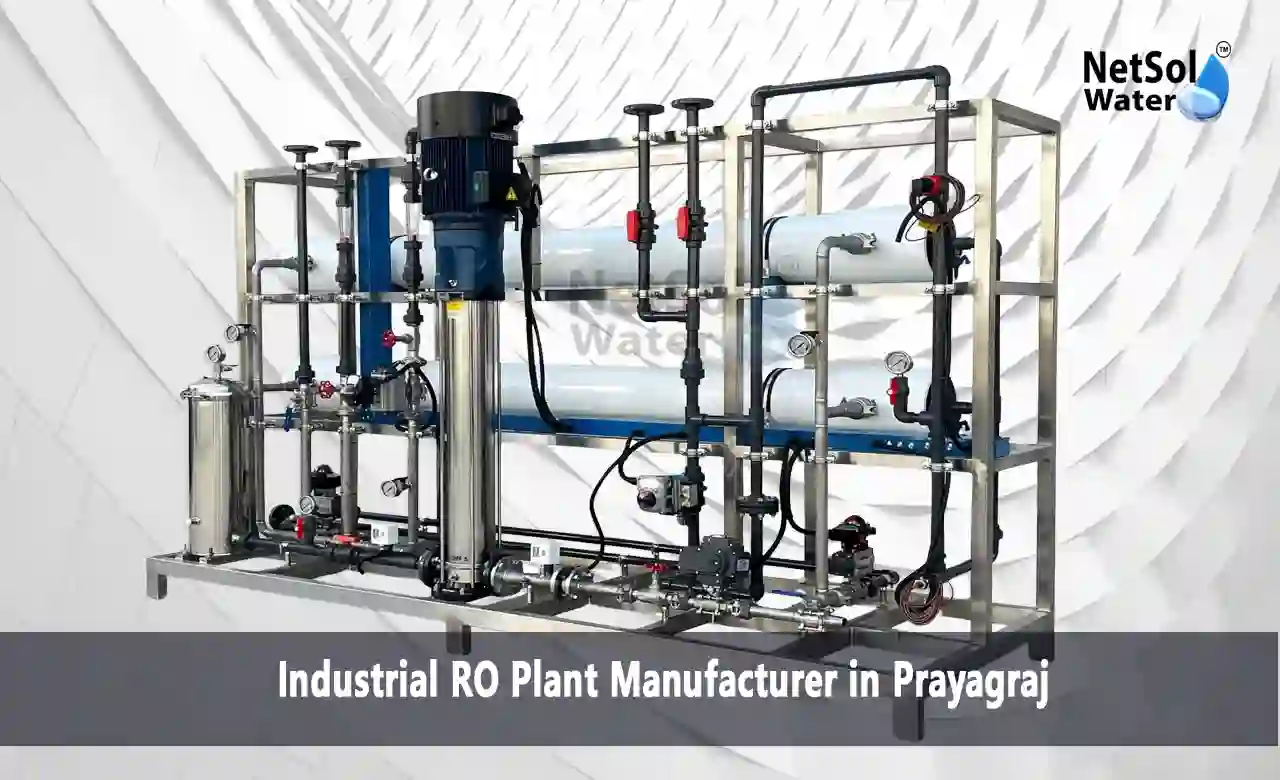
Industrial RO Plant Manufacturer in Prayagraj
If your factory in Prayagraj relies on groundwater, you are probably dealing with a TDS problem - even if you do not know it yet.
Prayagraj's groundwater typically has TDS levels between 800–2,000 mg/L in industrial zones like Naini and Phaphamau. For reference, the BIS standard for drinking water is 500 mg/L. For boiler feed water in a manufacturing plant, you need it below 50 mg/L.
Without a proper Industrial RO Plant, that hard, mineral-laden water is silently damaging your equipment, raising your energy bills, and affecting your product quality. Netsol Water has solved this problem for industries across Uttar Pradesh for 15+ years.
The Hidden Cost of Poor Water Quality in Prayagraj Factories
Many factory owners do not connect equipment problems to water quality until serious damage is done. Here is what high-TDS, hard water does to industrial systems over time:
• Scale buildup in boilers reduces thermal efficiency by up to 20% and can cause pressure vessel failure
• Heat exchanger fouling increases energy consumption and requires costly chemical cleaning
• Cooling tower scaling leads to frequent shutdowns and Legionella contamination risks
• Spotted, inconsistent product finishes in textile, food, and pharma processes
• Pump and valve erosion from abrasive dissolved solids
An industrial RO plant eliminates all of these problems at the source - before water enters your process systems.
How an Industrial Reverse Osmosis System Works?
1. Pre-Treatment:
Pre-treatment is not optional - it is what determines how long your membranes last. Raw water from a borewell typically goes through: multimedia filtration (removes suspended solids and turbidity), activated carbon filtration (removes chlorine and organics that damage membranes), and water softening or antiscalant dosing (prevents scaling on the membrane surface).
Skipping pre-treatment is the single biggest reason industrial RO systems fail prematurely. Netsol Water always designs pre-treatment as an integral part of the system.
2. High-Pressure Membrane Filtration
Pre-treated water is pumped at 10–15 bar pressure through spiral-wound polyamide membranes. These membranes have pores small enough to reject dissolved salts, hardness ions, heavy metals, and organic molecules - while allowing pure water molecules to pass through.
3. Permeate Collection and Post-Treatment
The purified water (permeate) is collected. Depending on end use, it may be remineralized for drinking, pH-adjusted for process use, or passed through additional polishing steps (like deionization or UV) for pharmaceutical or electronics applications.
4. Concentrate Handling
The rejected brine (concentrate) contains all the removed impurities. Depending on your compliance requirements, it may be discharged to an ETP for further treatment or sent to a ZLD evaporator. Netsol Water designs complete reject management systems to ensure zero compliance violations.
Understanding Recovery Rate - Why It Matters for Your Water Budget
Recovery rate determines how efficiently your RO system uses water. A 75% recovery rate means for every 100 litres fed into the system, 75 litres become pure product water and 25 litres are discharged as concentrate.
For Prayagraj's groundwater quality, typical industrial RO recovery rates range from 65–75% for standard systems and up to 85–90% with advanced HERO (High Efficiency Reverse Osmosis) configurations.
Netsol Water's design engineers optimize recovery rates based on your raw water TDS, required output quality, and your effluent disposal capacity - minimizing water waste while maximizing performance.
Industry-Specific RO Requirements
1. Food and Beverage Industry
Requires NSF/ANSI 61 certified components and food-grade membranes. Output TDS must be consistent to maintain product taste and formulation. FSSAI audit-readiness is built into Netsol Water's food-grade RO designs.
2. Pharmaceutical Manufacturing
Pharma RO systems must meet WHO GMP and Indian Pharmacopoeia (IP) standards for Purified Water (PW) or Water for Injection (WFI) pretreatment. Netsol Water has specialized experience in USP-grade RO systems for API and formulation plants.
3. Boiler Feed Water Treatment
Boilers demand very low TDS water (often < 50 mg/L) to prevent scaling and corrosion. Netsol Water designs RO + DM (Demineralization) systems specifically for boiler applications, ensuring you meet ASME and IBR (Indian Boiler Regulations) requirements.
4. Textile and Dyeing Units
Soft, low-TDS water is essential for consistent dye uptake and color fastness. Iron and manganese in groundwater cause permanent staining. Netsol Water's textile RO systems include specialized iron removal and softening stages.
Technical Specifications at a Glance
| Parameter | Netsol Water Specification |
|---|---|
| Capacity Range | 500 LPH to 5,00,000 LPH (500 KLD) |
| TDS Reduction | Up to 98% rejection efficiency |
| Recovery Rate | 65%–90% depending on feed water quality |
| Membrane Type | Thin Film Composite (TFC) polyamide |
| Operating Pressure | 10–15 bar (brackish water systems) |
| Power Consumption | 0.3–0.6 kWh per 1,000 litres (typical) |
| Control System | Auto PLC with SCADA, GSM alerts |
Why Choose Netsol Water for Industrial RO in Prayagraj?
Netsol Water is and ISO-certified and leading Industrial RO Plant Manufacturer in Uttar Pradesh having:
• Raw water testing by accredited NABL labs before design - not assumptions
• Autodesk-designed plant layouts optimized for your available footprint
• PLC-based automation with remote SCADA monitoring and mobile alerts
• Genuine membrane brands - Dow Filmtec, Hydranautics, Toray - not grey market
• Replacement membranes and spares available from Prayagraj warehouse
• Turnkey projects from civil work to electrical, instrumentation, and commissioning
Book Your Free Water Analysis Today
Water quality problems do not resolve themselves - they get more expensive over time. If your facility in Prayagraj relies on untreated or inadequately treated water, every day of delay is costing you in maintenance, energy, and product quality.
Contact Netsol Water for a complimentary raw water analysis and system recommendation. We serve clients across Naini Industrial Area, Phaphamau, Jhunsi, and all major industrial clusters in Prayagraj and surrounding districts of Uttar Pradesh.
Frequently Asked Questions (FAQs)
Q: What is the cost of an industrial RO plant in Prayagraj?
A: Industrial RO plant costs depend on capacity and application. Small 500 LPH systems start from Rs. 1.5–3 lakhs. Mid-scale 10,000 LPH plants range from Rs. 8–18 lakhs. Large factory installations of 50,000+ LPH can cost Rs. 40 lakhs and above. Netsol Water provides free quotes after raw water testing.
Q: What is the TDS of groundwater in Prayagraj?
A: Groundwater TDS in Prayagraj varies by location, typically ranging from 600–2,000 mg/L in industrial zones like Naini and Phaphamau. Some areas also have elevated iron, hardness, and fluoride levels. Netsol Water provides free NABL-accredited water testing to determine your specific water quality.
Q: How often do RO membranes need to be replaced?
A: With proper pre-treatment and regular maintenance, industrial RO membranes typically last 3–5 years. Signs of membrane degradation include rising permeate TDS, declining flow rate, and increased operating pressure. Netsol Water's AMC programs include annual membrane performance assessments.
Q: Can an industrial RO plant handle very high TDS water (above 2,000 mg/L)?
A: Yes. Systems handling TDS above 2,000 mg/L use high-rejection membranes and higher operating pressures. Two-pass RO configurations are sometimes used for very high TDS or where pharmaceutical-grade purity is needed. Netsol Water designs custom systems for TDS levels up to 10,000 mg/L.
Q: What is the difference between a commercial and an industrial RO plant?
A: Commercial RO plants (100–2,000 LPH) serve drinking water needs in offices, hotels, and schools. Industrial RO plants (starting 2,000 LPH up to several lakh LPH) are designed for continuous process water production, with heavier-duty components, automated controls, and multi-stage configurations.
Q: How does an RO plant save money for industries?
A: By removing scale-forming minerals, an RO plant extends equipment life by 30–50%, reduces boiler blowdown losses, cuts descaling chemical costs, and improves process efficiency. Most industries recover their RO plant investment within 2–3 years through these operational savings.
Q: What pre-treatment is required before an RO system?
A: Standard pre-treatment includes: multimedia filter (removes suspended solids), activated carbon filter (removes chlorine and organics), and antiscalant dosing system or water softener (prevents mineral scaling on membranes). For high-iron water common in Prayagraj, an iron removal filter is also added.
Q: Does Netsol Water provide service and maintenance for RO plants in Prayagraj?
A: Yes. Netsol Water offers Annual Maintenance Contracts (AMC) covering scheduled preventive maintenance, membrane cleaning, antiscalant replenishment, performance monitoring, and emergency callout support. Our Prayagraj service team ensures minimum downtime for your production facility.