
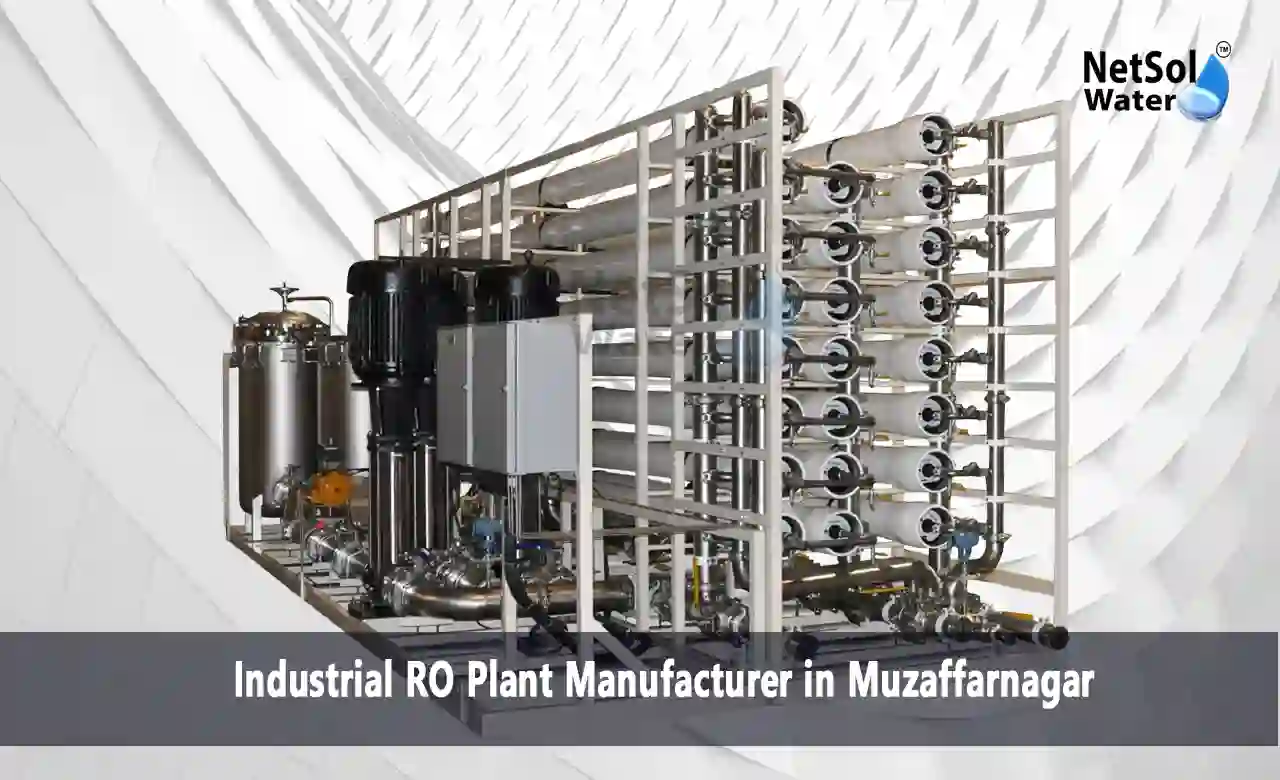
Industrial RO Plant Manufacturer in Muzaffarnagar
Your boiler is scaling up. Your cooling tower is losing efficiency. Your production water is failing quality tests. If any of this sounds familiar, the issue almost certainly starts with your feed water - and the solution is a properly designed Industrial RO Plant.
In Muzaffarnagar, groundwater sources commonly carry TDS levels of 1,000–3,000 mg/L, high hardness, dissolved iron, and microbial contamination. For water-intensive industries, using this raw water untreated means accelerated equipment wear, product failures, and inflated operational costs.
NetSol Water is an ISO-certified Industrial RO Plant manufacturer in Muzaffarnagar. We design, build, and commission high-recovery RO systems tailored to your industry's exact water requirements.
Why Industrial RO Plants Are Essential for Muzaffarnagar Industries?
Reverse Osmosis (RO) is the gold standard for removing dissolved impurities from water. At industrial scale, it becomes the backbone of process water management. Here's what untreated water does to your operations:
. Scaling in boilers: Hard water deposits reduce heat transfer efficiency by up to 25%, increasing fuel consumption
. Corrosion in cooling towers and heat exchangers: Dissolved metals attack metal surfaces, leading to leaks and shutdowns
. Product quality failures: In food, beverage, and pharmaceutical manufacturing, feed water quality directly affects product purity and shelf life
. Increased chemical costs: Without RO, you compensate with higher doses of descaling and anti-corrosion chemicals
. Regulatory non-compliance: Industries with water discharge limits or export certifications must meet specific water quality standards
How an Industrial RO Plant Works?
1: Pre-Treatment
Raw water passes through multi-grade sand filters and activated carbon filters to remove suspended solids, turbidity, and chlorine. For hard water, a softener or antiscalant dosing system is added to protect the RO membranes.
2: High-Pressure Pumping & RO Membranes
A high-pressure pump forces water through semi-permeable RO membranes. Dissolved salts, heavy metals, bacteria, and organic compounds cannot pass through - only clean water molecules do. Recovery rates of 65–80% are standard for industrial systems.
3: Post-Treatment
Permeate (purified water) undergoes pH adjustment, UV sterilization, or activated carbon polishing depending on the application - boiler feed, cooling tower, production water, or drinking water.
4: Storage, Distribution & Monitoring
Purified water is stored in food-grade tanks and distributed via stainless steel or HDPE piping. Smart monitoring systems track real-time TDS, flow, pressure, and conductivity - alerting operators to any drop in performance.
Industries in Muzaffarnagar That Rely on Industrial RO Plants
| Industry | Why RO Water Is Critical |
|---|---|
| Sugar Mills & Distilleries | Prevents boiler scaling; improves fermentation quality and yield |
| Paper & Pulp Plants | Ensures uniform paper quality; reduces chemical usage in pulping |
| Food & Beverage Units | Guarantees taste consistency, hygiene compliance, and shelf life |
| Chemical Manufacturing | Prevents unintended reactions; ensures process precision |
| Pharma & Healthcare | Meets WHO and ISO purity standards for production and cleaning |
Key Features to Demand from Your RO Plant Manufacturer
1. Custom System Design Based on Water Analysis
Your water source is unique. A system designed for Agra's groundwater won't perform the same in Muzaffarnagar. Insist on a water quality report before any design is finalized.
2. High-Recovery Membranes
Industry-grade membranes from Dow Filmtec, Hydranautics, or Toray offer recovery rates of 70–80%. Lower-quality membranes waste more water and fail faster.
3. Automated Monitoring & Alerts
Real-time sensors for TDS, flow rate, pressure differential, and conductivity prevent membrane fouling, catch performance drops early, and reduce maintenance costs.
4. Energy Recovery Systems
Modern industrial RO plants include energy recovery devices (ERDs) that cut electricity consumption by 30–40% - a significant operating cost reduction at high capacities.
5. Scalable Design
Your production may grow. Your RO plant should be designed with modular expansion in mind so you don't have to replace the entire system in 3 years.
Why Choose NetSol Water for Your Industrial RO Plant?
NetSol Water, a leading Industrial RO Plant Manufacturer and Supplier in Uttar Pradesh, brings together ISO-certified manufacturing, deep water chemistry expertise, and hands-on experience across the state’s diverse industrial sectors.
. Water analysis done before every design - no guesswork
. Premium RO membranes, high-pressure pumps, and control panels from trusted brands
. Automated systems with remote monitoring capability
. Full project execution: civil layout guidance, installation, commissioning, operator training
. AMC (Annual Maintenance Contracts) with guaranteed response times
. Experience serving sugar mills, food plants, chemical units, and pharma facilities across UP
Stop letting poor water quality eat into your margins. Contact NetSol Water today for a free water quality analysis and industrial RO plant proposal tailored to your Muzaffarnagar facility.
FAQs
Q: What is an industrial RO plant and how is it different from a commercial RO system?
A: An industrial RO plant handles high-capacity water purification for manufacturing, boiler feed, cooling, and process applications - typically 500 LPH to 50,000 LPH or more. It uses high-pressure pumps, industrial-grade membranes, and automated controls, unlike smaller commercial systems designed for offices or restaurants.
Q: What TDS level can an industrial RO plant achieve in Muzaffarnagar?
A: A well-designed industrial RO plant can reduce TDS from 2,000–4,000 mg/L (typical for Muzaffarnagar groundwater) down to 10–50 mg/L in the permeate, achieving over 95% salt rejection - well within standards for boiler feed, process water, and most production applications.
Q: How often do RO membranes need to be replaced in industrial plants?
A: With proper pre-treatment and antiscalant dosing, industrial RO membranes typically last 3 to 5 years. Without proper pre-treatment or with hard water or high iron content, membranes can foul within 6 to 12 months, significantly increasing operating costs.
Q: Can industrial RO plants be integrated with ZLD systems?
A: Yes. In a Zero Liquid Discharge (ZLD) configuration, the RO plant acts as the primary desalination stage. The RO concentrate is then processed through a Multi-Effect Evaporator (MEE) or Mechanical Vapour Recompression (MVR) system to recover additional water and crystallize dissolved solids.
Q: What is the water recovery rate of an industrial RO plant?
A: Standard industrial RO systems achieve 60–75% water recovery. This means for every 100 litres of feed water, 60–75 litres become purified permeate and 25–40 litres leave as concentrate. Advanced systems with energy recovery devices can push recovery above 80%.
Q: Is a water softener required before an industrial RO plant?
A: Not always, but it is highly recommended for water with high hardness (above 300 mg/L as CaCO3). Softeners or antiscalant dosing systems prevent calcium and magnesium from scaling the RO membranes, extending membrane life and maintaining consistent performance.
Q: What is the typical payback period for an industrial RO plant investment?
A: Depending on current water costs, chemical spending, and equipment maintenance savings, most industrial RO plants pay back their investment in 2 to 4 years. Plants replacing poor-quality municipal or groundwater in boiler or production applications often see payback within 18 to 24 months.