
Industrial RO Plant Manufacturer in Moradabad
Scale inside your boiler. White deposits on heat exchangers. Finished products failing quality checks because of dissolved minerals in the process water.
These are not occasional problems for Moradabad factories - they are routine consequences of using untreated groundwater that can have TDS levels 3–5 times higher than acceptable process limits.
An Industrial RO Plant fixes all of this. And choosing the right Industrial RO Plant manufacturer in Moradabad determines whether you get a system that performs for years or one that keeps your maintenance team busy from month one.
What Is an Industrial RO Plant and Why Does It Work?
Reverse Osmosis (RO) forces water through a semi-permeable membrane at high pressure. The membrane blocks dissolved salts, heavy metals, bacteria, and chemical compounds while letting clean water molecules pass through.
Industrial RO Plants scale this technology to factory-level volumes - from hundreds of litres per hour to millions of litres per day. Properly designed systems can reduce TDS from over 2,000 ppm to below 50 ppm, protecting equipment, improving product quality, and reducing chemical consumption across the plant.
Why Moradabad Factories Need Industrial RO Systems
1. High TDS Groundwater Across the Region
Groundwater in Moradabad and surrounding areas commonly shows TDS levels between 800–2,500 ppm. At those levels, scale formation inside boilers and heat exchangers is rapid and damaging. RO treatment brings TDS to safe operating levels before water enters any critical equipment.
2. Hard Water Destroying Expensive Machinery
Calcium and magnesium ions in hard water form hard scale deposits inside pipes, cooling towers, and boilers. Scale reduces heat transfer efficiency by up to 25%, increases fuel consumption, and causes premature equipment failure. Industries using RO-treated water consistently report 40–60% lower maintenance costs on water-contact equipment.
3. Boiler Feed Water Requirements
Steam-generating boilers require water with very low TDS - typically below 10–50 ppm depending on operating pressure. Using untreated groundwater in a boiler is not just inefficient, it is dangerous. An Industrial RO Plant is not optional for any facility running steam-based processes.
4. Pharmaceutical and Food Grade Compliance
Drug manufacturing requires Purified Water (PW) and Water for Injection (WFI) meeting pharmacopoeia standards. Food and beverage production demands consistent water quality for every batch. An Industrial RO Plant is the foundation of both systems - and the manufacturer must understand the downstream polishing stages required for each.
Industries in Moradabad Using Industrial RO Plants
Brass and Metal Processing: Cooling, surface cleaning, process water - RO reduces equipment corrosion and improves finish quality
Boiler & Steam Generation: Feed water preparation - essential for scale-free, safe boiler operation
Pharmaceutical Manufacturing: Foundation of Purified Water and WFI systems - combined with EDI or distillation for final polishing
Food & Beverage Processing: Process and cleaning water - removes chlorine, pesticides, dissolved solids, and microbiological risk
Textile Processing: Dyeing and finishing - RO water ensures consistent dye uptake and reduces chemical dosing
Cooling Towers: Makeup water - reduces scaling, fouling, and chemical treatment requirements significantly
Chemical Manufacturing: Process water of controlled purity - prevents ionic interference with production chemistry
Complete Industrial RO System
1. Pre-Treatment System (The Most Critical Stage)
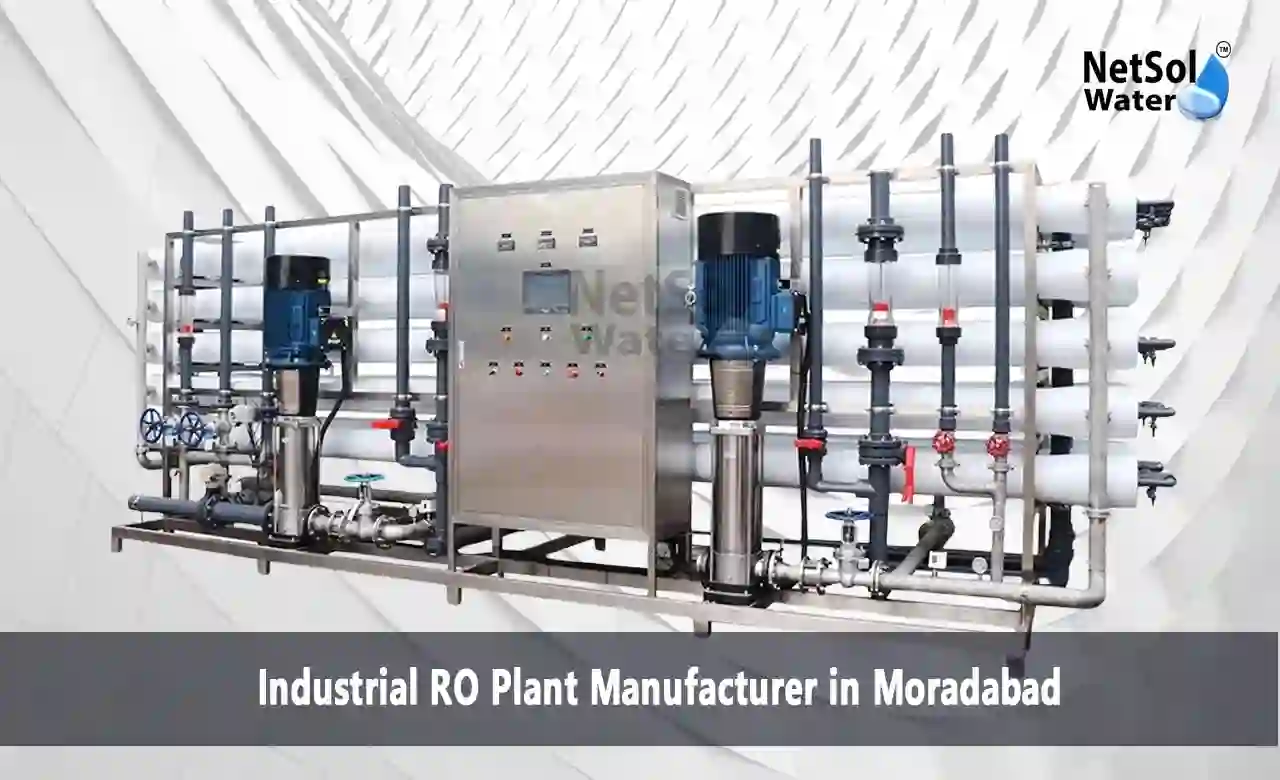
Multi-grade sand filtration removes suspended solids that would foul membranes within days. Activated carbon removes chlorine and organics that chemically degrade membrane material. Antiscalant dosing or a softener controls scaling potential. A well-designed pre-treatment system is the difference between membranes lasting 3–5 years and membranes requiring replacement in 8–12 months.
2. High Pressure Pump and Membrane Assembly
Spiral wound polyamide membranes in pressure vessels do the core separation work. The high pressure pump must be precisely sized - undersizing reduces recovery, oversizing wastes energy. Industrial systems typically achieve 60–75% water recovery and 95–99% salt rejection at operating pressures of 8–15 bar.
3. Post-Treatment and Distribution
For pharmaceutical applications, post-RO polishing via Electrodeionisation (EDI) or UV disinfection brings water to pharmacopoeia standards. For boiler feed, pH adjustment may be needed. For food-grade applications, remineralisation may be required. Your post-treatment design is application-specific.
4. Automated Control and Monitoring Panel
Modern systems include PLC-based controls that monitor feed pressure, permeate TDS, flow rates, and system status in real time. Automated alerts catch issues before membrane damage occurs. Remote monitoring capability is increasingly standard on industrial installations.
Key Performance Parameters You Must Ask About
| Parameter | What It Means for You |
|---|---|
| Recovery Rate (60–75%) | Percentage of feed water becoming purified output. Higher recovery = less water wasted and lower operating cost. |
| Salt Rejection Rate (95–99%) | Percentage of dissolved solids blocked by membranes. Higher = better output quality. |
| Output TDS (< 50 ppm) | TDS level of purified water. Most industrial applications need below 50 ppm; pharmaceutical may need below 10 ppm. |
| Energy Consumption | RO is energy-intensive. Ask for kWh/m³ figures. Well-designed systems with energy recovery use 0.5–1.5 kWh/m³. |
| Membrane Life (3–5 years) | Achievable with good pre-treatment and regular CIP (Clean-in-Place) cleaning. Poor pre-treatment halves this. |
How to Evaluate Industrial RO Plant Vendors in Moradabad
• Always start with feed water analysis - no legitimate manufacturer quotes without it.
• Scrutinise the pre-treatment design - it protects your membrane investment.
• Ask for honest recovery projections with supporting calculations, not marketing claims.
• Check that automation includes remote monitoring and early-warning alerts.
• Confirm local service presence in UP - remote support fails in real emergencies.
• Request references from similar industries and actually call them.
Why NetSol Water for Your Industrial RO Plant in Moradabad
NetSol Water is an ISO certified Industrial RO Plant manufacturer with installations across Uttar Pradesh in metal processing, pharmaceutical, food, textile, and chemical industries.
• Feed water analysis before every design - zero assumptions.
• Application-specific design: boiler feed, pharmaceutical water, food-grade, cooling tower - each configured differently.
• High-quality membranes and components with documented performance specifications.
• Complete project delivery: testing → design → supply → installation → commissioning → training.
• Annual Maintenance Contracts with regular CIP, filter replacement, and performance verification.
• Established service network across UP for rapid on-site response.
Your water quality problem has a solution. Contact NetSol Water for a free feed water analysis and consultation. Let us show you exactly what your source water contains and design a system that solves it permanently.
FAQs
Q 1: What TDS level does an Industrial RO plant reduce water to?
Industrial RO plants typically reduce TDS from source levels of 500–3,000 ppm down to below 50 ppm. Pharmaceutical-grade systems using post-RO EDI can achieve below 1 ppm. Actual output TDS depends on source water quality, membrane type, and system design.
Q 2: How much does an Industrial RO plant cost in Moradabad?
Industrial RO plant cost in Moradabad ranges from ?3–8 lakhs for small systems (500 LPH – 2,000 LPH) to ?15–40 lakhs for larger plants (10,000–50,000 LPH). Cost depends on feed water quality, required recovery rate, pre-treatment design, automation level, and application.
Q 3: What pre-treatment does an Industrial RO plant need?
Pre-treatment typically includes multi-grade sand filtration (removes suspended solids), activated carbon filtration (removes chlorine and organics), and either a water softener or antiscalant dosing system (controls scaling). The exact pre-treatment configuration depends on your source water's specific chemistry.
Q 4: How long do Industrial RO membranes last?
With proper pre-treatment and regular CIP (Clean-in-Place) maintenance, industrial RO membranes last 3–5 years. Poor pre-treatment, irregular cleaning, and incorrect chemical dosing can reduce membrane life to under 12 months - significantly increasing operating costs.
Q 5: Can an Industrial RO plant handle high TDS groundwater in UP?
Yes. Industrial RO systems are specifically designed for high TDS groundwater. UP groundwater commonly ranges from 800–2,500 ppm TDS. A well-designed system with appropriate pre-treatment and membrane configuration handles these conditions reliably and consistently.
Q 6: What is the difference between a water softener and an RO plant?
A water softener only removes hardness (calcium and magnesium) through ion exchange. An RO plant removes a much broader range of contaminants: dissolved salts, heavy metals, bacteria, organics, and practically all other dissolved solids. Most industrial applications need RO, not just softening.
Q 7: Does an Industrial RO plant need regular maintenance?
Yes. Regular maintenance includes daily pressure and TDS monitoring, weekly pre-filter inspections, monthly CIP cleaning of membranes when fouling is detected, quarterly performance testing, and annual membrane integrity checks. An Annual Maintenance Contract with your manufacturer ensures all of this is handled properly.