
Industrial RO Plant Manufacturer in Mahoba
A scaled boiler. A fouled heat exchanger. A batch of pharmaceutical products rejected because process water failed quality checks. For industries in Mahoba, these are not theoretical risks - they are the expensive, operational consequences of running on untreated groundwater.
Mahoba's groundwater routinely carries TDS levels of 800–1,400 mg/L, elevated hardness, iron, and in some zones, fluoride. For factories dependent on consistent water quality for boilers, cooling systems, dyeing, rinsing, or pharmaceutical production, this source water is a production liability.
NetSol Water is an ISO-certified industrial RO plant manufacturer with installations in Uttar Pradesh - including pharma units, textile mills, food processing plants, and chemical manufacturers in cities like Agra, Amroha, and Ambedkar Nagar. We bring that same depth of engineering and field experience to Mahoba's growing industrial base.
What Is an Industrial RO Plant and How Does It Differ from Commercial Systems?
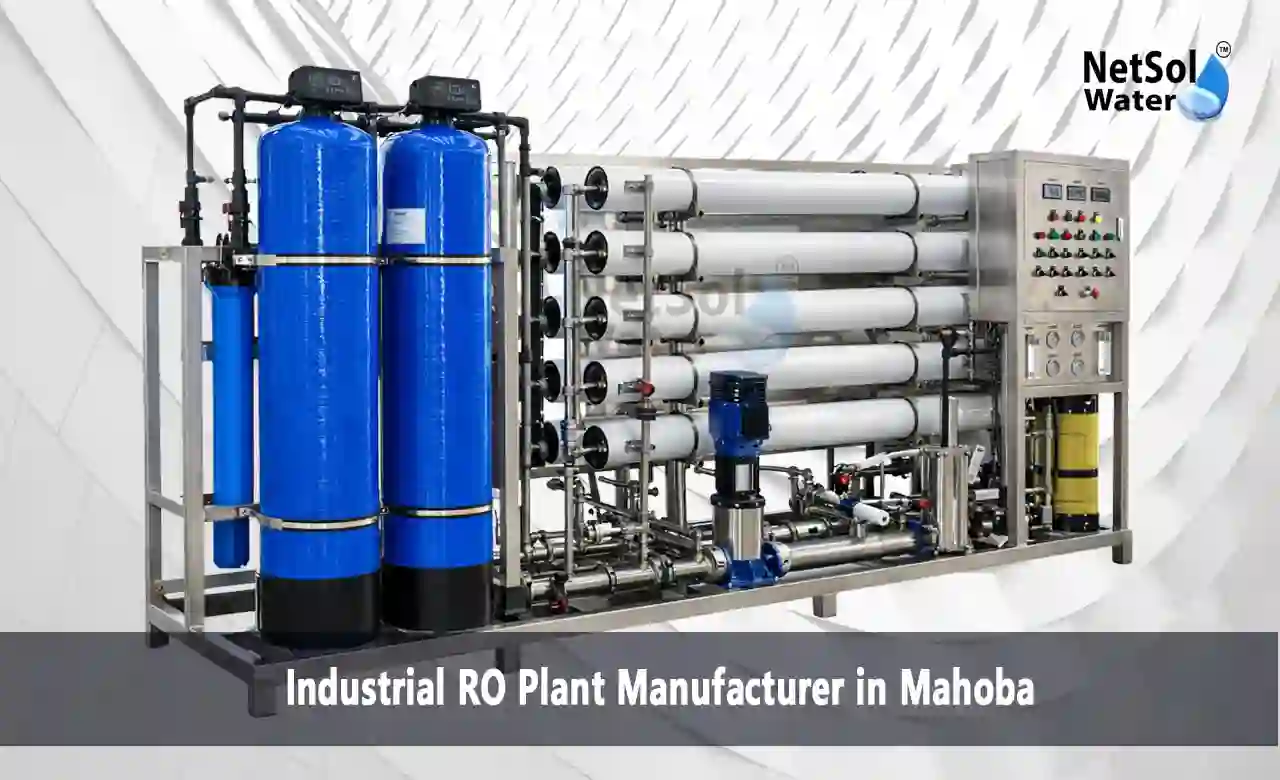
An industrial RO plant is a high-volume, continuously operating reverse osmosis system engineered to meet specific process water quality standards for factory use - handling flows from 1,000 LPH to over 50,000 LPH.
Industrial systems operate at higher pressures, process larger volumes, and use more robust components than commercial RO plants. They are often integrated with pretreatment systems (iron removal, softeners, media filters) and post-treatment stages (deionization, SCADA monitoring) designed around the exact quality demands of the factory's production processes.
Why Mahoba Industries Cannot Run on Untreated Groundwater
• High TDS (800–1,400 mg/L) causes rapid mineral scale in boilers - every 6mm of scale reduces heat transfer efficiency by 25%, directly increasing fuel costs
• Hard water forms calcium and magnesium deposits in cooling towers and heat exchangers, cutting operational efficiency by 15–30%
• Iron content above 0.3 mg/L (common in Mahoba boreholes) clogs and damages RO membranes within months if not removed in pretreatment
• Textile units using high-TDS water produce uneven dye absorption, resulting in quality rejection and fabric wastage
• Pharmaceutical manufacturers using non-purified process water risk batch failures, regulatory non-compliance, and product recall
• Industries buying tanker water at Rs 500–1,500 per kilolitre face Rs 15–50 lakh/year in water procurement costs that an on-site RO plant eliminates
Types of Industrial RO Systems Available
1. Single Pass RO: Water passes through membranes once. Produces water with moderate purity (TDS 20–100 mg/L). Suitable for cooling, washing, general process water.
2. Double Pass RO: Permeate from Pass 1 is re-treated through a second membrane set. Produces ultra-pure water (TDS < 10 mg/L). Required for pharmaceutical and electronics manufacturing.
3. High Recovery RO (up to 85%): Advanced design recovers more purified water per unit of feed. Critical for water-scarce regions like Bundelkhand to minimise reject water wastage.
4. RO with Softener Pretreatment: Water softener installed before membranes when source hardness exceeds 300 mg/L. Extends membrane life 2–3x and reduces cleaning frequency.
5. RO with Iron Removal Pretreatment: Iron removal filter protects membranes from iron fouling - essential for Mahoba borewell water where iron often exceeds safe thresholds.
6. ZLD Integrated RO: RO reject water fed into evaporators and crystallisers for 100% recovery. Required by UPPCB for textile and chemical industries - zero discharge compliance built in.
How to Calculate the Right Capacity for Your Factory?
Getting capacity wrong costs you twice - an undersized plant starves your process; an oversized one wastes capital and runs inefficiently. Here is how to calculate correctly:
• Step 1: List every process that consumes water (boiler feed, cooling, washing, rinsing, product mixing)
• Step 2: Add up daily volumes for each use in kilolitres per day
• Step 3: Divide by operating hours to get litres per hour requirement
• Step 4: Add 15–20% buffer for peak demand periods
• Step 5: Account for RO recovery rate - a system at 75% recovery needs 1.33x your purified water requirement as feed water
• Step 6: Factor 3–5 year production growth into your design capacity
Industrial RO Plant Cost in Mahoba
. Small Industrial RO (250–2,000 LPH): Rs 1,00,000 – Rs 4,00,000
. Medium Industrial RO (2,000–10,000 LPH): Rs 4,00,000 – Rs 15,00,000
. Large Industrial RO (10,000 LPH+): Rs 15,00,000 – Several Crores
Actual cost depends on source water TDS/hardness/iron levels, pretreatment requirements, automation level (basic vs SCADA), and site infrastructure. NetSol Water provides free source water testing before issuing any quotation.
Industries in Mahoba That Need an Industrial RO Plant
Textile & Dyeing Units: Consistent water quality is critical for even dye absorption. High TDS causes colour defects and fabric rejection.
Pharmaceutical Manufacturers: Process water, purified water (PW), and water for injection (WFI) all require multi-stage RO treatment meeting IP/USP standards.
Food & Beverage Processors: FSSAI mandates water quality standards for production. RO water eliminates microbial risk and ensures ingredient consistency.
Chemical Manufacturers: Reaction processes require water with specific ionic profiles. Inconsistent water quality leads to product failures.
Stone & Mineral Processing: Cutting and polishing machinery benefits from low-TDS water to reduce mineral deposits on surfaces and extend tool life.
Captive Power Plants & Boilers: Boiler feed water must have TDS < 1 mg/L (demin standard). Scale in boilers is both an efficiency and a safety hazard.
Ice Plants & Cold Storage: Food-grade ice requires water meeting BIS drinking water standards. An industrial RO plant is the only reliable way to achieve this.
What to Demand from Any Industrial RO Plant Manufacturer in Mahoba
• Written source water test report before system design begins
• Membrane brand specification in the quotation (not just 'branded membranes')
• Stated TDS rejection guarantee (minimum 95–99% for good quality systems)
• Recovery rate commitment (typically 65–85% depending on system type)
• SCADA / PLC automation for unattended operation if you lack dedicated operators
• Factory Acceptance Test (FAT) before dispatch and Site Acceptance Test (SAT) at commissioning
• Written Annual Maintenance Contract with defined SLA response times
• Operator training programme included as part of the handover package
Why NetSol Water Is Mahoba's Trusted Industrial RO Partner?
Free Source Water Testing: We test and document your source water quality before designing a single component.
Industry-Specific Design: We have designed systems for pharma, textile, food, and chemical industries across UP - sector-specific experience matters.
Trusted Component Brands: Dow FilmTec / Hydranautics membranes, Grundfos / Danfoss pumps, reputed PLC/SCADA panels.
Fast Delivery: Design → Manufacture → Install → Commission → Operator Training. One accountable team.
Transparent Itemised Pricing: Every component and its cost is listed. No hidden charges.
Long-Term AMC Partnership: Our service team is available and responsive. Breakdowns get resolved - not ignored.
Contact NetSol Water today. We will test your water, assess your process requirements, and deliver an industrial RO plant your factory can depend on, shift after shift, year after year.
FAQs
Q: What is the difference between a single pass and double pass RO system?
A: In a single pass RO, water passes through the membranes once, producing water with TDS of 20–100 mg/L. In a double pass system, the purified water from Pass 1 is treated again through a second membrane set, producing ultra-pure water with TDS below 10 mg/L. Pharmaceutical, electronics, and lab-grade applications require double pass systems.
Q: How much does an industrial RO plant cost in Mahoba?
A: Small industrial RO plants (1,000–5,000 LPH) in Mahoba cost Rs 3 to 10 lakh. Medium systems (5,000–20,000 LPH) range from Rs 10 to 35 lakh. Large systems above 20,000 LPH can cost Rs 35 lakh to several crores. Final pricing depends on source water quality, pretreatment required, and automation level.
Q: What TDS level is required for boiler feed water?
A: Boiler feed water should have very low TDS - typically below 1 mg/L for high-pressure boilers and below 10 mg/L for medium-pressure systems. Standard RO achieves TDS of 20–100 mg/L; achieving boiler-grade water requires a double-pass RO followed by demineralisation (DM plant) or electrodeionisation (EDI) treatment.
Q: How does iron content in Mahoba groundwater affect an RO plant?
A: Iron above 0.3 mg/L in source water rapidly fouls RO membranes, causing pressure drop, reduced flow rate, and membrane damage. An iron removal filter (greensand or birm filter) must be installed in the pretreatment system before the RO membranes. NetSol Water always tests for iron content before finalising the pretreatment design.
Q: What is the recovery rate of an industrial RO plant?
A: Standard industrial RO systems recover 65–75% of feed water as purified permeate; the remaining 25–35% exits as concentrate/reject. High-recovery systems can achieve 80–85% recovery. In water-scarce regions like Bundelkhand, high-recovery or ZLD-integrated designs are strongly recommended to minimise water wastage.
Q: Do industrial RO plants require full-time operators?
A: Modern industrial RO plants with SCADA/PLC automation can operate largely unattended. Automated controls manage pressure, flow rate, and membrane flush cycles. A trained operator is needed for periodic monitoring, consumable replacement, and maintenance - not continuous manual operation. NetSol Water trains your team at handover.
Q: How long do industrial RO membranes last?
A: With proper pretreatment and regular maintenance, industrial RO membranes last 3 to 7 years. Premature failure is almost always caused by inadequate pretreatment (chlorine exposure, iron fouling, or scaling), operating at incorrect pressure, or skipping antiscalant dosing. NetSol Water's AMC programme ensures membranes perform to their rated lifespan.
Q: Can an industrial RO plant be upgraded to achieve Zero Liquid Discharge?
A: Yes. Existing industrial RO systems can be retrofitted with evaporation and crystallisation equipment to achieve ZLD compliance. The RO concentrate/reject stream, which contains the removed impurities, is processed further to recover additional water and produce a dry solid waste. NetSol Water can audit your existing RO system and propose the most cost-effective ZLD upgrade path.