

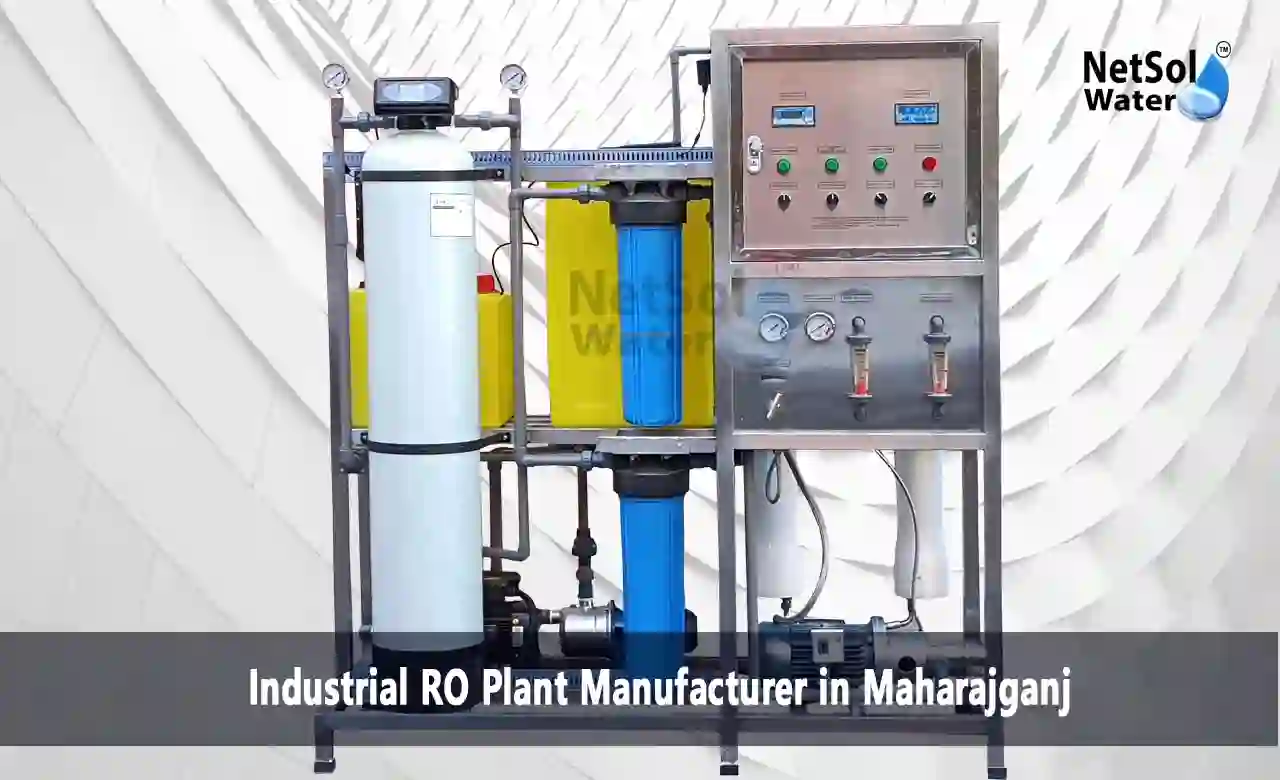
Industrial RO Plant Manufacturer in Maharajganj
Water is not a background utility for industries - it is a critical process input. It goes into your boilers, your cooling towers, your production lines, and sometimes your finished products. When that water is impure, everything downstream is affected: scaling in boilers, contamination in food batches, inconsistent dye results in textiles, and regulatory failures in pharma.
Maharajganj has a growing industrial base - rice mills, sugar processing, food manufacturing, pharmaceuticals, and textiles. Every one of these industries depends on a consistent, reliable source of high-purity water. If you are searching for an industrial RO plant manufacturer in Maharajganj, this guide covers what you need to know before making your investment.
Why Industrial Water Quality Is a Bigger Problem Than Most Think
Groundwater in Maharajganj and surrounding areas of eastern UP presents serious challenges for industrial use:
• TDS levels often exceed 800–1,200 mg/L in many industrial zones - well above limits for most process applications.
• High calcium and magnesium hardness causes aggressive scaling in boilers and heat exchangers, reducing efficiency by 15–25% within months.
• Iron content above 0.3 mg/L stains products, clogs membranes, and creates compliance failures in food and pharmaceutical manufacturing.
• Biological contamination from shallow aquifers and agricultural runoff is a persistent risk.
For households, this is a health concern. For industries, it is a direct operational and financial threat. An industrial RO plant solves all of these problems at once, giving your facility a dependable supply of process-grade purified water regardless of what comes out of the borewell.
Industrial RO vs. Commercial RO - What Is the Difference?
This is a question many buyers ask. Both use reverse osmosis membranes, but the design philosophy is entirely different:
| Feature | Commercial RO | Industrial RO |
|---|---|---|
| Primary Use | Drinking water, hospitality | Process water, boilers, manufacturing |
| Output Capacity | 200–2,000 LPH | 2,000–10,000+ LPH |
| Operating Hours | 8–16 hours/day | 16–24 hours/day |
| Pre-Treatment | Standard sediment + carbon | Advanced multi-stage treatment |
| Pressure System | Medium pressure pumps | High-pressure industrial pumps |
| Control System | Manual / basic auto | PLC/SCADA automation |
| Output TDS | < 100 mg/L | 10–50 mg/L (process-specific) |
Industries in Maharajganj That Need Industrial RO Plants
• Rice Mills & Grain Processing: Steam generation and washing require soft, low-TDS water to avoid equipment damage.
• Sugar Mills: Large-volume process water for evaporation and crystallisation stages.
• Food & Beverage Factories: Direct product contact makes water purity a food safety requirement.
• Pharmaceutical Units: USP Purified Water or Water for Injection (WFI) standards require multi-stage RO with EDI or distillation.
• Textile & Dyeing Units: Iron and hardness in water cause uneven dyeing and product rejections.
• Dairy & Cold Storage: Hygiene-critical environments need biologically safe, low-TDS water.
• Boiler Feed Applications: Boilers run on low-TDS water (typically < 50 mg/L) to prevent scaling and tube damage.
• Chemical Manufacturing: Demineralised water (DM water) is often required for reaction processes.
How a Well-Designed Industrial RO Plant Is Built
A proper industrial RO system is not just membranes in a frame. It is a complete treatment chain:
Stage 1: Raw Water Intake & Storage
Borewell, river, or municipal water is collected in a raw water tank with sufficient buffer capacity to handle feed rate variations. This protects the system from supply fluctuations.
Stage 2: Pre-Treatment
This is the most critical stage - and the one most vendors underdesign. Pre-treatment for industrial systems typically includes coarse filtration (multi-grade sand filter), activated carbon filtration to remove chlorine and organics, antiscalant dosing to prevent mineral scaling, a water softener if calcium hardness is very high, and an iron removal filter if Fe content exceeds 0.3 mg/L.
Stage 3: High-Pressure RO Membrane Array
Industrial-grade high-pressure pumps (typically 15–25 bar) push water through arrays of RO membrane vessels. Multiple arrays in series or parallel achieve the required output volume and TDS reduction.
Stage 4: Post-Treatment
Depending on your application: pH correction for aggressive permeate, UV disinfection, mixed-bed deionisers (for ultra-pure DM water), or electrodeionisation (EDI) for pharmaceutical-grade output.
Stage 5: Treated Water Storage & Distribution
Purified water is held in clean, sealed storage tanks and distributed through a dedicated pipeline network. Pressure pumps ensure consistent delivery pressure to all points of use.
Key Specifications to Discuss with Your Manufacturer
• Feed Water TDS: Always get your borewell water tested before system design. TDS determines membrane selection and array configuration.
• Required Output TDS: Boiler feed needs < 50 mg/L. Pharma needs < 1 mg/L. Food processing needs < 100 mg/L. Be specific.
• Flow Rate (LPH/CMD): Calculate peak hour demand and daily total. Plan for 3–5 year growth.
• Recovery Rate: Target 70–80%. Lower recovery wastes water and inflates operating costs.
• Operating Hours: 24/7 systems need more robust components and frequent pre-treatment maintenance.
• Reject Water Handling: High-recovery systems may need reject recirculation or ZLD integration.
Operating Costs - What to Budget For
| Cost Item | Frequency | Impact on Savings |
|---|---|---|
| Electricity (HP pumps) | Ongoing – daily | Largest opex; reduce via energy-efficient pumps |
| Membrane CIP cleaning | Every 3–6 months | Extends membrane life by 1–2 years |
| Membrane replacement | Every 3–5 years | Well-maintained systems reach upper range |
| Filter media replacement | Every 6–12 months | Protects membranes; reduces replacement frequency |
| Antiscalant dosing | Ongoing – daily | Prevents scale; saves ?2–5 lakh/year on boilers |
| AMC service visits | Quarterly / biannual | Prevents costly emergency breakdowns |
Why NetSol Water for Your Industrial RO Plant in Maharajganj?
NetSol Water is an ISO-certified industrial water treatment manufacturer in U.P. with a proven track record. We have built industrial RO systems for rice mills, pharmaceutical manufacturers, textile units, dairy facilities, and boiler feed applications across the region.
• Custom Engineering: Every system is designed around your source water test data and your process requirements - no off-the-shelf templates.
• Quality Components: Industrial-grade membranes, high-pressure pumps, and PLC control panels from trusted brands.
• Complete Installation: We handle everything from civil layout and equipment installation to commissioning and operator training.
• Long-Term AMC: Scheduled maintenance, membrane cleaning, filter replacement, and a dedicated service team.
• Industry-Specific Experience: We have worked with pharmaceutical, food processing, textile, and boiler feed applications. We know what your sector requires.
Contact NetSol Water today. Share your industry type, water source, and daily requirements - and get a custom industrial RO plant proposal for your Maharajganj facility.
FAQs - Industrial RO Plant in Maharajganj
Q: What capacity industrial RO plant do I need for a rice mill in Maharajganj?
A: A rice mill's water demand depends on production volume and steam requirements. Most small-to-mid rice mills in UP need between 5,000 LPH and 20,000 LPH (120 to 480 KLD). Boiler feed water quality should target TDS below 50 mg/L. Have your source water tested before finalising capacity.
Q: What is the difference between an industrial RO plant and a DM plant?
A: An industrial RO plant uses semi-permeable membranes to remove 95–99% of dissolved salts and produce water with TDS below 50 mg/L. A DM (demineralisation) plant uses ion exchange resins to remove nearly all dissolved ions, producing near-zero TDS water. Many industrial setups use RO as the primary stage followed by DM for ultra-pure applications.
Q: How much does an industrial RO plant cost in Maharajganj?
A: Industrial RO plants in Maharajganj typically cost between ?5 lakh and ?80 lakh depending on capacity (from 2,000 LPH to 50,000+ LPH), feed water TDS, pre-treatment requirements, and automation level. Always obtain a quote based on your actual water test report.
Q: What TDS level does an industrial RO plant produce?
A: A properly designed industrial RO plant produces permeate with TDS between 10 and 50 mg/L from feed water of up to 2,000 mg/L TDS. Higher feed TDS or specific process requirements may need multi-pass RO or post-treatment polishing stages.
Q: How long do RO membranes last in an industrial plant?
A: Industrial RO membranes typically last 3–5 years with proper pre-treatment and regular CIP (Clean-in-Place) maintenance. Plants with well-designed pre-treatment and scheduled AMC frequently achieve the upper end of that range. Poorly maintained systems may need replacement in under 2 years.
Q: Can an industrial RO plant handle very high TDS water in eastern UP?
A: Yes. Industrial RO plants can treat feed water with TDS up to 5,000–8,000 mg/L using high-pressure two-pass configurations. For Maharajganj groundwater, which typically tests at 800–1,500 mg/L TDS, a standard single-pass system with proper pre-treatment is usually sufficient.
Q: What pre-treatment is needed for an industrial RO plant in Maharajganj?
A: Given Maharajganj's groundwater profile - high TDS, iron, and occasional biological contamination - a proper pre-treatment train should include sand filtration, activated carbon filtration, iron removal filter, antiscalant dosing, and a softener if hardness exceeds 400 mg/L as CaCO?. Skipping any stage risks rapid membrane fouling.