
Industrial RO Plant Manufacturer in Kannauj
Water is the backbone of industrial production. Whether you are running a pharmaceutical unit, a textile mill, a chemical plant, or a food processing facility in Kannauj, the quality of the water you use directly determines the quality of your output. Hard water damages boilers. High-TDS water disrupts chemical reactions. Contaminated water in food production creates compliance nightmares. The solution to all of these challenges is a well-designed industrial reverse osmosis (RO) plant.
Netsol Water has established itself as one of the most trusted Industrial RO Plant Manufacturers in Kannauj by delivering systems that are purpose-built for industrial demands - not just adapted from smaller domestic units. The company combines hands-on engineering experience with deep knowledge of local water conditions in Uttar Pradesh, making it the preferred partner for industries that cannot afford unreliable water supply.
This guide covers everything you need to know about industrial RO plants in Kannauj - from how the technology works and which industries need it, to what the installation process looks like and how to evaluate costs. If you are planning a water treatment upgrade for your facility, this is the place to start.
What Is an Industrial RO Plant and Why Does Kannauj Need It?
Reverse osmosis (RO) is a water purification process that forces feed water through a semi-permeable membrane under pressure. The membrane acts as a molecular filter, allowing clean water molecules to pass through while rejecting dissolved salts, heavy metals, organic compounds, bacteria, and other contaminants. The result is purified water that meets the stringent quality demands of industrial processes.
Kannauj, located in the Gangetic plain of Uttar Pradesh, draws most of its industrial water from groundwater sources. While the region is not water-scarce, groundwater here typically carries elevated TDS (Total Dissolved Solids) levels ranging from 800 to 2,000 mg/L, significant hardness caused by calcium and magnesium carbonates, and in some pockets, traces of fluoride and iron. This water profile is unsuitable for direct use in most industrial applications without proper treatment.
For a perfume manufacturer in Kannauj using hard water in the extraction process, mineral deposits can alter fragrance compounds. For a pharmaceutical unit, even trace levels of dissolved salts can compromise drug formulations. For a textile dye house, high TDS causes uneven colour uptake. An industrial RO plant resolves all these issues by delivering treated water with consistently low TDS - typically below 50 mg/L - and virtually zero hardness.
About Our Industrial RO Solutions in Kannauj
Netsol Water does not believe in off-the-shelf industrial RO systems. Every plant it designs and builds in Kannauj begins with a comprehensive feed water analysis. The company's engineers collect samples from your water source - whether borewell, municipal supply, or a river intake - and run detailed laboratory tests to measure TDS, pH, hardness, iron, silica, turbidity, and microbial load. These results determine everything: the pretreatment configuration, membrane type and count, pump sizing, and recovery rate target.
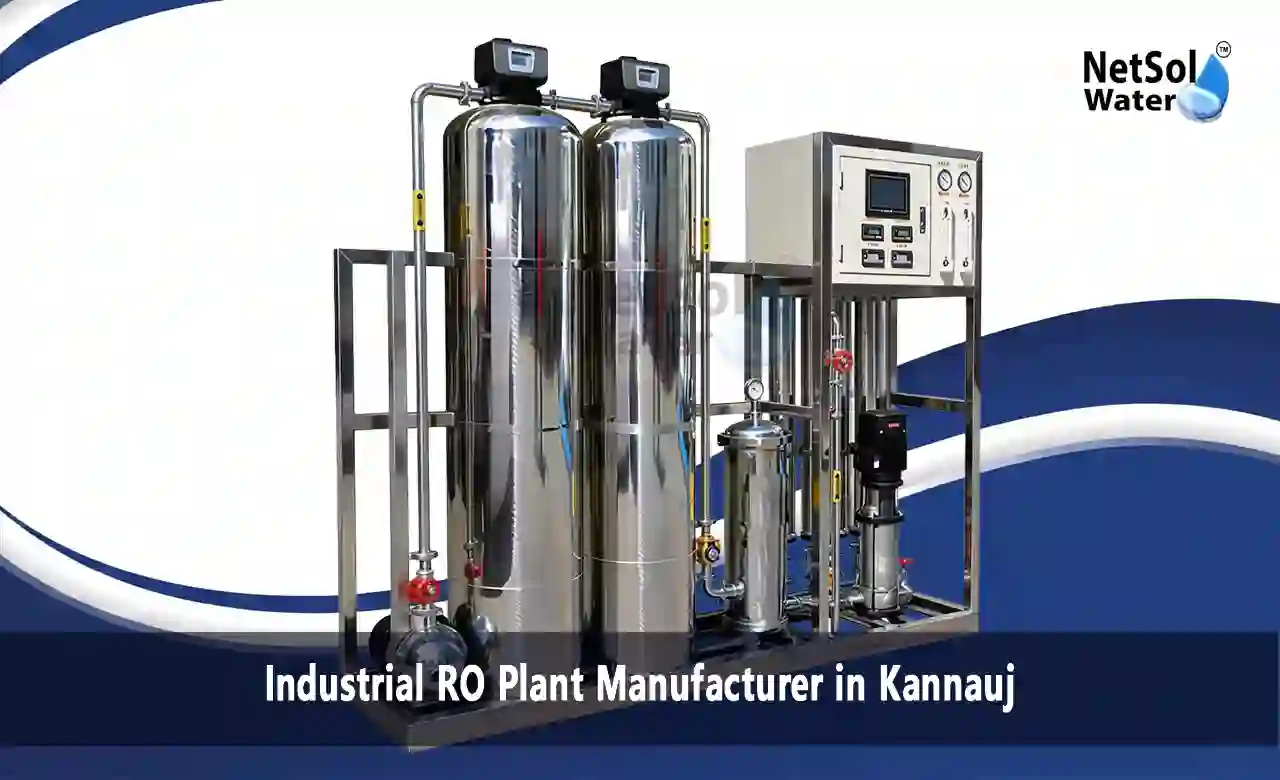
The company's product range covers the full spectrum of industrial needs. Small skid-mounted RO units starting from 500 LPH (litres per hour) suit compact manufacturing setups. Modular systems in the range of 5,000 to 50,000 LPH serve medium-scale industries with growing demand. Large custom-designed plants exceeding 1 lakh LPH are engineered for heavy industries, large campuses, and centralised treatment hubs serving multiple production lines.
Durability is a core design principle. Industrial RO plants from Netsol Water use SS 304 or SS 316 frames, HDPE or SS piping rated for continuous pressure operation, high-rejection spiral-wound membranes from globally proven brands, and stainless-steel or PVDF pressure vessels. Every component is chosen for industrial-grade service life, not just initial performance.
Energy efficiency is built in from the start. Variable frequency drives (VFDs) on high-pressure pumps allow the system to adjust power draw based on actual demand, reducing electricity consumption by 20–35% compared to fixed-speed systems. Energy recovery devices are integrated where feed water conditions allow, further lowering the cost per cubic metre of treated water.
Industries We Serve in Kannauj
Kannauj's economy is built on a unique combination of industries, and each sector has specific water quality requirements that demand a tailored RO solution.
1. Perfume and Fragrance Industry
Kannauj is internationally known as India's perfume capital. The extraction and blending processes used in attar and perfume manufacturing require water with extremely low mineral content. Hard water introduces calcium and magnesium ions that interfere with essential oil extraction and distillation, affecting the purity and scent profile of the final product. Industrial RO plants producing water with TDS below 20 mg/L and near-zero hardness are the standard solution for this sector.
2. Pharmaceutical and Chemical Plants
Pharmaceutical manufacturing in Kannauj demands water that meets Indian Pharmacopoeia (IP) or WHO GMP standards. Purified water (PW) and water for injection (WFI) production begins with an industrial RO stage that removes dissolved solids, organic compounds, and endotoxin precursors. Chemical plants need consistent ion profiles in process water to ensure repeatable reaction conditions. Netsol Water designs multi-pass RO systems and post-RO polishing stages (EDI, mixed bed DI) for these critical applications.
3. Textile and Dyeing Units
The textile industry is a significant water user. Dyeing and finishing processes require soft, low-TDS water to achieve uniform colour penetration, reduce fabric damage, and improve dye uptake efficiency. Hard water causes uneven dyeing, increased chemical consumption, and higher rejection rates in finished fabric. Industrial RO plants from Netsol Water provide the consistently soft, purified water that textile processors need.
4. Food and Beverage Manufacturing
Food safety regulations require water used in processing, rinsing, and cleaning-in-place (CIP) operations to meet potable water standards as a minimum - and often stricter process-specific standards. Netsol Water designs food-grade RO plants with NSF-compliant materials, UV disinfection post-treatment, and easy-clean designs that support food safety audits.
5. Power Plants and Industrial Boilers
Boiler feed water must have near-zero hardness to prevent scale formation that reduces heat transfer efficiency and eventually causes tube failures. Even a 1mm scale deposit in a boiler tube can increase fuel consumption by 7–10%. Industrial RO plants producing softened, demineralised feed water are standard in power generation and process steam applications, protecting capital equipment and ensuring efficient operation.
6. Large Industrial Complexes and Campuses
For large industrial parks or multi-unit complexes, centralised RO systems provide economic and operational advantages. A single large-capacity plant serving multiple production units reduces capital cost per unit of water, simplifies maintenance, and provides consistent water quality across all users. Netsol Water designs centralised systems with redundancy built in - dual trains, duty-standby pumps, and auto-switchover - to ensure uninterrupted supply.
Our Industrial RO Plant Technology
A well-designed industrial RO plant is not simply a membrane housing and a pump. It is a complete multi-stage system where each component plays a specific role in protecting water quality and system longevity.
1. Pretreatment System
Raw feed water first passes through a pretreatment train designed to remove particulates, biological growth, and scale-forming compounds that would otherwise damage the RO membranes. Typical pretreatment stages include coarse screening and sand filtration to remove suspended solids, activated carbon filtration to remove chlorine, chloramines, and organic compounds, antiscalant dosing to prevent calcium carbonate and sulphate scale formation, and 5-micron cartridge filtration as the final guard before the high-pressure pump.
2. RO Membrane System
High-pressure pumps (typically stainless-steel multistage centrifugal pumps operating at 8–15 bar for brackish water and up to 80 bar for seawater) force the pretreated water through spiral-wound polyamide composite membranes. These membranes reject 97–99.5% of dissolved salts and most organic compounds. Multi-stage and multi-pass configurations allow higher recovery rates (up to 75–85% for industrial applications) while maintaining product water quality.
3. Control and Automation
Netsol Water installs PLC-based control panels on all industrial RO plants, providing real-time monitoring of feed pressure, permeate pressure, conductivity, flow rates, and recovery ratio. Automated CIP (clean-in-place) cycles run at programmed intervals to maintain membrane performance. Alarm systems alert operators immediately when parameters drift outside set limits. For clients with SCADA infrastructure, remote monitoring integration is standard.
4. Post-Treatment Options
Depending on the application, Netsol Water adds post-treatment stages to the RO output. Remineralisation for drinking water, UV disinfection for food-grade applications, EDI (electrodeionisation) or mixed-bed ion exchange for ultra-pure water production in pharmaceutical or electronics manufacturing - all are available as part of an integrated system design.
Why Choose Netsol Water as Your Industrial RO Plant Manufacturer in Kannauj?
Choosing the right manufacturer makes the difference between a plant that runs reliably for 10+ years and one that causes repeated problems from day one. Here is why industries in Kannauj choose Netsol Water as a trusted Industrial RO Plant Manufacturer and Supplier in Uttar Pradesh:
• End-to-end project ownership: Netsol Water handles everything from site survey and water analysis to design, fabrication, installation, commissioning, and after-sales support - with a single point of
accountability.
• Proven industrial experience: The company has successfully commissioned RO plants across UP's industrial belt, including chemical, pharma, textile, and food processing sectors.
• Quality-certified manufacturing: All systems are built to accepted industry standards with components sourced from established global and Indian suppliers. Factory acceptance tests are run before
each unit ships.
• Local presence and fast response: Netsol Water maintains a local service network, in-stock spare parts, and field engineers who can reach Kannauj-area sites quickly when urgent support is needed.
• Transparent quotation process: The company provides line-item cost breakdowns covering civil, equipment, electrical, and commissioning costs - so there are no surprises on the final invoice.
• Operator training and documentation: At handover, your operations team receives practical training on system operation, routine maintenance, and fault diagnosis - along with clearly written O&M manuals.
Industrial RO Plant Installation Process in Kannauj
1 - Feed Water Analysis and Site Survey
Every project begins here. Netsol Water's engineers visit your site to collect water samples from the actual source and conduct a full site inspection. The lab analysis measures TDS, pH, hardness, alkalinity, iron, silica, turbidity, SDI (Silt Density Index), and microbial load. The site survey documents available space, electrical supply, drainage options, and piping distances. These inputs form the technical foundation for the system design.
2 - System Design and Engineering
Using the water analysis data, the design team sizes the pretreatment system, selects membrane type and count, calculates pump specifications, and designs the piping and instrumentation layout. A P&ID (Piping and Instrumentation Diagram) and equipment layout drawing are prepared and reviewed with the client before fabrication begins. This stage typically takes 5–10 days.
3 - Fabrication and Factory Testing
Skid-mounted systems are assembled at Netsol Water's manufacturing facility. All mechanical and electrical sub-assemblies are tested at the factory before shipment. Pressure tests confirm piping integrity. Electrical inspections verify wiring and panel safety. A first water run on municipal supply validates flow rates and basic system function. Factory acceptance test reports are shared with the client.
4 - Site Installation and Civil Work
On-site, the Netsol Water installation team places the skid or modules, connects process piping, installs electrical connections, and integrates the control panel. Civil support work - anchor bolts, drain channels, platform preparation - is coordinated with your site civil team. Installation of a standard industrial RO plant typically takes 3–7 days depending on system complexity.
5 - Commissioning and Performance Testing
The plant is started on actual feed water. Engineers tune control set points, flush the membrane system, and run a stabilisation period (typically 24–72 hours) before acceptance testing. Performance testing records permeate flow, recovery rate, rejection percentage, and product TDS - all compared against the design specification. Any deviations are corrected before sign-off.
6 - Handover and Operator Training
After successful performance testing, Netsol Water conducts operator training covering daily operating checks, routine maintenance tasks, shutdown and startup procedures, CIP operation, and basic fault diagnosis. The client receives a complete documentation package: O&M manual, as-built drawings, equipment data sheets, spare parts list, and service contact details.
Cost of Industrial RO Plant in Kannauj
Industrial RO plant cost in Kannauj varies based on several key parameters. Understanding these factors helps you budget accurately and compare quotes fairly.
• Plant capacity: The most significant cost driver. Systems are priced per unit of output capacity. Larger systems cost more in absolute terms but typically lower cost per m³ of treated water.
• Feed water quality: High-TDS or heavily fouling water requires more extensive pretreatment - additional filtration stages, antiscalant dosing systems, softeners - which adds to capital cost.
• Recovery rate target: Achieving 80%+ recovery in difficult water conditions may require staging the RO system (two-stage design), adding inter-stage booster pumps, or using specific membrane
types - all of which affect cost.
• Automation level: Basic manual systems cost less upfront. PLC-based systems with SCADA integration, remote monitoring, and data logging add 15–25% to panel costs but significantly reduce
staffing requirements and improve uptime.
• Site conditions: Long piping runs, elevated installation points, special structural support requirements, or difficult electrical access can increase civil and installation costs.
• Post-treatment requirements: Adding EDI, UV disinfection, remineralisation, or mixed-bed polishing raises system cost but may be essential for pharmaceutical or food applications.
As a general guide, a 5,000 LPH industrial RO system with standard pretreatment and PLC controls typically falls in the range of ?8–15 lakh installed. Systems above 50,000 LPH are priced on a project-specific basis. Netsol Water provides detailed, itemised quotations after a site survey - never generic pricing without understanding your actual requirements.
Frequently Asked Questions (FAQs)
Q1. What TDS level does an industrial RO plant achieve?
A well-designed industrial RO plant typically produces permeate water with TDS between 10 and 50 mg/L, depending on feed water quality and the membrane type used. For applications requiring ultra-pure water, post-RO polishing using EDI or mixed-bed ion exchange can bring TDS below 1 mg/L. Netsol Water designs to the product water specification your process actually requires.
Q2. How long do RO membranes last in an industrial plant?
With properly maintained pretreatment and regular CIP (clean-in-place) cycles, industrial RO membranes typically last 3 to 5 years. Membrane life depends heavily on feed water quality, antiscalant dosing accuracy, and operating pressure. Netsol Water designs pretreatment systems specifically to maximise membrane life, and provides AMC (Annual Maintenance Contract) plans that include scheduled membrane inspections and replacement.
Q3. What is the typical water recovery rate for an industrial RO plant?
Recovery rate is the percentage of feed water that becomes product water. For groundwater with moderate TDS (500–2000 mg/L), industrial RO plants typically achieve 70–80% recovery. Higher recovery is possible with two-stage RO configurations but increases concentrate TDS and the risk of scaling. Netsol Water balances recovery targets against water chemistry to optimise both resource efficiency and membrane life.
Q4. Can an industrial RO plant run 24 hours a day?
Yes. Industrial RO plants are designed for continuous operation. Netsol Water builds systems with duty-standby pump configurations, automated CIP cycles that run without interrupting production, and alarm systems that alert operators to any anomalies. Properly maintained systems commonly run 8,000+ hours per year without major interruption. The PLC control system manages start-up and shutdown automatically.
Q5. What pretreatment does an industrial RO plant need?
Pretreatment requirements depend on feed water quality. Most systems require multi-media filtration to remove suspended solids, activated carbon filtration to remove chlorine (which damages polyamide membranes), antiscalant dosing to prevent scale, and 5-micron cartridge filtration as final protection. Water with high iron, manganese, or silica may need additional treatment stages. Netsol Water designs the pretreatment system based on actual water test results.
Q6. How often does an industrial RO plant need maintenance?
Routine daily maintenance includes checking pressure gauges, flow meters, and conductivity readings - a 10–15 minute task. Weekly checks cover chemical dosing levels and filter condition. Monthly maintenance involves cartridge filter replacement and membrane performance review. CIP cleaning is performed every 3–6 months. Annual maintenance includes pump servicing and membrane integrity testing. Netsol Water provides clear maintenance schedules at handover.
Q7. Is it better to buy or lease an industrial RO plant?
For most industries in Kannauj, outright purchase provides better long-term value since the plant has a 10–15 year service life. Some clients prefer the BOOT (Build-Own-Operate-Transfer) model for large systems where capital outlay is a concern. Netsol Water can discuss both options and help you evaluate which makes more financial sense based on your water consumption and project scale.
Conclusion
The right Industrial RO Plant Manufacturer in Kannauj does more than supply equipment - they solve your water problem comprehensively, from analysis through installation through long-term support. Netsol Water brings all of that to every project. If your facility in Kannauj is struggling with hard water, high TDS, boiler scaling, or water quality compliance, contact Netsol Water today for a free site assessment and no-obligation quotation.
Call Netsol Water: +91-9650608473 | Email: enquiry@netsolwater.com | Free Site Survey Available