
Industrial RO Plant Manufacturer in Jhansi
Jhansi is one of the most strategically important industrial cities in Madhya Pradesh and the central Indian region. Its location at the intersection of key national highways and railways, combined with a strong base of defence manufacturing, engineering, granite processing, food production, and pharmaceutical activity, makes it a city that depends heavily on reliable industrial infrastructure - and water treatment is a critical part of that infrastructure.
The water challenge in Jhansi is specific and significant. The city and its surrounding Bundelkhand region face periodic water scarcity, and the available groundwater often contains high TDS, fluoride above permissible limits, and variable hardness that makes it unsuitable for direct industrial use. Industries that draw from the Betwa River or other surface sources face turbidity, seasonal variation, and biological load issues.
Netsol Water has built expertise specifically in serving the water treatment needs of industries in this region, establishing itself as a trusted Industrial RO Plant Manufacturer in Jhansi. The company's deep understanding of Bundelkhand's water chemistry, combined with proven engineering capability, makes it the partner of choice for Jhansi's industrial operators who need water treatment they can depend on.
Jhansi's Water Challenge and How Industrial RO Addresses It
Groundwater in the Bundelkhand region frequently carries TDS in the range of 1,000–3,500 mg/L - far above the 500 mg/L limit for industrial process water in most applications and well above the 250 mg/L recommended for boiler feed. Fluoride concentrations in some aquifers exceed 3 mg/L, and arsenic has been detected in some deep bore wells in the region. Hardness values of 400–800 mg/L as CaCO3 are common, causing rapid scaling in heat exchangers, boilers, and pipelines.
Industrial RO technology effectively addresses all of these challenges. A correctly designed RO system reduces TDS by 95–99%, reduces hardness to near zero, removes fluoride, arsenic, and other trace contaminants, and eliminates biological contamination. For Jhansi industries, this means boilers that run without scale-related shutdowns, process reactions that proceed with consistent water chemistry, and products that meet purity specifications.
Beyond water quality, RO systems also support Jhansi's water conservation agenda. By achieving 70–80% recovery, an industrial RO plant converts 70–80 litres of every 100 litres of feed water into usable treated water, reducing overall water demand from scarce local sources.
About Our Industrial RO Solutions in Jhansi
Netsol Water designs every industrial RO plant for Jhansi facilities from a site-specific engineering basis. The starting point is always a comprehensive feed water analysis - not a catalogue selection. Engineers collect and test samples from your actual water source, measuring the complete ionic profile, biological load, fouling potential (SDI), and any site-specific contaminants.
This data drives the design of a system that is optimised for your water - not for an average water quality profile. Pretreatment is designed specifically around your feed water's scaling and fouling potential. Membranes are selected for their rejection characteristics and tolerance to your specific water chemistry. Recovery targets are set to maximise water efficiency while protecting membrane life.
Netsol Water offers the full capacity range for industrial users in Jhansi. Small systems at 500–2,000 LPH suit machine shops, small pharmaceutical units, and food processing operations. Medium systems at 5,000–25,000 LPH serve manufacturing plants, mid-sized textile mills, and hospital complexes. Large-capacity systems above 50,000 LPH are designed for power plants, large industrial estates, and municipal augmentation projects in the region.
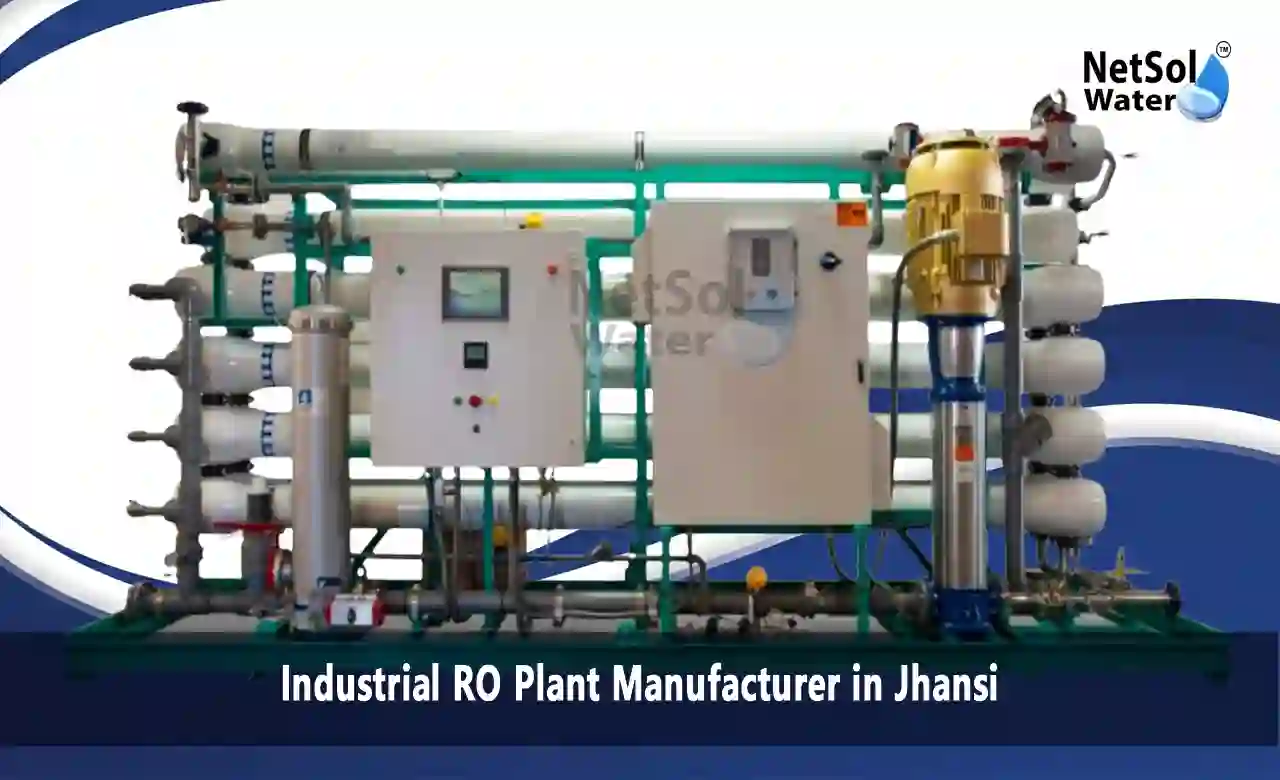
All systems are built for continuous industrial operation - not intermittent or light-commercial use. Frames are fabricated in SS 304 or MS powder-coated steel. Piping is UPVC, SS, or HDPE depending on pressure and chemical compatibility requirements. High-pressure pumps are selected for continuous duty with planned service intervals exceeding 8,000 hours. Control panels are IP54-rated for industrial environments.
Key Industries Served in Jhansi
1. Defence and Engineering Manufacturing
Jhansi has a significant defence manufacturing presence, including the Bharat Heavy Electricals Limited (BHEL) complex and various engineering fabrication units. These industries use purified water for precision cleaning of components, hydrostatic testing, chemical processing, and cooling. Netsol Water designs demineralised water plants and high-purity RO systems that meet the water quality specifications required by these precision manufacturing applications.
2. Power Generation and Utilities
Boiler feed water in thermal power plants and industrial steam systems must be practically free of dissolved minerals to prevent scale formation that reduces heat transfer and causes tube failures. Even a 1 mm mineral scale deposit in a high-pressure boiler tube can increase fuel consumption by 7–10% and risk catastrophic tube failure. Netsol Water designs industrial RO systems specifically for power plant feed water applications, achieving very low TDS and near-zero hardness output that protects capital infrastructure.
3. Granite Processing and Stone Industry
Jhansi is a major hub for granite and natural stone processing. Stone polishing and cutting operations use high-pressure water jets, and the quality of this water affects cutting speed, blade life, and finished product quality. Minerals in hard water cause residue deposits on stone surfaces that require additional cleaning steps. RO-treated water reduces mineral deposits, extends cutting tool life, and improves surface finish quality - tangible operational benefits for granite processors.
4. Pharmaceutical and Chemical Industries
Pharmaceutical manufacturers in Jhansi and the surrounding district require water meeting Indian Pharmacopoeia (IP) purified water specifications for drug formulation and equipment cleaning. Chemical processing industries need consistent water chemistry for reproducible reactions and product quality control. Netsol Water designs multi-pass RO systems with post-treatment polishing to achieve the required water purity levels, and provides the validation documentation required for pharmaceutical GMP compliance.
5. Food and Beverage Production
Food processors in Jhansi use water in product formulation, equipment rinsing, and CIP (clean-in-place) operations. Water quality directly affects food safety, taste, and shelf life. Netsol Water designs food-grade RO systems with materials compliant with food contact standards (FDA/NSF), UV disinfection post-treatment, and sanitary design features that support food safety audits and FSSAI compliance.
Industrial RO Technology and System Components
1. Feed Water Pretreatment
Jhansi groundwater's typically high turbidity and hardness require robust pretreatment. Netsol Water's standard pretreatment train for Jhansi conditions includes coagulation and sand filtration for turbidity removal, iron and manganese removal filters where needed, activated carbon filtration for chlorine removal, chemical softening or antiscalant dosing to control carbonate and sulphate scaling, and 5-micron cartridge filtration before the high-pressure stage.
2. High-Pressure Pumps and Energy Recovery
High-pressure pumps are the heart of the RO system and the primary energy consumer. Netsol Water selects pumps from proven manufacturers, sized precisely for the design flow and pressure of your system. Variable frequency drives (VFDs) on high-pressure pumps allow the system to reduce power draw during off-peak operation, reducing electricity consumption by 20–35% compared to direct-on-line started pumps. For large systems above 100 m³/h, pressure energy recovery devices further reduce power consumption.
3. Membrane Array and Pressure Vessels
Industrial RO membranes are spiral-wound polyamide composite elements housed in fibreglass or stainless-steel pressure vessels. Netsol Water designs the membrane array (number of elements, staging, and arrangement) to achieve the target recovery rate and product water quality for your specific feed water conditions. For Jhansi's high-TDS groundwater, two-stage arrangements are commonly used to achieve 75–80% recovery while maintaining high salt rejection.
4. Instrumentation and Controls
Netsol Water's industrial RO systems include comprehensive instrumentation: feed, permeate, and concentrate flow meters; feed, inter-stage, and product pressure transmitters; feed and product conductivity meters; turbidity sensor; and inlet/outlet temperature monitoring. This data feeds a PLC control system with colour touchscreen HMI that displays real-time system status, trends, and alarms. Remote monitoring capability allows Netsol Water's service team to assist with diagnostics without a site visit.
Why Jhansi Industries Choose Netsol Water?
. Regional water chemistry expertise: Netsol Water understands Bundelkhand's specific water challenges - high fluoride, elevated TDS, seasonal variation - and designs systems that handle these conditions reliably.
. Proven project track record: The company has commissioned industrial RO plants across the Jhansi and Bundelkhand region, building direct experience with local site conditions and utility infrastructure.
. Single-contractor delivery: From survey to handover, Netsol Water manages the complete project, eliminating the coordination complexity of managing multiple civil, mechanical, and electrical contractors.
. In-stock spare parts: Critical spare parts - cartridge filters, antiscalant chemicals, pressure gauges, membrane elements - are held in regional stock for rapid dispatch, minimising downtime when maintenance is needed.
. Flexible after-sales packages: Annual maintenance contracts (AMC), comprehensive maintenance contracts (CMC), and pay-per-call options are available to suit different client preferences and budget structures.
Also Read: Industrial RO Plant Manufacturer in Uttar Pradesh
Installation Process for Industrial RO Plants in Jhansi
The installation process follows six structured stages: (1) Feed water analysis and site survey to characterise water quality and site conditions; (2) System design and engineering with client review; (3) Fabrication and factory acceptance testing at Netsol Water's manufacturing facility; (4) Site installation coordinating civil, mechanical, and electrical work; (5) Commissioning, performance testing, and parameter optimisation; and (6) Handover with operator training, documentation, and service setup. Typical project duration from site survey to commissioning is 6–10 weeks for standard systems, and 12–20 weeks for larger or more complex plants.
Cost of Industrial RO Plant in Jhansi
Cost parameters for industrial RO plants in Jhansi mirror those in Kannauj and Kushinagar, with some additional factors specific to the region. High fluoride or high-TDS groundwater in Bundelkhand often requires more robust pretreatment - iron removal filters, softeners, or even a two-stage RO configuration - which increases capital cost compared to areas with better groundwater quality. Remoteness from major industrial supply chains can also affect equipment lead times and freight costs.
. Capacity-based cost range: 5,000 LPH systems typically range from INR6–10 lakh installed. 25,000 LPH systems range from INR40–60 lakh. Above 50,000 LPH, project-specific pricing applies.
. Fluoride or high-TDS water: May require additional pretreatment or two-stage RO, adding 10–25% to base system cost.
. Automation and remote monitoring: PLC systems with remote access add ?1–3 lakh to panel cost but provide significant operational advantages.
Netsol Water provides fully itemised quotations after a site survey. These quotes cover equipment, civil interface, installation, commissioning, and documentation - with no hidden charges.
FAQs - Industrial RO Plant Jhansi
Q1. Can an industrial RO plant remove fluoride from Jhansi groundwater?
Yes. Polyamide reverse osmosis membranes reject 90–95% of fluoride from feed water. For Jhansi groundwater with fluoride at 2–4 mg/L, a standard industrial RO system achieves product water fluoride well below the 1.5 mg/L permissible limit. For very high fluoride levels or applications requiring even lower product fluoride, a two-pass RO or activated alumina post-treatment stage can further reduce fluoride to below 0.5 mg/L.
Q2. What recovery rate is achievable with Jhansi's high-TDS groundwater?
With typical Jhansi groundwater at 1,500–3,000 mg/L TDS, single-stage RO systems achieve 65–70% recovery with careful antiscalant design. Two-stage systems can push recovery to 75–80%. Higher recovery is generally not recommended for high-TDS Bundelkhand water without concentrate treatment, as the concentrate becomes extremely high in scaling ions that shorten membrane life significantly.
Q3. How does an industrial RO plant benefit power plant operations in Jhansi?
Industrial RO plants for Jhansi power facilities produce boiler feed water with TDS below 10 mg/L and near-zero hardness, virtually eliminating scale formation in boiler tubes. Scale-free operation reduces blowdown frequency, improves heat transfer efficiency, cuts fuel consumption by up to 15%, and extends tube life significantly - all of which reduce operating costs and improve plant availability.
Q4. What is the minimum space required for an industrial RO plant?
A 5,000 LPH industrial RO skid typically occupies a footprint of approximately 3m x 1.5m, plus space for chemical dosing tanks and product water storage. A 25,000 LPH system may need 6m x 3m for the RO skid and pretreatment. Netsol Water prepares detailed layout drawings showing exact space requirements and utility connections as part of the project design, allowing clients to plan the plant room or installation area accurately.
Q5. Does Netsol Water offer service support in Jhansi?
Yes. Netsol Water maintains regional service capability covering Jhansi and the Bundelkhand area. The company holds critical spare parts in regional stock for rapid dispatch and can mobilise field engineers for urgent site visits. Clients on AMC plans receive scheduled maintenance visits, remote monitoring support, and priority response for breakdowns - typically within 24–48 hours for urgent issues.
Q6. What wastewater is produced by an industrial RO plant?
An industrial RO plant produces a concentrate stream (also called reject water or brine) containing the salts rejected from the feed water. At 75% recovery, the concentrate volume is 25% of the feed flow. This concentrate has a TDS approximately 3–4 times the feed TDS and must be disposed of responsibly - typically to the sewer, to an ETP, to evaporation ponds, or through ZLD treatment. Netsol Water advises on the appropriate concentrate disposal method for each project.
Conclusion
Jhansi's industrial sector needs water treatment solutions designed for the region's specific challenges - high TDS, fluoride, and seasonal scarcity. Netsol Water's purpose-built industrial RO plants deliver reliable, high-quality treated water that protects equipment, improves product quality, and supports compliance. Contact the team today to start with a free site survey and water analysis.
Call Netsol Water: +91-9650608473 | Email: enquiry@netsolwater.com