
Industrial RO Plant Manufacturer in Hathras
If your production line depends on consistently pure water, a poorly designed RO system isn't just an inconvenience - it's a costly breakdown waiting to happen. Scaling, membrane fouling and inconsistent output can shut down entire processes.
Netsol Water is a trusted industrial RO plant manufacturer in Hathras with years of hands-on experience designing, building, and servicing water treatment systems for demanding industrial environments. Whether you run a textile unit, a pharmaceutical facility, or a food processing plant, we build RO systems that match your exact process needs.
What Makes Our Industrial RO Solutions in Hathras Different?
Most industrial water problems don't start at the RO membrane - they start with poor system design. At Netsol Water, we begin every project with a detailed feed water analysis. This tells us exactly what your water contains and what pre-treatment your system needs before it even reaches the membrane.
Every system we design is custom-engineered for your site, your industry, and your water quality targets. We don't sell off-the-shelf systems and hope they work. Here's what our industrial RO solutions in Hathras include:
• Feed water analysis and site study before any design work begins
• Multi-stage pre-treatment including softeners, antiscalant dosing, and ultra-filters to prevent membrane fouling
• High-pressure pumps and energy recovery devices that reduce power costs by up to 30%
• Automated control panels that monitor conductivity, pressure, and flow in real time
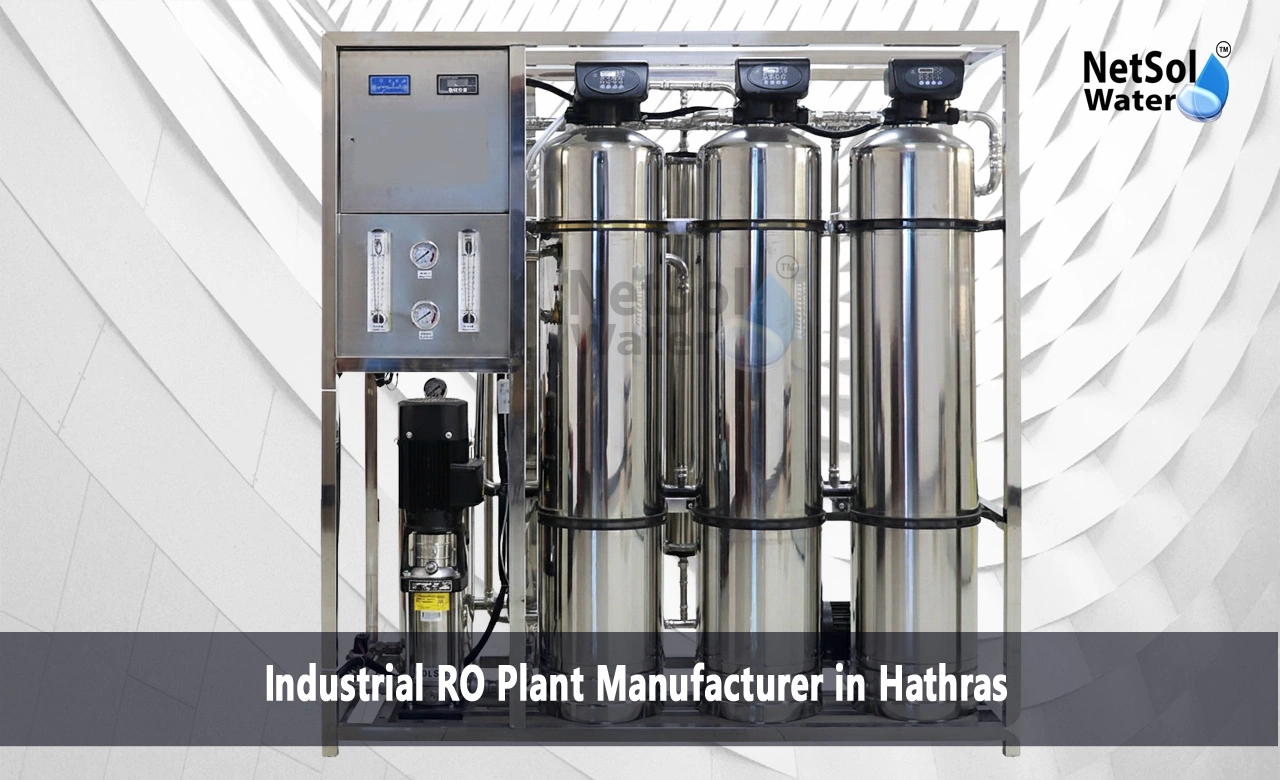
• Robust skid-mounted frames built from SS304/SS316 to handle harsh industrial environments
• High water recovery rates - typically 75–85% - reducing raw water demand significantly
• Remote monitoring capability for plants that need 24/7 operational oversight
The result? Consistent output, fewer shutdowns, lower operational costs, and a system that meets local CPCB discharge standards without you having to worry about compliance.
Industries We Serve in Hathras and Surrounding Regions
Different industries have very different water quality requirements. A pharmaceutical plant needs water that meets IP/BP standards. A boiler plant needs water with near-zero TDS and conductivity below 0.1 µS/cm. A food and beverage unit needs water that's safe, odour-free, and consistent in taste. We understand these distinctions deeply.
Industries We Routinely Serve:
|
Industry |
Key Water Requirement |
|
Pharmaceutical & Biotech |
USP Purified Water, low endotoxins, IP/BP compliance |
|
Food & Beverage |
Taste-neutral, bacteria-free, consistent TDS |
|
Textile & Dyeing |
Soft water, low silica, consistent pH |
|
Power & Boiler Plants |
Ultra-low TDS, zero hardness, low conductivity |
|
Chemical Manufacturing |
Process-specific purity, chemical resistance |
|
Steel & Metal Processing |
Scale-free water, corrosion prevention |
|
Hospitals & Healthcare |
Sterile water, bacteria-free supply |
|
Large Industrial Complexes |
High-volume supply with reliable uptime |
No matter which sector you're in, our engineering team will configure your system to meet the exact water quality specs your process demands - down to TDS targets, recovery rates, and compliance documentation.
The Technology Behind Our Industrial RO Plants
Reverse osmosis works by forcing pressurized water through semi-permeable membranes that block dissolved salts, heavy metals, bacteria, and other contaminants. What sounds simple in principle requires careful engineering in an industrial setting.
How Our Multi-Stage Treatment Process Works
1. Pre-Filtration: Multi-media and cartridge filters remove suspended solids, sand, and sediment from the raw feed water.
2. Water Softening: Ion exchange softeners remove calcium and magnesium to prevent scaling on RO membranes.
3. Antiscalant Dosing: Chemical dosing prevents mineral precipitation inside pressure vessels.
4. High-Pressure Pumping: Energy-efficient pumps build the pressure needed to push water through membranes (typically 8–16 bar for industrial RO).
5. RO Membrane Filtration: Multi-pass membrane arrays remove 95–99% of dissolved solids, producing permeate water.
6. Post-Treatment: Remineralization, UV sterilization, or polishing filters added based on end-use requirements.
7. Monitoring & Control: Automated panels track conductivity, TDS, pressure differential, and permeate flow continuously.
This layered approach doesn't just produce cleaner water - it protects your membranes from premature fouling and extends system life to 10–15 years with proper maintenance.
Industrial RO Plant Installation Process - Step by Step
One of the most common concerns we hear from plant managers is: 'How long will the installation take, and will it disrupt our operations?' Here's exactly how we handle it:
• Site Study & Water Analysis (Week 1–2): We collect water samples and visit your facility to assess flow, pressure, space, and power availability.
• Custom System Design (Week 2–3): Our engineers prepare detailed P&ID drawings, equipment layout, and BOM specific to your plant requirements.
• Factory Fabrication & Pre-Testing (Week 3–6): Skids are built, assembled, and pressure-tested in our facility before dispatch.
• Site Installation (Week 6–7): Our team handles mechanical, piping, electrical, and instrumentation connections at your site.
• Commissioning & Performance Testing (Week 7–8): We run the system under full load, verify flow rates, TDS output, and recovery ratios.
• Operator Training & Handover: Your team gets hands-on training, operational manuals, and a daily checklist for routine maintenance.
After handover, we offer annual maintenance contracts (AMC), emergency service support, and remote monitoring to keep your system running at peak performance.
What Does an Industrial RO Plant Cost in Hathras?
The cost of an industrial RO plant varies based on several factors. Providing a flat price here would be misleading - what matters is understanding the key cost drivers so you can plan accurately:
|
Cost Factor |
How It Affects Pricing |
|
Plant Capacity |
Higher flow rate (m³/hr) requires larger membranes, pumps, and pressure vessels - directly increases cost. |
|
Feed Water Quality |
Highly saline or contaminated water requires more intensive pre-treatment stages, adding to system cost. |
|
Recovery Rate Target |
Higher recovery (80–85%+) needs additional pressure control and brine management - more complex and costlier. |
|
Automation Level |
Basic manual plants are lower cost. SCADA/PLC-integrated systems with remote monitoring cost more but reduce labour. |
|
Material Grade |
SS316 components for corrosive environments cost more than standard SS304 but last significantly longer. |
|
Site Conditions |
Difficult sites (space constraints, high civil work, remote locations) increase installation costs. |
|
Post-Treatment Needs |
UV sterilization, DM polishing, or EDI systems for pharma/food grade add to total project cost. |
Our team will provide a detailed, transparent quote after a free initial site assessment. We also offer phased delivery options for large projects to spread capital expenditure.
Why Industrial Units in Hathras Choose Netsol Water?
Choosing a water treatment partner is a long-term decision. The wrong choice can mean years of system failures, water quality complaints, and unexpected repair bills. Here’s what makes Netsol Water a dependable choice as a trusted Industrial RO Plant Manufacturer in Uttar Pradesh:
• Certified Manufacturing: Our facility follows ISO-compliant quality processes from raw material inspection to final pressure testing.
• Industry-Specific Design: We don't use one-size-fits-all templates. Every system is engineered for your specific water chemistry and process targets.
• Dedicated Site Support: Our service engineers are available for commissioning, emergency breakdowns, and scheduled maintenance visits.
• Transparent Project Execution: Phased project plans keep you informed at every milestone - no surprises at delivery.
• After-Sales Reliability: We stock spare membranes, cartridges, and consumables so your AMC never faces delays due to part shortages.
• Compliance Documentation: We assist with all technical documentation required for CPCB/SPCB audits, ISO certification, and internal quality audits.
Ready to Get a Quote for Your Industrial RO Plant?
Contact our engineering team today for a free site assessment and detailed project estimate. We'll visit your facility, analyse your feed water, and give you a transparent breakdown of costs.
+91-9650608473 | enquiry@netsolwater.com
Frequently Asked Questions (FAQs)
Q1. What is an industrial RO plant and how does it work?
An industrial RO plant is a large-scale water purification system that uses high-pressure membranes to remove dissolved salts, heavy metals, bacteria, and other contaminants from feed water. Water is forced through semi-permeable membranes, producing purified permeate water and a concentrated reject stream, typically achieving 95–99% TDS removal.
Q2. What is the cost of an industrial RO plant in Hathras?
The cost of an industrial RO plant in Hathras depends on capacity, feed water quality, automation level, and site conditions. Small systems (500–1000 LPH) typically start lower, while large systems (10,000+ LPH) with full automation and advanced pre-treatment cost more. Contact Netsol Water for a free, transparent site-based quote.
Q3. Which industries use industrial RO plants?
Industrial RO plants are used across pharmaceuticals, food and beverage, textiles, power generation (boiler feed), chemical manufacturing, steel processing, hospitals, and large commercial complexes. Each industry requires different water quality levels - from near-zero TDS for boiler feed water to taste-safe water for food production.
Q4. How long does it take to install an industrial RO plant?
A standard industrial RO plant installation by Netsol Water typically takes 6–8 weeks from the initial site assessment to full commissioning. This includes water analysis, custom design, factory fabrication, site installation, and operator training. Complex projects with extensive civil or electrical work may take slightly longer.
Q5. What is the typical water recovery rate of an industrial RO system?
Most industrial RO plants achieve a water recovery rate of 70–85%, meaning 70–85 litres of purified water are produced from every 100 litres of feed water. Recovery rates above 85% are possible with advanced brine recycling systems and are recommended for water-scarce regions or high-cost raw water sources.
Q6. How often do industrial RO membranes need to be replaced?
With proper pre-treatment and regular CIP (clean-in-place) maintenance, industrial RO membranes typically last 3–5 years. Poor pre-treatment, high SDI feed water, or chlorine exposure can significantly shorten membrane life. Netsol Water's AMC programs include scheduled membrane checks and timely replacement to prevent unexpected failures.
Q7. Does Netsol Water provide after-sales service in Hathras?
Yes, Netsol Water offers comprehensive after-sales support in Hathras including Annual Maintenance Contracts (AMC), emergency breakdown service, scheduled preventive maintenance, spare parts supply, and remote monitoring. Our service engineers are based locally to ensure fast response times and minimal plant downtime.
Q8. Can an industrial RO plant be customized for pharmaceutical-grade water?
Absolutely. Netsol Water designs pharmaceutical-grade water systems that meet IP/BP/USP standards. These systems include multi-stage RO, electrodeionization (EDI), UV sterilization, and 316L stainless steel piping to prevent bacterial contamination. All pharmaceutical RO systems are validated and come with full qualification documentation (DQ/IQ/OQ).