

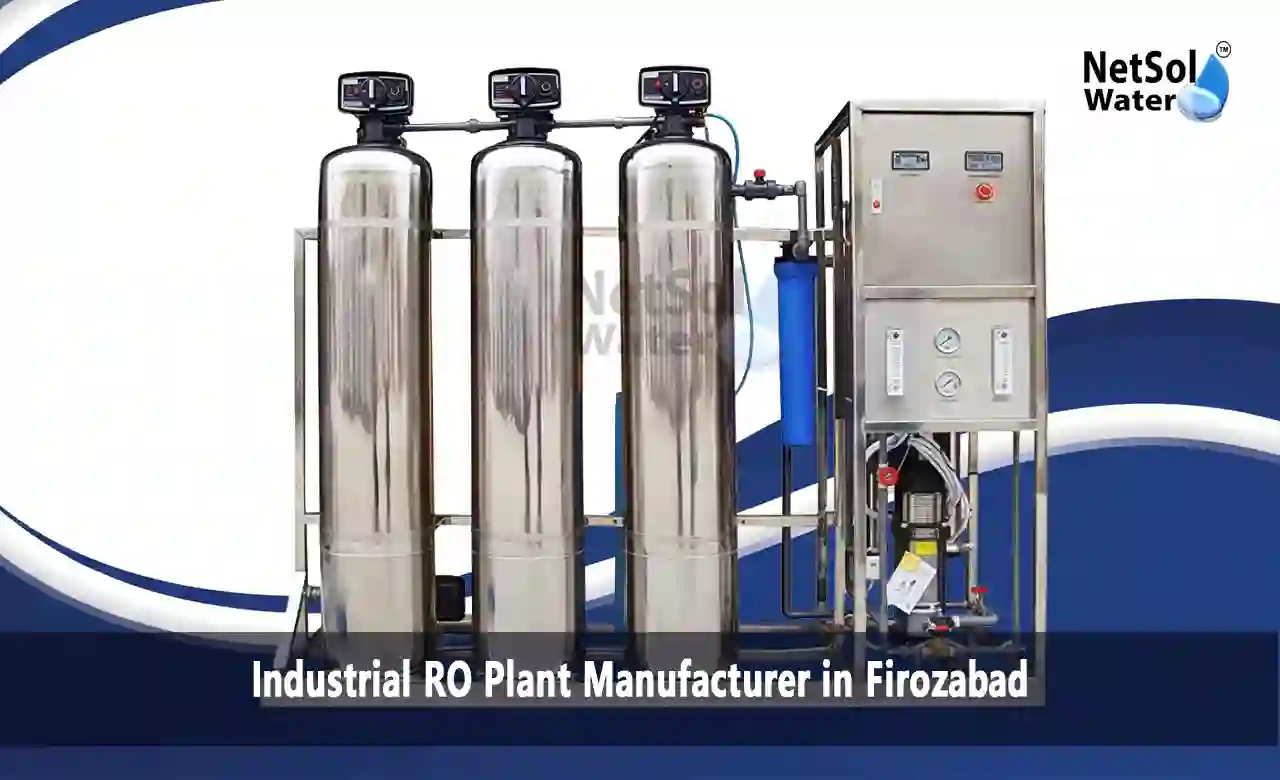
Industrial RO Plant Manufacturer in Firozabad
Firozabad's industrial heartbeat runs on water. Whether you're running a glass furnace cooling system, a pharmaceutical formulation unit or a food processing line, the quality of your process water makes the difference between smooth production and costly breakdowns.
Yet Firozabad's groundwater is notoriously hard with TDS levels frequently exceeding 800–1200 mg/L and high hardness values that accelerate scaling in boilers, heat exchangers and cooling towers. For industries in the city, an industrial RO plant is not an optional upgrade it is a fundamental requirement for operational efficiency.
Netsol Water is a trusted Industrial RO Plant Manufacturer in Firozabad. We have designed and commissioned RO systems for the city's glass, textile, chemical, pharmaceutical and food industries each system built around the actual water chemistry and production demands of the client.
The Water Challenge in Firozabad's Industries
Hard water with high TDS causes scaling inside boilers, reducing thermal efficiency and shortening equipment lifespan. In glass manufacturing, water quality directly affects cooling system performance and product cleanliness. For pharmaceutical units, even minor TDS variations can affect formulation quality. For food units, off-taste and microbial contamination from untreated water create product quality risks.
A properly designed industrial RO plant addresses all of these challenges. By removing 95–99% of dissolved solids, hardness, silica and other contaminants, RO systems protect your equipment, improve product quality and reduce chemical treatment costs across the plant.
Our Industrial RO Plant Solutions in Firozabad
Glass Industry RO Plants
Glass manufacturing uses large quantities of water for furnace cooling, forming equipment and surface washing. We design high-capacity RO plants for glass factories in Firozabad that deliver consistent low-TDS water for cooling circuits, reduce scaling in heat exchangers and minimise chemical consumption in water treatment programmes.
Pharmaceutical Grade RO Systems
Pharma units in Firozabad require Purified Water (PW) meeting USP/IP standards for API synthesis, equipment washing and clean-in-place systems. Netsol Water designs multi-pass RO systems with online conductivity monitoring and UV disinfection to ensure water meets pharmacopoeial specifications at all times.
Boiler Feed Water Treatment
Scaling in boilers is one of the biggest causes of energy loss and downtime in Firozabad's industrial units. Our RO systems deliver deionised, ultra-soft water for boiler feed eliminating scale formation, reducing blowdown losses and significantly extending boiler tube life. Systems are sized to match boiler capacity and operating cycles.
Food & Beverage Water Purification
Food and beverage units require water that meets BIS IS 10500 standards for safety, taste and hygiene. Netsol Water designs RO systems for food factories that remove TDS, hardness, biological contamination and odour ensuring product quality and FSSAI compliance.
Key Features of Our RO Plants in Firozabad
. High-efficiency spiral-wound RO membranes rated for 3–5 year service life under normal conditions
. Energy recovery devices and VSD pumps reducing electricity consumption by up to 30%
. Automatic CIP (Clean-In-Place) system for safe, fast membrane cleaning without manual disassembly
. Online TDS, conductivity and flow monitoring with data logging and alarm management
. Pre-treatment systems matched to Firozabad's hard borewell water profile
. Modular skid design for fast installation and future capacity expansion
Why Choose Netsol Water in Firozabad?
1. Local Water Profile Knowledge: We have characterised Firozabad's groundwater extensively. Our pre-treatment systems are designed specifically for the city's high-hardness, high-TDS borewell water preventing membrane fouling that generic systems miss.
2. Glass Industry Expertise: We understand the specific water demand cycles, flow requirements and purity standards of Firozabad's glass manufacturing sector the backbone of the city's economy.
3. Fast Commissioning: Pre-assembled, factory-tested skid systems reduce on-site installation time. Most plants are commissioned within 2–4 weeks of site readiness.
4. Proven ROI: Our plants pay for themselves through reduced chemical treatment costs, extended equipment life, lower energy consumption and reduced water wastage typically achieving ROI within 18–36 months.
Also Read: Industrial RO Plant Manufacturer in Uttar Pradesh
Industrial RO Plant Installation Process in Firozabad
1: Feed water sampling and lab analysis (TDS, hardness, silica, organics, biological count)
2: Site survey and utility assessment (power, drain, space, access)
3: System design pre-treatment train + RO configuration + post-treatment polishing
4: Proposal review and project approval
5: Fabrication, assembly and Factory Acceptance Testing (FAT)
6: Site installation skid placement, piping, electrical connections
7: Commissioning pressure testing, performance verification, water quality confirmation
8: Operator training, handover documentation and AMC activation
Cost of Industrial RO Plant in Firozabad
RO plant costs in Firozabad are influenced by daily water production capacity, feed water TDS and hardness, recovery rate target, automation requirements and site conditions. Given Firozabad's hard groundwater, pre-treatment (softener, antiscalant dosing) represents a significant and unavoidable component of the system cost. Netsol Water provides transparent cost breakdowns and helps you compare the capital cost of RO against the ongoing savings in chemical treatment, boiler maintenance and water purchasing.
Frequently Asked Questions
Q1: What TDS level is common in Firozabad's borewell water?
A: Firozabad's borewell water typically has TDS levels between 800–1500 mg/L with high hardness (300–600 mg/L as CaCO3). These levels cause significant scaling in boilers and cooling systems. Netsol Water designs RO plants specifically matched to Firozabad's water profile, including appropriate pre-treatment to protect membranes.
Q2: Can an RO plant improve glass manufacturing quality in Firozabad?
A: Yes. Dissolved minerals in hard water leave deposits on glass surfaces, impair cooling system efficiency and increase chemical treatment costs. Netsol Water's RO plants deliver consistent low-TDS water for cooling, washing and forming operations improving product cleanliness and reducing production downtime.
Q3: How is an industrial RO plant different from a domestic RO system?
A: Industrial RO plants are engineered for continuous high-volume operation at flows from 500 LPH to several lakh litres per day. They include robust pre-treatment systems, high-pressure pumps, automation and performance monitoring that domestic systems lack. Netsol Water designs industrial RO plants for the demanding 24/7 operating conditions of Firozabad's factories.
Q4: What is the water recovery rate of an industrial RO plant?
A: Netsol Water's industrial RO plants in Firozabad typically achieve 70–85% water recovery meaning 70–85% of feed water becomes usable product water. Recovery rate is balanced against feed water quality and membrane health. Higher recovery reduces freshwater consumption and operating costs.
Q5: Do I need a water softener before the RO plant?
A: For Firozabad's hard borewell water, a water softener or antiscalant dosing system is often recommended before the RO stage to prevent calcium and magnesium scaling on the membranes. Netsol Water assesses your specific feed water and designs the pre-treatment train accordingly.
Q6: How long do RO membranes last and when do they need replacing?
A: Under good pre-treatment and regular maintenance, RO membranes typically last 3–5 years. Netsol Water's AMC service includes periodic membrane performance monitoring to track flux decline and salt rejection alerting you to membrane degradation before it affects product water quality.
Q7: What is the energy consumption of an industrial RO plant?
A: Energy consumption depends on feed water TDS, operating pressure and plant capacity. Netsol Water uses high-efficiency pumps, variable speed drives and energy recovery devices where applicable to minimise power draw. A properly optimised plant in Firozabad typically consumes 3–6 kWh per cubic metre of product water.