
Industrial RO Plant Manufacturer in Etah
Water is at the centre of almost every industrial operation in Etah. You need it for washing, cooling, mixing, processing, cleaning, and in many cases, as a direct product input. But here is the reality that most factory operators in Etah are dealing with: the groundwater available from borewells across this region is not clean enough for direct industrial use. Not even close.
Field water testing across different parts of Etah consistently shows TDS between 1,000 and 3,000 mg/L, total hardness exceeding 400 to 800 mg/L, iron above the standard industrial threshold of 1 mg/L, and in certain zones, fluoride and nitrate contamination from decades of heavy agricultural activity. For a household, this means buying bottled water. For an industry, it means equipment damage, product quality problems, compliance failures, and maintenance costs that escalate every year the problem goes untreated.
The solution that industries across Etah are implementing is installing a properly designed RO system from a qualified Industrial RO Plant Manufacturer in Etah who understands both the local water conditions and the specific demands of your operations. This guide covers everything you need to know to make that decision well.
The Real Water Quality Challenge in Etah
Understanding what is in your water is the starting point for every RO plant design decision. Etah sits in a region of Uttar Pradesh where groundwater has been under heavy agricultural and industrial stress for decades. Excessive irrigation, fertiliser runoff, and the natural geological composition of the area have combined to create water quality challenges that affect almost every borewell source in the district.
What this water does to industrial equipment and processes is well-documented. Hardness causes scale deposits in boiler tubes that reduce heat transfer efficiency by 10 to 15 percent per millimetre of scale thickness - increasing fuel consumption and accelerating tube wear. High TDS creates conductivity problems in electrical equipment, contamination risks in food and pharmaceutical processing, and performance degradation in cooling systems. Iron deposits stain surfaces in food processing, dairy, and textile applications. Nitrate contamination creates regulatory compliance risk for food and beverage producers.
An industrial RO plant addresses all of these problems simultaneously by removing 90 to 98 percent of dissolved contaminants from your feed water - delivering clean, stable, consistent treated water regardless of seasonal variations in your source water quality.
How Industrial Reverse Osmosis Technology Works?
Reverse osmosis is a pressure-driven membrane separation process. Water is forced through a semi-permeable membrane under high pressure. The membrane allows water molecules to pass through while rejecting the vast majority of dissolved salts, heavy metals, bacteria, viruses, and other contaminants. The clean permeate water is collected for use. The concentrated reject stream - carrying the rejected contaminants - is either discharged or partially recycled to improve overall water recovery.
What makes RO particularly effective for industrial applications in Etah is its ability to handle variable input water quality and still deliver consistent output. Even if your borewell TDS fluctuates between 1,200 and 2,500 mg/L across seasons, a properly designed industrial RO system with the right pre-treatment delivers output water within your target TDS range consistently, all year round.
Industries That Benefit From Industrial RO Plants in Etah
1. Agro-Processing and Rice Mills
Etah has a significant agro-processing sector including rice mills, flour mills, and oil extraction units. These industries use water extensively in washing, boiler operations, and cooling. High TDS and hardness in the feed water leads to scaling and corrosion that reduces equipment life and increases maintenance downtime. RO-treated water eliminates these problems and protects capital equipment.
2. Dairy Processing and Milk Chilling Centres
Dairy is one of the most important industries in the Etah region. Milk chilling centres, butter and ghee manufacturing units, and dairy cooperatives need water that meets strict hygiene and food safety standards. Any contamination in water used for cleaning equipment, processing milk, or manufacturing dairy products creates safety and compliance risks. An industrial RO plant removes bacteria, dissolved solids, and chemical contaminants to deliver water that consistently meets dairy production standards.
3. Packaged Drinking Water Plants
Packaged drinking water businesses depend entirely on their water treatment system for product quality, regulatory compliance, and commercial viability. Any weakness in the RO system shows up directly in product TDS, taste, bacterial counts, and BIS compliance test results. Working with a reliable Industrial RO Plant Manufacturer in Etah is not just a business preference for these operations - it is a licensing requirement and a commercial survival matter.
4. Ice Manufacturing Plants
Ice plants are more water quality-sensitive than most people realise. The quality of input water directly determines the clarity, taste, and commercial acceptability of the ice produced. Hard water produces cloudy ice with an off-taste that commercial customers and food service operations reject. RO-treated water produces clear, clean ice that meets commercial and food safety standards. Ice plant operators in Etah who have switched to RO-treated feed water consistently report better product quality and lower customer complaint rates.
5. Educational Institutions and Hostels
Large educational campuses and residential hostels with their own water supply infrastructure often need industrial-scale water treatment. The volumes involved - hundreds or thousands of users - make them natural clients for properly scaled industrial RO systems rather than commercial or household-grade equipment. Netsol Water designs campus water treatment solutions that handle the actual demand profile of large institutional users.
6. Cold Storage and Refrigeration Facilities
Cold storage facilities use water in cooling systems and for equipment maintenance. Hard water in cooling tower makeup water accelerates corrosion and scale build-up in heat exchangers, reducing cooling efficiency and increasing energy costs. RO-treated water significantly extends the service life of cooling infrastructure and reduces maintenance requirements.
7. Brick and Tile Manufacturing
Even in heavy construction material manufacturing, water quality matters. Using high-hardness water in production affects the consistency and quality of the final product. RO-treated water gives manufacturers better control over their production process and a more consistent end product.
Complete Process: How an Industrial RO Plant in Etah Is Designed and Built
1 - Source Water Analysis
The design process begins with certified laboratory analysis of your actual source water. Testing covers TDS, total hardness, calcium and magnesium levels, iron, pH, bacterial count, fluoride, nitrate, and any other parameters relevant to your specific industry application. This data is the foundation for every subsequent design decision.
2 - Pre-Treatment System Design
Pre-treatment is designed specifically to address what your water analysis reveals. Standard components include a pressure sand filter (removes turbidity and suspended particles), activated carbon filter (removes chlorine, organic compounds, and odour), and in high-hardness areas of Etah, a water softener (reduces calcium and magnesium to protect RO membranes). For water with high iron content, an iron removal filter is added before the softener.
3 - Chemical Dosing System
Antiscalant chemicals are dosed into pre-treated water before it enters the RO membrane array. Correct antiscalant selection, based on specific water chemistry, prevents mineral scale formation on membrane surfaces during operation - significantly extending membrane life and maintaining performance.
4 - Micron Cartridge Filtration
A 5-micron cartridge filter provides final particle protection for the RO membranes. This is the last line of defence before the membrane array and prevents fine particles that passed through earlier filtration stages from fouling the membranes prematurely.
5 - High-Pressure Membrane Array
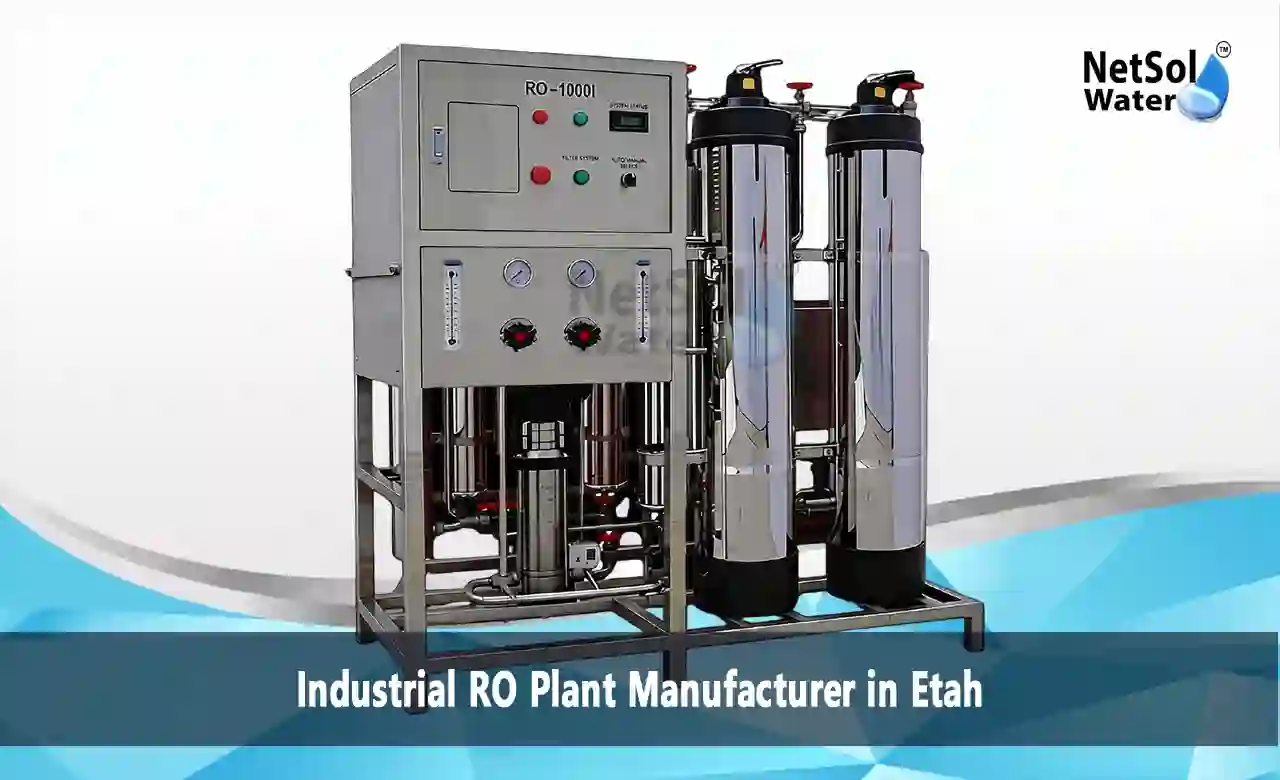
A high-pressure pump delivers pre-treated water to the RO membrane modules at the correct operating pressure. The membrane array (multiple elements arranged in series and parallel configurations) removes 90 to 98 percent of dissolved contaminants. Permeate - the clean treated water - moves to post-treatment and storage. Concentrate is discharged or partially recycled.
6 - Post-Treatment
Post-treatment depends on your application. For food and beverage processing or packaged drinking water, UV disinfection provides final biological safety assurance. For applications requiring specific mineral content, a remineraliser adds back essential minerals to improve taste and nutritional value. For pharmaceutical and laboratory applications, further polishing through deionisation may be added.
7 - Storage and Distribution
Treated water is stored in appropriately sized food-grade or industrial-grade storage tanks and distributed to production points through a dedicated clean water pipeline network. Storage capacity is sized to provide operational continuity for at least 6 to 8 hours of peak demand.
Capacity Planning - Getting the Size Right
Sizing your industrial RO plant correctly from the start is one of the most important project decisions. Undersizing creates supply shortfalls during peak demand. Oversizing wastes capital investment on unnecessary capacity.
Practical Sizing Framework
1. Map every water use point in your facility - all production processes, cleaning stations, boilers, cooling systems, and any other points where treated water is consumed.
2. Estimate daily consumption at each point in litres per day. Sum all points for total daily treated water requirement.
3. Add 20 to 25 percent buffer for peak demand periods, seasonal variation, and near-term production growth.
4. Divide daily requirement by operating hours to get required LPH capacity.
5. Account for RO reject water - at 75 percent system recovery, every 100 litres of permeate requires approximately 133 litres of feed water input.
6. Size treated water storage tanks to provide 6 to 8 hours of peak consumption continuity.
Why Netsol Water Is the Right Industrial RO Plant Manufacturer in Etah
Netsol Water is an ISO-certified RO plant manufacturer with installations across Uttar Pradesh including Agra, Amroha, Ambedkar Nagar, and many other cities and towns in the region. This UP-wide operational experience is directly relevant for Etah-based industries because it means the company understands the specific water quality characteristics of western UP groundwater - the high TDS, hardness, and iron content that your facility is almost certainly dealing with.
1. Genuine Water Quality Assessment: Every project starts with a complete water analysis - not a TDS reading and a price. Understanding your full water profile is the only basis for designing a system that actually performs.
2. Quality-Verified Components: Membranes, pumps, control panels, and piping are sourced from established manufacturers with documented performance histories. The quality of components determines how long your system performs reliably.
3. End-to-End Accountability: Site survey, water testing, system design, manufacturing, installation, commissioning, operator training, and AMC service - all with a single point of responsibility. No finger-pointing when multiple vendors are involved.
4. Service Network Across UP: Netsol Water has service coverage across Uttar Pradesh and can reach Etah when your system needs attention. For industrial operations running continuous production, responsive after-sales support is not a nice-to-have - it is critical.
5. AMC Plans Built for Industrial Clients: Scheduled preventive maintenance visits, membrane cleaning cycles, filter replacements, performance monitoring, and priority emergency response. Planned maintenance under AMC consistently costs less than reactive repairs.
Cost of Industrial RO Plant in Etah
The main factors that determine industrial RO plant cost in Etah are:
1. Capacity: Higher capacity means more membranes, larger pumps, bigger storage tanks, and more piping. Cost does not scale linearly - per-litre cost decreases as capacity increases.
2. Source Water TDS and Quality: Higher TDS requires more membranes and higher-pressure operation. Specific contaminants like iron or fluoride require additional pre-treatment stages.
3. Pre-Treatment Configuration: A basic system with sand and carbon filtration costs less than one requiring a softener, iron removal, and multiple dosing systems.
4. Automation Level: Basic manual systems cost less upfront but require more operator attention. Fully automated PLC-based systems with remote monitoring cost more but deliver better operational consistency.
5. Membrane Brand: Premium membranes cost more initially but deliver longer life and better rejection. Over a 5-year period, quality membranes are almost always more economical.
6. Installation and Civil Scope: Civil work, piping, electrical connections, and operator training all contribute to total project cost.
Contact Netsol Water for a site visit, water quality assessment, and transparent project proposal with full cost breakdown. For any industry in Etah looking for a reliable Industrial RO Plant Manufacturer, this is where the conversation should start.
FAQs
Q1. What TDS levels does an industrial RO plant achieve for Etah borewell water?
Industrial RO plants in Etah typically reduce source water TDS of 1,000 to 3,000 mg/L down to 15 to 150 mg/L in the treated permeate - a 90 to 98 percent reduction. Output TDS depends on membrane type, operating pressure, and system recovery. This level meets the requirements of most industrial process applications including food processing, dairy, and packaged drinking water.
Q2. How does hard borewell water in Etah affect industrial equipment?
Hard water containing high calcium and magnesium levels forms scale deposits inside boilers, heat exchangers, pipes, and cooling systems. Scale buildup reduces heat transfer efficiency, increases energy consumption, and accelerates equipment wear. A 1mm scale layer reduces boiler efficiency by 10 to 15 percent. Industrial RO with water softening removes hardness completely, eliminating scale-related maintenance costs.
Q3. What capacity industrial RO plant does a dairy unit in Etah need?
A dairy unit processing 10,000 to 50,000 litres of milk per day typically requires 5,000 to 30,000 LPH of treated water for equipment cleaning, processing, and utility use. Exact capacity depends on the specific processes involved, cleaning frequency, and whether water reuse is planned. Netsol Water calculates requirements from a detailed water demand assessment rather than rule-of-thumb estimates.
Q4. How long do industrial RO membranes last in Etah's water conditions?
With proper pre-treatment, antiscalant dosing, and regular cleaning, industrial RO membranes in Etah's high-TDS, high-hardness water conditions typically last 3 to 5 years. Systems with comprehensive AMC programmes and correct pre-treatment consistently achieve the longer end of this range. Membranes exposed to inadequate pre-treatment or missing antiscalant dosing fail significantly sooner.
Q5. What is the reject water ratio and how can it be managed?
Industrial RO systems typically operate at 70 to 80 percent recovery - producing 70 to 80 litres of treated permeate per 100 litres of feed water. Reject water (concentrate) can be reused for gardening, dust suppression, vehicle washing, or non-critical cleaning. In water-stressed areas, high-recovery systems using energy recovery devices can push recovery rates above 85 percent, minimising overall water wastage.
Q6. How do I choose between different RO plant manufacturers in Etah?
The key differentiators are: whether the manufacturer tests your actual water before designing the system, their experience with industries similar to yours, the quality of components specified in their proposal, their post-installation service capabilities in the Etah region, and whether they provide transparent cost breakdowns. A manufacturer who asks detailed questions about your effluent and operations before quoting is demonstrably more reliable than one who provides a price within minutes of being contacted.
Q7. Does Netsol Water provide AMC services for RO plants in Etah?
Yes. Netsol Water provides Annual Maintenance Contract services for industrial RO plants in Etah covering scheduled preventive maintenance visits, membrane cleaning, filter replacement, performance testing, antiscalant dosing calibration, and priority emergency support. AMC clients receive priority scheduling, advance parts availability, and documented performance records for compliance purposes.