
Industrial RO Plant Manufacturer in Chitrakoot
NetSol Water manufactures industrial-grade Reverse Osmosis plants for industries in Chitrakoot and across MP and UP. Capacity range: 250 LPH to 5 lakh litres per day. Designed around your actual bore well water analysis. Free water testing available for industries in Chitrakoot. Call us to arrange it.
Is Poor Water Quality Costing Your Chitrakoot Industry Money Every Month?
A boiler that keeps scaling up. A food batch that fails quality checks. Textile dye that comes out uneven run after run. In most cases, tracing these problems back to their source reveals the same thing: water quality.
Chitrakoot's groundwater is genuinely unpredictable. Bore well TDS levels commonly run between 600 and 1800 mg/L - well above the 500 mg/L drinking water standard. Hard water destroys equipment. Iron contaminates products. Fluoride creates compliance headaches for food and pharmaceutical operations.
An industrial RO plant eliminates this variable entirely. Whatever the bore well delivers on any given day, your process receives consistent, clean, fit-for-purpose water. That is what the right industrial RO plant manufacturer in Chitrakoot makes possible.
What Is an Industrial RO Plant?
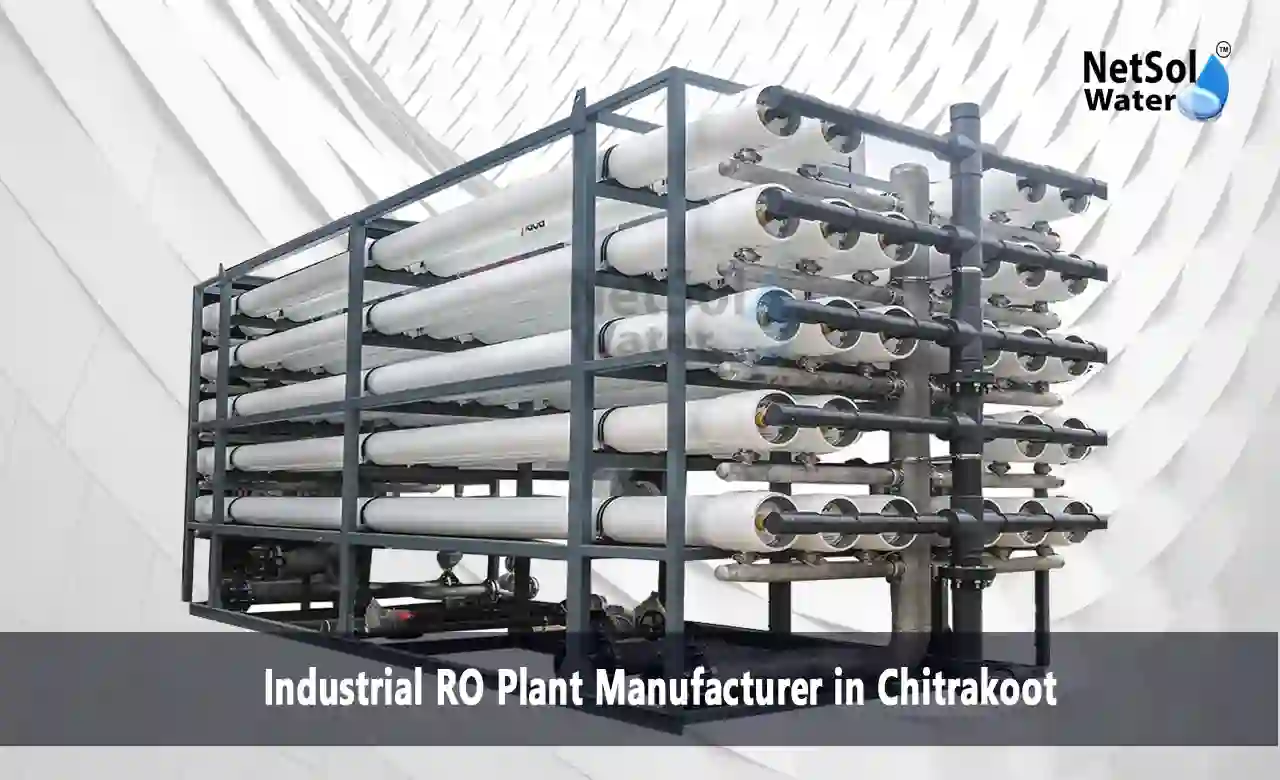
An Industrial Reverse Osmosis Plant is a high-capacity water purification system that uses semi-permeable membranes and high-pressure pumps to remove dissolved salts, heavy metals, bacteria, viruses, and other contaminants from water. It is used as a process water source for manufacturing, as boiler feed water, for cooling towers, and anywhere clean, low-TDS water is operationally critical.
Industrial RO vs. Domestic RO - They Are Not the Same
|
Feature |
Industrial RO vs Domestic RO |
|
Capacity |
500 LPH to 5 lakh LPD vs 15–25 LPH |
|
Feed Water |
Bore well, river, municipal - variable quality vs Clean municipal supply assumed |
|
Operating Pressure |
10–15 bar (high-pressure pump required) vs Low pressure |
|
Pre-Treatment |
Custom-designed for source water analysis vs Basic sediment + carbon filter |
|
Controls |
PLC automation, flow meters, conductivity monitors vs Manual, basic |
|
Maintenance |
Trained technician + AMC vs Annual filter change |
|
Application |
Manufacturing, boiler feed, process water vs Drinking water for a family |
Chitrakoot Groundwater - What the Data Actually Shows
Understanding local water conditions is foundational to designing the right industrial RO system. Here is what routine water testing from this region consistently reveals:
. TDS: 600–1800 mg/L in bore well water (acceptable limit: 500 mg/L). High TDS affects taste, product quality, and causes scale in all equipment.
. Total Hardness: 300–600 mg/L in many areas. Hard water scales boilers, heat exchangers, cooling towers, and kitchen equipment.
. Iron: Above 0.3 mg/L (permissible limit) in multiple bore well samples. Iron clogs membranes and stains products.
. Fluoride: Above 1.5 mg/L documented across parts of MP. A compliance and health issue for food, beverage, and pharmaceutical operations.
. Biological: Coliform contamination common in untreated bore well water, especially post-monsoon.
Industries running on untreated or poorly treated water typically spend 20–35% more on maintenance, cleaning chemicals, and energy compared to those using properly treated process water.
- Based on operational cost analysis across water treatment projects in MP and UP.
How an Industrial RO Plant Works
Stage 1: Raw Water Storage
Water from your source enters a raw water storage tank. Buffer storage allows continuous RO operation even when supply is intermittent - a practical design consideration in Chitrakoot.
Stage 2: Multimedia Filtration
Layers of gravel, sand, and anthracite remove suspended solids and turbidity before water reaches the membranes. This is the first line of membrane protection and one of the most important components for long membrane life.
Stage 3: Activated Carbon Filtration
Carbon media removes chlorine, chloramines, and organic compounds. Chlorine chemically damages polyamide RO membranes irreversibly if it reaches them. This stage is non-negotiable in any competently designed RO system.
Stage 4: Softening or Iron Removal (if required)
Where feed water analysis shows very high hardness or significant iron levels, a softener or iron removal filter is added to the pre-treatment train. This specifically protects membranes from scaling and fouling that the other stages do not address.
Stage 5: Antiscalant Dosing
A small dosing pump injects antiscalant chemical just before the high-pressure pump. This prevents mineral salts from precipitating on the membrane surface during the concentration process inside the RO system. It is inexpensive but has an outsized effect on how long the membranes last.
Stage 6: High-Pressure Pump
The pump drives water through the RO membranes at 10–15 bar for typical brackish groundwater. Pump quality and sizing directly determines energy efficiency and system reliability. A cheap or incorrectly sized pump is the most expensive false economy in the whole design.
Stage 7: RO Membrane Array
Pressurized water passes through the membrane elements. Water molecules cross the semi-permeable membrane; dissolved salts, heavy metals, bacteria, and other contaminants are rejected and removed in the concentrate stream. Product water recovery typically runs 60–80% depending on feed quality and design.
Stage 8: Post-Treatment & Storage
Treated water collects in a product tank and distributes to points of use. Post-treatment additions - UV disinfection, remineralization, deionization - are selected based on the application.
Stage 9: Reject Water Management
The concentrate stream must comply with discharge standards. Recovery optimization, reject reuse strategies, and regulatory compliance for the reject stream should be designed in from the start, not resolved after installation.
Industrial RO Capacity Guide for Chitrakoot Industries
|
Application Type |
Recommended Capacity Range |
|
Small textile or food processing unit |
250 LPH – 2,000 LPH |
|
Mid-size pharmaceutical or chemical plant |
2,000 – 10,000 LPH |
|
Large industrial complex or bottling plant |
10,000 LPH – 5 lakh LPD |
|
Hotel or hospitality (process + laundry) |
1,000 – 5,000 LPH |
|
Boiler feed for medium industrial boiler |
500 – 2,000 LPH |
Specifications That Actually Matter When Comparing Proposals
. Recovery rate (aim for 70–80% on typical brackish groundwater)
. Specific energy consumption in kWh per kilolitre of product water
. Membrane brand and model specified by name (Dow Filmtec, Hydranautics, Toray)
. Pre-treatment design explained with reasoning based on your water analysis
. Control system type - PLC-based automation is worth specifying
. Structural materials with specifications (SS, mild steel with epoxy, FRP)
. Warranty terms for membranes, pressure vessels, and mechanical components
Why NetSol Water for Industrial RO in Chitrakoot?
We are NetSol Water - an ISO-certified Industrial RO Plant Manufacturer and Supplier in U.P., specializing in industrial RO plants, commercial RO systems, ETPs, and STPs across India. When an industry in Chitrakoot contacts us, our first conversation is about your water and your application.
We conduct a water analysis before putting any design on paper. We have installed industrial RO plants across UP and MP for food processors, pharmaceutical manufacturers, textile operations, and boiler feed applications. We use quality membranes from established brands. Our pre-treatment systems are engineered around actual water data.
Our AMC teams know the systems they maintain and respond when something needs attention. We design for Chitrakoot's realities - irregular power supply, limited local technical support - not for ideal conditions that do not exist here.
Stop paying the hidden cost of bad process water.
Contact NetSol Water with your water source details and capacity requirement. We will design a solution that fits your operation and your budget - backed by a water analysis, a site visit, and a proper AMC.
FAQs
Q: What is an Industrial RO Plant and how does it work?
A: An Industrial RO Plant uses high-pressure pumps to force water through semi-permeable membranes, removing dissolved salts, heavy metals, bacteria, and other contaminants. It delivers consistently clean, low-TDS water for manufacturing processes, boiler feed, cooling towers, and other industrial applications where water quality directly affects output quality and equipment life.
Q: What is the cost of an industrial RO plant in India?
A: Industrial RO plant costs in India typically range from Rs 3–8 lakhs for a 500–1000 LPH system to Rs 15–50 lakhs for larger high-capacity plants. The final cost depends on feed water quality, required output quality, pre-treatment complexity, membrane brand, control system type, and installation conditions.
Q: What TDS level does an industrial RO plant achieve?
A: A well-designed industrial RO plant typically reduces TDS by 90–98%. Feed water with TDS of 1000–1500 mg/L is routinely treated to below 50 mg/L for sensitive applications. The exact output TDS depends on membrane type, operating pressure, feed water composition, and recovery rate.
Q: How long do industrial RO membranes last?
A: With proper pre-treatment and regular maintenance, industrial RO membranes typically last 3–5 years. The single biggest factor in membrane life is the pre-treatment system. Skipping antiscalant dosing, allowing chlorine to reach the membranes, or neglecting the multimedia filter can cut membrane life to 12–18 months.
Q: What is the difference between a domestic and an industrial RO plant?
A: A domestic RO purifier handles 15–25 litres per hour of pre-treated municipal water. An industrial RO plant handles 500 LPH to several lakh LPD of variable-quality source water. Industrial systems require high-pressure pumps, multi-element membrane arrays, custom pre-treatment, PLC automation, and trained maintenance - none of which apply to domestic units.
Q: Why is pre-treatment so important in an industrial RO system?
A: Pre-treatment protects the RO membranes from fouling, scaling, and chemical damage - the three leading causes of membrane failure. A properly designed pre-treatment system that removes suspended solids, chlorine, and scaling minerals can double or triple membrane life, significantly reducing the total cost of system operation.
Q: Can an industrial RO plant handle bore well water in Chitrakoot?
A: Yes. Industrial RO plants are specifically designed for variable-quality source water, including bore well water with high TDS, hardness, iron, or fluoride - all common issues in the Chitrakoot region of Madhya Pradesh. The pre-treatment system is customized to your specific bore well water analysis before the membranes are sized.