
Industrial RO Plant Manufacturer in Bijnor
Poor water quality is quietly costing Bijnor's factories thousands of rupees every month - through scale build-up in boilers, rejected batches in food units, and damaged machinery in textile mills.
An industrial RO plant doesn't just treat water. It protects your equipment, stabilizes your production quality, and pays for itself faster than most factory managers expect.
If you're looking for a trusted Industrial RO Plant Manufacturer in Bijnor, this guide covers everything: plant types, capacity options, real pricing, and how to choose a partner who'll still be there three years after installation.
What Is an Industrial RO Plant?
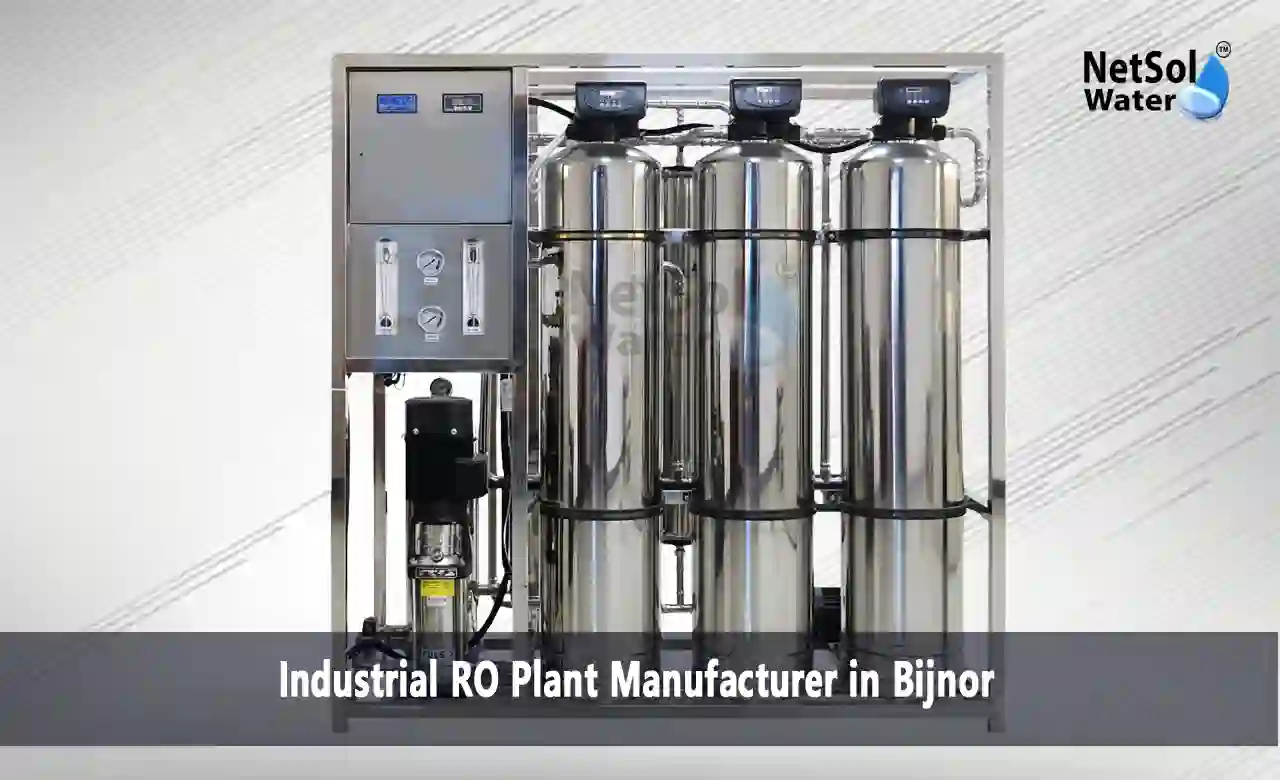
An industrial reverse osmosis plant is a water purification system that forces raw water through semi-permeable membranes under high pressure - removing dissolved salts, heavy metals, bacteria, and other impurities down to the parts-per-million (PPM) level.
Bijnor sits in western Uttar Pradesh where groundwater TDS levels often exceed 800–1200 mg/L - well above safe limits for boilers (under 50 ppm), pharmaceutical processes (below 10 ppm), and even most textile operations.
Without a properly sized RO system, you're either damaging equipment slowly or paying for bulk water delivery - both of which cost far more over time.
About Netsol Water
Netsol Water is a specialized industrial water treatment company and a leading Industrial RO Plant Manufacturer and Supplier in Uttar Pradesh, designing and installing RO plants for factories, mills, pharmaceutical units, and power plants across Bijnor and greater Uttar Pradesh.
The company's approach is practical: every project starts with a site visit and a water analysis report, not a catalog. This means the system you get is engineered for your actual feed water conditions - not a generic off-the-shelf unit.
What Sets Netsol Water Apart
• Pre-purchase water quality testing and site survey - at no extra cost
• Designs systems from 500 LPH to 1,00,000 LPH for any scale
• Trains your on-site operators for daily monitoring and early fault detection
• Maintains a ready inventory of membranes and spare parts in the region
• Offers clear warranty terms plus structured Annual Maintenance Contracts (AMC)
• Provides remote troubleshooting support to reduce unplanned downtime
Types of Industrial RO Plants Offered in Bijnor
The right plant type depends on your available space, daily demand, and whether your business is likely to grow. Here's a straightforward breakdown:
| Plant Type | Best For | Key Advantage |
|---|---|---|
| Skid-Mounted Compact RO | Small factories, workshops, pilot units | Pre-assembled, fast commissioning, minimal space |
| Modular / Containerised RO | Expanding businesses, multi-site operations | Add capacity without replacing the full system |
| Large Central RO Trains | Big factories, continuous-flow production | Redundant trains, automated load sharing |
| Custom High-Purity RO | Pharma, chemical, electronic manufacturing | Polished output for stringent quality specs |
1. Skid-Mounted Plants (Compact & Ready-to-Run)
These units come fully assembled on a steel skid frame. They're designed to be dropped into a shed, connected to a feed water line and drain, and commissioned within a day. Ideal for businesses that need water treatment fast without complex civil work.
2. Modular & Containerised Plants
Modular plants are designed to grow with your business. You start with a base configuration and bolt on additional membrane trains as demand increases - without changing pumps, tanks, or controls. Containerized versions are useful if your operation moves or expands to another site.
3. Large Multi-Train Industrial RO Systems
For high-volume operations like sugar mills, power plants, or large pharmaceutical facilities, multi-train systems run in parallel. If one train goes offline for membrane servicing, the others continue - ensuring zero interruption to your production schedule.
How an Industrial RO Plant Works - Step by Step
Understanding the process helps you operate and maintain the plant more effectively. Here's what happens from raw water intake to treated output:
1. Pretreatment Stage
Raw water first passes through multimedia filters that remove suspended solids, turbidity, and sediment. Anti-scalant chemicals are dosed to prevent calcium and magnesium from crystallizing on the membranes. This step protects the RO membranes and extends their operational life significantly.
2. Reverse Osmosis Stage
High-pressure pumps push the pretreated water through spiral-wound RO membranes. The membranes reject dissolved salts, TDS, heavy metals, and microorganisms - allowing only clean permeate to pass through. The concentrated brine exits separately for disposal or zero-liquid discharge (ZLD) treatment.
3. Post-Treatment & Storage
The treated water may go through pH correction, mineral re-dosing (for drinking or process use), and UV sterilization before storage. For boiler feed water, dissolved oxygen may also be removed to prevent corrosion.
Industrial RO Plant Capacity Range
Choosing the right capacity is critical. Running a plant at its maximum rated capacity continuously shortens membrane life and increases downtime risk. Netsol Water recommends sizing with a 20–30% operational buffer.
| Capacity Range | Suitable For | Estimated Daily Output |
|---|---|---|
| 250 – 2,000 LPH | Small workshops, labs, pilot projects | 6,000 – 48,000 litres/day |
| 2,000 – 5,000 LPH | Mid-size factories, food processing units | 48,000 – 1,20,000 litres/day |
| 5,000 – 10,000 LPH | Textile mills, large production facilities | 1,20,000 – 2,40,000 litres/day |
| 10,000 – 50,000 LPH | Industrial complexes, chemical plants | Up to 12,00,000 litres/day |
| 50,000 – 1,00,000 LPH | Power plants, large-scale manufacturing | Up to 24,00,000 litres/day |
Applications of Industrial RO Plants in Bijnor
RO plants serve almost every industrial sector in Bijnor that uses water in its process or utilities. Here are the main use cases:
1. Food & Beverage Manufacturing
Taste consistency and product safety both depend on water quality. RO-treated water removes chlorine, heavy metals, and organic compounds that alter flavor or shorten shelf life. Beverage manufacturers and food processors see measurable improvements in product quality and batch consistency.
2. Textile & Dyeing Units
Hard water causes uneven dye uptake, fabric streaking, and equipment fouling. RO-treated soft water with controlled TDS levels leads to vibrant, consistent colors and significantly lower dye consumption - typically reducing chemical costs by 15–25%.
3. Pharmaceutical & Chemical Industries
These sectors require water that meets strict purity standards - often USP purified water or WFI (Water for Injection) grade. Netsol Water designs RO systems paired with EDI (Electrodeionization) modules to meet these specifications consistently.
4. Boiler Feed Water Treatment
Scale deposits in boilers are the leading cause of tube failures and heat exchanger damage. RO-treated boiler feed water with TDS below 50 ppm eliminates scale and dramatically extends equipment life - often saving more than the cost of the RO plant itself within 12–18 months.
5. Workshops, Plating & Finishing
Electroplating and metal finishing operations require low-conductivity water for rinse tanks and process baths. RO plants improve finish quality, reduce reject rates, and cut wastewater treatment costs.
Industrial RO Plant Cost in Bijnor
Pricing varies widely based on capacity, membrane quality, automation level, and pretreatment needs. Below is a realistic cost overview to help with your budgeting:
| Capacity | Indicative Capital Cost (INR) | Key Cost Drivers |
|---|---|---|
| 250 – 2,000 LPH | INR 90K – INR 2.8 Lakhs | Single-phase motor, basic controls |
| 2,000 – 5,000 LPH | INR 2.8 – INR 7 Lakhs | Membrane count, pump grade |
| 5,000 – 10,000 LPH | INR 7 – INR 14 Lakhs | Automation, pretreatment complexity |
| 10,000 – 50,000 LPH | INR 14 – INR 70 Lakhs | Multi-train design, SCADA |
| 50,000 – 1,00,000 LPH | INR 70 Lakhs – INR 4 Cr+ | Civil work, ZLD integration |
Ongoing Operating Costs to Factor In
• Energy consumption: High-pressure pump runs 24/7 - energy is typically INR0.50–INR1.50 per 1,000 litres treated
• Membrane replacement: Every 2–4 years depending on feed water quality (INR800–INR3,000 per element)
• Chemical cleaning (CIP): Every 3–6 months depending on fouling rate
• AMC (Annual Maintenance Contract): Typically INR15,000–INR75,000/year depending on plant size
Netsol Water provides a detailed Lifecycle Cost Estimate after conducting a water analysis and site survey - so you can compare total cost of ownership, not just the capital price tag.
Regulatory Compliance - What Netsol Water Handles For You
Industrial water treatment plants in Uttar Pradesh need to comply with Central Pollution Control Board (CPCB) and UP Pollution Control Board (UPPCB) norms - particularly around brine/reject water discharge.
• Documentation support for UPPCB clearance and consent to operate
• Effluent characterization reports and sampling plans for regulatory submissions
• Guidance on zero-liquid discharge (ZLD) options to eliminate discharge-related penalties
• Performance compliance certificates that confirm the plant meets declared specifications
Top 3 Industrial RO Plant Manufacturers in Bijnor - Quick Comparison
| Company | Strengths | Best For |
|---|---|---|
| Netsol Water | Full project lifecycle support, local training, spare parts availability, flexible capacity (500–1,00,000 LPH) | All scales – small workshops to large industrial units |
| Urban RO Plant | Compact skid systems, fast delivery, strong regional presence | Quick-turnaround projects with standard specifications |
| Commercial RO Plant | Modular systems, mid-scale focus, local service teams | Businesses planning phased capacity expansion |
When evaluating any supplier, compare: warranty period, spare parts availability, local response time, operator training support, and the quality of the water analysis they provide before design.
Ready to Get a Free Site Survey & Water Analysis?
Netsol Water offers no-obligation site visits and water quality testing before you commit to any purchase.
Phone: +91-9650608473, Email: enquiry@netsolwater.com
Request your consultation today - and get an accurate capacity recommendation with a clear cost estimate.
FAQ Section
Q: What is an industrial RO plant and how is it different from a commercial RO plant?
A: An industrial RO (Reverse Osmosis) plant is a large-scale water purification system designed for factories, power plants, and processing units. It differs from commercial RO systems in its higher capacity (typically 2,000 LPH and above), heavier-duty components, advanced pretreatment stages, and the ability to handle challenging feed water quality including high TDS, heavy metals, and biological contamination.
Q: What is the price of an industrial RO plant in Bijnor?
A: Industrial RO plant prices in Bijnor range from approximately INR1.5 Lakhs for a 500 LPH compact unit to INR4 Crore or more for a 1,00,000 LPH multi-train system. The exact cost depends on feed water quality, required output quality, level of automation, pretreatment needs, and installation complexity. A free quote from Netsol Water requires a water analysis and site survey.
Q: Which industries in Bijnor use industrial RO plants?
A: Industrial RO plants in Bijnor are widely used in food and beverage manufacturing, textile and dyeing units, pharmaceutical and chemical factories, sugar mills, power plants, boiler feed water systems, metal finishing and electroplating shops, and paper mills. Any industry that requires consistent water quality for its process or utilities benefits from an RO system.
Q: How long does an industrial RO plant last?
A: A well-maintained industrial RO plant can last 15–20 years. The membranes inside it typically need replacement every 2–4 years depending on feed water quality and operating conditions. Regular cleaning (CIP), antiscalant dosing, and proper pretreatment significantly extend membrane life. Netsol Water offers AMC services to help maintain optimal plant performance throughout its lifespan.
Q: What capacity industrial RO plant should I choose for my factory in Bijnor?
A: The right RO plant capacity depends on your average daily water requirement plus a 20–30% buffer for peak demand. As a rule of thumb: multiply your peak hourly consumption in litres by the number of operating hours, then add the safety buffer. Netsol Water's engineers conduct a free site survey and help you size the plant correctly to avoid under-sizing or over-investment.
Q: Does an industrial RO plant require a UPPCB permit in Bijnor?
A: Yes. Industrial water treatment plants in Uttar Pradesh that discharge RO brine or concentrate into drains or water bodies require a Consent to Operate from the UP Pollution Control Board (UPPCB). Netsol Water assists clients with required documentation, effluent characterization reports, and compliance filings to ensure the plant operates within legal norms.
Q: What is the TDS output of an industrial RO plant?
A: A standard industrial RO plant reduces TDS (Total Dissolved Solids) by 90–99% depending on the number of membrane passes and the feed water quality. For example, feed water with 1,000 ppm TDS typically yields permeate with 10–100 ppm TDS in a single-pass system. Double-pass systems can achieve below 5 ppm - suitable for pharmaceutical and high-purity process applications.
Q: Why should I choose Netsol Water as my industrial RO plant manufacturer in Bijnor?
A: Netsol Water combines local service responsiveness with engineering expertise - offering pre-purchase water analysis, site surveys, flexible plant sizes from 500 to 1,00,000 LPH, trained local technicians, and a ready spare-parts inventory. The company provides transparent warranty terms, AMC plans, and regulatory compliance support, making it a reliable long-term partner for industrial water treatment in Bijnor.