
Industrial RO Plant Manufacturer in Basti
If your factory, food plant, or industrial facility in Basti is struggling with hard water, high TDS levels, or frequent equipment scaling - you already know the cost of bad water quality. Production delays, damaged membranes, corroded pipes, and rejected batches all trace back to one root problem: untreated water.
The good news? A properly designed industrial RO plant solves all of this in one go. And Netsol Water, one of the most trusted industrial RO plant manufacturers in Basti, has been doing exactly that for businesses across Uttar Pradesh.
In this guide, we cover everything you need to know - from how RO plants work, to what capacity you actually need, to honest pricing ranges and what to look for before you sign with any manufacturer.
Why Industrial Water Treatment Is Non-Negotiable for Basti Factories?
Water in Basti and the surrounding Uttar Pradesh region commonly carries high dissolved solids, iron content, and seasonal turbidity. If that water enters your boilers, cooling towers, or production lines untreated, the consequences are predictable and expensive.
• Scaling in heat exchangers reduces efficiency by up to 20–30%.
• Corrosion shortens the life of pumps, pipes, and vessels.
• High TDS water affects product quality in food, beverage, pharma, and textile sectors.
• Regulatory bodies increasingly require treated effluent and documented water quality.
A well-designed reverse osmosis (RO) system removes up to 99% of dissolved salts, heavy metals, bacteria, and other contaminants - turning your raw feed water into a consistent, reliable industrial-grade input.
About Netsol Water
Netsol Water is a specialized water treatment company and trusted Industrial RO Plant Manufacturer in Uttar Pradesh, serving industrial clients across Basti, Gorakhpur, and the wider eastern UP belt. The company designs, manufactures, installs, and services industrial RO plants tailored to each client's feed water quality and production demand.
What sets Netsol Water apart from generic equipment vendors is the end-to-end accountability - from the initial water test and system sizing right through to annual maintenance contracts (AMC) and emergency support.
Key Strengths at a Glance
• Custom-designed systems - no one-size-fits-all solutions.
• Local installation teams in Basti for faster commissioning and lower travel costs.
• Operator training included with every installation.
• Genuine spare parts and membrane supply on short lead times.
• Proven track record with factories in textiles, food processing, pharma, and chemicals.
Types of Industrial RO Plants Offered by Netsol Water
Netsol Water supplies three main configurations, each suited to different space constraints, budgets, and output requirements.
1. Standard Inline RO Systems
Ideal for small factories and workshops with moderate daily water demand. These systems include multi-media pre-filters, antiscalant dosing, high-pressure pumps, and RO membrane trains. They are straightforward to operate and maintain, making them a practical first step for businesses new to water treatment.
• Best for: Workshops, small food units, service industries.
• Output: 500 LPH to 2,000 LPH.
2. Skid-Mounted RO Plants
Pre-assembled on a structural steel frame, skid-mounted units arrive at your site almost ready to run. All pumps, valves, membranes, and instrumentation are pre-wired and pre-piped. This slashes installation time from weeks to days and is perfect where space is tight.
• Best for: Expanding units, rented premises, space-constrained plants.
• Output: 2,000 LPH to 20,000 LPH.
3. Modular Industrial RO Plants
For large production facilities with high flow demands, Netsol Water configures multiple RO trains in parallel, all managed from a centralized control panel. The modular design also means you can add capacity in the future without scrapping the existing system - a critical advantage for growing businesses.
• Best for: Large manufacturing, power plants, textile mills, bulk water supply.
• Output: 20,000 LPH to 1,00,000 LPH and beyond.
How an Industrial RO Plant Works - Step by Step
Understanding the treatment stages helps you ask better questions when evaluating any system and ensures you don't pay for stages you don't need.
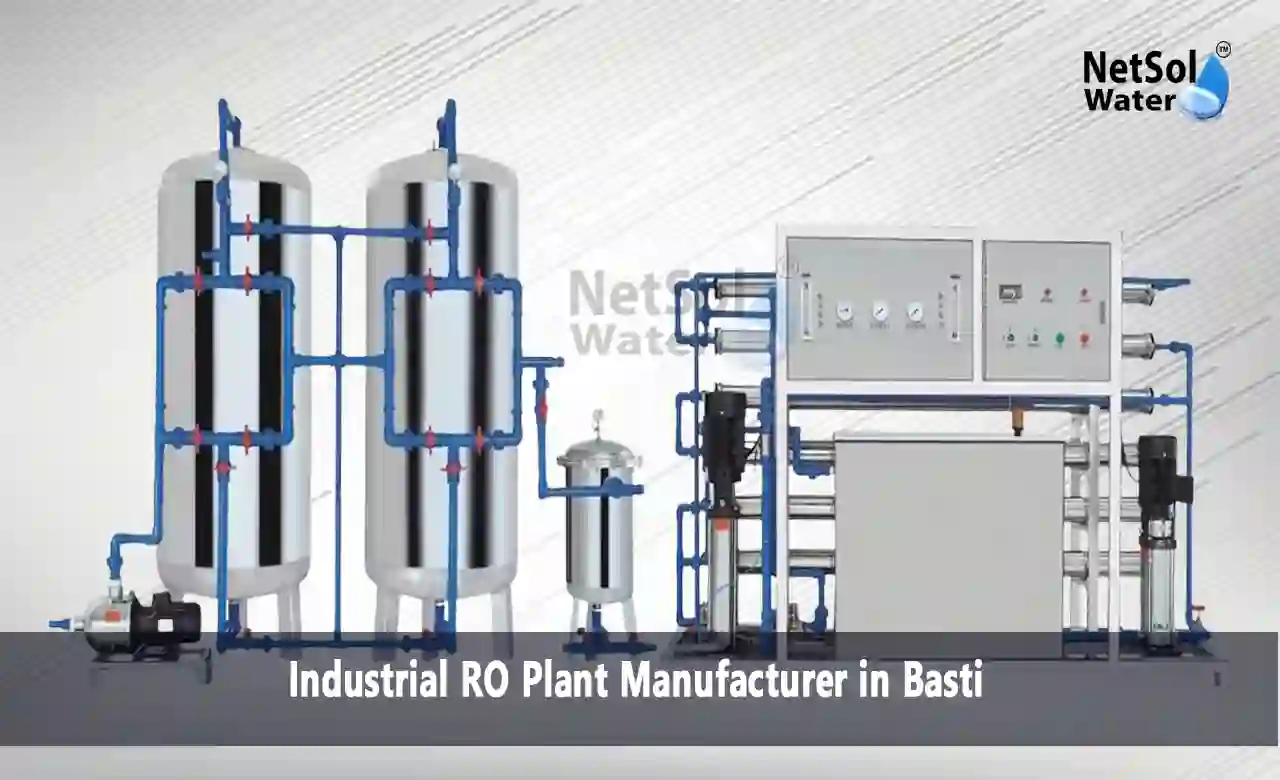
1. Feed Water Intake & Pre-Filtration - Raw water passes through multi-media filters to remove suspended solids, sand, and turbidity. This is critical for protecting the expensive RO membranes downstream.
2. Chemical Dosing (Antiscalant / pH Correction) - Chemicals are dosed precisely to prevent scale buildup on membranes and to adjust pH for optimal membrane performance and longevity.
3. 5-Micron Cartridge Filtration - A final particle filter catches any fine sediment that passed the pre-filters, giving the membranes a clean feed.
4. High-Pressure Pump - This is the heart of the system. The pump drives water at 8–15 bar pressure through the RO membranes.
5. RO Membrane Separation - Semi-permeable membranes reject up to 99% of dissolved salts, heavy metals, and microbes. Clean 'permeate' water flows to the product tank; the reject (concentrate) is routed away.
6. Post-Treatment (Optional) - UV sterilization, activated carbon filters, or remineralization are added based on end-use requirements.
7. Product Water Storage & Distribution - Treated water is stored in a clean water tank and fed to process lines, boilers, or cooling towers.
Industrial RO Plant Capacity Guide - What Size Do You Need?
Choosing the right capacity is the most important decision in the buying process. Too small and your plant runs dry during peak shifts; too large and you've over-invested in capital equipment you don't use.
Netsol Water engineers size every system based on: peak hourly demand, operating hours per day, water recovery rate, and projected growth over 5 years.
| Capacity Range | Ideal For |
|---|---|
| 250 – 2,000 LPH | Small workshops, service units, light manufacturing |
| 2,000 – 10,000 LPH | Mid-size factories, food & beverage units, textile dyeing |
| 10,000 – 50,000 LPH | Large industrial plants, pharmaceutical units, power stations |
| 50,000 – 1,00,000+ LPH | Mega factories, utility-scale water supply, multi-unit campuses |
Industries Served by Netsol Water in Basti & Eastern UP
Netsol Water's industrial RO systems are currently operational across a wide range of sectors in the region:
• Food & Beverage - Ingredient-grade purified water for blending, washing, and CIP (clean-in-place) operations.
• Textile & Dyeing - Consistent low-TDS water prevents color variation and reduces chemical consumption in dyeing baths.
• Pharmaceutical - High-purity process water for cleaning, formulation support, and non-sterile manufacturing.
• Power & Utilities - Low-conductivity water for boiler feed and cooling tower makeup to prevent corrosion and scaling.
• Chemical Manufacturing - Controlled input water quality for consistent reaction conditions and product purity.
• Hospitals & Institutions - Reliable safe water for large facility operations including CSSD, laundry, and dietary.
Industrial RO Plant Cost in Basti
Pricing varies based on capacity, pre-treatment complexity, membrane brand, and level of automation. Below are indicative ranges to help your budgeting exercise. For an accurate quote specific to your water quality and flow requirement, a site survey is essential.
Important: Always evaluate total cost of ownership - not just the sticker price. A slightly more expensive system with better membranes and a solid AMC plan often costs less over 5 years than a cheap system with high downtime and frequent membrane replacement.
| System Size | Indicative Capital Cost (INR) |
|---|---|
| 250 – 2,000 LPH | INR 90K – INR 3 Lakh |
| 2,000 – 10,000 LPH | INR 3 Lakh – INR 13 Lakh |
| 10,000 – 50,000 LPH | INR 13 Lakh – INR 80 Lakh |
| 50,000 – 1,00,000 LPH | INR 80 Lakh – INR 3.5 Crore+ |
These are approximate ranges only. Final pricing depends on site conditions, pre-treatment requirements, membrane selection, automation level, and civil work. Contact Netsol Water for a detailed, no-obligation project estimate.
What to Look for in an Industrial RO Plant Manufacturer in Basti?
Not every vendor offering RO plants in Basti has the engineering depth or after-sales commitment you need for a long-term industrial application. Here is a quick checklist:
• Do they perform an actual water test before sizing the system?
• Do they provide a detailed Bill of Materials (BOM) with membrane and pump specifications?
• Do they offer a performance guarantee (output quality and flow rate)?
• Do they have a local service team in or near Basti?
• Do they offer an Annual Maintenance Contract (AMC)?
• Can they show case studies or references from similar industries?
If a vendor skips the water test and quotes purely on a capacity number, walk away. A good RO system is designed around your water, not around a price list.
Get a Site Survey & Custom Quote from Netsol Water
Whether you are setting up a new plant or upgrading an aging system, the best next step is a no-cost site survey. Netsol Water's engineering team will test your water, assess your flow requirements, and provide a clear technical and commercial proposal - no obligation.
Ready to Get Clean, Pure Industrial Water?
Contact Netsol Water today for a free site survey and customized RO plant quote.
Call: +91-9650608473, E-mail: enquiry@netsolwater.com
FAQ Section
Q: What is an industrial RO plant and how does it work?
A: An industrial RO (Reverse Osmosis) plant is a water purification system that uses high-pressure pumps to force feed water through semi-permeable membranes, removing up to 99% of dissolved salts, heavy metals, and microbes. It typically includes pre-filtration, chemical dosing, membrane separation, and optional post-treatment stages.
Q: How much does an industrial RO plant cost in Basti?
A: Industrial RO plant prices in Basti range from approximately ?2.5 lakh for small 500 LPH systems to over ?3.5 crore for large 1,00,000 LPH modular installations. The final cost depends on capacity, pre-treatment needs, membrane brand, and automation level. Contact Netsol Water for a site-specific quote.
Q: Which capacity RO plant is right for my factory in Basti?
A: The right capacity depends on your peak hourly water demand and daily operating hours. Small units (500–2,000 LPH) suit workshops and small food units. Mid-range systems (2,000–10,000 LPH) cover most mid-size factories. Larger plants (10,000 LPH+) serve heavy industry, power stations, and pharmaceutical units.
Q: What is the difference between a skid-mounted and a modular RO plant?
A: A skid-mounted RO plant is pre-assembled on a steel frame and ready to commission quickly - ideal for space-limited or temporary sites. A modular plant uses multiple RO trains working in parallel for large flow demands and can be expanded later without replacing existing equipment.
Q: Why is Netsol Water a trusted industrial RO plant manufacturer in Basti?
A: Netsol Water offers end-to-end service - from water testing and custom system design to local installation, operator training, and annual maintenance contracts. The company serves clients across eastern Uttar Pradesh and is known for transparent pricing, genuine spare parts, and reliable after-sales support.
Q: Do I need government approvals to install an industrial RO plant in Basti?
A: Yes, in most cases you will need Consent to Establish (CTE) and Consent to Operate (CTO) approvals from the Uttar Pradesh Pollution Control Board (UPPCB), especially for discharge of reject/concentrate water. Netsol Water assists clients with all regulatory documentation and compliance planning.
Q: How often do RO membranes need to be replaced?
A: In well-designed and properly maintained industrial RO plants, membranes typically last 3–5 years. Replacement frequency depends on feed water quality, pre-treatment efficiency, and adherence to cleaning schedules. Regular antiscalant dosing and periodic CIP (clean-in-place) cycles significantly extend membrane life.
Q: What industries in Basti benefit most from industrial RO plants?
A: Key industries in Basti and eastern UP that benefit include textile and dyeing units, food and beverage manufacturers, pharmaceutical facilities, chemical plants, power and utility operators, hospitals, and large institutions. Any process that requires consistent low-TDS or high-purity water is a strong candidate for RO treatment.