
Industrial RO Plant Manufacturer in Bahraich
If your production line depends on consistent water quality, you already know how quickly things go wrong when feed water quality drops. Boiler tubes scale up. Cooling towers demand more blowdown. Product batches fail quality checks. For industries in Bahraich drawing from groundwater with TDS levels often above 800 ppm, these are not hypothetical risks - they are daily operational realities.
The right industrial RO plant removes that uncertainty. It strips dissolved salts, suspended particles, heavy metals, and biological contaminants from your feed water before they reach your equipment or your product. When the plant is designed for your specific water profile and process demands - not copied from a generic template - the difference in output quality and equipment life is significant.
Netsol Water has been designing and commissioning industrial reverse osmosis plants across Uttar Pradesh since 2012. With over 1500 systems installed, ISO 9001:2015 certification, and a team of dedicated water treatment engineers, the company is one of the most trusted names in industrial RO plant manufacturer in Bahraich.
Who Is Netsol Water?
Netsol Water is an ISO 9001:2015 certified industrial water treatment company with over 15 years of experience in designing, manufacturing, and servicing reverse osmosis plants. The company operates a dedicated manufacturing facility and has commissioned more than 1500 RO systems for industries including pharmaceuticals, food processing, textiles, chemicals, power generation and large-scale manufacturing complexes.
What sets Netsol Water apart from equipment resellers is their end-to-end approach. The company does not sell off-the-shelf units. Every plant begins with a site-level water analysis - measuring TDS, hardness, iron content, silica, pH, and biological load. That data determines membrane selection, pre-treatment design, recovery rate targets, and the control strategy. The result is a plant sized and configured for your water, not a generic design retrofitted to your site.
After commissioning, Netsol Water provides operator training, a spare parts inventory plan, AMC options, and remote monitoring support. Their service team covers Bahraich and surrounding districts in Uttar Pradesh with a typical response time under 24 hours.
Why Choose Netsol Water as Your RO Plant Supplier in Bahraich?
Choosing a local, experienced manufacturer over a distant supplier or an equipment broker makes a measurable difference across the plant's operating life. Here is what clients across Uttar Pradesh consistently report as the key differentiators.
Netsol Water, a trusted Industrial RO Plant Manufacturer in Uttar Pradesh, starts every project with a free site visit and laboratory water analysis. Most suppliers skip this step and size systems based on assumed TDS values. Netsol Water's engineers use actual water data to select membranes and design pre-treatment — which directly affects recovery rate, membrane life, and energy consumption. A system designed on real data typically runs 20 to 30% more efficiently than one based on estimates.
The company's modular design philosophy means your plant can grow with your production. Skid sections are pre-assembled and tested in the factory, reducing on-site installation time. If your capacity needs increase in two years, adding a module is straightforward and does not require rebuilding the existing system.
Regulatory compliance is built into every project. Netsol Water handles UPPCB discharge documentation, assists with local water use permissions, and provides calibrated sensor data for regulatory audits. For industries subject to FSSAI, GMP, or pharma guidelines, the company also supports validation documentation for purified water systems.
Finally, the service network. A plant in Bahraich maintained by an engineer from Delhi adds travel time and costs to every breakdown. Netsol Water's regional team means faster response and lower maintenance overhead over the plant's 10 to 15 year operating life.
Industrial RO Plants Supplied by Netsol Water
Not every facility has the same space constraints, budget envelope, or growth trajectory. Netsol Water manufactures three main formats to fit different site realities.
1. Packaged Skid Units
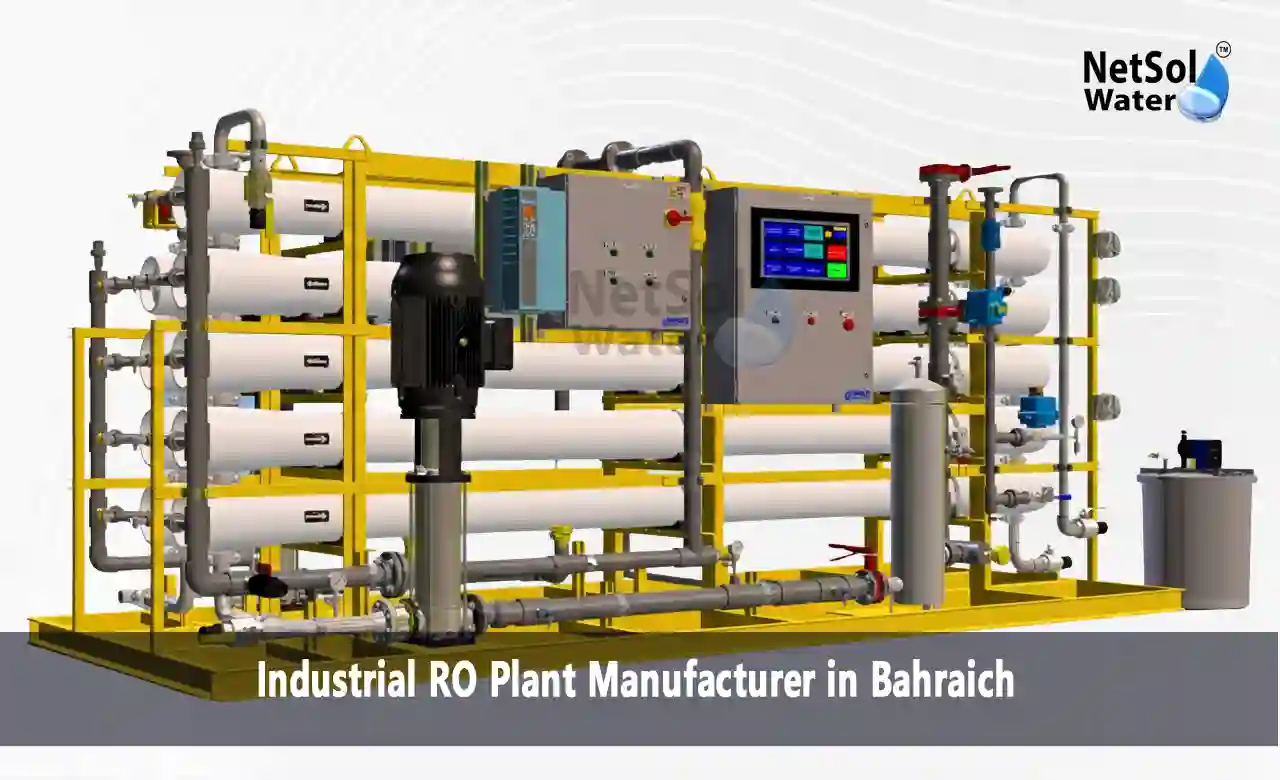
Packaged skid units are factory-assembled, tested, and delivered ready to connect. They suit smaller production lines, remote processing sites, and facilities where installation time matters. The entire system - pre-filter, high-pressure pump, membrane housing, controls, and post-treatment - arrives on a single skid. Electrical and piping connections are minimal. Capacity typically ranges from 500 LPH to 5,000 LPH. These units are the fastest path from order to operation, usually commissioned within one to two days of delivery.
2. Modular Skid Systems
Modular systems are designed for facilities that expect capacity growth. Each stage of the process - pre-treatment, RO trains, post-treatment - is a discrete skid module that can be operated independently or in parallel. When production demands increase, a new module is added without taking the existing system offline. This format suits medium to large factories with capacities from 5,000 LPH up to 50,000 LPH. The phased investment model is also budget-friendly - you install capacity as your production scales, not ahead of it.
3. Large Civil-Built RO Trains
For centralised water treatment serving large factories, industrial parks, or multi-building complexes, Netsol Water designs and builds civil-integrated RO systems. These installations have dedicated pump rooms, civil foundations, large-diameter piping headers, and centralised SCADA control. Capacities start at 50,000 LPH and extend to 5,00,000 LPH (5 lakh LPH) and above. Project timelines are longer - typically 8 to 16 weeks from design sign-off - but the output is a purpose-built, long-life water treatment infrastructure matched to the facility's full-scale requirements.
How Does an Industrial RO Plant Work?
Reverse osmosis sounds complex, but the operating principle is straightforward. Here is how water moves through a typical Netsol Water industrial RO system from raw feed to treated permeate.
1. Raw feed water enters a multi-media filter that removes suspended solids, turbidity, and iron particles. This protects downstream components from fouling.
2. Water then passes through a water softener or antiscalant dosing system to reduce hardness and prevent calcium carbonate scale forming on membrane surfaces.
3. A 5-micron cartridge filter catches any fine particles that passed the pre-treatment stage, giving the high-pressure pump and membranes clean, particle-free feed.
4. High-pressure pumps force the pre-treated water through semi-permeable RO membranes at pressures of 8 to 15 bar. The membranes reject up to 98% of dissolved salts, heavy metals, nitrates, fluorides, and bacteria. Clean water passes through as permeate; rejected contaminants leave as concentrate.
5. Post-treatment steps - pH correction, UV disinfection, or mixed-bed polishing - adjust the permeate to meet the exact quality specification your process requires.
6. PLC-based controls and online sensors continuously monitor feed pressure, permeate conductivity, flow rates, and system differential pressure. Alarms trigger automatically if any parameter drifts outside the setpoint range.
The entire process runs with minimal manual intervention. Modern Netsol Water RO systems include automatic membrane flush cycles, chemical dosing controls, and data logging - reducing operator workload and extending membrane life.
Applications of Industrial RO Plants in Bahraich
Different industries have different water quality thresholds, and the consequences of poor water quality vary significantly between them. Here is how industries across Bahraich and Uttar Pradesh are using Netsol Water RO systems.
1. Boiler feed water: Dissolved calcium, magnesium, and silica form hard scale inside boiler tubes, increasing energy consumption and risking tube failure. RO-treated water with TDS below 50 ppm eliminates scale formation, extends service intervals, and reduces chemical treatment costs by 40 to 60 percent.
2. Cooling tower make-up water: High-TDS make-up water increases cycles of concentration and blowdown frequency. RO-treated make-up water extends blowdown cycles, reduces chemical consumption, and cuts water usage - important in water-stressed industrial zones.
3. Food and beverage processing: FSSAI and BIS standards require process water to meet strict microbiological and chemical quality limits. RO plants providing consistent TDS below 100 ppm with UV polishing meet these standards reliably across seasonal raw water quality variations.
4. Pharmaceutical manufacturing: Purified water for formulation and equipment rinsing must meet IP / USP conductivity and TOC limits. Netsol Water's double-pass RO systems with EDI polishing produce pharmaceutical-grade purified water compliant with Schedule M requirements.
5. Textile and dyeing units: Hardness and iron in feed water interfere with dye uptake, causing colour inconsistency and batch rejection. RO-treated process water produces more uniform dyeing results and reduces dye consumption per batch.
6. Chemical plants and laboratories: Process chemistry and reagent preparation require low-conductivity water free from interference ions. RO plants with TDS rejection above 97% provide reliable base water for chemical manufacturing and analytical laboratory use.
Industrial RO Plant Capacity Range in LPH
Netsol Water manufactures systems across a broad capacity spectrum. Selecting the right capacity requires accounting for your average daily demand, peak hourly demand, production schedule (single shift vs continuous), and a growth buffer of 20 to 30 percent. Under-sizing causes production shortfalls; over-sizing wastes capital and increases membrane fouling risk from low-flow operation.
Small packaged units range from 500 LPH to 5,000 LPH and suit workshops, small food processing units, laboratories, and light industrial applications.
Mid-range modular systems cover 5,000 LPH to 50,000 LPH and serve medium-scale factories, textile units, dairy plants, institutional water supplies, and multi-shift production facilities.
Large centralised RO trains range from 50,000 LPH to 5,00,000 LPH (5 lakh LPH) and are designed for heavy industry, industrial parks, large-scale beverage or pharmaceutical plants, and power generation facilities with high boiler feed demand.
Netsol Water provides a free capacity assessment as part of the initial consultation. Their engineers calculate required permeate output, system recovery rate (typically 65 to 75 percent for groundwater sources), and membrane array size - giving you a precise capacity specification rather than a rounded estimate.
Cost of an Industrial RO Plant in Bahraich
Budget planning is easier when you have real numbers to work with. While exact pricing depends on feed water TDS, site conditions, civil work, automation level, and membrane brand, the following indicative ranges give a realistic starting point for capacity planning.
Packaged units (500 LPH – 5,000 LPH): Typically priced between Rs. 1.5 lakh and Rs. 8 lakh. Basic pre-treatment, standard TFC membranes, PLC or digital controls. Suitable for single-shift light industrial or food processing use.
Modular systems (5,000 LPH – 50,000 LPH): Typically priced between Rs. 8 lakh and Rs. 45 lakh. Includes antiscalant dosing, multi-stage pre-treatment, higher-efficiency membranes, remote monitoring, and full automation. Suited to continuous-operation manufacturing.
Large civil-built RO trains (50,000 LPH and above): Pricing typically starts at Rs. 50 lakh and scales with capacity, civil scope, and automation complexity. These projects are priced after detailed site survey and process design.
Additional cost items to include in your budget: water softener (if hardness exceeds 300 mg/L), concentrate disposal infrastructure, electrical load upgrade, civil foundations, operator training, and the first year's AMC. Netsol Water provides a line-item quotation covering all of these components - no hidden charges after the site visit.
Regulatory Compliance and Approvals
Industrial water treatment installations in Uttar Pradesh are subject to UPPCB environmental norms, BIS water quality standards, and - depending on the industry - FSSAI, Pharma GMP, or ISO process requirements. Navigating these requirements without guidance from an experienced manufacturer adds time and risk to your project.
Netsol Water's compliance team assists with UPPCB trade effluent consent documentation, preparing the required inlet and outlet water quality data submissions. For groundwater abstraction, they advise on Central Ground Water Authority compliance where applicable. For food, beverage, and pharma facilities, the team provides water quality certificates and calibration records for regulatory audits.
On the equipment side, all Netsol Water systems are manufactured to IS/ISO quality standards. Pressure vessels carry BIS certification. Electrical panels comply with IS 5039. For export-oriented units or MNC clients requiring CE-marked components, the team can specify and source internationally certified equipment.
The compliance support does not end at commissioning. Netsol Water offers quarterly sampling and analysis services, calibration of online conductivity and flow meters, and record-keeping templates for your QA team - making your annual regulatory audit a straightforward process rather than a scramble.
Frequently Asked Questions
What is an industrial RO plant and how is it different from a commercial unit?
An industrial RO plant is a reverse osmosis system designed for continuous, high-volume operation in manufacturing and processing environments. Unlike commercial RO units designed for offices or apartment buildings, industrial plants handle feed water with high TDS, suspended solids, and variable chemical composition. They operate on high-pressure pumps running 16 to 24 hours a day, include multi-stage pre-treatment, and are engineered to meet specific process water quality targets rather than just meeting drinking water standards.
What is the cost of an industrial RO plant in Bahraich?
Industrial RO plant costs in Bahraich range from approximately Rs. 1.5 lakh for a basic 500 LPH packaged unit to Rs. 50 lakh and above for large centralised systems above 50,000 LPH. The main cost drivers are system capacity, feed water TDS, the level of automation required, and any civil or electrical infrastructure work needed on site. Netsol Water provides a detailed quotation after a free site water test and assessment.
How much TDS can an industrial RO plant remove?
A well-designed industrial RO plant rejects 95 to 98 percent of dissolved solids. If your source water has a TDS of 1,000 ppm, the treated permeate will typically have a TDS between 20 and 50 ppm. For applications requiring even lower TDS - such as pharmaceutical purified water or electronics rinsing - a second RO pass or EDI polishing stage brings conductivity below 1 microsiemens per centimetre.
How long do RO membranes last in an industrial plant?
With proper pre-treatment and regular maintenance, commercial-grade TFC membranes in industrial plants typically last 3 to 5 years. The most common cause of premature membrane failure is inadequate pre-treatment - specifically, insufficient hardness removal or chlorine carryover from the feed. Netsol Water's pre-treatment design specifically addresses these failure modes, and their annual maintenance contracts include membrane performance monitoring to catch degradation before it affects process water quality.
What happens to the reject water from an industrial RO plant?
Every RO plant produces a concentrate stream containing the rejected contaminants. In a typical plant with 70 percent recovery, approximately 30 percent of feed water exits as concentrate. For most groundwater sources in Bahraich, this concentrate can be directed to cooling tower top-up (if TDS is acceptable), used for garden irrigation or dust suppression, or discharged to drain subject to UPPCB consent norms. Netsol Water's design includes concentrate management planning and, where required, a zero-liquid-discharge configuration using evaporators.
How often does an industrial RO plant need maintenance?
Routine maintenance tasks - pre-filter cartridge replacement, antiscalant dosing system check, sensor calibration, and automatic flush programme review - are recommended monthly. A full preventive maintenance service covering membrane performance testing, pump inspection, valve checks, and chemical cleaning should be carried out every six months. Netsol Water's AMC programmes cover all of these tasks on a fixed-cost basis, which makes budgeting for maintenance straightforward.
Can Netsol Water upgrade an existing RO plant that is not performing well?
Yes. Netsol Water's engineering team regularly audits underperforming RO systems - including plants originally supplied by other manufacturers. Common upgrade interventions include pre-treatment redesign to protect membranes, membrane replacement with higher-rejection elements, control system upgrades for better automation, and recovery rate improvements through system reconfiguration. An audit visit typically identifies the root cause of performance issues within a single site visit.
How long does installation take for an industrial RO plant in Bahraich?
Packaged skid units can be commissioned within one to two days of delivery, assuming utilities are ready. Modular systems with pre-treatment and post-treatment stages typically require three to seven days on site. Large civil-built RO trains require longer project timelines of four to twelve weeks depending on civil scope. Netsol Water provides a project schedule at the time of order so you can plan production around the installation period.
Ready to Improve Your Process Water Quality?
Choosing the right industrial RO plant manufacturer in Bahraich is not just a procurement decision - it is an engineering decision that affects equipment life, production consistency, and operational cost for the next 10 to 15 years. Getting the design right from the start costs less than fixing a poorly specified system two years into operation.
Netsol Water offers a free site water test and no-obligation system design consultation for industrial clients in Bahraich and across Uttar Pradesh. Their team will assess your source water, understand your process requirements, and propose a correctly sized, compliant system with transparent pricing.
Whether you are planning a new installation, upgrading an existing system, or troubleshooting performance issues with your current RO plant, the starting point is the same: a water test and a site visit.
Contact Netsol Water
Phone: +91-9650608473
Email: enquiry@netsolwater.com
Service Area: Bahraich, Shravasti, Gonda, Balrampur, Lucknow, and all districts of Uttar Pradesh