
Industrial RO Plant Manufacturer in Bagpat
Most factory owners in Bagpat never think about their water source - until the day they have to. A boiler starts scaling up and fuel bills creep higher. A production batch fails quality inspection and the cause isn't obvious. A cooling system that used to run six months without trouble now needs attention every eight weeks.
In almost every one of these situations, the investigation eventually leads back to the same culprit: untreated raw water being fed directly into industrial processes. The water looked fine. But looks are misleading when TDS levels in Bagpat's groundwater can run anywhere from 800 to over 2,000 mg/L.
An Industrial RO Plant solves this problem at the source. It delivers consistently purified water - batch after batch, day after day - so your equipment lasts longer, your processes stay on spec, and your water supply stops being a variable you have to worry about.
We are Netsol Water, an ISO-certified Industrial RO Plant Manufacturer and Supplier operating across Uttar Pradesh and India since 2013. This page covers everything you need to understand before choosing a system - including honest cost figures, a realistic installation timeline, and a clear explanation of what makes water treatment in Bagpat different from the generic advice you'll find elsewhere.
What Is an Industrial RO Plant - and How Is It Different from a Regular RO Purifier?
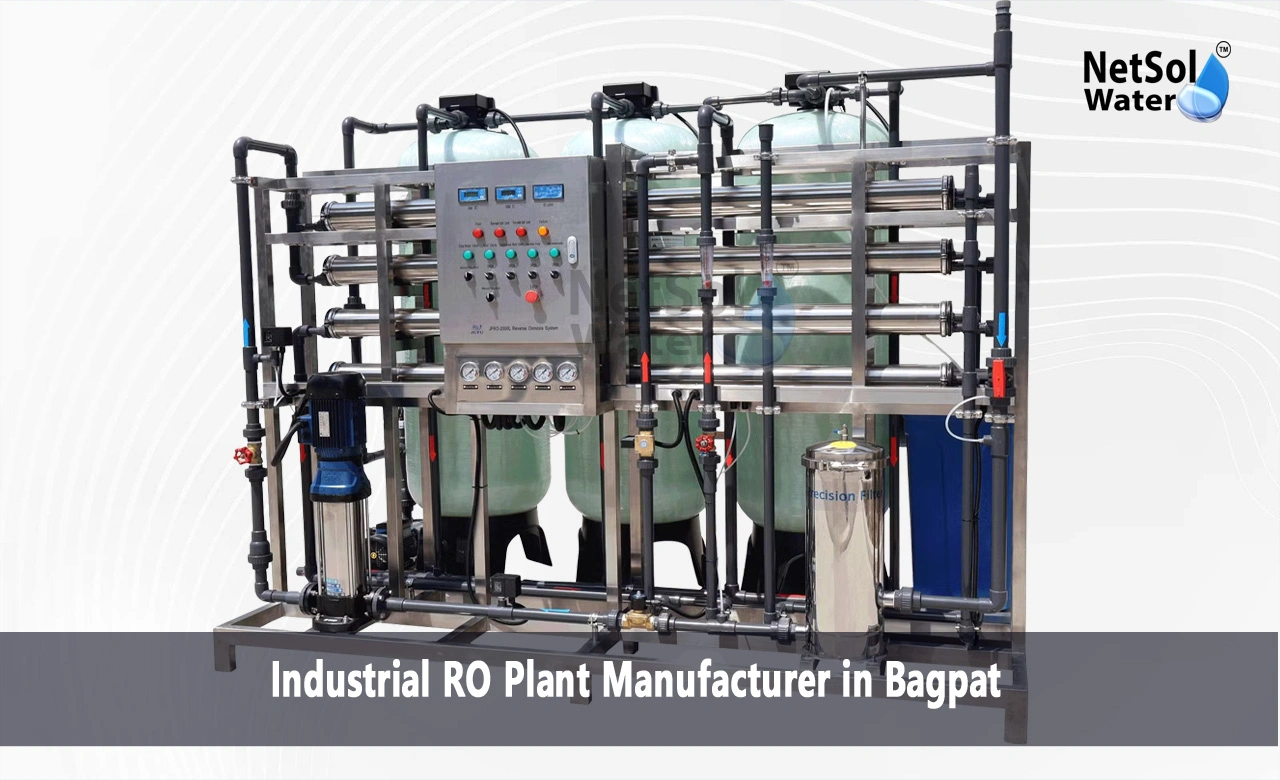
An Industrial RO Plant is a high-capacity water purification system that removes 95–99% of dissolved salts, heavy metals, bacteria, and other contaminants using reverse osmosis membranes. Unlike household purifiers that produce 50–200 litres per hour, industrial systems deliver thousands of litres per hour continuously to support manufacturing processes.
The core principle - forcing water through a semi-permeable membrane under pressure - is the same in both. But that is roughly where the similarity ends.
A household RO unit is designed for drinking water at low volumes. An industrial RO plant is engineered to run 16 to 24 hours a day, seven days a week, feeding boilers, cooling towers, washing lines, formulation tanks, and product processing systems. The build quality reflects that difference: high-pressure stainless steel or FRP pressure vessels, commercial-grade pumps, multi-membrane configurations, automated control panels with real-time TDS monitoring, and pre-treatment systems sized specifically for your raw water source.
A system that cannot sustain that load reliably is not an industrial RO plant, regardless of what the brochure claims.
Why Bagpat's Groundwater Makes RO Purification a Necessity - Not an Option
Bagpat sits in the Indo-Gangetic plain, and the groundwater here reflects the geology of that belt. Borewell water TDS in many parts of the district ranges from 800 to over 2,000 mg/L, according to CGWB (Central Ground Water Board) district data. The acceptable limit for most industrial processes is under 500 mg/L. For pharmaceutical manufacturing or food processing, it needs to be significantly lower than that.
High TDS is just one part of the picture. The raw water issues commonly encountered in this region include:
• High hardness (calcium and magnesium) that builds scale in pipes, boilers, and heat exchangers over time
• Elevated iron content that stains products, clogs membranes, and accelerates equipment wear
• Fluoride levels that exceed permissible limits in certain pockets of the district
• Seasonal turbidity spikes during and after monsoon that overwhelm basic filtration
• Microbial contamination in open or shallow water sources
None of these problems improve on their own - they compound as equipment ages and contamination accumulates. An industrial RO plant removes 95 to 99 percent of dissolved solids, heavy metals, and microbial contaminants, giving you a stable, predictable water supply regardless of what comes out of the ground on any given day.
What Untreated Water Is Actually Costing Your Factory Right Now?
The damage from hard or high-TDS water is gradual and often misattributed to other causes - which makes it expensive and easy to ignore until the numbers get large.
1. Boiler and Heat Exchanger Scaling
According to BEE India (Bureau of Energy Efficiency), every 1mm of scale on a boiler heat transfer surface increases fuel consumption by approximately 7–10%. A heavily scaled boiler can consume 25–30% more fuel than a clean one. For a mid-sized industrial boiler running year-round, that excess fuel cost alone often exceeds the total installation cost of an RO plant.
2. Cooling Tower and Chiller Damage
Hard water causes carbonate scale in cooling towers and chiller condensers, reducing heat transfer efficiency and increasing compressor load. This shortens equipment service life and leads to more frequent, costly mechanical failures.
3. Product Quality Failures and Batch Rejections
In food, beverage, and pharmaceutical production, water with high TDS or microbial content directly causes product quality failures. In serious cases, this results in regulatory action from FSSAI or the drug regulatory authority - consequences that go well beyond the cost of a rejected batch.
4. Membrane and Pump Failures in Existing RO Systems
If you already have a small RO system and it is underperforming or fouling membranes frequently, the likely cause is inadequate pre-treatment, not the membrane itself. A properly sized pre-treatment train dramatically extends membrane life and reduces your operating costs.
5. Pipe Corrosion and Product Line Contamination
Certain dissolved minerals and gases in raw water accelerate corrosion in metal pipework. Left unaddressed, this leads to leaks, product contamination, and expensive replacement work on lines that should have lasted years longer.
The Cost of Doing Nothing:
Add up your annual fuel overconsumption from scaled boilers, maintenance and downtime from scaling damage, product rejection losses, and tanker water purchase costs. For most mid-sized factories in Bagpat, that total exceeds the installation cost of a properly sized RO plant within 18 to 24 months.
Industrial RO Plant Price in Bagpat - Realistic Cost Ranges
One of the most useful things a manufacturer can do is be straightforward about costs. Here is a realistic picture based on our installations across UP.
|
Capacity |
Indicative Price Range (Approx.) |
Best Suited For |
|
500 LPH – 2,000 LPH |
Rs. 1.2 lakh – Rs. 3.5 lakh |
Small factories, workshops, hotels, hospitals |
|
2,000 LPH – 10,000 LPH |
Rs. 3.5 lakh – Rs. 12 lakh |
Mid-size manufacturing, food processing, textiles |
|
10,000 LPH – 50,000 LPH |
Rs. 12 lakh – Rs. 60 lakh |
Large industrial units, sugar mills, pharmaceuticals |
|
50,000 LPH and above |
Rs. 60 lakh upward |
Municipal supply, large-scale industrial complexes |
These are indicative ranges. Your actual system cost depends on: required capacity in LPH or KLD, raw water quality and pre-treatment requirements, application type (food grade, pharma grade, or general industrial), automation level, and membrane brand and configuration.
We provide itemised quotations - not ballpark estimates - after conducting a water quality test at your site. Contact us for an accurate quote specific to your application.
Single Pass vs Double Pass RO - Which Configuration Does Your Industry Need?
Single pass RO is sufficient for most industrial applications including boiler feed, cooling towers, and general manufacturing. Double pass RO is required when output water purity must consistently fall below 10 mg/L TDS - typically for pharmaceuticals, electronics, and high-purity chemical processes.
|
Feature |
Single Pass RO |
Double Pass RO |
|
How it works |
Water passes through membranes once |
Permeate from first pass fed into a second RO stage |
|
Output TDS |
Typically 15–75 mg/L (from 1,500 mg/L feed) |
Consistently below 10 mg/L |
|
Rejection rate |
95–99% of dissolved solids |
99.5%+ cumulative |
|
Best for |
Boiler feed, cooling towers, textiles, food processing, general industrial |
Pharmaceuticals, electronics, labs, high-purity chemical processes |
|
Relative cost |
Standard |
Higher (additional membranes, pumps, controls) |
How Long Does Industrial RO Plant Installation Take in Bagpat?
Most standard capacity industrial RO plants are installed and commissioned within 4 to 6 weeks from the initial site assessment. There is no civil construction involved - installation is mechanical and electrical only.
Here is a realistic week-by-week breakdown of what the process looks like:
1. Water Quality Testing and Site Assessment
Our team visits your site, reviews the available space, understands your water consumption and application requirements, and collects raw water samples. We test TDS, hardness, iron, pH, turbidity, and microbiological parameters. Results come back within 1 to 3 working days.
2. System Design and Proposal
Based on your test results and capacity requirements, we design the complete system: pre-treatment configuration, membrane sizing, pump selection, storage capacity, and automation level. You receive a detailed, itemised proposal with clear specifications - not a vague estimate.
3. Manufacturing and Procurement
Membranes, pressure vessels, pumps, control panels, and filter housings are assembled or procured. Most standard capacity systems are ready within 5 to 7 working days.
4. Delivery and Installation
The system is delivered to your site and installed. Piping connections, electrical work, and panel setup are completed. A standard capacity plant typically takes 1 to 2 days to install, depending on site conditions.
5. Commissioning, Trial Run, and Handover
The system is started and tested under actual operating conditions. Feed water and permeate quality are measured and verified. Operating parameters are fine-tuned. We hand over the system with full operator training once output quality is confirmed to your specifications.
Larger systems or complex configurations with advanced pre-treatment take 1 to 15 days. Pharma-grade systems with validation requirements may take longer - we will tell you upfront.
What Our Clients Experience After Installation?
Client Result - Textile Unit, Western UP:
A textile processing unit in western Uttar Pradesh was spending heavily on boiler maintenance and fuel due to hardness-related scaling. After installing a 10,000 LPH Netsol Water RO system with antiscalant dosing and softener pre-treatment, their boiler maintenance intervals extended from 6 weeks to over 8 months, and fuel consumption dropped measurably within the first two quarters. Installation was completed in 5 weeks.
We have completed industrial water treatment installations across textiles, food processing, pharmaceuticals, sugar mills, paper industries, hospitals, and municipal facilities in multiple states. Each system is engineered around the specific water quality and process requirements of that site - not taken off a shelf.
Why Industries in Bagpat Choose Netsol Water?
Netsol Water is an ISO-certified Industrial RO Plant Manufacturer in Uttar Pradesh and a leading supplier with over a decade of engineering experience in industrial water purification. Our facility designs, manufactures, and installs complete water treatment systems for clients across Uttar Pradesh, Delhi NCR, and other parts of India. We specialise in high-performance industrial RO systems that ensure reliable water purification for manufacturing, processing, and commercial applications.
Here is what that means specifically for your project:
• Raw water testing before every project - we analyse your actual source water before recommending any system design
• Custom-engineered systems - capacity, pre-treatment, membrane sizing, and automation designed for your specific water quality and application
• High-grade components - RO membranes from leading brands, high-efficiency pumps, stainless steel or FRP pressure vessels, and reliable automated control panels
• Complete turnkey delivery - testing, design, manufacturing, installation, commissioning, and operator training, all from our team
• Single pass and double pass configurations available depending on your purity requirements
• Capacity range from 500 LPH to 1,00,000 LPH and above
• Annual Maintenance Contracts with scheduled service visits and emergency support
• Cross-industry experience - we have solved problems like yours before, and we can show you the work
We do not hand over a system and disappear. Our team stays available through the operational life of every plant we install - and that is a practical commitment, not a marketing line.
Frequently Asked Questions - Industrial RO Plant in Bagpat
How much does an industrial RO plant cost in Bagpat?
The cost depends on capacity and application. A 500–2,000 LPH system starts at approximately Rs. 1.5 to 4 lakh. A 2,000–10,000 LPH system typically ranges from Rs. 4 to 15 lakh. Larger systems of 10,000–50,000 LPH cost Rs. 15 to 60 lakh approximately. Exact pricing requires a raw water test and site assessment, which we provide at no charge.
What is the TDS of borewell water in Bagpat?
According to CGWB district data, borewell water TDS in Bagpat and the surrounding region typically ranges from 800 to over 2,000 mg/L. The BIS acceptable limit for industrial process water is generally below 500 mg/L, and pharmaceutical or food-grade applications require significantly lower levels. An industrial RO plant routinely brings TDS down to 15–75 mg/L (single pass) or below 10 mg/L (double pass).
How long does RO plant installation take in Bagpat?
For most standard capacity systems, the complete process - water testing, design, manufacturing, installation, and commissioning - takes 4 to 6 weeks. There is no civil construction involved. Larger or more complex systems take 6 to 10 weeks.
What maintenance does an industrial RO plant require?
Routine maintenance includes periodic membrane cleaning, pre-filter cartridge replacement, antiscalant dosing system checks, pump pressure verification, and TDS monitoring. We offer Annual Maintenance Contracts covering scheduled service visits and emergency call-outs so your plant operates at peak performance year-round.
Is a double pass RO system required for food processing in Bagpat?
Not necessarily. Most food processing applications run well on single pass RO, which typically delivers output TDS of 15–75 mg/L. Double pass RO - which brings TDS below 10 mg/L consistently - is primarily required for pharmaceutical purified water systems, electronics manufacturing, and certain high-purity chemical processes. We recommend the right configuration based on your FSSAI requirements and process water specification.
Does Netsol Water serve industries outside Bagpat in UP?
Yes. We serve industries across western and central Uttar Pradesh, including Meerut, Muzaffarnagar, Ghaziabad, Hapur, Bulandshahr, and surrounding districts. We also have installations in Delhi NCR and multiple other states. Contact us to confirm coverage for your location.
Your Water Quality Problem Has a Straightforward Solution
If your factory in Bagpat is dealing with boiler scaling, frequent equipment maintenance, product quality rejections, high tanker water costs, or an unreliable water supply, an industrial RO plant addresses all of those problems at once. The investment pays back through lower fuel consumption, longer equipment life, fewer production failures, and reduced dependence on purchased water. For most industries, the payback period is well under two years.
The first step is a water quality test. It costs you nothing, and it tells us exactly what your source water contains and what your system needs to do. From there, we build a specification around your actual situation - not a generic package.
Get a Free Site Assessment and Quotation
Share your raw water quality data if you have it, tell us your application and daily water requirement, and we will come back with a clear, itemised proposal. No obligation. No vague estimates. Call / WhatsApp: 9650608473 Email: enquiry@netsolwater.com Or fill in the contact form on this page and we will reach out within one business day.