
Industrial RO Plant Manufacturer in Badaun
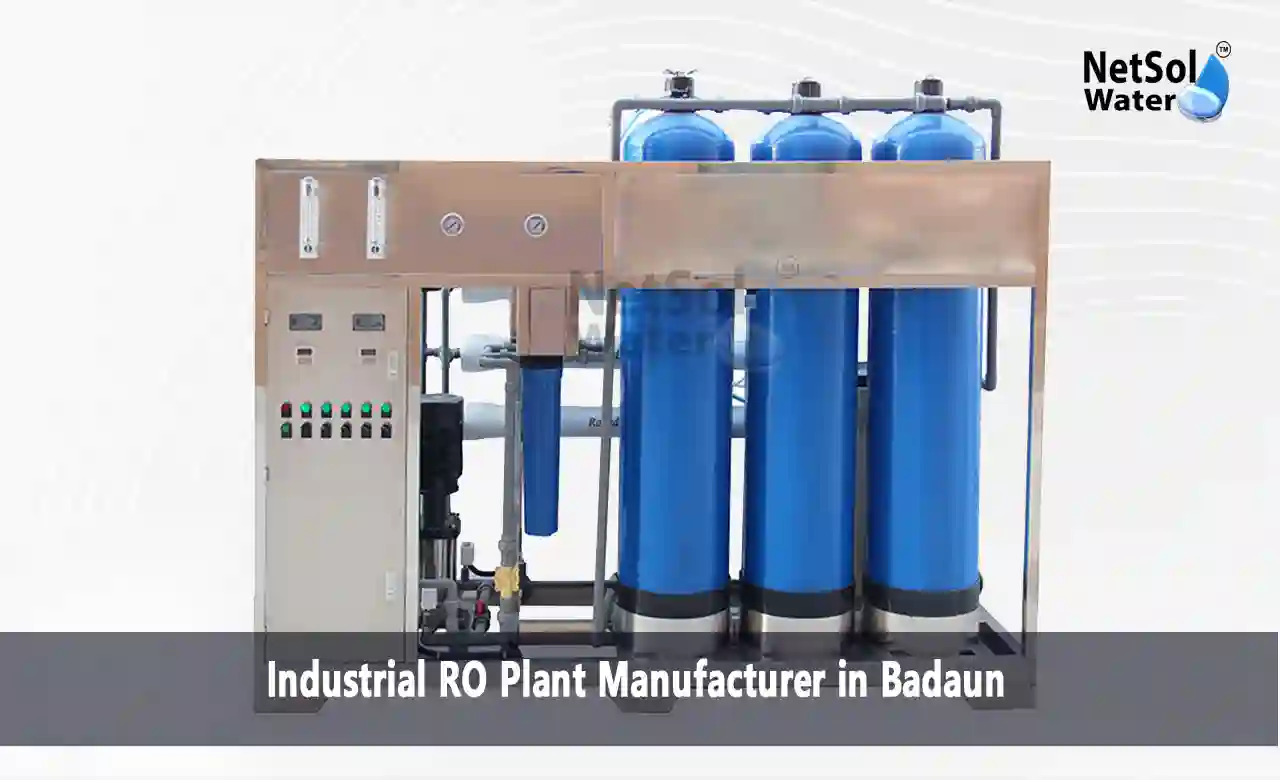
An industrial RO plant is a high-capacity water purification system that forces pressurised water through semi-permeable membranes to remove dissolved salts, heavy metals, bacteria, and other contaminants. It delivers water with TDS levels as low as 10–50 ppm from source water that may have TDS values of 500–2,000 ppm or higher.
Industries in Badaun often draw water from groundwater sources with TDS levels ranging between 600 and 1,800 ppm - well above the 200–500 ppm threshold recommended for most industrial processes. Without proper treatment, this high-mineral water causes scaling in boilers, corrosion in cooling towers, and off-spec output in food and pharmaceutical production. An industrial RO plant solves this at the source.
Why Do Industries in Badaun Need an RO Plant?
Badaun sits in a region where groundwater hardness routinely exceeds 400–600 mg/L (as CaCO3), and fluoride, iron, and chloride levels frequently breach Bureau of Indian Standards (BIS) limits for industrial use. The impact on manufacturing operations is direct and costly:
• Boilers and heat exchangers develop scale 3–5x faster with hard water, cutting thermal efficiency by up to 25% and shortening equipment life significantly.
• Textile dyeing and finishing units see inconsistent colour results when water TDS exceeds 300 ppm - leading to batch rejections and material waste.
• Food processing and beverage plants risk product contamination and non-compliance with FSSAI water quality standards when using untreated groundwater.
• Pharmaceutical manufacturers are required under Schedule M (GMP) to use purified water that meets strict conductivity and pyrogen limits - untreated water simply cannot comply.
• Chemical and paint industries experience unwanted reactions when dissolved minerals interact with process chemicals, reducing product quality.
Industries that have installed properly sized RO systems typically report a 60–80% reduction in boiler descaling frequency and a 15–30% reduction in annual water-related maintenance costs. These are conservative figures based on real installations in similar agro-industrial belts across Uttar Pradesh.
How Does an Industrial RO System Work?
A well-designed industrial RO plant is a multi-stage treatment train. Here is how each stage contributes:
Stage 1 - Pre-Treatment
Raw water first passes through a Pressure Sand Filter (PSF) to remove suspended solids and turbidity, followed by an Activated Carbon Filter (ACF) to strip chlorine, organic compounds, and odour. These two units protect the RO membrane from fouling. Without them, a membrane rated for 3–5 years of service can fail within months.
Stage 2 - Antiscalant Dosing
A metered antiscalant chemical is dosed into the feed water just before the high-pressure pump. This prevents sparingly soluble salts — calcium carbonate, silica, barium sulphate — from precipitating on the membrane surface, which is one of the most common and expensive failure modes in hard-water regions like Badaun.
Stage 3 - High-Pressure RO Membrane Filtration
High-pressure pumps (typically operating at 8–15 bar for brackish water sources) force feed water across polyamide thin-film composite (TFC) membranes. The membranes reject 95–99% of dissolved salts, heavy metals, bacteria, and viruses, allowing only clean water molecules to pass through as permeate. The remaining concentrated brine is discharged — typically 20–35% of the feed volume in a well-optimised system.
Stage 4 - Post-Treatment
Depending on the application, treated water may undergo UV disinfection (for zero-microbial counts), pH correction (RO permeate is slightly acidic at pH 5.5–6.5), or remineralisation for drinking and food-grade use. For boiler feed applications, a mixed-bed deioniser (DI) can be added as a final polishing step to achieve near-zero TDS.
Industrial RO Plant Cost in Badaun
Pricing depends on four primary variables: system capacity (LPH), raw water TDS level, degree of automation, and any additional treatment stages required. Below are realistic installed-cost benchmarks for Badaun-region water conditions (typical feed TDS: 800–1,500 ppm).
500 LPH - Small Industrial Unit
• Installed cost: Rs. 1.25 lakh – Rs. 1.5 lakh
• Best suited for: Small food processing units, packaging plants
• Key features: Pressure sand filter, activated carbon filter, single-stage RO, basic control panel
• Payback period: 18–24 months
1,000 LPH - Small to Mid-Scale
• Installed cost: Rs. 1.5 lakh – Rs. 2.5 lakh
• Best suited for: Rice mills, small textile units
• Key features: PSF, ACF, antiscalant dosing, 1–2 RO stages, stainless-steel frame
• Payback period: 18–24 months
2,000 LPH - Mid-Scale Industry
• Installed cost: Rs. 2.5 lakh – Rs. 4 lakh
• Best suited for: Medium pharma plants, dairy units
• Key features: Dual RO pass option, high-pressure pump, SCADA-ready control panel
• Payback period: 20–28 months
5,000 LPH - Large Mid-Scale
• Installed cost: Rs. 6.5 lakh – Rs. 7.5 lakh
• Best suited for: Textile clusters, chemical manufacturing units
• Key features: Multi-stage RO, energy recovery device, full SCADA with GSM alerts
• Payback period: 20–28 months
10,000 LPH and Above - Large Industrial
• Installed cost: Rs. 11.5 lakh – Rs. 13 lakh+
• Best suited for: Large industrial facilities, Industrial Park Clusters (IPCs)
• Key features: Multi-train RO, UF pre-treatment, advanced automation, remote monitoring dashboard
• Payback period: 24–36 months
Note: Prices are ex-works estimates for standard Badaun groundwater conditions. Sites with TDS above 2,000 ppm, iron content above 1 mg/L, or high silica may require additional pre-treatment, which will affect cost. Contact Netsol Water for a site-specific quote based on your water analysis report.
What Factors Affect the Total Cost?
• Feed water TDS and contamination profile - iron, silica, hardness, and fluoride each require specific pre-treatment steps.
• Required permeate quality - pharma-grade water needs multi-pass RO or EDI polishing; boiler feed needs conductivity below 0.1 micro-S/cm.
• Level of automation - basic float-valve systems vs. full PLC/SCADA control with GSM alerts differ by Rs. 1–3 lakh.
• Civil installation requirements - whether the plant room, piping runs, and drainage are already in place.
• Annual Maintenance Contract (AMC) - membrane replacement every 3–5 years and consumable costs should be factored into the total cost of ownership.
How to Choose the Right Industrial RO Plant for Your Facility?
Selecting an undersized or incorrectly configured RO system is one of the most common and expensive mistakes industrial buyers make. Here is a practical 5-step selection guide:
1. Before comparing vendors, commission a water analysis report that covers TDS, hardness, iron, fluoride, silica, chloride, and pH. This single report determines your pre-treatment requirements and membrane selection. Without it, any system quote you receive is a guess. Get your water tested first.
2. Add up process water, boiler feed, cooling tower make-up, and cleaning requirements. Then add a 20% buffer for peak demand and future expansion. This gives you your minimum system capacity. Calculate your daily consumption accurately.
3. A well-designed RO system for Badaun groundwater should achieve 65–75% water recovery. Systems below 60% waste significant water and increase your operating cost. Ask vendors specifically about recovery at your feed TDS. Verify the recovery rate.
4. Demand membranes from established manufacturers - Dow Filmtec, Hydranautics, Toray, or Koch. Ask for a 1-year membrane performance warranty backed by the supplier in writing. Assess the membrane brand and warranty.
5. An RO system needs quarterly servicing, annual membrane inspection, and periodic chemical cleaning. Choose a manufacturer with a local service team in Uttar Pradesh, not just a Delhi or Noida office. Evaluate the after-sales support.
Why Industries in Badaun Choose Netsol Water?
Netsol Water is a leading Industrial RO Plant Manufacturer in Uttar Pradesh, headquartered in Noida and serving industries across Uttar Pradesh, Delhi-NCR, and 14 other states. With over a decade of field experience and 1,200+ water treatment installations, we design RO systems specifically for the water chemistry of each site - not off-the-shelf units shipped regardless of your actual feed water conditions.
• Every project begins with a water analysis and plant audit. We size the system for your actual peak demand, not average demand. Site-specific design:
• We use Dow Filmtec / Toray RO membranes, stainless-steel frames, and energy-efficient Grundfos or CNP high-pressure pumps - all backed by documented warranty terms. Quality components:
• Our systems are optimised for 70–75% recovery at Badaun's typical groundwater TDS, reducing wastewater discharge and cutting your total water consumption. High water recovery:
• We maintain a service team available across Uttar Pradesh for emergency callouts, routine AMC visits, and consumable supply. Local service network:
• Every installation includes a complete O&M manual, P&ID drawing, electrical schematic, and performance test report. Transparent documentation:
• Our systems meet BIS 10500:2012 industrial water standards and can be configured for FSSAI, GMP (Schedule M), or pharmaceutical water requirements. Compliance-ready:
Top Industrial RO Plant Manufacturers Serving Badaun — Comparison
Three manufacturers are commonly evaluated by industries in Badaun and the broader Uttar Pradesh market. Here is an objective comparison across the parameters that matter most for industrial buyers:
1. Netsol Water
• Capacity range: 500 LPH to 50,000+ LPH
• Primary market: SME and mid-size industry
• Customisation: Full site-specific design for every project
• Local UP service: Yes — dedicated UP field team
• Minimum order: No minimum order — flexible for all sizes
• Certifications: ISO 9001:2015 quality process
• AMC availability: Yes — comprehensive AMC with consumables included
• Approximate lead time: 3–6 weeks
2. Ion Exchange India Limited
• Capacity range: 1,000 LPH to 100,000+ LPH
• Primary market: Mid to large industry
• Customisation: Modular systems with customisation options
• Local UP service: Regional office in Lucknow
• Minimum order: Typically 1,000 LPH and above
• Certifications: ISO 9001, ISO 14001
• AMC availability: Yes
• Approximate lead time: 6–10 weeks
3. Thermax Limited
• Capacity range: 2,000 LPH to 500,000+ LPH
• Primary market: Large and enterprise industry
• Customisation: Fully engineered-to-order systems
• Local UP service: Project-based service teams
• Minimum order: Typically 5,000 LPH and above
• Certifications: ISO 9001, ISO 14001, OHSAS 18001
• AMC availability: Yes — enterprise-level contracts
• Approximate lead time: 10–16 weeks
Note: Netsol Water is best suited for small to mid-scale Badaun industries requiring fast deployment, custom engineering, and ongoing local support. Ion Exchange and Thermax are excellent options for very large, multi-crore projects with dedicated project management requirements.
Frequently Asked Questions
Q: What is the price of an industrial RO plant in Badaun?
A: For Badaun groundwater conditions, installed costs range from approximately Rs. 2 lakh for a 500 LPH system to Rs. 55 lakh or more for a 10,000 LPH+ plant. The final price depends on your feed water TDS, required output quality, capacity, and level of automation. A free site assessment from Netsol Water will give you an accurate quotation.
Q: What TDS levels are typical in Badaun groundwater?
A: Groundwater TDS in and around Badaun typically ranges from 600 to 1,800 ppm, with some deep borewell sources exceeding 2,000 ppm. Hardness (as CaCO3) commonly falls between 400 and 700 mg/L. These levels require a properly pre-treated RO system. A basic domestic or semi-commercial RO unit will not handle this effectively.
Q: How much water does an industrial RO plant waste?
A: A well-optimised industrial RO system for Badaun's water quality achieves 65–75% water recovery, meaning for every 100 litres of feed water, 65–75 litres become clean permeate and 25–35 litres are discharged as concentrate. Recovery below 60% is a sign of either poor design or incorrect membrane selection.
Q: How often do RO membranes need to be replaced?
A: In properly maintained systems with adequate pre-treatment, RO membranes last 3–5 years. Key maintenance steps include quarterly cartridge filter replacements, annual Chemical Cleaning In Place (CIP), and monthly performance monitoring. Skipping pre-treatment maintenance is the leading cause of premature membrane failure.
Q: Can an RO plant handle high iron content in Badaun water?
A: Yes, but iron must be removed before the RO membrane — it cannot be handled by the membrane directly. Iron levels above 0.05 mg/L will foul RO membranes within weeks. The correct approach is to add an iron removal filter upstream of the RO system. Netsol Water includes iron assessment in every site survey.
Q: What is the typical payback period for an industrial RO plant in Badaun?
A: Most small to mid-scale installations in Badaun achieve payback within 18–30 months through savings on reduced boiler descaling (typically Rs. 40,000–1,00,000 per year), lower chemical consumption in process lines, fewer batch rejections in food and pharma units, and reduced equipment replacement costs.
Q: Does Netsol Water provide AMC (Annual Maintenance Contracts)?
A: Yes. Netsol Water offers comprehensive AMC packages covering periodic servicing, membrane inspection, consumable supply (cartridge filters, antiscalant chemicals), and emergency callouts. AMC pricing starts at Rs. 18,000–25,000 per year for small systems. Contact us at +91-9650608473 for a customised AMC quote.
About Netsol Water
Netsol Water is a leading water and wastewater treatment company headquartered in Greater Noida, Uttar Pradesh. Here is a quick overview:
Company Details
• Founded: 2012
• Headquarters: Greater Noida, Uttar Pradesh
• Installations: 1,200+ water treatment projects across India
• States served: 16 states
• Certifications: ISO 9001:2015 quality management process
Product Range
• Industrial RO plants: 500 LPH to 50,000+ LPH
• Sewage Treatment Plants: STP design, supply, and installation
• Effluent Treatment Plants: ETP for textile, chemical, food industries
• Water softeners: DM plants and ion exchange systems
• ZLD systems: Zero Liquid Discharge for high-compliance industries
The Bottom Line for Badaun Industries
Badaun's groundwater is among the more challenging in western Uttar Pradesh for industrial use - high TDS, significant hardness, and occasional iron and fluoride issues. A correctly designed and maintained industrial RO plant is not a luxury for most production facilities here; it is a basic requirement for process reliability and equipment longevity.
The difference between a system that performs well for 10+ years and one that fails within 18 months almost always comes down to three things: accurate water analysis before design, correct pre-treatment to protect the membranes, and a genuine after-sales service commitment from the manufacturer. These are the areas where Netsol Water focuses its engineering effort.
If you are evaluating an RO plant for your facility in Badaun, the best first step is a free water test and site consultation - not a brochure. Reach out to our team and we will visit your site, analyse your water, and give you an honest recommendation with a detailed quotation.
Get a Free Site Assessment & Quotation
Tell us your industry type, daily water requirement, and location. Our engineers will visit your site, test your water, and provide a detailed system recommendation at no charge.
Phone / WhatsApp: +91-9650608473, Email: enquiry@netsolwater.com